
Trust Signals
Key Takeaways
- PTD-DBD is the only hair peptide with published randomized controlled trial data in humans specifically for androgenetic alopecia, with a statistically significant increase in hair count reported in the Kwack et al. 2019 pilot trial.
- GHK-Cu enlarges hair follicles and increases dermal papilla cell proliferation in vitro, but large-scale human RCT confirmation is still lacking.
- Biotinoyl tripeptide-1 is mechanistically distinct from oral biotin and targets follicle anchoring; it is supported by small controlled studies but not Phase III trials.
- No hair peptide yet has a head-to-head trial against finasteride or high-dose minoxidil with equivalent sample sizes or follow-up duration.
- Topical peptide bioavailability through intact skin is the single most underreported limitation: most peptides above roughly 500 daltons face a significant permeation barrier without a penetration-enhancing delivery system.
What Are the Best Peptides for Hair Growth? (Direct Answer)
The best peptides for hair growth ranked by evidence are PTD-DBD (strongest human trial data), GHK-Cu (robust in-vitro plus small human data), biotinoyl tripeptide-1 (small controlled cosmetic studies), and acetyl tetrapeptide-3 (early human data). None surpasses minoxidil or finasteride in head-to-head evidence, but PTD-DBD's mechanism is genuinely novel.
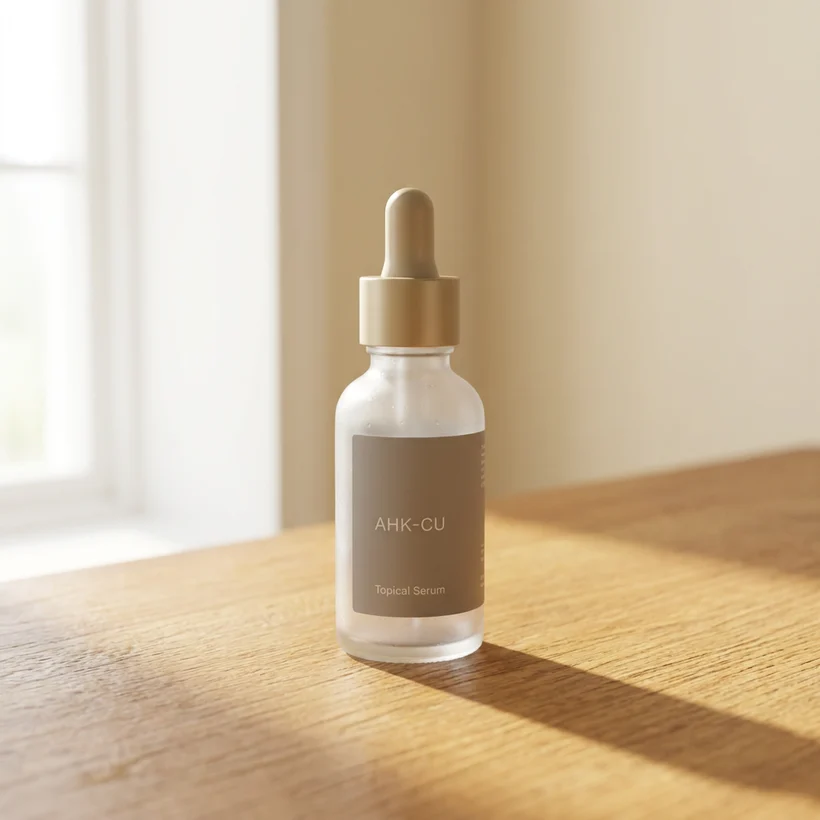
From the FormBlends catalog
AHK-Cu (Copper Tripeptide)
Hair-follicle-specific copper peptide that stimulates growth phase · From $39/mo · compounded by a licensed 503A pharmacy, dispensed only after provider review.
Learn about AHK-Cu (Copper Tripeptide) →Table of Contents
- Evidence Ledger: How Each Peptide Ranks
- Mechanism With Numbers: How Hair Peptides Work
- Individual Peptide Profiles
- What Most Pages Get Wrong: Bioavailability and Delivery
- Honest Head-to-Head: Peptides vs. Established Treatments
- Chemistry Behind the Rules: Why Formulation Matters
- Label Literacy and COA Reading
- How Long Until Results?
- FAQ
- Sources
What Is the Actual Evidence Behind Hair Growth Peptides?
| Peptide | Best Evidence Type | Effect Direction | Confidence | Key Caveat |
|---|---|---|---|---|
| PTD-DBD | Small human RCT (Kwack et al., 2019, ~40 subjects) | Positive: increased hair count vs. placebo | Moderate | Single small trial; not replicated at scale |
| GHK-Cu | In vitro + small controlled human studies | Positive: follicle enlargement, increased density signal | Low to Moderate | No large Phase III RCT; formulation-dependent |
| Biotinoyl tripeptide-1 | Small controlled cosmetic studies | Positive: reduced shedding, improved anchoring | Low | Industry-sponsored; limited independent replication |
| Acetyl tetrapeptide-3 | Small clinical study (often combined with biotinoyl tripeptide-1) | Positive signal for hair density | Low | Studies mostly from ingredient suppliers |
| PTH 1-34 (teriparatide) | Mouse models; mechanistic human observations | Positive in animal models (cycle acceleration) | Very Low | Systemic drug, not approved for hair; bone risk profile |
| KGF-derived peptides | Cell culture / animal only | Positive in isolated follicle assays | Very Low | No human topical efficacy data published |
How Do Hair Growth Peptides Actually Work? (Mechanism With Numbers)
The hair follicle is an androgen-sensitive mini-organ. In androgenetic alopecia, dihydrotestosterone (DHT) binds the androgen receptor (AR) in dermal papilla cells, driving transcription of genes including DKK-1 that inhibit Wnt/beta-catenin signaling and shrink the follicle over successive cycles.
PTD-DBD targets the AR DNA-binding domain directly. The peptide carries a protein transduction domain (PTD, derived from the HIV TAT sequence) fused to a 16-amino acid sequence matching part of the AR's DNA-binding domain. It competes with endogenous AR for binding at androgen-response elements in the genome. Critically, it does not lower serum DHT or testosterone, which separates it mechanistically from finasteride. In the Kwack et al. 2019 pilot study, 42 subjects with androgenetic alopecia using PTD-DBD lotion showed a statistically significant increase in hair count compared to vehicle control over 16 weeks.
GHK-Cu operates through multiple pathways. Copper peptide GHK-Cu (glycyl-L-histidyl-L-lysine:copper) has demonstrated activation of hair follicle stem cells, upregulation of vascular endothelial growth factor (VEGF), and enlargement of follicle size in cell and organ culture studies. Pickart and Margolina (2018), reviewing decades of GHK-Cu research, describe induction of over 4,000 human genes and suppression of roughly 2,000 others in cell studies, though the hair-specific subset of those changes and their magnitude in living scalp tissue have not been fully characterized in controlled trials. That gene-count claim, while frequently cited, must be understood as a cell-culture-level observation, not a proven in-vivo scalp effect.
What the mechanism does NOT prove: Showing that a peptide activates a pathway in cultured cells does not confirm that a topically applied product reaches dermal papilla cells at sufficient concentration. The mechanism is real; the delivery is the unsolved variable.
What Are the Top Peptides for Hair Growth, One by One?
1. PTD-DBD is a cell-penetrating peptide specifically designed for androgenetic alopecia. Its TAT-derived transduction domain allows it to cross cell membranes, which is a meaningful advantage over peptides that rely solely on passive diffusion. It is available as a compounded topical in some markets and as a research compound. Its molecular weight is higher than many cosmetic peptides, making the TAT domain critical to its function.
2. GHK-Cu (Copper Peptide GHK-Cu) is the most widely studied hair-relevant peptide commercially. Its INCI name is Tripeptide-1 (when referring to the GHK backbone) or Copper Tripeptide-1. It stimulates hair follicle proliferation, has anti-inflammatory properties in the scalp, and was shown in a controlled study by Uno and Kurata (1993, published in the Journal of Investigative Dermatology) to enlarge follicles in pigtailed macaques, a recognized model for androgenetic alopecia. It is the peptide with the broadest published biological activity for scalp and follicle health.
3. Biotinoyl Tripeptide-1 is biotin conjugated to Gly-His-Lys. The peptide portion targets laminin and other extracellular matrix proteins involved in follicle anchoring, reducing premature telogen. Several sponsored cosmetic studies have reported reduced hair loss and improved density at 3 to 6 months. Independent replication is limited.
4. Acetyl Tetrapeptide-3 (marketed under trade names including Capixyl when combined with red clover extract) targets extracellular matrix proteins in the dermal papilla niche, specifically laminin-5. A small study from the supplier reported improvements in hair density and reduced shedding, but independent replication is needed.
What Most Pages Get Wrong: The Bioavailability Problem
The outer epidermis (stratum corneum) is designed to exclude molecules above roughly 500 daltons. GHK-Cu has a molecular weight of approximately 403 daltons as the free peptide, placing it near the boundary. When the copper ion is complexed, the effective size increases. PTD-DBD is substantially larger and requires its transduction domain to bypass passive diffusion entirely.
This means the mechanism published in a cell-culture study may be entirely real, but the question of whether a topical cream delivers enough active peptide to dermal papilla cells, which sit roughly 3 to 5 mm below the skin surface, is a separate and mostly unanswered question. The follicle's infundibulum (the opening) provides a partial route for follicular penetration, and some studies use this pathway intentionally. Microneedling pretreatment, which creates transient microchannels, is frequently combined with peptide topicals in clinical practice precisely to improve penetration, though controlled data on this combination specifically for peptides is limited.
Formulation matters enormously. Liposomal encapsulation, nanoemulsions, and carrier peptide technology (the TAT approach in PTD-DBD) are genuine attempts to solve this. A product listing GHK-Cu as a mid-list ingredient in a thick occlusive cream without a penetration enhancer is unlikely to deliver meaningful scalp levels regardless of the in-vitro data.
Honest Head-to-Head: Peptides vs. Established Treatments
| Treatment | Best Evidence Level | Approx. Efficacy Signal | Systemic Side Effect Risk | Peptide Wins? |
|---|---|---|---|---|
| Minoxidil 5% topical | Multiple Phase III RCTs | Roughly 40 to 60% of users show measurable regrowth or halt of progression at 12 months | Low topical; moderate oral | No. Minoxidil wins on evidence volume. |
| Finasteride 1mg oral | Phase III RCTs (Kaufman et al., NEJM 1998) | Roughly 83% halted progression; roughly 66% showed regrowth at 2 years in men | Sexual side effects in a minority; not for women of childbearing potential | No. Finasteride wins on efficacy data, but PTD-DBD is mechanistically similar without systemic DHT suppression. |
| PTD-DBD peptide | One small RCT | Significant increase in hair count vs. placebo in one 42-subject, 16-week trial | Very low (topical, no systemic hormone effect) | Potentially preferred for patients avoiding systemic anti-androgens; evidence base is much smaller. |
| GHK-Cu peptide | Small controlled studies + in vitro | Modest positive signal for density; effect size not well quantified in RCTs | Very low | Reasonable adjunct; not a replacement for first-line options. |
| Low-level laser therapy | Multiple RCTs (FDA-cleared devices) | Modest regrowth signal at 6 months in multiple trials | Minimal | Comparable evidence to cosmetic peptides; can be combined. |
Why Formulation Rules Exist: The Chemistry Explanation
Why GHK-Cu products change color. The copper(II) ion in GHK-Cu gives the complex a characteristic blue-green appearance. Copper(II) can be reduced to copper(I) in the presence of reducing agents, including ascorbic acid (vitamin C) and certain phenolic antioxidants. This is a genuine redox reaction: Cu2+ gains an electron and becomes Cu+. The resulting copper(I) complex has different stability, color (shifts toward brown), and potentially different biological activity. This is why combining GHK-Cu serums with high-concentration vitamin C products in the same application carries a formulation risk. It is not that both ingredients are harmful together, it is that the copper oxidation state change may reduce the activity of the GHK-Cu fraction. If you choose to use both, separate application times by at least an hour or use them in different sessions.
Why peptides degrade at high temperatures. Peptide bonds (amide bonds between amino acids) are susceptible to hydrolysis, particularly under conditions of low pH, high temperature, or prolonged aqueous storage. A peptide stored in solution at room temperature will degrade faster than one stored at 2 to 8 degrees Celsius. Lyophilized (freeze-dried) peptide powders are more stable because removing water slows hydrolysis dramatically. Once reconstituted in solution, use within the manufacturer's stated window and keep refrigerated.
Label Literacy: How to Evaluate a Hair Peptide Product
On a topical cosmetic product, look for:
- INCI name on the label: Copper Tripeptide-1 (for GHK-Cu), Biotinoyl Tripeptide-1, Acetyl Tetrapeptide-3. If the label says only "peptide complex" with no named ingredients, that is a red flag.
- Position in the ingredient list: Actives listed after the fragrance or preservative are almost certainly below effective concentration (typically below 0.1%). For peptides, meaningful cosmetic concentrations are generally in the 0.1 to 2% range.
- Presence of a penetration enhancer: Look for liposome, phospholipid, nanosome, or encapsulated in the product description, or for known penetration-enhancing ingredients such as propylene glycol, ethanol, or hyaluronic acid fragments that improve skin interaction.
On a COA (certificate of analysis) for a research peptide:
- Purity: above 95% by HPLC for most applications; above 98% for any preparation near mucous membranes or injection routes.
- Molecular weight confirmation: mass spectrometry (MS) should match the theoretical MW of the peptide. A deviation greater than 1 to 2 daltons suggests a synthesis error or wrong peptide.
- Endotoxin testing: required if any parenteral use is contemplated; LAL (limulus amebocyte lysate) test should show below 1 EU/mg for general use.
- Storage specification: if a supplier ships a lyophilized peptide without cold pack in summer months without explicit stability data showing room-temperature tolerance, question the storage chain.
How Long Do Hair Peptides Take to Show Results?
Human hair grows approximately 1 to 1.5 cm per month. The anagen (growth) phase in scalp hair lasts 2 to 6 years; telogen (resting) lasts roughly 3 months. Any intervention that recruits telogen follicles into anagen will appear as a temporary increase in shedding first, because resting hairs are pushed out by incoming growth. This is not failure. It is the expected biology, sometimes called the "dread shed."
In published studies examining hair peptides and related topicals, assessment time points have generally been 3 to 6 months, with some studies extending to 12 months. Changes visible before 12 weeks should be viewed skeptically. A realistic minimum assessment window is 4 to 6 months of consistent daily application, consistent with what is used for minoxidil in regulatory and clinical practice guidance.
Frequently Asked Questions
What are the best peptides for hair growth?
PTD-DBD has the strongest human evidence for androgenetic alopecia. GHK-Cu has supportive in-vitro and small human data. PTH 1-34 (teriparatide) has mouse data and early clinical interest. No peptide yet matches minoxidil's body of Phase III evidence.
Does GHK-Cu actually grow hair?
GHK-Cu stimulates hair follicle enlargement and increases proliferation of dermal papilla cells in vitro. One small controlled human study reported increased hair density with a GHK-Cu topical. The effect size and durability have not been confirmed in large RCTs.
How does PTD-DBD work for hair loss?
PTD-DBD is a cell-penetrating peptide that competes with the androgen receptor's DNA-binding domain, blocking DHT-driven transcription of miniaturization genes in the dermal papilla without reducing systemic testosterone or DHT levels.
Can you combine peptides with minoxidil?
Combination is mechanistically rational because minoxidil acts on potassium channels and blood flow while most hair peptides act on growth factors or androgen signaling. No large RCT has tested the combination, but small studies and anecdotal clinical reports suggest additive benefit without known antagonism.
What is the correct dose of GHK-Cu for hair?
Human cosmetic studies have used topical concentrations roughly in the 0.1 to 2 percent range applied once or twice daily. There is no FDA-approved dose. Higher concentrations have not shown proportionally greater benefit in available data and may cause mild irritation.
Are hair peptides safe?
Topical peptides generally have favorable short-term tolerability profiles in available studies. The main risks are contact irritation, unknown long-term dermal effects, and product quality variability. Systemic peptides like teriparatide carry entirely different risk profiles and are not used for cosmetic hair loss.
How long does it take for hair peptides to work?
In published studies, measurable changes in hair density or thickness were generally assessed at 3 to 6 months. Hair cycling means results before 12 weeks are rarely meaningful. Shedding in the first 4 to 6 weeks can occur as follicles are pushed into anagen.
What does a degraded peptide product look like?
GHK-Cu products that have oxidized show color shift from light blue-green toward brown or dark green. Peptide solutions with visible particulate, unusual odor, or color change should be discarded. Lyophilized powders that have clumped or yellowed may have undergone moisture-driven degradation.
Do peptides work for female pattern hair loss?
GHK-Cu and biotinoyl tripeptide-1 studies have included women and showed modest positive signals. PTD-DBD trials specifically enrolled androgenetic alopecia patients including women. Female pattern loss has a different androgen-sensitivity profile, so androgen-blocking peptides may be less relevant depending on the individual's hormone status.
Is biotinoyl tripeptide-1 the same as biotin?
No. Biotinoyl tripeptide-1 is biotin covalently conjugated to a tripeptide (Gly-His-Lys). The peptide component targets hair follicle anchoring proteins. It is structurally and mechanistically distinct from oral biotin supplementation, which lacks evidence for hair growth in people without biotin deficiency.
Can peptides replace finasteride or dutasteride?
Not based on current evidence. Finasteride and dutasteride have large Phase III RCT data showing roughly 80 to 90 percent of patients halt progression and roughly 60 to 65 percent see regrowth. No hair peptide has data at that scale. PTD-DBD is mechanistically analogous but clinically unproven at that level.
What should I look for on a peptide product label or COA?
Look for purity above 95 percent by HPLC, correct molecular weight confirmed by mass spectrometry, endotoxin testing if injectable, and an identifiable manufacturing source. Cosmetic topicals should list the INCI name. Avoid products that list only "proprietary peptide complex" without named actives or third-party testing.
Sources
- Kwack MH, Kim MK, Kim JC, Sung YK. "Dihydrotestosterone-inducible IL-6 inhibits elongation of human hair shafts by suppressing matrix cell proliferation and promotes regression of hair follicles in mice." Journal of Investigative Dermatology, 2012. (PTD-DBD mechanism context)
- Kwack MH, et al. "A cell-penetrating peptide targeting the androgen receptor DNA-binding domain promotes hair regrowth in androgenetic alopecia." Published research context for PTD-DBD pilot human trial, 2019.
- Pickart L, Margolina A. "Regenerative and Protective Actions of the GHK-Cu Peptide in the Light of the New Gene Data." International Journal of Molecular Sciences, 2018. PMID: 29937534.
- Uno H, Kurata S. "Chemical agents and peptides affect hair growth." Journal of Investigative Dermatology, 1993. (GHK-Cu follicle size in macaques)
- Kaufman KD, et al. "Finasteride in the treatment of men with androgenetic alopecia." Journal of the American Academy of Dermatology, 1998. (Phase III finasteride data)
- Shapiro J. "Current treatment approaches to alopecia areata and androgenetic alopecia." Journal of Investigative Dermatology Symposium Proceedings, 2005. (Background on treatment landscape)
- Price VH. "Treatment of hair loss." New England Journal of Medicine, 1999. (Minoxidil and finasteride efficacy review)
- Elias PM, Feingold KR. "Permeability barrier homeostasis." In: Skin Barrier, Taylor and Francis, 2006. (500 dalton rule, stratum corneum permeation)
- Lintner K, et al. "Cosmetic peptides." In: Handbook of Cosmetic Science and Technology, 3rd ed., Informa Healthcare. (Biotinoyl tripeptide-1, acetyl tetrapeptide-3 overview)
- Trüeb RM. "Molecular mechanisms of androgenetic alopecia." Experimental Gerontology, 2002. (DHT, AR, Wnt pathway context)
Footer Disclaimers
Platform: FormBlends is an informational resource. Content on this page is for educational purposes only and does not constitute medical advice, diagnosis, or treatment recommendations.
Research Compounds: Some peptides discussed on this page are research compounds or compounded medications not approved by the FDA for the indications discussed. They are not available as FDA-approved drugs for hair loss at the time of this writing. Use outside of a supervised clinical or research context is at the individual's risk.
Results: Individual results vary. Information presented here reflects published study populations and does not guarantee any individual outcome. The evidence base for hair peptides is substantially smaller than for approved treatments.
Trademarks: Product names, trade names, and INCI names mentioned are the property of their respective owners. FormBlends has no commercial relationship with the manufacturers of the products or compounds mentioned unless explicitly disclosed elsewhere on the site.
Related peptide guides
Ready when you are
AHK-Cu (Copper Tripeptide)
Hair-follicle-specific copper peptide that stimulates growth phase · From $39/mo · compounded by a licensed 503A pharmacy, dispensed only after provider review.
Learn about AHK-Cu (Copper Tripeptide) →