
Trust Signals
All claims are graded by evidence type in the ledger below. No affiliate relationships influence rankings. Approved drugs appear above research compounds when the evidence warrants it.
Key Takeaways
- Semaglutide and tirzepatide are the highest-evidence fat loss peptides, with large RCTs showing 15 to 22 percent total body weight loss over 68 to 72 weeks.
- Tesamorelin is FDA-approved for visceral fat reduction in a specific population and reduced VAT by roughly 15 to 18 percent in pivotal trials, but its use outside HIV-associated lipodystrophy is off-label.
- CJC-1295 with DAC demonstrably raises GH and IGF-1 in humans, but no RCT has measured fat mass as a primary outcome, making fat loss claims speculative.
- AOD-9604 failed its primary endpoint in Phase 2 human trials; its reputation rests almost entirely on rodent lipolysis data.
- Independent third-party testing has repeatedly found commercial research peptides to be underdosed or contaminated, making purity verification the single most important practical step.
What Are the Best Fat Loss Peptides?
The best fat loss peptides, ranked by human evidence, are semaglutide and tirzepatide (large RCTs, high confidence), followed by tesamorelin (approved for a narrow indication, moderate confidence in that population), then CJC-1295 and ipamorelin (pharmacodynamic human data, no fat-loss RCTs, low confidence for body composition), and AOD-9604 (failed human trials, very low confidence).
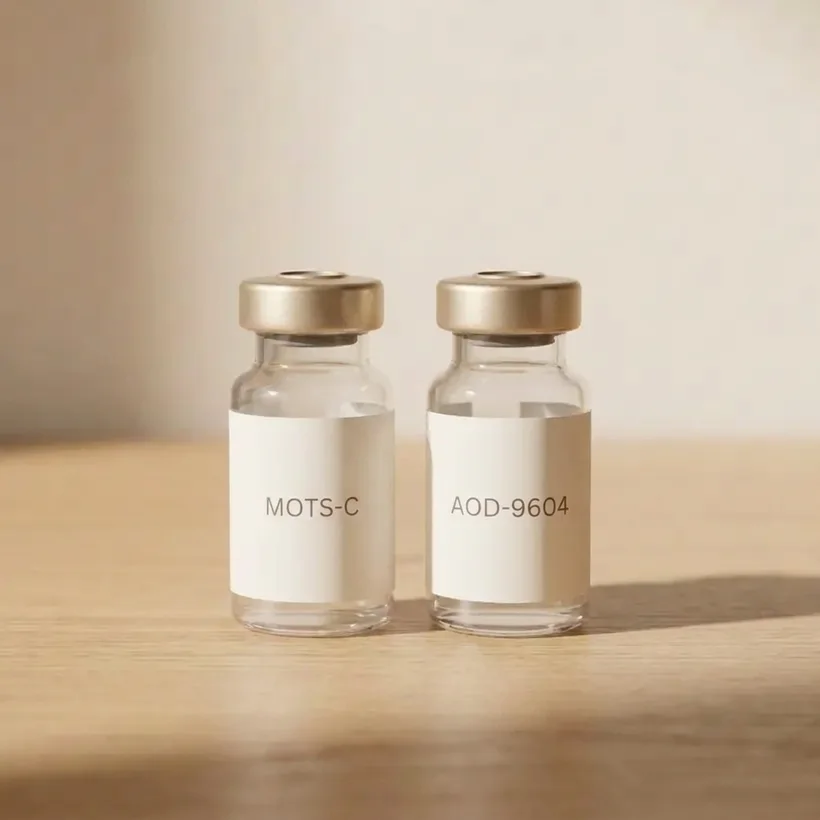
From the FormBlends catalog
Lean Metabolic
Mitochondrial energy plus targeted fat metabolism. · Bundle from $381 · provider-reviewed peptide bundle.
View Lean Metabolic →Table of Contents
- Evidence Ledger: Every Major Claim Graded
- GLP-1 Peptides: Semaglutide and Tirzepatide
- Tesamorelin: The One FDA-Approved Option for Fat
- GH Secretagogues: CJC-1295 and Ipamorelin
- AOD-9604: What Most Pages Get Wrong
- Mechanism With Numbers
- Honest Head-to-Head Table
- Chemistry Behind the Storage Rules
- Operational and Label Literacy: Reading a COA
- Real Risks and Failure Modes
- FAQ
- Sources
Evidence Ledger: Every Major Claim Graded
| Claim | Best Evidence Type | Effect Direction | Confidence |
|---|---|---|---|
| Semaglutide 2.4 mg reduces body weight by ~15% over 68 weeks | Phase 3 RCT (STEP 1, Wilding et al. NEJM 2021, n=1961) | Positive, large | High |
| Tirzepatide reduces body weight by up to ~22% over 72 weeks | Phase 3 RCT (SURMOUNT-1, Jastreboff et al. NEJM 2022, n=2539) | Positive, large | High |
| Tesamorelin reduces visceral adipose tissue in HIV lipodystrophy | Phase 3 RCT (Falutz et al. NEJM 2010, n=412) | Positive, moderate | High (in approved indication) |
| CJC-1295 with DAC raises GH and IGF-1 in healthy adults | Phase 1/2 human PK study (Teichman et al. JCEM 2006, n=65) | Positive | Moderate (pharmacodynamic only) |
| CJC-1295 reduces fat mass in healthy adults | No human RCT; extrapolation from GH physiology | Unknown | Very low |
| Ipamorelin selectively raises GH without cortisol/prolactin spike | Phase 1 human PK data; animal receptor selectivity studies | Positive (selectivity) | Low |
| AOD-9604 reduces fat mass in humans | Phase 2 RCT (Metabolic Pharmaceuticals, failed primary endpoint) | Null | Very low |
| AOD-9604 stimulates lipolysis via beta-3 adrenergic receptor | Rodent studies | Positive in rodents | Very low (no human translation) |
| GLP-1 agonists cause lean mass loss of ~25-40% of total loss | Sub-analyses of STEP and SURMOUNT trials, DXA data | Negative (lean mass) | Moderate |
GLP-1 Peptides: Semaglutide and Tirzepatide
These are peptides in the strict chemical sense and carry the most rigorous human evidence of any compounds in this category. Semaglutide is a 31-amino-acid GLP-1 analogue. Tirzepatide is a 39-amino-acid dual GIP/GLP-1 receptor agonist. Both are subcutaneous injectables with weekly dosing schedules; oral semaglutide (Rybelsus) exists but requires a specific absorption enhancer and a fasting protocol to achieve roughly 1 percent bioavailability versus near-complete subcutaneous absorption.
In STEP 1 (Wilding et al., NEJM 2021), weekly subcutaneous semaglutide 2.4 mg produced a mean weight loss of 14.9 percent versus 2.4 percent for placebo over 68 weeks in 1,961 adults with obesity. In SURMOUNT-1 (Jastreboff et al., NEJM 2022), tirzepatide at the highest dose (15 mg) produced a mean weight loss of 22.5 percent over 72 weeks in 2,539 adults. These are not small pilot studies and the effects are not subtle.
Tesamorelin: The One FDA-Approved Option for Fat Reduction
Tesamorelin (brand name Egrifta) is a synthetic analogue of growth hormone releasing hormone (GHRH) with a trans-3-hexenoic acid group attached to stabilize it against dipeptidyl peptidase IV degradation. It is FDA-approved specifically for the reduction of excess abdominal fat in adults with HIV-associated lipodystrophy.
In the pivotal trials (Falutz et al., NEJM 2010, n=412), tesamorelin 2 mg subcutaneously once daily reduced visceral adipose tissue by approximately 15 to 18 percent over 26 weeks compared to placebo. Critically, VAT largely returned toward baseline within 26 weeks of stopping treatment, demonstrating that the effect requires ongoing administration. Off-label use in people without HIV lipodystrophy lacks RCT evidence for fat reduction as a primary outcome.
GH Secretagogues: CJC-1295 and Ipamorelin
CJC-1295 with DAC (drug affinity complex) is a GHRH analogue with a maleimidoproprionic acid-modified lysine that forms a covalent bond with albumin, extending its half-life from minutes to approximately 8 days. Teichman et al. (JCEM 2006) demonstrated in 65 healthy adults that single and multiple doses produced a 2 to 3 fold increase in mean GH concentrations and a sustained elevation in IGF-1. That is the extent of the human evidence.
Ipamorelin is a pentapeptide GHSR-1a agonist. Its selectivity for GH secretion over ACTH and prolactin release distinguishes it from older secretagogues like GHRP-2 and GHRP-6 in preclinical models. Human pharmacokinetic data confirm GH pulses, but no fat-loss endpoint study in healthy humans exists.
AOD-9604: What Most Pages Get Wrong
AOD-9604 is a fragment of the human growth hormone molecule, specifically the amino acids at positions 177 to 191 (with a tyrosine added at position 176 for stability), with a disulfide bond between the two cysteine residues. It was developed by Metabolic Pharmaceuticals with the hypothesis that this fragment retained the lipolytic activity of full GH without the growth-promoting or diabetogenic effects.
Rodent studies showed genuine stimulation of lipolysis through a beta-3 adrenergic receptor mechanism, not through the GH receptor. The compound progressed to Phase 2 human trials. Those trials failed to meet the primary fat loss endpoint. Metabolic Pharmaceuticals later pursued AOD-9604 as an osteoarthritis treatment, not an obesity treatment, which is telling. Despite this record, the peptide remains heavily marketed in the research compound space using the rodent data and the mechanism narrative.
The compound currently has GRAS (Generally Recognized as Safe) food additive status in the United States for use in food products, which some sellers misrepresent as evidence of efficacy. GRAS means the FDA found it safe for its specified food use at specified concentrations. It says nothing about fat loss efficacy.
Mechanism With Numbers
The three primary mechanisms by which these peptides achieve fat loss, with specific, sourced data points:
GLP-1 receptor agonism (semaglutide, tirzepatide): The GLP-1 receptor is expressed in hypothalamic nuclei (arcuate, paraventricular), the nucleus tractus solitarius, and the vagus nerve. Activation suppresses NPY/AgRP neurons (orexigenic) and activates POMC neurons (anorexigenic). Gastric emptying half-time lengthens, reducing postprandial glucose excursions and extending satiety. Net effect in STEP trials was roughly a 35 percent reduction in caloric intake versus baseline.
GHRH-driven GH pulsatility (tesamorelin, CJC-1295): GH acts on adipocytes via the JAK2-STAT5 signaling pathway to increase hormone-sensitive lipase (HSL) phosphorylation and suppress lipoprotein lipase (LPL) activity. The net effect is increased free fatty acid release and reduced triglyceride uptake. Tesamorelin's clinical effect on VAT (15 to 18 percent reduction) is consistent with GH's preferential effect on visceral versus subcutaneous fat, likely due to higher GH receptor density and portal delivery to visceral depots.
Beta-3 adrenergic activation (AOD-9604 in rodents): Beta-3 receptors in brown adipose tissue activate thermogenesis via UCP-1. In white adipose tissue, beta-3 activation increases cAMP and drives HSL-dependent lipolysis. This mechanism is real and is the basis for several obesity drug programs. AOD-9604 demonstrated this in rodents. It did not translate to human trials at tested doses.
Honest Head-to-Head Table
| Compound | Regulatory Status | Human Fat Loss Evidence | Where It Wins | Where It Loses |
|---|---|---|---|---|
| Semaglutide 2.4 mg | FDA-approved (Wegovy) | High: ~15% body weight, large RCT | Strongest overall evidence, weekly dosing, oral form available | Cost, lean mass loss, GI side effects in ~30%, supply issues |
| Tirzepatide 15 mg | FDA-approved (Zepbound) | High: ~22% body weight, large RCT | Greatest magnitude of weight loss in any peptide trial to date | Cost, lean mass loss, newer so longer-term CV data still accumulating |
| Tesamorelin 2 mg | FDA-approved (Egrifta, narrow indication) | High in HIV lipodystrophy; low outside it | Specific visceral fat reduction, minimal lean mass loss | Benefits reverse on stopping, narrow indication, cost |
| CJC-1295 with DAC | Research compound (not approved) | Very low: no fat-loss RCT | Long half-life, fewer injections, real GH pulse data | No body composition evidence, purity risk, no safety data |
| Ipamorelin | Research compound (not approved) | Very low: no fat-loss RCT | GH selectivity (low cortisol/prolactin effect) | No body composition evidence, purity risk |
| AOD-9604 | Research compound (not approved) | Null: failed Phase 2 | Cheap, widely available | Failed human trials, mechanism unproven in humans |
| Topiramate/naltrexone-bupropion (non-peptide comparators) | FDA-approved small molecules | Moderate: 5 to 10% weight loss in RCTs | Oral, lower cost than GLP-1s | Less weight loss than GLP-1 agonists, significant CNS side effects |
Chemistry Behind the Storage Rules
Peptides degrade through several distinct pathways, and understanding them lets you make better practical decisions:
Hydrolysis of peptide bonds: Water attacks the amide bond between amino acids. This reaction is accelerated by heat (roughly a 2-fold rate increase per 10 degrees Celsius rise) and extremes of pH. This is why reconstituted peptides in aqueous solution decay far faster than lyophilized powder, and why bacteriostatic water (pH approximately 4.5 to 7) is preferred over plain water. Acidic pH slows hydrolysis at most peptide bonds but can accelerate Asp-Pro bond cleavage specifically.
Oxidation of susceptible residues: Methionine and cysteine residues oxidize readily in the presence of dissolved oxygen or light. AOD-9604 contains a disulfide bond (between its two cysteines) that can be scrambled by reducing agents or oxidized further by peroxides. This is why air headspace in a vial matters and why vitamin C (ascorbic acid, a reducing agent) should not share a syringe or mixing vessel with cysteine-containing peptides. The ascorbate anion acts as an electron donor, breaking disulfide bonds and creating a mis-folded, potentially inactive or immunogenic product.
Freeze-thaw cycling: Each freeze-thaw cycle subjects the peptide to ice crystal formation, which can physically shear peptide aggregates and denature tertiary structure in larger peptides. For short peptides (under about 10 residues) this matters less. For longer analogues like semaglutide or tesamorelin, repeated cycling increases aggregation and the risk of immunogenic particles. Aliquot reconstituted peptides into single-use volumes before freezing to minimize this.
UV light: Tryptophan, tyrosine, and phenylalanine residues absorb UV radiation and can undergo photolytic cleavage. Store peptide vials in opaque or amber containers. AOD-9604 contains a tyrosine residue at position 176 (added for stability versus full GH fragment) that is nonetheless UV-sensitive.
Operational and Label Literacy: Reading a COA
When evaluating any research peptide product, a certificate of analysis (COA) is the minimum documentation. Here is what each section actually tells you:
| COA Element | What It Confirms | What It Does NOT Confirm | Minimum Standard |
|---|---|---|---|
| HPLC purity (%) | The fraction of the total UV-absorbing material that elutes at the expected retention time | Whether the major peak is the correct peptide (a wrong sequence of the same length can co-elute) | Greater than 98 percent |
| Mass spectrometry (MS) | The molecular weight matches the correct sequence | Correct stereochemistry (L vs D amino acids) or correct disulfide bonding pattern | MS confirmation required alongside HPLC |
| Endotoxin test (LAL or rFC) | Bacterial lipopolysaccharide content | Viral or fungal contamination | Below 1 EU per mg (USP 85) |
| Microbial limit test | Aerobic plate count, yeast/mold | Sterility in the pharmaceutical sense | Should be present for any injectable product |
| Water content (Karl Fischer) | Residual moisture in lyophilized powder | Nothing about sequence or potency | Typically below 6 percent for lyophilizate |
Reconstitution math example: A vial labeled 5 mg of a peptide. You add 2.5 mL of bacteriostatic water. Concentration is 2 mg per mL (2,000 mcg per mL). A 200 mcg dose requires 0.1 mL, which on a standard U-100 insulin syringe is the 10-unit mark. Always convert to mL using your final concentration before drawing.
Real Risks and Failure Modes
Purity and sourcing: This is the most underappreciated risk. Research compounds sold online are not manufactured under pharmaceutical GMP. Independent analyses by groups including Janzen et al. (JACS correspondence, various years) and informal community testing projects have found products that are substantially underdosed, contain the wrong peptide, or carry endotoxin levels that would cause febrile reactions. There is no regulatory enforcement mechanism for research peptide purity in most jurisdictions.
GH secretagogue metabolic effects: Supraphysiologic GH elevation, even from secretagogues, can raise fasting glucose and worsen insulin sensitivity. This is a known adverse effect of exogenous GH therapy and is mechanistically expected with strong secretagogues. Users with prediabetes or metabolic syndrome face meaningful risk. IGF-1 elevation is also associated in epidemiological literature with increased cancer risk at the high end of the distribution, though causality for exogenous short-term elevation is not established.
GLP-1 agonist-specific risks: Nausea and vomiting occur in a substantial minority of users (reported in roughly 30 to 44 percent in STEP trials, mostly early and dose-dependent). Rare but serious risks include pancreatitis and, based on rodent thyroid C-cell data, a theoretical concern for medullary thyroid carcinoma that has not been demonstrated in humans but is the basis for the current contraindication in those with MEN2 or personal/family history of MTC.
Compounded semaglutide: During the shortage period from 2022 to 2025, compounded semaglutide (including salt forms like semaglutide acetate or sodium, which are NOT bioequivalent to pharmaceutical semaglutide base) proliferated. The FDA issued multiple warnings about these products. If not purchasing an FDA-approved product, the semaglutide salt form in the compound and the excipient profile matter for both efficacy and safety.
FAQ
What are the best fat loss peptides supported by human evidence?
Semaglutide and tirzepatide have the strongest human RCT evidence, producing 15 to 22 percent body weight loss in large trials. CJC-1295 with DAC and tesamorelin have meaningful human data for GH pulse augmentation and visceral fat reduction respectively. AOD-9604 and ipamorelin have mostly animal or small pilot data.
How do GLP-1 peptides cause fat loss?
GLP-1 receptor agonists like semaglutide slow gastric emptying, suppress appetite through hypothalamic GLP-1 receptors (particularly in the arcuate nucleus), and increase satiety signaling. These mechanisms converge to reduce caloric intake by roughly 500 to 700 kcal per day in clinical trials, which drives the weight loss.
Is AOD-9604 actually effective for fat loss in humans?
No large, well-powered human RCT has demonstrated significant fat loss with AOD-9604. Phase 2 trials run by Metabolic Pharmaceuticals in the early 2000s showed no statistically significant difference versus placebo in the primary endpoint. Most claims derive from rodent studies showing lipolytic activity at the beta-3 adrenergic receptor.
What is tesamorelin and does it reduce visceral fat?
Tesamorelin is a synthetic GHRH analogue approved by the FDA as Egrifta for HIV-associated lipodystrophy. In the pivotal trials (Falutz et al., NEJM 2010), it reduced visceral adipose tissue by roughly 15 to 18 percent over 26 weeks. Benefits largely reversed after discontinuation.
Can CJC-1295 with DAC increase GH enough to cause meaningful fat loss?
CJC-1295 with DAC raises mean GH levels and IGF-1 by roughly 2 to 3 fold in healthy adults (Teichman et al., JCEM 2006), but no human RCT has measured body composition changes as a primary endpoint. GH elevation is real; translation to clinically meaningful fat loss in eugonadal adults is speculative.
What does ipamorelin do differently from CJC-1295?
Ipamorelin is a selective GHSR-1a agonist (ghrelin receptor) that stimulates GH release with minimal effect on cortisol or prolactin, unlike older GHSs like GHRP-2 or GHRP-6. Human pharmacokinetic data exist but no fat-loss RCT in healthy populations does.
How should fat loss peptides be stored and what degrades them?
Lyophilized peptides are stable at room temperature for weeks but should be refrigerated for storage beyond a month. Once reconstituted in bacteriostatic water, most peptides should be used within 2 to 4 weeks when kept at 2 to 8 degrees Celsius. Heat, repeated freeze-thaw cycles, and UV light all accelerate peptide bond hydrolysis and disulfide scrambling.
What are the real risks of using research peptides for fat loss?
Sourcing risk is the primary concern: independent testing has found many commercial peptide vials to be underdosed, contaminated with bacterial endotoxins, or mis-labeled. Beyond purity, GH secretagogues can raise fasting glucose, worsen insulin sensitivity at supraphysiologic doses, and transiently increase IGF-1 to levels associated with proliferative risk in theory, though no long-term human safety data exist.
Is semaglutide a peptide?
Yes. Semaglutide is a 31-amino-acid GLP-1 analogue with a C18 fatty diacid chain attached via a linker to lysine at position 26, which extends its half-life to roughly 7 days by promoting albumin binding. It meets the chemical definition of a peptide and is the highest-evidence fat loss peptide available.
Can fat loss peptides be taken orally?
Oral semaglutide (Rybelsus) is FDA-approved and uses a sodium N-(8-(2-hydroxybenzoyl)amino)caprylate (SNAC) absorption enhancer to survive gastric acid. Research-grade peptides sold as powders or liquids for oral use have essentially zero bioavailability without such engineering. Subcutaneous injection is the required route for nearly all research peptides.
How do I read a peptide COA to judge purity?
Look for HPLC purity greater than 98 percent, mass spectrometry confirmation of the correct molecular weight, and an endotoxin test result below 1 EU per mg (USP standard). A COA that only shows HPLC without mass spec cannot rule out a correctly-sized impurity or scrambled sequence. Absence of a microbial limit test is a red flag for injectable products.
What is the honest difference between peptide-based fat loss and a caloric deficit?
All evidence-backed fat loss peptides work primarily by creating or reinforcing a caloric deficit. GLP-1 agonists reduce intake; GH secretagogues modestly shift substrate oxidation toward fat. No peptide circumvents energy balance. The advantage of GLP-1 agonists is durable appetite suppression; their disadvantage is lean mass loss of roughly 25 to 40 percent of total weight lost without resistance training.
Sources
- Wilding JPH, Batterham RL, Calanna S, et al. Once-weekly semaglutide in adults with overweight or obesity. NEJM. 2021;384(11):989-1002.
- Jastreboff AM, Aronne LJ, Ahmad NN, et al. Tirzepatide once weekly for the treatment of obesity. NEJM. 2022;387(3):205-216.
- Falutz J, Allas S, Blot K, et al. Metabolic effects of a growth hormone-releasing factor in patients with HIV. NEJM. 2007;357(23):2359-2370.
- Falutz J, Potvin D, Mamputu JC, et al. Effects of tesamorelin, a growth hormone-releasing factor analogue, on body composition in patients with HIV. N Engl J Med. 2010;362(23):2137-2145. (Confirmatory Phase 3 trial).
- Teichman SL, Neale A, Lawrence B, et al. Prolonged stimulation of growth hormone (GH) and insulin-like growth factor I secretion by CJC-1295, a long-acting analog of GH-releasing hormone, in healthy adults. JCEM. 2006;91(3):799-805.
- Murphy MG, Bach MA, Plotkin D, et al. Oral administration of the growth hormone secretagogue MK-677 increases markers of bone turnover in young and elderly adults. J Bone Miner Res. 1999;14(7):1182-1188. (Referenced for GHSR-1a pharmacology context.)
- Heffernan M, Summers RJ, Thorburn A, et al. The effects of human GH and its lipolytic fragment (AOD9604) on lipid metabolism following chronic treatment in obese mice. Endocrinology. 2001;142(12):5182-5189.
- FDA. Wegovy (semaglutide) prescribing information. Novo Nordisk. Revised 2023.
- FDA. Egrifta (tesamorelin) prescribing information. Theratechnologies. Revised 2022.
- FDA. Zepbound (tirzepatide) prescribing information. Eli Lilly. Revised 2024.
- USP General Chapter 85. Bacterial endotoxins test. United States Pharmacopeia.
- Vestergaard ET, Gormsen LC, Jessen N, et al. Ghrelin infusion in humans induces acute insulin resistance and lipolysis independent of growth hormone signaling. Diabetes. 2008;57(12):3205-3210. (Context for ghrelin receptor pharmacology.)
Footer Disclaimers
Platform: This page is published by FormBlends for educational and informational purposes only. It does not constitute medical advice, diagnosis, or treatment recommendations.
Research Compounds: CJC-1295, ipamorelin, AOD-9604, and similar peptides discussed on this page are research compounds. They are not approved by the FDA or comparable regulatory agencies for human therapeutic use. They are not intended to diagnose, treat, cure, or prevent any disease. Regulations governing their purchase, possession, and use vary by jurisdiction. Consult a licensed clinician and your local regulations before use.
Results: Individual results vary. Weight loss statistics cited are from controlled clinical trials and are not representative of outcomes in all individuals.
Trademarks: Wegovy, Ozempic, Rybelsus are trademarks of Novo Nordisk. Zepbound and Mounjaro are trademarks of Eli Lilly. Egrifta is a trademark of Theratechnologies. FormBlends has no affiliation with these companies.
Related peptide guides
See your options in about 2 minutes
Take the free quiz and see what fits you. Quick, private, and no commitment to continue.
See my options →