
Key Takeaways
- Semaglutide (STEP 1 trial, n=1,961) produced mean body weight reduction of approximately 15% versus roughly 2.4% for placebo at 68 weeks, making it the highest-evidence peptide for fat loss by a wide margin.
- Tesamorelin is FDA-approved for visceral fat reduction only in HIV-associated lipodystrophy; its Phase III trials are real but the indication is narrow.
- CJC-1295/ipamorelin stacks raise GH and IGF-1 measurably in small human trials, but no large RCT links them to clinically meaningful fat mass reduction in otherwise healthy adults.
- AOD-9604 showed lipolytic activity in animal models but failed to reach statistical significance for weight loss in human trials, and commercial development was discontinued.
- Purity fraud is the primary sourcing risk: third-party COA confirmation of identity, purity above 98%, and endotoxin testing is the minimum bar before any research peptide is credible.
What are the best peptides for fat loss?
The best-evidenced peptides for fat loss are semaglutide and tirzepatide, both FDA-approved with large RCT data. Among research-grade peptides, tesamorelin, CJC-1295 with ipamorelin, and GHRP-2 have the strongest mechanistic rationale and human data, but their effects are substantially smaller and the evidence base is thin. No research peptide approaches the fat-loss magnitude of approved GLP-1 agonists.Table of Contents
- Evidence Ledger: Every Major Claim Graded
- How Do Fat-Loss Peptides Actually Work?
- The Ranked List: 6 Peptides Examined
- How Do Research Peptides Compare to Approved Drugs?
- What Most Pages Get Wrong About Peptides and Fat Loss
- Why the Storage and Mixing Rules Exist
- How to Read a COA and Judge a Source
- Dosing Reference Table
- Frequently Asked Questions
- Sources
Evidence Ledger: Every Major Claim Graded
Each peptide's fat-loss claim is graded by the best evidence type supporting it, effect direction, and a plain confidence rating. A claim supported by a 2,000-person RCT is not the same as one supported by a rat study.
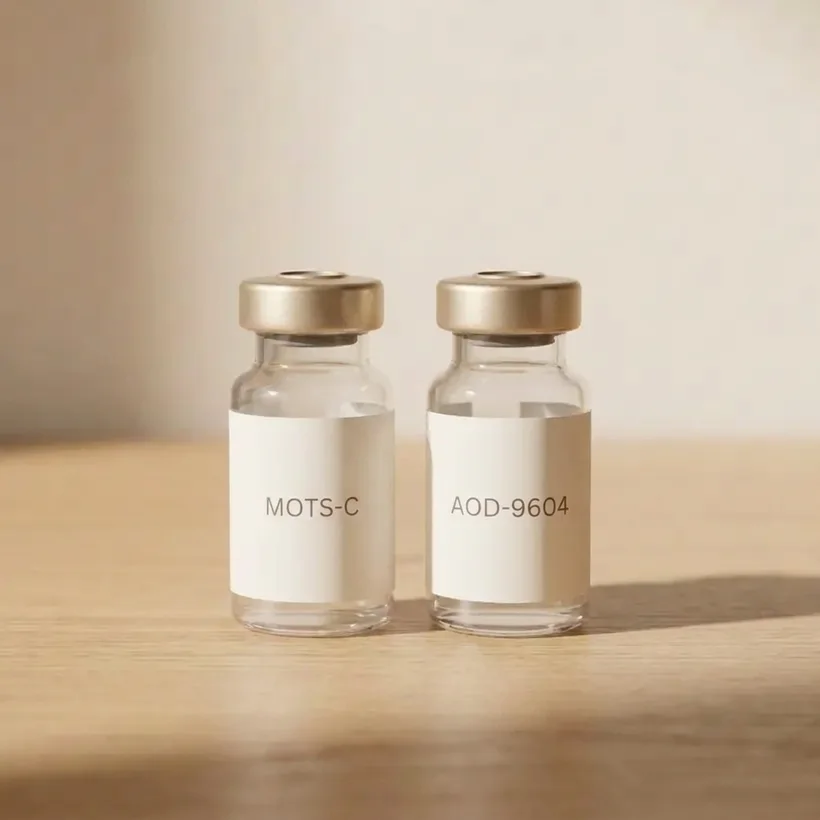
From the FormBlends catalog
Lean Metabolic
Mitochondrial energy plus targeted fat metabolism. · Bundle from $381 · provider-reviewed peptide bundle.
View Lean Metabolic →| Peptide | Primary Fat-Loss Claim | Best Evidence Type | Effect Direction | Confidence |
|---|---|---|---|---|
| Semaglutide | Reduces total body weight and fat mass via GLP-1 receptor agonism | Multiple large phase III RCTs (STEP program) | Strong positive | High |
| Tirzepatide | Reduces body weight via dual GIP/GLP-1 agonism | Phase III RCT (SURMOUNT-1, n=2,539) | Strong positive | High |
| Tesamorelin | Reduces visceral adipose tissue in lipodystrophy | Phase III RCTs (FDA-approved indication) | Positive (narrow indication) | Moderate |
| CJC-1295 + Ipamorelin | Raises GH/IGF-1; shifts substrate toward fat oxidation | Small human pharmacokinetic trials; no fat-loss RCT | Modest positive (mechanism) | Low |
| GHRP-2 | GH pulse amplification; lipolytic downstream effects | Small human trials confirming GH release | Modest positive (surrogate) | Low |
| AOD-9604 | Direct lipolysis via GH fragment mechanism | Animal data positive; human trials did not reach significance | Neutral to negative (human) | Very Low |
| BPC-157 | Fat loss through anti-inflammatory/metabolic support | Animal data only; no human fat-loss evidence | Insufficient | Very Low |
How Do Fat-Loss Peptides Actually Work?
Peptides reach fat cells through several distinct biological pathways. Understanding the pathway determines realistic expectations.
GLP-1 receptor agonism (semaglutide, tirzepatide). GLP-1 receptors are expressed in the hypothalamic arcuate and paraventricular nuclei. Activation suppresses appetite by reducing neuropeptide Y and AgRP signaling and increasing POMC activity. Semaglutide also slows gastric emptying, extending satiety signals. The result is a calorie deficit driven by appetite suppression, not direct fat oxidation. The fat loss is a downstream consequence of sustained energy intake reduction.
GH secretagogue axis (CJC-1295, ipamorelin, GHRP-2, tesamorelin). These peptides stimulate the pituitary to release growth hormone by two distinct receptor types: GHRH receptors (CJC-1295, tesamorelin) and ghrelin/GHS-R1a receptors (ipamorelin, GHRP-2). GH then acts on adipocytes via hormone-sensitive lipase activation, promoting lipolysis. GH also reduces lipoprotein lipase activity in fat tissue, decreasing triglyceride uptake. The practical result is a shift in substrate utilization favoring fat oxidation, especially visceral fat, because visceral adipocytes have higher GH receptor density than subcutaneous fat.
IGF-1 as a secondary mediator. GH raises hepatic IGF-1 production. IGF-1 at physiologic levels promotes lean mass preservation, which raises resting metabolic rate modestly over time. However, chronically elevated IGF-1 has theoretical oncologic concerns at supraphysiologic levels, a caveat that commodity pages omit.
AOD-9604 (residues 177-191 of GH). Animal data suggested this fragment stimulated lipolysis through a beta-3-adrenergic receptor mechanism that does not require IGF-1. The mechanism is plausible but human translation failed. The failure of translation from rodent lipolysis data to human weight loss is a recurring pattern in this field.
What mechanism does NOT prove: A peptide raising GH or shifting substrate oxidation in a pharmacokinetic study does not prove net fat mass reduction. Compensatory appetite increase (GH stimulates ghrelin in some contexts), muscle water retention, and measurement confounding can all obscure true fat loss. No mechanistic study substitutes for a controlled fat mass endpoint trial.
The Ranked List: 6 Peptides Examined
1. Semaglutide FDA Approved
A 31-amino acid GLP-1 analogue with a C18 fatty diacid chain enabling albumin binding and extending half-life to approximately 7 days, allowing once-weekly dosing. The STEP 1 trial (Wilding et al., NEJM 2021, n=1,961 adults with BMI 30+) showed mean weight loss of approximately 15% with 2.4 mg weekly versus approximately 2.4% with placebo at 68 weeks. STEP 4 demonstrated that discontinuation led to regaining roughly two-thirds of the lost weight within a year, confirming the effect is treatment-dependent. Requires a prescription. Side effects are predominantly gastrointestinal: nausea in a substantial minority of users, typically dose-dependent and transient.
2. Tirzepatide FDA Approved
A dual GIP and GLP-1 receptor agonist (39 amino acids). SURMOUNT-1 (Jastreboff et al., NEJM 2022, n=2,539) showed mean weight reductions of approximately 15%, 19.5%, and 20.9% at the 5 mg, 10 mg, and 15 mg doses respectively versus approximately 3.1% for placebo at 72 weeks. The additive GIP signaling appears to enhance fat oxidation and reduce GLP-1-related nausea at equivalent efficacy doses. FDA-approved for type 2 diabetes (Mounjaro) and obesity (Zepbound).
3. Tesamorelin FDA Approved (narrow)
A GHRH analogue (44 amino acids plus a trans-3-hexenoic acid modification for stability). FDA-approved as Egrifta for HIV-associated lipodystrophy. Phase III trials confirmed statistically significant visceral adipose tissue reduction versus placebo. Not approved for general obesity or cosmetic fat reduction. Half-life is short (approximately 26 minutes); it requires daily subcutaneous injection. Using it off-label for general fat loss is not supported by the approved evidence base.
4. CJC-1295 / Ipamorelin Stack Research Compound
CJC-1295 is a modified GHRH analogue. Without DAC (the modification that enables albumin binding), its half-life is roughly 30 minutes; with DAC, half-life extends to approximately 8 days. Ipamorelin is a pentapeptide GHS-R1a agonist. A published phase II trial by Teichman et al. (JCEM 2006) demonstrated that CJC-1295 raised mean 24-hour GH levels dose-dependently and elevated IGF-1 by roughly 1.5 to 3-fold above baseline in healthy adults, with effects maintained for up to 28 days with the DAC formulation. However, this trial measured hormonal surrogates, not fat mass. No published RCT has used fat mass reduction as a primary endpoint for this stack in non-deficient adults.
5. GHRP-2 Research Compound
A hexapeptide acting at GHS-R1a. GH pulse amplitude is meaningfully increased in multiple small human pharmacokinetic studies. Unlike ipamorelin, GHRP-2 also stimulates cortisol and prolactin release to a greater degree, which is undesirable for fat loss goals since cortisol promotes visceral fat accumulation. The selectivity disadvantage of GHRP-2 versus ipamorelin is well-documented in pharmacology literature.
6. AOD-9604 Research Compound
Metabolic Pharmaceuticals conducted human trials for AOD-9604 as an oral obesity treatment. The trials were safe but did not demonstrate statistically significant weight loss versus placebo. The program was discontinued. Rat data showing lipolysis remained compelling enough for the compound to circulate in research peptide markets, but the human translation failure is disqualifying for a clinical recommendation.
How Do Research Peptides Compare to Approved Drugs?
| Attribute | Semaglutide / Tirzepatide | GH Secretagogue Peptides (CJC-1295/Ipamorelin) |
|---|---|---|
| Fat loss magnitude | 15-21% body weight in large RCTs | No direct fat mass RCT; estimated modest effect from GH surrogates |
| Evidence quality | Multiple phase III RCTs, thousands of patients | Small PK studies; no phase III fat-loss endpoint |
| Regulatory status | FDA-approved, prescribable | Not approved for human use; research chemical status |
| Mechanism | Central appetite suppression + gastric motility | Pituitary GH release; indirect lipolysis |
| Side effect profile (known) | Nausea, vomiting, constipation (well-characterized); rare pancreatitis, thyroid C-cell risk in rodents | Water retention, carpal tunnel (GH effect); IGF-1 elevation; limited long-term human safety data |
| Purity assurance | Pharmaceutical grade, batch-tested | Depends entirely on supplier; variable without COA |
| Cost (monthly, approximate) | High without insurance; compounded versions lower but regulatory status in flux | Lower; but cost-effectiveness is undermined by uncertain efficacy |
| Where research peptides win | Research peptides carry fewer GI side effects and may support lean mass preservation alongside fat reduction, which GLP-1 monotherapy does not directly target. | |
What Most Pages Get Wrong About Peptides and Fat Loss
1. Raising GH does not equal losing fat. GH secretagogues raise GH and IGF-1, and this is documented. But GH also stimulates appetite through ghrelin-adjacent mechanisms, and in some users, increased muscle glycogen storage and water retention can mask or offset lipolytic effects on the scale. The surrogate marker (GH level) is not a validated proxy for the outcome you care about (fat mass reduction).
2. Bioavailability of peptides beyond the injection site. Most fat-loss peptides require subcutaneous injection because oral bioavailability is near zero: digestive proteases cleave peptide bonds before systemic absorption can occur. Products marketing oral or topical peptides for fat loss face a fundamental delivery barrier. Some companies describe enteric-coated or lipid-encapsulated formulations, but human bioavailability data for research-grade oral peptides is essentially nonexistent.
3. The purity problem is larger than most users know. Independent analyses published in peer-reviewed pharmacy and anti-doping journals have repeatedly found that research-grade peptide products frequently contain less active compound than labeled, contain incorrect peptides, or contain bacterial endotoxins. A product with a plausible-looking COA printed in-house is not the same as one with a third-party HPLC and mass spectrometry result from an accredited laboratory. This is not a rare failure; it is a structural feature of the unregulated research chemical market.
4. DAC formulation trade-off. CJC-1295 with DAC is widely marketed because less frequent injections are convenient. But continuous, non-pulsatile GH elevation may blunt GH receptor sensitivity over time and disrupts the natural pulsatile GH pattern that governs much of GH's anabolic and lipolytic signaling. Whether this matters clinically at typical research doses is unknown, but it is not neutral, and the "just take it weekly" pitch omits this biological trade-off.
Why the Storage and Mixing Rules Exist
Rules about storage and reconstitution are not arbitrary caution. Here is the underlying chemistry.
Why bacteriostatic water, not sterile water. Bacteriostatic water contains benzyl alcohol at approximately 0.9% w/v, which inhibits microbial growth after the vial seal is punctured. Sterile water has no preservative; once opened, it becomes a growth medium within hours at room temperature. Using sterile water is acceptable only for single-use reconstitution with immediate injection.
Why cold storage after reconstitution. Peptide bonds undergo hydrolysis in aqueous solution at a rate that increases with temperature following the Arrhenius relationship. Higher temperature means exponentially faster bond cleavage. Refrigeration at 2-8°C substantially slows hydrolysis relative to room temperature. This is not a binary issue: a peptide left at room temperature for two days loses measurably more potency than one kept cold, but it is not instantly destroyed. The practical shelf life after reconstitution at 4°C is generally estimated at several weeks; the same solution at 25°C degrades significantly faster.
Why avoid agitation and freeze-thaw cycles. Peptides in solution can aggregate (form physical clumps) under mechanical stress or repeated freezing. Aggregates do not reconstitute back to monomer. They reduce effective dose and can trigger immune reactions at the injection site. Gentle swirling, not vortexing, is the correct technique. Freezing reconstituted peptide is generally inadvisable; freeze the lyophilized powder if long storage is needed.
Why peptides degrade faster at high or low pH. Most research peptides are most stable near neutral pH (6-8). Reconstituting in acidic or alkaline diluents accelerates hydrolysis of susceptible peptide bonds, particularly those adjacent to aspartate residues.
How to Read a COA and Judge a Source
A certificate of analysis is only as trustworthy as the laboratory that issued it. Here is what to look for and what to question.
| COA Element | What It Should Show | Red Flag |
|---|---|---|
| Identity test | Mass spectrometry confirming the correct molecular weight (e.g., ipamorelin MW approximately 711.9 Da) | Identity confirmed by HPLC alone (retention time matching is insufficient) |
| Purity | Greater than 98% by reversed-phase HPLC; impurity peaks individually identified | Purity stated without a chromatogram; single number only |
| Endotoxin testing | LAL (limulus amebocyte lysate) test; result below 1 EU/mg for injectables | Endotoxin testing absent entirely; most red-flag products skip this |
| Issuing laboratory | Named, accredited third-party lab (ISO 17025 preferred); verifiable contact information | In-house testing; laboratory name not independently searchable |
| Lot number | Matches the product vial; COA can be cross-referenced to specific batch | Generic COA with no lot number or "representative batch" language |
| Date | Recent (within 12-18 months of purchase) | Undated or clearly outdated COA reused across products |
Dosing Reference Table
| Peptide | Trial / Protocol Dose | Route | Frequency | Half-Life | Evidence Source |
|---|---|---|---|---|---|
| Semaglutide | 0.25 mg escalating to 2.4 mg | Subcutaneous | Once weekly | ~7 days | STEP 1 trial (Wilding et al., NEJM 2021) |
| Tirzepatide | 5 mg, 10 mg, or 15 mg | Subcutaneous | Once weekly | ~5 days | SURMOUNT-1 (Jastreboff et al., NEJM 2022) |
| Tesamorelin | 2 mg | Subcutaneous | Daily | ~26 min | FDA label (Egrifta) |
| CJC-1295 (no DAC) | 100-300 mcg | Subcutaneous | Daily or 2x daily | ~30 min | Teichman et al., JCEM 2006 (DAC form); extrapolated |
| CJC-1295 with DAC | 1-2 mg | Subcutaneous | Once weekly | ~8 days | Teichman et al., JCEM 2006 |
| Ipamorelin | 200-300 mcg | Subcutaneous | Daily; often split into 2 doses | ~2 hours | Raun et al., European J Endocrinology 1998 |
| GHRP-2 | 100-300 mcg | Subcutaneous | 2-3x daily | ~30-60 min | Multiple small human PK studies |
Frequently Asked Questions
What are the best peptides for fat loss?
Semaglutide and tirzepatide are the best-evidenced options with human RCT data showing meaningful fat mass reduction. Among research-grade peptides not approved for fat loss, CJC-1295/ipamorelin combinations and tesamorelin have the next strongest evidence base, but effects are smaller and evidence quality is lower.
Does CJC-1295 actually burn fat?
CJC-1295 raises GH and IGF-1 levels, which can shift substrate oxidation toward fat. Small human trials show modest lean mass increases and some visceral fat reduction, but no large RCT has proven standalone fat loss. Effects are real but modest compared to GLP-1 agonists.
What is the difference between CJC-1295 with DAC and without DAC?
DAC (Drug Affinity Complex) extends the half-life of CJC-1295 from roughly 30 minutes to approximately 8 days by covalently binding to albumin. The long half-life produces a continuous GH elevation rather than a pulsatile one, which some researchers argue blunts the anabolic signal quality.
Is tesamorelin approved for fat loss?
Tesamorelin (Egrifta) is FDA-approved specifically for HIV-associated lipodystrophy, not general fat loss. Phase III trials showed statistically significant visceral adipose tissue reduction. Using it off-label for general fat loss is not an approved indication.
How does ipamorelin differ from other GHRPs for fat loss?
Ipamorelin is selective for the ghrelin/GHS-R1a receptor with minimal cortisol and prolactin stimulation compared to GHRP-6. This selectivity makes it a cleaner GH secretagogue, but it does not produce direct fat oxidation. It works only by raising GH, which then acts on fat cells.
Can AOD-9604 target belly fat directly?
AOD-9604 is a C-terminal fragment of GH (residues 177-191) that in animal studies activated lipolysis via a non-IGF-1-dependent mechanism. Human clinical trials for obesity showed it was safe but failed to demonstrate statistically significant weight loss, and the development program was discontinued.
What does a degraded peptide vial look like?
Degraded peptides typically show visible particulates, cloudiness in a solution that should be clear, or a yellow-brown discoloration in lyophilized powder that should be white. Any color change after reconstitution or failure to dissolve fully is a red flag. Discard the vial.
How should fat-loss peptides be stored?
Lyophilized (freeze-dried) peptides are stable at room temperature for weeks to months but degrade faster with heat and humidity. After reconstitution with bacteriostatic water, most peptides should be refrigerated at 2-8°C and used within 4 weeks. Freeze-thaw cycles accelerate aggregation and should be avoided.
Are peptides for fat loss legal to buy?
Regulatory status varies. Semaglutide and tesamorelin are FDA-approved drugs requiring a prescription. Research peptides like CJC-1295, ipamorelin, and BPC-157 are sold as research chemicals not approved for human use. WADA prohibits GH secretagogues in competitive sport. Always verify local regulations.
How do peptide fat-loss effects compare to semaglutide?
Semaglutide at 2.4 mg weekly produced mean body weight reductions of about 15% in the STEP 1 trial (n=1,961). GH-secretagogue peptides like CJC-1295/ipamorelin show much smaller effects in much smaller trials. There is no head-to-head RCT, but the magnitude gap is large and honest.
What is the biggest sourcing problem with research peptides?
Independent analyses have found significant discrepancies between labeled and actual peptide content in research-grade products. Without a certificate of analysis from a third-party laboratory confirming identity, purity above 98%, and absence of endotoxins, you cannot verify what you are injecting.
Is BPC-157 useful for fat loss?
No meaningful evidence supports BPC-157 as a fat-loss peptide. Its studied mechanisms involve tissue repair, angiogenesis, and gut healing. It appears in fat-loss stack discussions primarily due to its anti-inflammatory and recovery properties, not direct lipolytic or metabolic effects.
Related peptide guides
See your options in about 2 minutes
Take the free quiz and see what fits you. Quick, private, and no commitment to continue.
See my options →