
Trust Signals
Key Takeaways
- Semaglutide (a GLP-1 agonist) produced roughly 15% body weight loss in women in the STEP 1 trial at 68 weeks, the highest human RCT effect size of any peptide class.
- Tirzepatide (dual GIP/GLP-1) beat semaglutide in head-to-head data, reaching roughly 21% weight reduction at 72 weeks in SURMOUNT-1, making it the current efficacy leader.
- GH secretagogues (CJC-1295, ipamorelin, sermorelin) have real mechanistic support but only small, short trials, most with under 40 subjects; they are rated Low to Moderate evidence.
- AOD-9604 failed Phase 3 trials for weight loss in humans. It should not be recommended for fat loss despite heavy online promotion.
- Roughly 40% of weight lost on GLP-1 agonists is lean mass, not fat alone. Resistance training is the best-evidenced co-intervention to limit this.
What Is the Best Peptide for Female Fat Loss? (Direct Answer)
The best peptide for female fat loss, ranked by human evidence, is semaglutide or tirzepatide, both GLP-1-class FDA-approved medications with large randomized trial data in women. For non-approved research compounds, CJC-1295 combined with ipamorelin is the most commonly cited GH secretagogue stack, but evidence remains limited and regulatory status is unsettled.
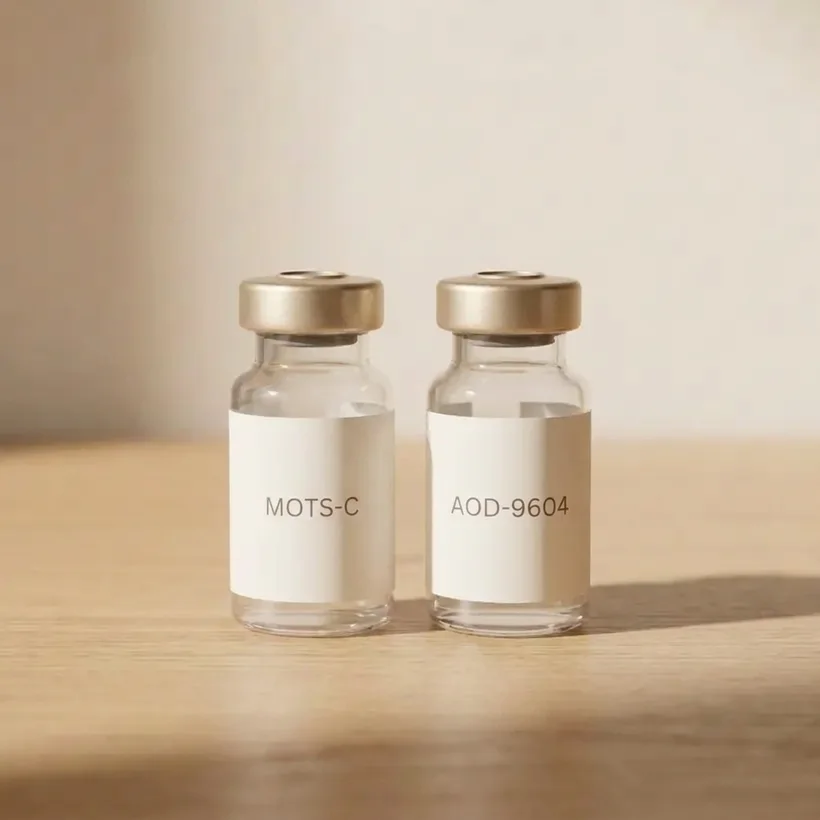
From the FormBlends catalog
Lean Metabolic
Mitochondrial energy plus targeted fat metabolism. · Bundle from $381 · provider-reviewed peptide bundle.
View Lean Metabolic →Table of Contents
- Ranked List: Best Peptides for Female Fat Loss
- Evidence Ledger Table
- How These Peptides Drive Fat Loss: Mechanism With Numbers
- What Most Pages Get Wrong About Peptides and Women
- Honest Head-to-Head: Peptides vs. Alternatives
- The Lean Mass Problem
- Label and COA Literacy: How to Judge a Product
- Stability and Formulation: The Gotchas
- Practical Dosing Reference
- Frequently Asked Questions
- Sources
Which Peptides Actually Work for Female Fat Loss, Ranked?
Tier 1: FDA-Approved GLP-1 and GIP/GLP-1 Agonists
1. Tirzepatide (Zepbound/Mounjaro) Dual GIP and GLP-1 receptor agonist. SURMOUNT-1 (2022, n=2539) showed roughly 21% body weight reduction at the 15 mg dose over 72 weeks. It is the highest-efficacy peptide for fat loss in any large human trial to date.
2. Semaglutide (Wegovy) Selective GLP-1 receptor agonist. STEP 1 (Wilding et al., 2021, n=1961) showed roughly 15% body weight reduction at 68 weeks versus 2.4% for placebo. Approved for chronic weight management at 2.4 mg once weekly subcutaneous.
3. Liraglutide (Saxenda) An earlier GLP-1 agonist, daily injection. SCALE Obesity trial showed roughly 8% body weight reduction over 56 weeks. Substantially less effective than semaglutide. Included for completeness.
Tier 2: Research Peptides With Mechanistic Support, Limited Human Data
4. CJC-1295 plus ipamorelin (combination) CJC-1295 is a GHRH analog; ipamorelin is a selective ghrelin mimetic. Together they increase GH pulse amplitude and frequency. Small studies (generally under 40 subjects) suggest improvements in body composition, primarily reduced visceral fat and increased lean mass, but no large RCT in women exists. Not FDA-approved for weight loss.
5. Sermorelin Oldest GHRH analog. Once FDA-approved for pediatric GH deficiency, now compounded. Adult fat-loss data is observational and sparse. Lower peak GH elevation compared to CJC-1295/ipamorelin combinations.
6. Tesamorelin FDA-approved specifically for HIV-associated lipodystrophy (visceral fat reduction). A 26-week RCT (Falutz et al., 2010, n=412) showed significant visceral fat reduction in that specific population. Evidence does not cleanly generalize to general female fat loss.
Tier 3: Widely Marketed, Evidence Does Not Support
7. AOD-9604 (hGH fragment 176-191) Failed Phase 3 clinical trials for obesity. No approved indication for fat loss. Despite heavy online marketing, clinical evidence in humans is rated Very Low. Do not rely on it as a primary fat-loss peptide.
8. BPC-157 Primarily a repair peptide with gastrointestinal and connective tissue data, mostly in rodents. No credible fat-loss mechanism or human trial in this context. Included here only to name it as a non-candidate.
Evidence Ledger: What Does the Data Actually Support?
| Peptide | Best Evidence Type | Effect on Fat Mass | Female-Specific Data? | Confidence |
|---|---|---|---|---|
| Tirzepatide | Large human RCT (SURMOUNT-1) | Roughly 21% body weight loss at 15 mg, 72 wks | Yes, subgroup data available | High |
| Semaglutide 2.4 mg | Large human RCT (STEP 1) | Roughly 15% body weight loss at 68 wks | Yes, subgroup data available | High |
| Liraglutide 3.0 mg | Large human RCT (SCALE) | Roughly 8% body weight loss at 56 wks | Yes, included in SCALE population | High |
| Tesamorelin | Human RCT, specific population (HIV) | Significant visceral fat reduction in HIV lipodystrophy | Partial (HIV cohorts) | Moderate (narrow population) |
| CJC-1295 plus ipamorelin | Small human trials, animal data | Possible visceral fat reduction, lean mass gain | Minimal, not powered for women | Low |
| Sermorelin | Small human observational, animal | Modest GH elevation, possible body comp improvement | Minimal | Low |
| AOD-9604 | Failed Phase 3 human RCT | No significant effect vs placebo | Included in failed trials | Very Low |
How Do Fat-Loss Peptides Work? Mechanism With Numbers
GLP-1 Agonists: Central Appetite Suppression and Slower Gastric Emptying
GLP-1 receptors are expressed in the hypothalamic arcuate nucleus and in vagal afferents. Semaglutide activates these receptors to increase POMC/CART neuron activity and suppress NPY/AgRP, reducing hunger signaling. Gastric emptying slows by roughly 25 to 40% in pharmacokinetic studies, extending satiety. The plasma half-life of semaglutide is approximately 165 to 184 hours, enabling once-weekly dosing. This is 10 times the half-life of native GLP-1 (1 to 2 minutes), achieved via albumin binding and a C18 fatty diacid linker.
Important caveat: slower gastric emptying explains tolerability issues (nausea in 40 to 50% of STEP 1 participants) but does not fully explain the magnitude of weight loss. CNS effects on reward and food preference appear important but are not yet quantified in humans.
GH Secretagogues: Pulsatile GH Release and Lipolysis
CJC-1295 is a synthetic GHRH analog with a Drug Affinity Complex (DAC) modification that extends its half-life to roughly 6 to 8 days in humans versus under 10 minutes for native GHRH. Ipamorelin is a pentapeptide ghrelin mimetic with high selectivity for the GHS-R1a receptor. CJC-1295 with DAC increased mean GH concentration by approximately 2 to 10 fold and IGF-1 by roughly 1.5 to 3 fold in a small (n=32) 2006 trial by Teichman et al. published in the Journal of Clinical Endocrinology and Metabolism.
Elevated GH and IGF-1 activate hormone-sensitive lipase (HSL) in adipocytes, increasing free fatty acid release. GH receptor signaling in adipose tissue also downregulates lipoprotein lipase (LPL), reducing fat storage. These mechanisms are real. The honest caveat: these mechanisms operate at physiological GH levels. Supraphysiological levels carry known risks including insulin resistance, fluid retention, and potential carcinogenicity at sustained high doses. The small trials did not measure long-term outcomes.
What Most Pages Get Wrong About Peptides and Female Fat Loss
Female hormonal cycling is almost always ignored. Estrogen upregulates GLP-1 receptor expression in some tissues, which may partly explain why premenopausal women in some analyses lose slightly more body fat percentage on GLP-1 agonists than men. Progesterone has opposing effects on gastric motility. These interactions are under-studied and no dosing protocol is currently adjusted for menstrual phase. A clinician who ignores this is not wrong; a writer who claims certainty about it is.
Peptide purity is not guaranteed by the vendor's label. A 2022 analysis by researchers at Valisure (an independent lab) and covered in industry pharmacy press found that multiple commercially available "research peptide" vials contained either incorrect concentrations or detectable bacterial endotoxins. This is not rare. A vendor claiming 99% purity on a product webpage is not the same as a COA from an ISO-17025-accredited lab.
AOD-9604 is still heavily marketed despite failed trials. The Phase 2 trials in the early 2000s showed modest lipid oxidation signals. Phase 3 did not replicate this as weight loss. Metabolic Pharmaceuticals halted the program. The compound persists in the peptide market because the Phase 2 data sounds compelling in isolation.
Honest Head-to-Head: Peptides vs. Real Alternatives
| Intervention | Average Fat Loss | Evidence Quality | Where Peptide Wins | Where Peptide Loses |
|---|---|---|---|---|
| Semaglutide 2.4 mg | Roughly 13 to 15% body weight | High (large RCT) | Magnitude, convenience (weekly injection) | Cost, lean mass loss, requires Rx, nausea |
| Tirzepatide 15 mg | Roughly 18 to 21% body weight | High (large RCT) | Highest efficacy of any current peptide | Cost, GI side effects, Rx required |
| Orlistat 120 mg (drug, non-peptide) | Roughly 3 to 5% body weight | High | OTC availability, lower systemic risk | Far lower efficacy, GI side effects (oily stool) |
| Calorie deficit plus resistance training | Roughly 5 to 10% over 6 months | High | Lean mass preserved, no drug costs, sustainable | Requires adherence, slower rate of loss |
| CJC-1295 plus ipamorelin | Not well quantified in humans | Low | Possible lean mass preservation, no Rx in some markets | Unregulated, unknown purity, limited human data |
| Metformin (off-label) | Roughly 2 to 3% body weight | Moderate to High | Low cost, metabolic benefits in insulin resistance | Small fat loss effect alone |
Should Women Worry About Losing Muscle on Peptides?
Yes, and this deserves its own section because most listicles bury or omit it. STEP 1 and companion studies using DEXA or bioimpedance found that a meaningful fraction of weight lost on semaglutide is lean mass, including skeletal muscle and bone-adjacent tissue. The clinical implications for women are specific: women who are perimenopausal or postmenopausal are already losing muscle at an accelerated rate. Adding a GLP-1 agonist without a resistance training protocol can compound sarcopenia risk.
GH secretagogues are sometimes advocated as a solution because elevated GH and IGF-1 are anabolic. The theory is reasonable. The human data combining GH secretagogues with calorie restriction in women to specifically protect lean mass is very limited. Until larger trials are run, this remains a plausible hypothesis, not a proven protocol. Resistance training two to four sessions per week with adequate protein (1.6 to 2.2 g/kg body weight per day based on current exercise physiology consensus) is the best-evidenced strategy available for lean mass preservation during any weight-loss intervention.
How to Judge a Peptide Product: Label and COA Literacy
Knowing what to look for in a product separates informed buyers from people paying for saline.
- Source of supply: Compounded GLP-1 agonists require a valid prescription and must come from an FDA-registered 503A (patient-specific) or 503B (outsourcing facility) pharmacy. If no prescription was required, it is not a legitimate compounded medication.
- COA requirements for research peptides: The certificate of analysis must be from an independent ISO-17025-accredited testing laboratory, not the manufacturer's own lab. Check for peptide identity confirmation (typically by HPLC and mass spectrometry), purity above 98% by area, and a bacterial endotoxin test result (less than 1 EU/mg is a common standard).
- Lot number and testing date: A COA without a lot number that matches the vial you received is unverifiable. Demand lot-specific documentation.
- What to look for on reconstituted peptides: Lyophilized research peptides should appear as a white or off-white powder. After reconstitution with bacteriostatic water, the solution should be clear and colorless. Cloudiness, particulates, or yellow discoloration after reconstitution indicates degradation or contamination. Do not inject a degraded solution.
- Reconstitution math example: A 5 mg vial of ipamorelin reconstituted with 2.5 mL bacteriostatic water gives a concentration of 2 mg/mL (2000 mcg/mL). A 200 mcg dose would require 0.1 mL (10 units on an insulin syringe). Calculate before every preparation.
Stability and Formulation: The Gotchas Competitors Omit
Why peptides degrade: Peptide bonds are susceptible to hydrolysis, and disulfide-containing peptides are vulnerable to oxidation. Elevated temperature accelerates both pathways. Lyophilized peptides are generally stable for 12 to 24 months at -20 degrees Celsius. Once reconstituted, most peptides should be refrigerated at 2 to 8 degrees Celsius and used within 28 to 30 days, though this varies by compound and formulation.
The bacteriostatic water rule and why it exists: Standard sterile water for injection has no antimicrobial agent. Once a vial is punctured, bacterial contamination can occur on re-entry. Bacteriostatic water contains 0.9% benzyl alcohol, which inhibits microbial growth in multi-use vials. Using plain sterile water for a multi-dose vial introduces real infection risk. This is chemistry, not convention.
Freeze-thaw cycles degrade peptides: Repeated freezing and thawing causes ice crystal formation that physically disrupts peptide secondary structure and aggregates proteins. If you are storing lyophilized powder, aliquot into single-use amounts before reconstitution so each aliquot is only thawed once.
The GLP-1 agonist pen device difference: Branded semaglutide (Wegovy) in its auto-injector pen contains a stabilized formulation that does not require refrigeration below a certain temperature threshold for short travel periods (see the product labeling for specific conditions). Compounded semaglutide in vials does not have the same stabilizing excipient profile. Treat compounded versions more conservatively.
Practical Dosing Reference for Women
| Peptide | Typical Starting Dose | Typical Maintenance Dose | Route | Frequency | Notes |
|---|---|---|---|---|---|
| Semaglutide (Wegovy) | 0.25 mg | 2.4 mg | Subcutaneous | Once weekly | 16-week titration; nausea peaks at dose escalation |
| Tirzepatide (Zepbound) | 2.5 mg | Up to 15 mg | Subcutaneous | Once weekly | Dose escalated every 4 weeks per prescriber |
| CJC-1295 (no DAC) | 100 mcg | 100 to 300 mcg | Subcutaneous | Once to twice daily | Research compound; half-life approximately 30 min without DAC |
| Ipamorelin | 100 mcg | 200 to 300 mcg | Subcutaneous | Once to twice daily | Often combined with CJC-1295; research compound |
| Sermorelin | 200 mcg | 200 to 500 mcg | Subcutaneous | Nightly (before sleep) | Compounded; approved only for pediatric GH deficiency previously |
Frequently Asked Questions
What is the best peptide for female fat loss?
Semaglutide has the strongest human RCT evidence for fat loss in women, with the STEP 1 trial showing roughly 15% body weight reduction at 68 weeks. GLP-1 agonists are the only peptides with large-scale female-specific efficacy data. Growth hormone secretagogues like CJC-1295 and ipamorelin have supporting evidence but come from smaller, less rigorous trials.
Does semaglutide work differently in women than men?
Subgroup analyses from the STEP trials suggest women achieve comparable or slightly greater percent weight loss than men, though absolute fat mass lost is similar. Hormonal cycling can affect GLP-1 receptor sensitivity, but no large trial has been powered to isolate that effect cleanly.
Can CJC-1295 or ipamorelin help women lose fat?
Both stimulate growth hormone pulses, which can improve lipolysis, especially visceral fat. However, the trials supporting them are small (often under 30 subjects) and rarely powered on female-specific endpoints. Evidence is rated Low to Moderate. They are unregulated research compounds in most countries.
Are peptides safe for women with PCOS or thyroid issues?
GLP-1 agonists have shown benefit in PCOS-related insulin resistance in several small trials. Thyroid C-cell tumors are a black-box warning for GLP-1 agonists in patients with personal or family history of medullary thyroid carcinoma. Growth hormone secretagogues have not been studied in these populations at a level that supports clinical guidance.
What dose of semaglutide is used for fat loss in women?
The FDA-approved Wegovy dose for chronic weight management is 2.4 mg subcutaneously once weekly, reached via a 16-week titration from 0.25 mg. Lower doses used off-label vary. Dose titration is essential to limit nausea, which is the most common discontinuation reason.
How does tirzepatide compare to semaglutide for female fat loss?
In the SURMOUNT-1 trial, tirzepatide at 15 mg achieved roughly 21% body weight reduction versus roughly 15% for semaglutide in STEP 1. Tirzepatide's dual GIP and GLP-1 agonism appears to produce greater fat mass loss. Both are approved drugs, not research peptides, and are the strongest fat-loss peptides by evidence.
What is AOD-9604 and does it work for fat loss in women?
AOD-9604 is a modified fragment of human growth hormone (hGH 176-191) designed to activate fat metabolism without IGF-1 elevation. Human trials for obesity were discontinued after Phase 3 showed no significant benefit over placebo for weight loss. Evidence is currently Very Low for fat loss in humans of any sex.
Do peptides preserve muscle mass during fat loss in women?
GLP-1 agonists cause mixed lean mass and fat mass loss. The STEP 1 trial showed approximately 40% of weight lost was lean mass, which is a legitimate concern. Growth hormone secretagogues may partially protect lean mass by raising IGF-1, but this is based on small trials. Resistance training alongside any peptide protocol is the best-supported strategy for lean mass preservation.
Can I use peptides for fat loss while breastfeeding or pregnant?
No. GLP-1 agonists carry a contraindication during pregnancy and breastfeeding due to animal reproductive toxicity data and a lack of human safety data. Growth hormone secretagogues have no human reproductive safety data at all. Peptide-based fat loss protocols should not be used in pregnancy or lactation.
How do I know if a peptide product is legitimate?
Legitimate compounded semaglutide requires a valid prescription from a licensed provider and compounding by an FDA-registered 503A or 503B pharmacy. Research peptides sold online without a prescription often lack third-party purity testing. Look for a certificate of analysis from an independent ISO-17025-accredited lab confirming identity, purity above 98%, and absence of endotoxins.
What happens when you stop taking a fat-loss peptide?
Weight regain is common after GLP-1 agonist discontinuation. A study by Wilding et al. (2022) following STEP 1 participants found that one year after stopping semaglutide, participants regained roughly two-thirds of the weight lost. This underscores that these are chronic-use medications, not short courses.
Sources
- Wilding JPH, et al. "Once-weekly semaglutide in adults with overweight or obesity." New England Journal of Medicine. 2021;384:989-1002. (STEP 1 trial)
- Jastreboff AM, et al. "Tirzepatide once weekly for the treatment of obesity." New England Journal of Medicine. 2022;387:205-216. (SURMOUNT-1 trial)
- Wilding JPH, et al. "Weight regain and cardiometabolic effects after withdrawal of semaglutide: the STEP 1 trial extension." Diabetes, Obesity and Metabolism. 2022;24(8):1553-1564.
- Pi-Sunyer X, et al. "A randomized, controlled trial of 3.0 mg of liraglutide in weight management." New England Journal of Medicine. 2015;373:11-22. (SCALE Obesity trial)
- Falutz J, et al. "Effects of tesamorelin, a growth hormone-releasing factor analog, in HIV-infected patients with excess abdominal fat: a pooled analysis of two multicenter, double-blind placebo-controlled phase 3 trials with safety extension data." Journal of Acquired Immune Deficiency Syndromes. 2010;53(3):311-322.
- Teichman SL, et al. "Prolonged stimulation of growth hormone (GH) and insulin-like growth factor I secretion by CJC-1295, a long-acting analog of GH-releasing hormone, in healthy adults." Journal of Clinical Endocrinology and Metabolism. 2006;91(3):799-805.
- U.S. Food and Drug Administration. "Wegovy (semaglutide) prescribing information." FDA. 2022.
- U.S. Food and Drug Administration. "Zepbound (tirzepatide) prescribing information." FDA. 2023.
- Rubino DM, et al. "Effect of weekly subcutaneous semaglutide vs daily liraglutide on body weight in adults with overweight or obesity without diabetes: the STEP 8 randomized clinical trial." JAMA. 2022;327(2):138-150.
- Heymsfield SB, et al. "Recombinant methionyl human leptin and body composition changes." New England Journal of Medicine. 1999. (Context for lean mass discussion in caloric restriction.)
- Morton RW, et al. "A systematic review, meta-analysis and meta-regression of the effect of protein supplementation on resistance training-induced gains in muscle mass and strength in healthy adults." British Journal of Sports Medicine. 2018;52(6):376-384.
Footer Disclaimers
Platform: FormBlends is an informational and educational publishing platform. This page does not constitute medical advice, diagnosis, or treatment. Content is intended for informational purposes only.
Research Compound Notice: Several peptides discussed on this page (including CJC-1295, ipamorelin, sermorelin, and AOD-9604 in the context of fat loss) are research compounds. They are not FDA-approved for the uses described. They are legal to possess in the United States only under specific circumstances. Regulations vary by country. Consult a licensed healthcare provider before considering any of these compounds.
Results Disclaimer: Individual results from any peptide or drug discussed vary widely. Clinical trial averages do not predict individual outcomes. Weight-loss figures cited reflect mean results in controlled trial populations under specific dietary and exercise conditions. Real-world results are typically lower.
Trademark Notice: Wegovy, Mounjaro, Zepbound, and Saxenda are registered trademarks of their respective pharmaceutical manufacturers. FormBlends has no affiliation with those companies and receives no compensation from them.
Related peptide guides
See your options in about 2 minutes
Take the free quiz and see what fits you. Quick, private, and no commitment to continue.
See my options →