
Trust Signals
Key Takeaways
- CJC-1295 with DAC has an albumin-binding linker that extends its half-life to roughly 6 to 8 days; without DAC (MOD GRF 1-29), the half-life is roughly 30 minutes.
- Only the DAC form has published human trial data: Teichman et al. (2006) in the Journal of Clinical Endocrinology and Metabolism showed 200 to 400 percent IGF-1 elevation above baseline sustained over days with single doses from 30 to 120 mcg/kg.
- MOD GRF 1-29 is the preferred pulsatile form and is almost always co-administered with a GHRP such as ipamorelin; no standalone human IGF-1 dose-response data for this form has been published.
- The DAC form's long half-life is a double-edged trait: it reduces injection frequency but means side effects, if they occur, persist for days and receptor desensitization is a theoretical concern.
- Neither form is FDA-approved. Both are research compounds. Purity and identity vary substantially across suppliers; a third-party COA showing HPLC purity greater than 98 percent and mass spectrometry confirmation is the minimum credibility threshold.
Direct Answer: CJC 1295 DAC or No DAC?
Choose the DAC form if you want lower injection frequency and have access to the most human-sourced evidence for sustained IGF-1 elevation. Choose the no-DAC form (MOD GRF 1-29) if you want to mimic natural pulsatile GH secretion, combine with a GHRP for synergistic release, or minimize receptor desensitization risk. The two forms are not interchangeable: they have different pharmacokinetics, different dosing intervals, and different risk profiles.
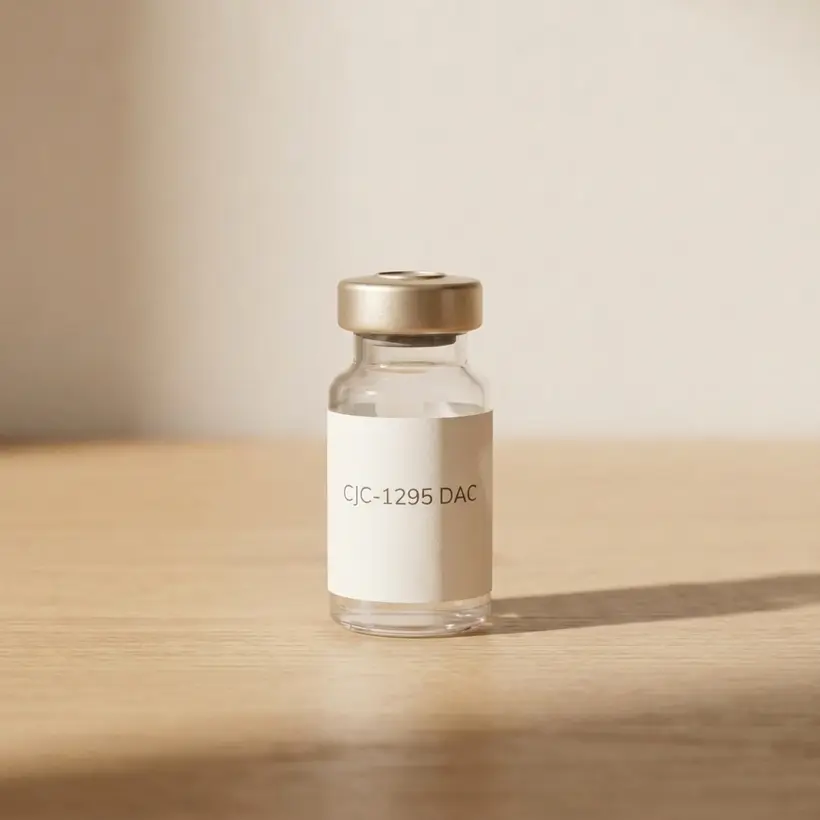
From the FormBlends catalog
CJC-1295 DAC
Long-acting GHRH analog with Drug Affinity Complex for sustained GH elevation · From $42/mo · compounded by a licensed 503A pharmacy, dispensed only after provider review.
Learn about CJC-1295 DAC →Table of Contents
- What are these two peptides, exactly?
- How does the DAC linker change the pharmacokinetics?
- Evidence ledger: what the research actually shows
- Mechanism with numbers: GHRH receptor signaling
- What most pages get wrong about CJC-1295
- Why the chemistry behind the DAC linker matters for safety
- Honest head-to-head comparison table
- Operational guide: dosing, reconstitution, and label literacy
- Who should avoid both forms
- FAQ
- Sources
- Disclaimers
What Are These Two Peptides, Exactly?
Both peptides are synthetic analogs of growth hormone-releasing hormone (GHRH). Natural GHRH is a 44-amino acid peptide secreted by the hypothalamus. Researchers established decades ago that the first 29 amino acids (GHRH 1-29) retain full receptor-binding activity.
CJC-1295 without DAC, known interchangeably as MOD GRF 1-29, is a version of GHRH 1-29 with four substituted amino acids at positions 2, 8, 15, and 27 to resist enzymatic cleavage by dipeptidyl peptidase IV (DPP-IV) and other serum proteases. This extends its half-life from the few minutes of native GHRH to roughly 30 minutes.
CJC-1295 with DAC adds a further modification: a Drug Affinity Complex attached to a lysine residue. This complex is a maleimidopropionic acid linker that forms a covalent thioether bond with the free cysteine-34 position of circulating serum albumin. Because albumin itself has a half-life of roughly 19 days, this dramatically extends the peptide's residence time in circulation to an estimated 6 to 8 days.
How Does the DAC Linker Change the Pharmacokinetics?
The albumin-binding strategy is not unique to CJC-1295. It is the same principle used in the diabetes drug semaglutide and the long-acting insulin detemir. Once the maleimide group reacts with albumin's cysteine-34 thiol via a Michael addition, the resulting thioether bond is stable under physiological conditions.
In the Teichman et al. (2006) trial, peak GH levels were seen within hours of injection, but IGF-1 elevations were sustained and measurable for more than two weeks after a single 60 mcg/kg dose in healthy adults. The mean IGF-1 increase was roughly 200 percent above baseline with lower doses and approached 400 percent at 120 mcg/kg, with the effect plateauing over repeated weekly dosing in the multiple-dose arm.
MOD GRF 1-29, by contrast, produces a sharp GH pulse that mimics the natural hypothalamic pulse pattern and is cleared within 1 to 2 hours. This is why co-administration with a GHRP (which acts via the separate ghrelin receptor, GHSR-1a) amplifies the pulsatile response without requiring continuous GHRH receptor stimulation.
Evidence Ledger: What the Research Actually Shows
| Claim | Best Evidence Type | Key Source | Effect Direction | Confidence |
|---|---|---|---|---|
| CJC-1295 DAC raises IGF-1 in healthy humans | Human RCT (small, n=65 total across groups) | Teichman et al., JCEM 2006 | Positive, dose-dependent, sustained | Moderate (single trial, industry-funded) |
| CJC-1295 DAC half-life is 6 to 8 days | Human PK data (same trial) | Teichman et al., JCEM 2006 | Confirmed | Moderate |
| MOD GRF 1-29 raises GH in humans | Mechanism extrapolation plus animal data | No standalone published human RCT found | Positive (expected by mechanism) | Low (mechanistic inference only) |
| GHRP plus MOD GRF 1-29 combination amplifies GH pulse | Animal studies; some human crossover data on GHRP alone | Multiple GHRP literature references | Positive, synergistic | Low to Moderate |
| Continuous GHRH stimulation can cause receptor desensitization | Animal and in vitro mechanistic data | GHRH receptor downregulation literature | Negative (concern) | Low (not confirmed in humans at these doses) |
| Body composition improvement with either form | No controlled human RCT for either form | Not available | Unknown in humans | Very Low (no evidence) |
| Flushing and nausea as side effects | Human trial adverse event reporting | Teichman et al., JCEM 2006 (DAC form) | Dose-dependent, mild to moderate | Moderate (for DAC form only) |
Mechanism With Numbers: GHRH Receptor Signaling
Both forms bind the GHRH receptor (GHRHR), a Gs-coupled G protein-coupled receptor expressed on somatotroph cells in the anterior pituitary. Binding activates adenylyl cyclase, increases intracellular cyclic AMP, activates protein kinase A, and triggers GH gene transcription and secretory granule release. IGF-1 is then produced primarily in the liver in response to circulating GH.
The affinity of GHRH analogs at the GHRHR is in the low nanomolar range. The amino acid substitutions in MOD GRF 1-29 (at positions 2, 8, 15, 27) primarily improve metabolic stability against DPP-IV and other endopeptidases rather than dramatically altering receptor binding affinity. This distinction matters because it means MOD GRF 1-29 is not pharmacologically more potent per molecule than native GHRH at the receptor; it simply survives longer to reach it.
What the mechanism does NOT prove: elevated IGF-1 in a human PK trial does not establish that lean mass, bone density, or recovery outcomes improve at any specific protocol. IGF-1 is a biomarker, not a validated surrogate endpoint for these outcomes in healthy adults.
What Most Pages Get Wrong About CJC-1295
The naming confusion is a product quality risk. "CJC-1295" is used by suppliers to mean either the DAC form or the no-DAC form (MOD GRF 1-29) interchangeably, sometimes on the same product run. If you order based on name alone, you may receive a different molecule than intended. The molecular weight difference (approximately 3647 Da for DAC vs. approximately 3368 Da for MOD GRF 1-29) is verifiable by mass spectrometry. A COA without MS confirmation cannot distinguish the two.
The 2 mg per week flat-dose protocol has no published basis. Teichman et al. used weight-based dosing (30 to 120 mcg/kg). A 2 mg flat dose in a 70 kg person corresponds to roughly 28 mcg/kg, below the lowest trial dose. The widely repeated "2 mg weekly" figure circulating in research communities is not derived from any published dose-escalation study in humans.
Reconstitution errors change the effective dose substantially. Many users reconstitute 2 mg vials with 2 mL bacteriostatic water, producing a 1 mg/mL solution. A 0.1 mL insulin syringe draw then delivers 100 mcg. Any math error at reconstitution multiplies through every subsequent dose. A diluted or over-concentrated vial that looks identical to a correctly made one is the most common operational failure mode.
Lyophilized peptide purity degrades before you open the vial. Lyophilized CJC-1295 is stable for extended periods at 2 to 8 degrees Celsius when sealed, but purity depends heavily on the manufacturing process (especially whether the DAC linker was correctly conjugated). A product that masses correctly at approximately 3647 Da may still contain racemization byproducts or aggregates that are invisible without HPLC. Purity below 95 percent increases the risk of immune reactions and reduces dose accuracy.
Why the Chemistry Behind the DAC Linker Matters for Safety
The maleimide-thiol Michael addition that attaches CJC-1295 to albumin is designed to be selective for cysteine-34 on albumin, but maleimides can also react with other free thiols in plasma, including glutathione and free cysteine. In well-manufactured batches, the reaction is completed during synthesis, so the product you inject is already albumin-bound or already has a capped maleimide. In a poorly synthesized batch, residual reactive maleimide could bind non-specifically in vivo.
The practical safety implication: the DAC linker chemistry is not unique or alarming when the product is made correctly. The concern is batch-to-batch variability in research-grade suppliers. This is the chemical basis for why a COA from an independent lab, not the manufacturer, matters more for the DAC form than for MOD GRF 1-29.
The longer half-life also changes how errors compound. If a patient reacts to a dose of MOD GRF 1-29, that dose is pharmacologically gone within a few hours. A reaction to the DAC form may persist for several days, because the albumin-bound peptide cannot be rapidly cleared.
Honest Head-to-Head Comparison
| Feature | CJC-1295 with DAC | CJC-1295 No DAC (MOD GRF 1-29) | Winner / Notes |
|---|---|---|---|
| Half-life | Approximately 6 to 8 days | Approximately 30 minutes | Depends on goal |
| Injection frequency | Once weekly or less | Multiple times daily (typically pre-sleep or pre-workout) | DAC wins on convenience |
| Human clinical evidence | One published human RCT (Teichman 2006) | No standalone human RCT found | DAC wins on evidence (narrow advantage) |
| Mimics natural GH pulse | No, produces sustained tonic elevation | Yes, produces discrete pulse | No DAC wins on physiological fidelity |
| GHRP synergy | Possible but pulse synergy is muted | Strong pulsatile synergy (ipamorelin, GHRP-6, etc.) | No DAC wins for combination protocols |
| Receptor desensitization risk | Higher theoretical risk (continuous stimulation) | Lower theoretical risk (pulsatile) | No DAC wins on theory; unconfirmed in humans |
| Duration of side effects if they occur | Days (albumin-bound, cannot be rapidly cleared) | Hours | No DAC wins on safety manageability |
| Naming confusion / sourcing risk | High (often mislabeled) | High (often mislabeled as CJC-1295) | Tie; MS confirmation required for both |
| Body composition evidence in humans | None (not a primary endpoint in any trial) | None | Tie, neither wins |
Operational Guide: Dosing, Reconstitution, and Label Literacy
Reconstitution math
Standard vials are sold as 2 mg lyophilized powder. Add bacteriostatic water slowly to the side of the vial, not directly onto the pellet. For a 2 mg vial with 2 mL bacteriostatic water: concentration is 1 mg per mL (1000 mcg per mL). On a 100-unit insulin syringe (0.1 mL = 10 units), each 10 units draws 100 mcg. For a weight-based dose approximating the Teichman trial's lowest dose (30 mcg/kg in a 70 kg person = 2100 mcg), you would need to draw more than one full 2 mg vial. This illustrates how the "100 mcg per injection" dosing common in research communities is well below published human trial doses.
How to read a COA for CJC-1295
- HPLC purity: look for greater than 98 percent. Values below 95 percent are a red flag.
- Molecular weight by mass spectrometry: DAC form should read approximately 3647 Da; MOD GRF 1-29 approximately 3368 Da. If the COA shows a single value but does not specify which form you ordered, request clarification.
- Endotoxin testing: for any injectable compound, bacterial endotoxins (LAL test) should be below 1 EU/mg. Many research suppliers omit this; that omission is a risk.
- Independent lab: the testing lab should be a third party, not the manufacturer's in-house lab. Look for the lab's own letterhead and accreditation number.
- Lot-specific COA: a COA with no lot number matching your vial is a generic document and is not meaningful quality assurance.
Signs of degraded peptide
Lyophilized peptide should be a white to off-white powder that is easily resuspended. Yellowing, caking that does not dissolve, or a reconstituted solution that is cloudy or shows particulates all suggest degradation or contamination. A degraded peptide will not produce the expected biomarker response and may be immunogenic.
Who Should Avoid Both Forms
- Anyone with active cancer or a personal or family history of pituitary tumors. GH axis stimulation is contraindicated in these contexts.
- Anyone with active acromegaly or confirmed GH excess.
- Pregnant or breastfeeding individuals.
- Individuals with type 2 diabetes or insulin resistance, where elevated GH and IGF-1 may worsen insulin sensitivity in some contexts.
- Anyone not under direct clinical supervision. These are not consumer wellness products; they require baseline and follow-up IGF-1 measurement at minimum.
FAQ
What is the main difference between CJC-1295 DAC and CJC-1295 no DAC?
CJC-1295 with DAC carries a lysine-maleimidopropionic acid linker that lets it covalently bind serum albumin, extending its half-life to roughly 6 to 8 days. CJC-1295 without DAC (MOD GRF 1-29) lacks that linker, giving it a half-life of roughly 30 minutes, which more closely mimics a natural growth hormone pulse.
Which form raises IGF-1 more reliably in humans?
CJC-1295 with DAC produced sustained IGF-1 elevations of roughly 200 to 400 percent above baseline for up to 28 days after a single dose in a human trial by Teichman et al. (2006). CJC-1295 without DAC has no comparable published human IGF-1 dose-response data; its IGF-1 effects are extrapolated from animal work and GHRP combination studies.
Is CJC-1295 without DAC the same as MOD GRF 1-29?
Yes. MOD GRF 1-29 is the same peptide as CJC-1295 without DAC. It is a modified version of the first 29 amino acids of GHRH, with four amino acid substitutions to improve stability. Some suppliers label it CJC-1295 (no DAC) and others label it MOD GRF 1-29; both names refer to the same research compound.
Can you combine CJC-1295 with a GHRP?
Yes, and the combination is common in research protocols. GHRPs such as ipamorelin act on the ghrelin receptor (GHSR-1a), while CJC-1295 acts on the GHRH receptor (GHRHR). The two pathways are synergistic. For MOD GRF 1-29, co-administration with a GHRP amplifies pulsatile GH release. With the DAC form, the sustained baseline elevation changes this dynamic and the pulse-on-pulse synergy is less pronounced.
What dose is used in human research for CJC-1295 with DAC?
The Teichman et al. (2006) trial used single and multiple subcutaneous doses from 30 mcg/kg to 120 mcg/kg in healthy adults. Doses in that range produced dose-dependent IGF-1 increases. The 2 mg flat-dose weekly protocol widely discussed in non-clinical communities is not directly derived from published dose-finding studies.
How should CJC-1295 peptide vials be stored?
Lyophilized powder should be stored at 2 to 8 degrees Celsius and protected from light. Once reconstituted with bacteriostatic water, refrigerate and use within approximately 4 weeks. Avoid repeated freeze-thaw cycles, which can degrade the peptide bond structure. Formal published stability data for these specific formulations is limited.
What are the known side effects of CJC-1295?
In the Teichman et al. (2006) human trial, the most commonly reported adverse events were flushing, nausea, and injection site reactions, occurring predominantly at higher doses. The longer half-life of the DAC form means side effects persist longer and cannot be resolved by simply missing a dose.
Does CJC-1295 with DAC blunt natural GH pulses?
This is a theoretical concern with mechanistic support. Continuous GHRH receptor stimulation can cause receptor desensitization. Animal studies show GHRH receptor downregulation with prolonged exposure. Whether this is clinically relevant in humans at research doses is unknown, but it is a reason some investigators prefer the pulsatile MOD GRF 1-29 approach.
Is CJC-1295 approved by the FDA?
No. Neither CJC-1295 with DAC nor CJC-1295 without DAC is FDA-approved for any indication. Both are research compounds not approved for human use outside of formal clinical research protocols in the United States.
How do you read a certificate of analysis for CJC-1295?
A credible COA should include: HPLC purity greater than 98 percent, mass spectrometry confirmation of molecular weight (DAC form: approximately 3647 Da; MOD GRF 1-29: approximately 3368 Da), sterility and endotoxin testing, and the independent testing lab name. A COA from the same manufacturer who made the product is not independent verification.
Which form is better for body composition goals?
No head-to-head human RCT has compared the two forms directly for body composition. The DAC form has more human evidence for sustained IGF-1 elevation. The no-DAC form is often combined with a GHRP for pulsatile release. Neither form has sufficient controlled human evidence to make a confident claim about body composition superiority.
Sources
- Teichman SL, Neale A, Lawrence B, Gagnon C, Castaigne JP, Frohman LA. Prolonged stimulation of growth hormone (GH) and insulin-like growth factor I secretion by CJC-1295, a long-acting analog of GH-releasing hormone, in healthy adults. Journal of Clinical Endocrinology and Metabolism. 2006;91(3):799-805.
- Frohman LA, Downs TR, Chomczynski P. Regulation of growth hormone secretion. Frontiers in Neuroendocrinology. 1992;13(4):344-405.
- Ionescu M, Frohman LA. Pulsatile secretion of growth hormone (GH) persists during continuous stimulation by CJC-1295, a long-acting GH-releasing hormone analog. Journal of Clinical Endocrinology and Metabolism. 2006;91(12):4792-4797.
- Sackmann-Sala L, Ding J, Frohman LA, Kopchick JJ. Activation of the GH/IGF-1 axis by CJC-1295, a long-acting GHRH analog, results in serum protein profile changes in normal adult subjects. Growth Hormone and IGF Research. 2009;19(6):471-477.
- Bowers CY. History and current status of studies of GHRP-6 and related GH secretagogues. Endocrine. 2001;14(1):21-31.
- Walker RF. Sermorelin: a better approach to management of adult-onset growth hormone insufficiency? Clinical Interventions in Aging. 2006;1(4):307-308.
- U.S. Food and Drug Administration. Growth hormone, peptide hormones, and related substances. FDA Import Alert and regulatory guidance documents. FDA.gov.
- Alba M, Fintini D, Sagazio A, Lawrence B, Castaigne JP, Frohman LA, Salvatori R. Once-daily administration of CJC-1295, a long-acting growth hormone-releasing hormone (GHRH) analog, normalizes growth in the GHRH knockout mouse. American Journal of Physiology Endocrinology and Metabolism. 2006;291(6):E1290-E1294.
Footer Disclaimers
Platform: This page is published by FormBlends for educational and informational purposes only. It does not constitute medical advice, diagnosis, or a treatment recommendation.
Research Compound Status: CJC-1295 with DAC and CJC-1295 without DAC (MOD GRF 1-29) are research compounds. They are not approved by the U.S. Food and Drug Administration or equivalent regulatory agencies in most jurisdictions for any therapeutic use in humans outside of formal clinical trials. They are not dietary supplements.
Results: Individual responses to any compound vary. The outcomes described in referenced studies were observed under controlled research conditions and may not reflect outcomes in other populations or settings. No body composition, anti-aging, or performance claim is endorsed by this page.
Trademark: CJC-1295 is a designation used generically in the research community. MOD GRF 1-29 is a descriptive term. FormBlends does not claim trademark ownership of these terms. All third-party trademarks referenced are the property of their respective owners.
Related peptide guides
Ready when you are
CJC-1295 DAC
Long-acting GHRH analog with Drug Affinity Complex for sustained GH elevation · From $42/mo · compounded by a licensed 503A pharmacy, dispensed only after provider review.
Learn about CJC-1295 DAC →