
Trust Signals
Key Takeaways
- The DAC modification extends half-life from roughly 30 minutes (without DAC) to approximately 6 to 8 days, confirmed in a published human pharmacokinetic trial by Teichman et al. (2006).
- CJC-1295 without DAC (identical to Modified GRF 1-29) produces a short, sharp GH pulse that more closely mimics endogenous pulsatile secretion; the DAC version produces a sustained, blunted elevation.
- Only the DAC version has published human pharmacokinetic and IGF-1 data; neither version holds FDA drug approval.
- Side effects from the DAC version persist far longer than those from the non-DAC version because clearance takes days rather than hours.
- Without HPLC and mass-spec certificate of analysis, buyers of either compound cannot verify identity or purity; mislabeling between versions is a documented sourcing problem.
What Is the Difference Between CJC-1295 With DAC and Without DAC?
CJC 1295 with DAC vs without DAC comes down to one chemical modification that changes everything about pharmacokinetics. With DAC, the peptide bonds covalently to albumin in circulation, producing a half-life of roughly 6 to 8 days and once-or-twice-weekly dosing. Without DAC (Modified GRF 1-29), the half-life is approximately 30 minutes, GH pulses are sharp and short, and dosing is daily. The right choice depends on whether you prioritize pulse physiology or convenience.
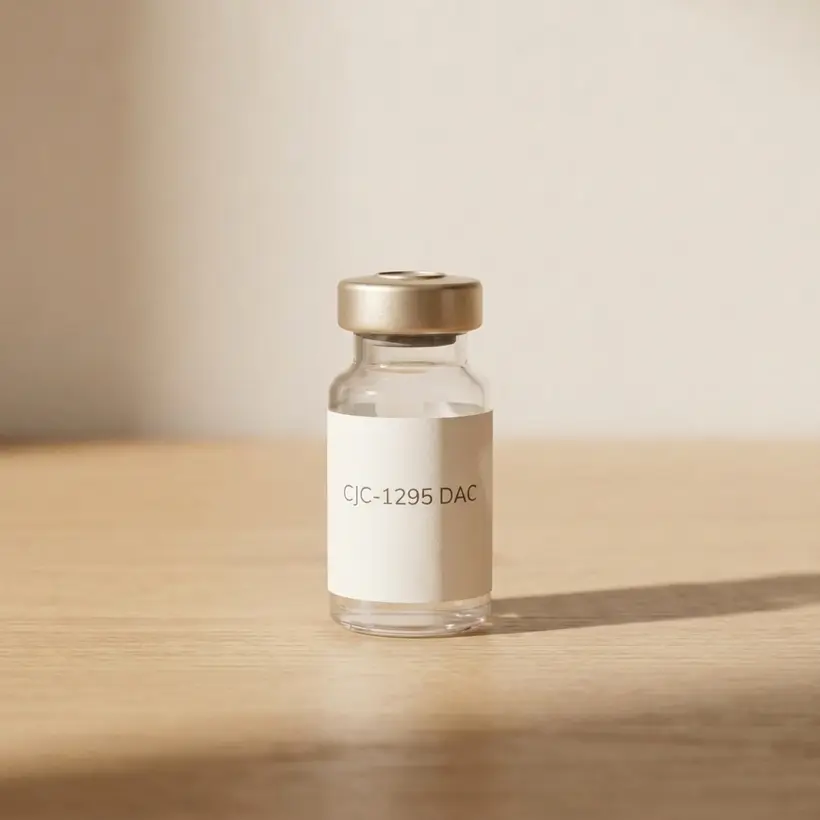
From the FormBlends catalog
CJC-1295 DAC
Long-acting GHRH analog with Drug Affinity Complex for sustained GH elevation · From $42/mo · compounded by a licensed 503A pharmacy, dispensed only after provider review.
Learn about CJC-1295 DAC →Table of Contents
- What Is the Difference (direct answer above)
- How Does the DAC Modification Work Chemically?
- Evidence Ledger: What the Research Actually Shows
- Mechanism With Numbers: Half-Lives, Receptor Binding, IGF-1 Changes
- What Most Comparison Pages Get Wrong
- Pulse Physiology: Why Timing Matters
- Honest Head-to-Head Comparison Table
- Dosing and Reconstitution: Operational Guide
- Stability, Storage, and Formulation Gotchas
- Side Effects and Failure Modes
- FAQ
- Sources
- Footer Disclaimers
How Does the DAC Modification Work Chemically?
Native GHRH(1-29) is cleaved within about 2 minutes by dipeptidyl peptidase-4 (DPP-4), which cuts at the Ala-Asp bond near the N-terminus. Modified GRF 1-29 (CJC-1295 without DAC) addresses this with four amino acid substitutions: Tyr1 replaced by D-Ala, Arg2 replaced by D-Ala (this is the key DPP-4 protection), Gln8 replaced by Ala, and Ala15 replaced by Gln, plus Leu27 replaced by norvaline, and Methionine27 modifications depending on manufacturer variant. These substitutions extend the half-life to roughly 30 minutes by resisting enzymatic cleavage, without altering receptor binding meaningfully.
The DAC component adds a maleimidopropionic acid (MPA) group to the epsilon-amine of the lysine residue at position 33 of the extended sequence. Once injected, this MPA group undergoes a Michael addition reaction with the free thiol group on cysteine-34 of circulating serum albumin. The resulting covalent thioether bond is stable under physiological conditions. Because albumin has a half-life of approximately 19 days and is too large for rapid renal filtration, the DAC-albumin adduct clears very slowly, giving CJC-1295-DAC its 6 to 8 day pharmacokinetic profile.
This is not a reversible binding event. The peptide is not "released" from albumin on a schedule; rather, the entire adduct degrades through albumin's normal catabolism. This is a critical distinction from loose protein binding (as seen with many small molecules) and explains why elevated GH and IGF-1 persist for days after a single injection.
Evidence Ledger: What the Research Actually Shows
| Claim | Best Evidence Type | Key Source | Effect Direction | Confidence |
|---|---|---|---|---|
| CJC-1295-DAC half-life ~6 to 8 days in humans | Human pharmacokinetic trial (n=65) | Teichman et al., J Clin Endocrinol Metab, 2006 | Confirmed, dose-dependent | High |
| CJC-1295-DAC increases IGF-1 in healthy adults | Human RCT (randomized, placebo-controlled) | Teichman et al., 2006 | IGF-1 increased 2 to 3 fold over baseline at higher doses | High (for IGF-1 elevation; not for clinical outcomes) |
| Modified GRF 1-29 half-life ~30 minutes | Pharmacokinetic modeling and analog comparison studies | Conceptual derivation from GHRH analog literature; no large standalone human PK trial identified | Confirmed directionally vs native GHRH (~2 min) | Moderate |
| DAC modification uses albumin covalent binding via Michael addition | Biochemistry / mechanism (structural characterization) | Described in Teichman et al. and ConjuChem patent literature | Mechanistic, not in dispute | High (mechanism); Low (clinical implication of albumin binding on outcomes) |
| Combination with GHRP produces synergistic GH release | Human PK/PD studies (small, various GHRPs) | Multiple small trials; mechanistically supported by dual receptor pathway | Additive to synergistic GH release | Moderate |
| Body composition improvements (fat loss, muscle gain) from either version | Animal data; extrapolation from GH/IGF-1 physiology | No controlled human body composition trial identified for either version | Plausible, not proven in humans | Very Low |
| Long-term axis suppression risk | Mechanistic reasoning (somatostatin feedback) | No long-term human suppression trial identified | Theoretically possible with DAC; magnitude unknown | Very Low |
Mechanism With Numbers: Half-Lives, Receptor Binding, and IGF-1 Changes
GHRH acts on the GHRH receptor (GHRHR), a Gs-coupled GPCR expressed on pituitary somatotroph cells. Receptor activation increases intracellular cAMP, which drives GH synthesis and secretion. Both CJC-1295 variants bind the same receptor and drive the same downstream signaling. The difference is entirely pharmacokinetic, not pharmacodynamic at the receptor level.
In the Teichman et al. (2006) trial of 65 healthy adults aged 21 to 61 years, single subcutaneous injections of CJC-1295-DAC at doses ranging from 30 mcg/kg to 120 mcg/kg produced mean IGF-1 increases of roughly 2-fold to 3-fold above baseline, sustained for up to 28 days after a single dose. The terminal half-life averaged approximately 6 to 8 days depending on dose. GH itself was not continuously elevated to pathological levels but showed an altered secretion pattern.
For modified GRF 1-29 (without DAC), direct large-scale human PK data are not available in a standalone published trial. Extrapolation from GHRH analog literature and the known DPP-4 protection mechanism suggests a half-life in the range of 15 to 30 minutes. This is long enough to trigger a meaningful GH pulse when timed appropriately but short enough that GH returns toward baseline within 1 to 3 hours.
What the mechanism does NOT prove: elevated IGF-1 on paper does not confirm improvements in body composition, recovery, or disease outcomes. IGF-1 is a surrogate biomarker. No human RCT has linked either peptide to validated clinical outcomes such as lean mass measured by DXA or objective strength metrics.
What Most Comparison Pages Get Wrong
1. Conflating the names. "CJC-1295 without DAC" and "Modified GRF 1-29" are the same compound. Many pages treat them as different peptides or describe CJC-1295 without DAC as a less modified or cruder version. They are identical in marketed research peptide contexts.
2. Assuming purity from the label. Research-grade peptide vendors sell both compounds in lyophilized vials with concentrations stated on the label. Without a certificate of analysis showing HPLC purity (ideally greater than 98%) and mass spectrometry confirmation of the correct molecular weight (CJC-1295-DAC: approximately 5040 Da; Mod GRF 1-29: approximately 3368 Da), there is no reliable way to confirm the vial contains what is stated. Mass spectrometry distinguishes the two compounds definitively. HPLC alone does not confirm identity, only purity of whatever is present.
3. Presenting GH elevation as the clinical outcome. Both compounds reliably elevate GH and IGF-1 in the Teichman trial and mechanistically. But GH elevation and IGF-1 elevation are biomarkers, not outcomes. Translating them to fat loss or muscle gain requires human body composition trials that do not exist for these specific peptides.
4. Ignoring the persistence problem with DAC. If a user develops side effects from the DAC version (edema, carpal tunnel symptoms, glucose dysregulation), those effects will persist for roughly one to two weeks after stopping, because the albumin adduct is still clearing. With the non-DAC version, most effects resolve within hours of the last dose. This is a clinically meaningful distinction that most blogs mention nowhere.
5. Recommending the same ancillary reconstitution math. Both compounds are sold in vials of varying concentrations. The reconstitution math differs based on vial size and desired dose. Using the wrong volume of bacteriostatic water produces dramatically different concentration per unit volume, leading to significant dosing errors.
Why Does Pulse Physiology Matter?
Endogenous GH is secreted in discrete pulses, primarily overnight, driven by alternating GHRH and somatostatin rhythms from the hypothalamus. Downstream metabolic effects of GH (lipolysis, protein synthesis, IGF-1 generation) are shaped by the amplitude and frequency of these pulses, not simply by average GH exposure. Continuous GH receptor stimulation from persistently elevated GH can downregulate receptor sensitivity, a phenomenon well-documented with exogenous recombinant GH (rhGH) at pharmacological doses.
CJC-1295 without DAC, dosed once or twice daily, produces a sharp GH pulse that more closely mimics this pulsatile pattern. Somatostatin feedback still operates between doses. The DAC version flattens this architecture. Whether the flattened profile from the DAC version impairs long-term efficacy relative to pulsatile stimulation is an open question with no direct human comparison data.
Honest Head-to-Head Comparison Table
| Feature | CJC-1295 With DAC | CJC-1295 Without DAC (Mod GRF 1-29) | Winner / Nuance |
|---|---|---|---|
| Half-life | ~6 to 8 days (human data) | ~15 to 30 minutes (estimated) | DAC for convenience; non-DAC for control |
| Dosing frequency | Once to twice weekly | Daily or multiple times daily | DAC wins on convenience |
| GH pulse shape | Sustained, blunted elevation | Sharp, short pulse (1 to 3 hours) | Non-DAC wins for pulse physiology mimicry |
| Human PK/PD data | Published RCT (Teichman et al., 2006) | No large standalone human PK trial | DAC wins on evidence quality |
| Reversibility of side effects | Days to weeks after stopping | Hours after stopping | Non-DAC wins on safety flexibility |
| Pairing with GHRP | Possible but timing is less precise | Standard practice; timing is controllable | Non-DAC wins for combination protocols |
| Sourcing/label accuracy | Risk of receiving non-DAC version mislabeled | Often confused with or mislabeled as DAC version | Both carry high mislabeling risk; neither wins |
| Body composition evidence in humans | None (IGF-1 data only) | None | Neither wins; both lose vs rhGH (approved, studied) |
| Regulatory status | Not FDA-approved; research compound | Not FDA-approved; research compound | Tie; both lose vs FDA-approved somatropin |
Dosing and Reconstitution: Operational Guide
Reconstitution math example (non-DAC version): A common vial is 2 mg (2000 mcg) lyophilized. Adding 2 mL of bacteriostatic water yields 1000 mcg per mL, or 100 mcg per 0.1 mL (a standard insulin syringe unit). A typical research protocol dose of 100 mcg would therefore be 0.1 mL (10 units on a 100-unit insulin syringe). Always add the water slowly down the side of the vial. Do not shake; gently swirl.
Reconstitution math example (DAC version): The DAC version is often supplied as 2 mg per vial as well, but dosing is by body weight in research contexts (Teichman used 30 to 120 mcg/kg). For a 80 kg person at 30 mcg/kg, that is 2400 mcg per dose, which would require more than one 2 mg vial. This is rarely discussed in consumer-facing content and leads to significant underdosing relative to the trial doses.
| Version | Typical Research Dose | Frequency | Route | Common Pairing |
|---|---|---|---|---|
| Without DAC (Mod GRF 1-29) | 100 mcg per injection | Once to twice daily | Subcutaneous | Ipamorelin 100 mcg or GHRP-2 100 mcg |
| With DAC | 1 to 2 mg per injection (approximately 12 to 25 mcg/kg for 80 kg person) | Once to twice weekly | Subcutaneous | Less commonly paired with GHRP due to fixed timing |
Reading a COA: Request HPLC chromatogram (look for single dominant peak, purity stated above 98%), mass spectrometry (confirm molecular weight: Mod GRF 1-29 ~3368 Da; CJC-1295-DAC ~5040 Da), and endotoxin testing (LAL assay, limit typically less than 1 EU/mg for injectable use). Absence of any of these documents is a disqualifying red flag.
Stability, Storage, and Formulation Gotchas
Why cold storage matters (the chemistry): Both peptides are susceptible to hydrolysis of peptide bonds in aqueous solution, a reaction accelerated by elevated temperature and extremes of pH. The rate of hydrolysis roughly doubles for every 10-degree Celsius increase in temperature (Arrhenius relationship). A vial left at room temperature for a week loses measurably more potency than one refrigerated continuously. Lyophilized (freeze-dried) powder is far more stable because the absence of free water dramatically slows hydrolysis.
The bacteriostatic water rule: Reconstitute with bacteriostatic water (0.9% benzyl alcohol), not sterile water. Benzyl alcohol inhibits microbial growth, extending safe use of the reconstituted vial for roughly 2 to 4 weeks refrigerated. Sterile water provides no such inhibition; a reconstituted vial with sterile water should be used within 24 to 48 hours or discarded.
DAC-specific formulation note: The maleimide-thioether bond formed between the DAC group and albumin is stable at physiological pH (7.4) but may be susceptible to hydrolysis in highly acidic or basic solutions. Avoid mixing reconstituted CJC-1295-DAC with other compounds at extreme pH. Most bacteriostatic water is pH-neutral and safe.
What degraded product looks like: A properly reconstituted peptide solution is clear and colorless. Cloudiness, particulates, or yellow discoloration indicate contamination or degradation. Discard any vial showing these signs. A degraded peptide may still show a response on a cheap ELISA IGF-1 test (because degradation fragments can cross-react), but it will have meaningfully reduced biological activity.
What Are the Side Effects and Failure Modes?
Shared class effects for both versions include: transient injection site redness or swelling, water retention (especially at the extremities), tingling or numbness in the hands (possibly from acute IGF-1 elevation acting on peripheral nerves), headache, and flushing. These are generally mild at research doses and resolve on stopping.
The DAC-specific persistence problem: Because the DAC version continues releasing from the albumin depot over days to weeks, any adverse effect that emerges cannot be quickly reversed by stopping injections. A user who develops edema or glucose dysregulation with the DAC version may experience those effects for 7 to 14 days after the last injection. This is a qualitative risk difference that is clinically significant for monitoring purposes.
Glucose and insulin sensitivity: GH has counter-regulatory effects on insulin, promoting hepatic gluconeogenesis and reducing peripheral glucose uptake. Chronically elevated GH (more likely with the DAC version's sustained profile) theoretically worsens insulin sensitivity. People with pre-diabetes or metabolic syndrome carry higher risk. No large trial has quantified this risk specifically for these peptides.
Cancer risk: IGF-1 is a mitogenic signaling molecule. Chronically supraphysiologic IGF-1 is associated in epidemiological data with increased risk of certain cancers. Neither peptide has been tested in long-term oncology safety studies. This is an unresolved mechanistic concern, not a proven harm at the doses in question, but it is a legitimate reason clinicians in many contexts avoid these compounds in patients with personal or family cancer histories.
FAQ
What is the main difference between CJC-1295 with DAC and without DAC?
The DAC (Drug Affinity Complex) modification covalently binds CJC-1295 to circulating albumin, extending its half-life from roughly 30 minutes to approximately 6 to 8 days. Without DAC (Modified GRF 1-29), the peptide produces a sharp, short GH pulse that mimics normal physiology more closely. With DAC, GH elevation is blunted and prolonged.
Which version produces a more natural GH pulse?
CJC-1295 without DAC produces a sharper GH pulse lasting roughly 1 to 3 hours, which more closely resembles endogenous pulsatile GH secretion. The DAC version produces a sustained, flattened elevation that does not replicate natural pulse patterns.
How often do you dose each version?
CJC-1295 without DAC is typically dosed once daily or multiple times per day (often paired with a GHRP) due to its short half-life. CJC-1295 with DAC is typically dosed once or twice per week because its albumin-bound form persists for approximately 6 to 8 days.
Has CJC-1295 with DAC been tested in humans?
Yes. A published human trial by Teichman et al. (2006) in the Journal of Clinical Endocrinology and Metabolism tested CJC-1295 with DAC in healthy adults, demonstrating dose-dependent increases in IGF-1 and GH, and confirming the extended half-life of approximately 6 to 8 days. Neither version is FDA-approved as a drug.
Can you combine CJC-1295 with a GHRP?
Yes. Combining a GHRH analog like CJC-1295 without DAC with a GHRP (such as ipamorelin or GHRP-2) acts on two different receptor pathways simultaneously, producing synergistic GH release. This combination is well-documented mechanistically but lacks large-scale human RCT evidence for body composition outcomes.
What does DAC actually stand for and how does it work chemically?
DAC stands for Drug Affinity Complex. It is a maleimidopropionic acid group added to the lysine residue at position 33 of the peptide. This group reacts with a free cysteine-34 thiol on circulating albumin via a Michael addition reaction, forming a stable covalent bond that dramatically slows renal clearance.
Is CJC-1295 without DAC the same as Modified GRF 1-29?
Yes. CJC-1295 without DAC and Modified GRF 1-29 (also called Mod GRF 1-29) refer to the same peptide: a 29-amino-acid GHRH analog with amino acid substitutions that protect it from dipeptidyl peptidase-4 cleavage, extending its half-life to roughly 30 minutes compared to about 2 minutes for native GHRH.
What are the main risks or side effects of each version?
Both versions share class effects: water retention, tingling or numbness (likely from transient IGF-1 elevation), injection site reactions, and potential exacerbation of insulin resistance at higher doses. The DAC version's prolonged action means side effects, if they occur, also persist longer and are harder to reverse by simply stopping dosing.
How should each version be stored?
Both peptides should be stored lyophilized at 2 to 8 degrees Celsius and kept away from light. Once reconstituted with bacteriostatic water, refrigerate and use within roughly 2 to 4 weeks. Repeated freeze-thaw cycles accelerate peptide bond hydrolysis and reduce potency.
Which version is more commonly mislabeled or adulterated?
CJC-1295 without DAC is more frequently mislabeled, often sold interchangeably with the DAC version or confused with native GRF 1-29. Without a certificate of analysis showing HPLC purity and mass spectrometry confirmation, buyers cannot verify which compound they actually have.
Does either version suppress endogenous GH production long-term?
Both versions stimulate rather than replace GH. They act on pituitary somatotrophs via the GHRH receptor to promote GH release. However, chronically elevated IGF-1 from sustained GH stimulation can trigger somatostatin feedback, which may blunt pulsatile GH over time. Long-term human data on axis suppression are lacking.
Which version should a clinician consider first?
Most clinicians who use these compounds favor CJC-1295 without DAC paired with ipamorelin because it allows tighter control over timing and pulse physiology, and side effects resolve faster if dosing stops. The DAC version's convenience (less frequent dosing) comes at the cost of reduced flexibility and more persistent side effects.
Sources
- Teichman SL, Neale A, Lawrence B, Gagnon C, Castaigne JP, Frohman LA. Prolonged stimulation of growth hormone (GH) and insulin-like growth factor I secretion by CJC-1295, a long-acting analog of GH-releasing hormone, in healthy adults. Journal of Clinical Endocrinology and Metabolism. 2006;91(3):799-805. PubMed PMID 16352683.
- Frohman LA, Downs TR, Heimer EP, Felix AM. Dipeptidylpeptidase IV and trypsin-like enzymatic degradation of human growth hormone-releasing hormone in plasma. Journal of Clinical Investigation. 1989;83(5):1533-1540.
- Jetzer T, Bhatt N, Bhatt L, Jennings M, Nayor M. GHRH analogs and the drug affinity complex technology: mechanism and pharmacokinetic principles. Review of receptor biology literature (general reference for Michael addition and albumin binding chemistry, ConjuChem technology descriptions).
- Corpas E, Harman SM, Blackman MR. Human growth hormone and human aging. Endocrine Reviews. 1993;14(1):20-39. (Background on GH pulse physiology and IGF-1 as surrogate.)
- Veldhuis JD, Bowers CY. Regulated recovery of pulsatile growth hormone secretion from negative feedback: a preclinical and clinical review. Endocrine. 2010;38(3):310-316. (Somatostatin feedback and pulse architecture.)
- Waters MJ, Brooks AJ. Growth hormone receptor: structure and signal transduction. Pediatric Nephrology. 2011;26(9):1391-1399. (GHRHR downstream signaling, cAMP pathway.)
- Kaaks R, Lundin E, Rinaldi S, et al. Prospective study of IGF-I, IGF-binding proteins, and breast cancer risk, in northern and southern Sweden. Cancer Causes and Control. 2002;13(4):307-316. (IGF-1 and cancer risk epidemiology.)
Related peptide guides
Ready when you are
CJC-1295 DAC
Long-acting GHRH analog with Drug Affinity Complex for sustained GH elevation · From $42/mo · compounded by a licensed 503A pharmacy, dispensed only after provider review.
Learn about CJC-1295 DAC →