
Trust Signals
Key Takeaways
- CJC-1295 with DAC extends peptide half-life from roughly 30 minutes to approximately 6 to 8 days via covalent albumin binding, a mechanism confirmed in the Teichman et al. 2006 Phase II trial.
- CJC-1295 without DAC (MOD GRF 1-29) produces short GH pulses more consistent with natural physiology, but has no published human RCT behind it as a standalone compound.
- The only human trial data that exists for either form is for the DAC version: Teichman et al. 2006 (n=65) showed mean IGF-1 increases of 30 to 106 percent depending on dose, sustained for 28 days post-injection.
- Neither version is FDA approved. Both are research compounds banned by WADA under the category of peptide hormones and growth factors.
- The most common sourcing failure is mislabeling: "CJC-1295" in supplier catalogs sometimes refers to MOD GRF 1-29 without DAC, creating significant dosing and protocol confusion.
Direct Answer: CJC With DAC or Without
Table of Contents
- What exactly is the chemical difference between CJC with DAC and without DAC?
- What does each form actually do to GH and IGF-1, with real numbers?
- What does the evidence actually show? (Evidence Ledger Table)
- What do most pages get wrong about CJC-1295?
- Why does storage and stability matter so much, and what is the chemistry?
- Honest head-to-head: CJC with DAC vs. without DAC vs. sermorelin vs. rhGH
- What are the real dosing protocols for each form?
- How do you read a COA and spot a fake or degraded product?
- What are the side effects, and which version carries more risk?
- FAQ
- Sources
What Exactly Is the Chemical Difference Between CJC With DAC and Without DAC?
Both compounds are synthetic analogs of growth hormone-releasing hormone (GHRH), specifically based on the first 29 amino acids of native GHRH (GHRH 1-29), with four amino acid substitutions engineered to resist cleavage by dipeptidyl peptidase IV (DPP-IV). Those four substitutions (at positions 2, 8, 15, and 27) give both versions extended resistance to enzymatic degradation compared to native GHRH, which has a plasma half-life of only a few minutes.
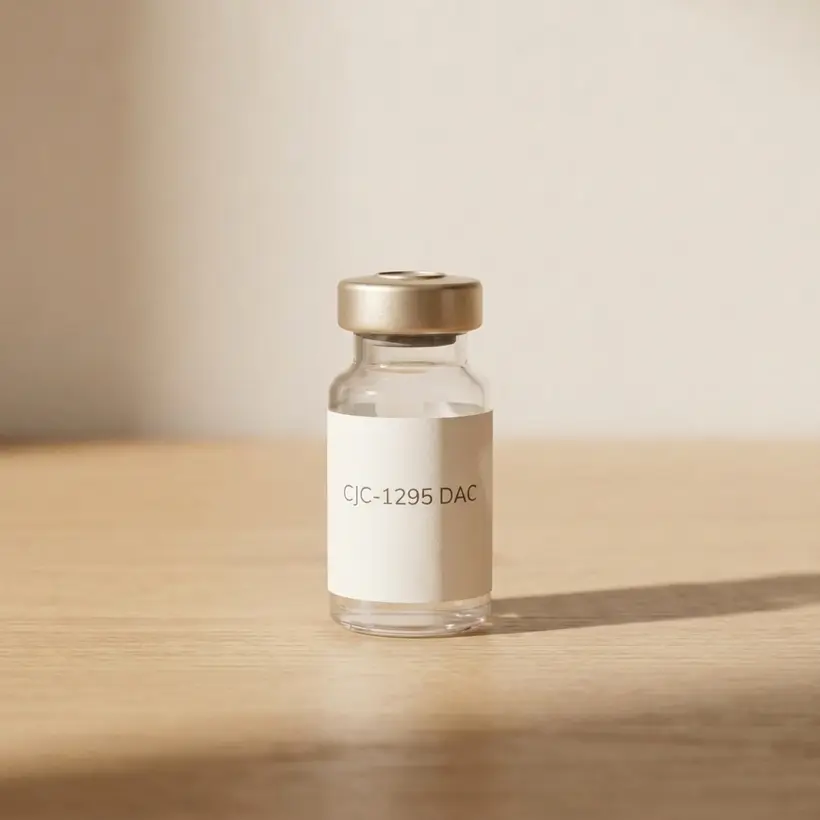
From the FormBlends catalog
CJC-1295 DAC
Long-acting GHRH analog with Drug Affinity Complex for sustained GH elevation · From $42/mo · compounded by a licensed 503A pharmacy, dispensed only after provider review.
Learn about CJC-1295 DAC →The DAC (Drug Affinity Complex) modification adds a maleimidoproprionic acid linker to the epsilon-amine group of lysine at position 40 of the peptide. This linker undergoes a Michael addition reaction with the free thiol (Cys-34) on circulating human serum albumin. Because albumin has a half-life of roughly 19 days, anything covalently attached to it gains dramatically extended residence time in plasma. The result: CJC-1295 with DAC achieves a half-life of approximately 6 to 8 days in humans, confirmed pharmacokinetically in the Teichman 2006 trial.
MOD GRF 1-29 (CJC without DAC) has the same four amino acid substitutions but no albumin-binding linker. Its half-life in vivo is roughly 30 minutes, and its GH-stimulating effect is therefore brief and pulse-like, analogous to natural GHRH secretion from the hypothalamus.
What Does Each Form Actually Do to GH and IGF-1, With Real Numbers?
CJC-1295 with DAC: In the Teichman et al. 2006 Phase II, double-blind, placebo-controlled trial (n=65 healthy adults), a single subcutaneous injection produced dose-dependent IGF-1 increases of 30 to 106 percent above baseline, with peak IGF-1 elevation sustained for 28 days. GH mean concentrations increased 2 to 10 fold above baseline depending on dose. The 60 mcg/kg dose weekly produced results near the top of the dose-response curve without proportionally increased adverse events.
MOD GRF 1-29: No published human RCT measures its standalone IGF-1 or GH effect with rigor comparable to the Teichman trial. Mechanistic rationale for its GH-stimulating effect is strong (same receptor target as native GHRH, GHRHR binding documented in animal and in vitro studies), but quantitative human data at pharmacological doses is absent from the peer-reviewed literature. What the mechanism proves: it will stimulate a GH pulse. What it does NOT prove: that any specific dose in humans produces a specific IGF-1 delta, or that the resulting pulse is superior to the with-DAC form for any body composition outcome.
Important caveat: IGF-1 elevation is a surrogate marker, not a proven outcome for muscle mass, fat loss, or recovery in healthy adults. Neither form has a completed human RCT measuring lean mass or fat mass as a primary endpoint with the statistical power to detect a difference.
What Does the Evidence Actually Show? (Evidence Ledger)
| Claim | Best Evidence Type | Effect Direction | Confidence |
|---|---|---|---|
| CJC with DAC elevates IGF-1 by 30 to 106% in healthy adults | Human RCT Phase II (Teichman 2006, n=65) | Positive, dose-dependent | Moderate |
| CJC with DAC has a half-life of approx. 6 to 8 days in humans | Human PK data (Teichman 2006) | Confirmed | High |
| MOD GRF 1-29 stimulates GH pulse via GHRHR binding | Mechanistic, animal, small human studies | Positive | Moderate (mechanism), Low (dose-response in humans) |
| Pulsatile GH secretion is superior to sustained elevation for muscle anabolism | Physiologic theory, animal data | Directionally plausible | Low |
| CJC with DAC improves lean body mass in humans | Trend in Teichman 2006 (not primary endpoint, underpowered) | Positive trend, not significant | Very Low |
| MOD GRF 1-29 plus GHRP produces synergistic GH peak | Small human mechanistic studies, animal data | Positive | Low |
| DAC version causes receptor desensitization over time | Mechanistic concern, animal data | Directionally plausible | Very Low |
| Water retention and edema are common adverse effects | Teichman 2006 adverse event reporting | Positive (adverse) | Moderate |
What Do Most Pages Get Wrong About CJC-1295?
The most pervasive error in the peptide community is using "CJC-1295" as a generic name for both forms interchangeably. They are not the same peptide. MOD GRF 1-29 has a different molecular weight (approximately 3149 Da versus approximately 3647 Da for the DAC version), a different C-terminal modification, a completely different pharmacokinetic profile, and a different injection frequency requirement. A product labeled "CJC-1295" that does not specify "with DAC" or "without DAC" is ambiguous and potentially mislabeled.
The second major omission: most pages present pulsatile release as clearly superior for anabolism without disclosing that this claim rests on physiologic theory and animal data, not a controlled human trial. The natural GH secretion pattern argument is rational but has not been proven in humans comparing these two peptides.
Third: penetration and bioavailability. Both forms are peptides of roughly 29 to 40 amino acids. Oral bioavailability is essentially zero; these are destroyed by gastrointestinal proteases before absorption. Subcutaneous injection is the only validated administration route from a pharmacokinetic standpoint. Any product claiming oral delivery of intact CJC-1295 or MOD GRF 1-29 is not supported by evidence.
Why Does Storage and Stability Matter, and What Is the Chemistry?
Lyophilized (freeze-dried) peptides are relatively stable because removing water slows two main degradation pathways: hydrolysis of peptide bonds and oxidation of susceptible amino acid residues, particularly methionine. When you add water (reconstitution), both pathways become active.
Hydrolysis accelerates with rising temperature and pH extremes. At physiologic pH (around 7.4) and room temperature (25 degrees Celsius), reconstituted peptides lose meaningful potency over weeks. Refrigeration at 2 to 8 degrees Celsius slows this substantially. This is why bacteriostatic water (containing 0.9% benzyl alcohol as a preservative) is used rather than sterile water: benzyl alcohol prevents microbial growth in multi-use vials, but it does not stop chemical hydrolysis or oxidation.
The DAC linker introduces an additional stability concern: the maleimide-thioether bond connecting the peptide to albumin is susceptible to retro-Michael (hydrolysis) under acidic conditions. This matters for the reconstituted stock vial, not for the albumin-bound form already in circulation. Keep reconstituted CJC with DAC at 2 to 8 degrees Celsius and use within 28 days as a conservative practical limit.
Exposure to light (UV) can oxidize aromatic residues and methionine. Amber vials or foil wrapping add meaningful protection. A reconstituted peptide solution that appears cloudy or has visible particulates should not be used; precipitation indicates aggregation or degradation has occurred.
Honest Head-to-Head: CJC Forms vs. Alternatives
| Compound | Half-Life | Human RCT Data | Injection Frequency | IGF-1 Effect (Human) | Regulatory Status | Where It Loses |
|---|---|---|---|---|---|---|
| CJC-1295 with DAC | 6 to 8 days | 1 Phase II RCT (Teichman 2006) | 1 to 2x weekly | 30 to 106% increase shown | Research compound only | Non-pulsatile; side effects persist longer; not approved |
| MOD GRF 1-29 (CJC without DAC) | ~30 min | None (standalone human RCT) | 2 to 3x daily | Not quantified in RCT | Research compound only | No human RCT; demanding dosing schedule; requires GHRP co-administration |
| Sermorelin (GHRH 1-29 native) | ~10 to 20 min | Multiple published trials, FDA approved (removed from market 2008) | Daily injection | Documented increases in clinical trials | Compounded use only in US | Shorter half-life than MOD GRF 1-29; more enzymatic susceptibility |
| Recombinant human GH (rhGH) | ~2 to 3 hours (subcutaneous) | Extensive (FDA approved for specific indications) | Daily injection | Strong, consistent | FDA approved (adult GHD, pediatric indications) | Higher cost; higher side effect burden; directly suppresses endogenous GH secretion |
The peptide loses decisively to rhGH on evidence depth. It loses to sermorelin on regulatory history. Its advantage over rhGH is that it stimulates endogenous GH release rather than replacing it, preserving the feedback arc of the hypothalamic-pituitary axis, at least in theory and in the short term.
What Are the Real Dosing Protocols for Each Form?
| Parameter | CJC-1295 with DAC | MOD GRF 1-29 (without DAC) |
|---|---|---|
| Typical research dose | 1 to 2 mg per injection (fixed dose); Teichman used weight-based 30 to 120 mcg/kg | 100 mcg per injection (common research protocol, not derived from human RCT) |
| Frequency | Once or twice weekly | 2 to 3 times daily |
| Timing | Any time; sustained levels make timing less critical | Fasting state preferred; before sleep or training for GH pulse alignment |
| Co-administration | Can be used alone; less commonly combined with GHRP | Almost always combined with GHRP (ipamorelin or GHRP-2) for pulse amplification |
| Reconstitution volume | Add 1 to 2 mL bacteriostatic water to 2 mg vial for a concentration of 1 to 2 mg/mL | Add 2 mL bacteriostatic water to 2 mg vial for 1 mg/mL; draw 0.1 mL for 100 mcg dose |
| Cycle length (research) | 8 to 12 weeks commonly described; no human trial confirms optimal duration | 8 to 12 weeks commonly described; no human trial confirms optimal duration |
How Do You Read a COA and Spot a Fake or Degraded Product?
A valid certificate of analysis (COA) for either CJC form should contain at minimum three things:
1. HPLC purity above 98 percent. High-performance liquid chromatography separates the peptide from impurities by retention time. A purity below 98% means meaningful levels of synthesis byproducts, truncated sequences, or oxidized species are present. Ask specifically for a reverse-phase HPLC chromatogram, not just a summary number.
2. Mass spectrometry molecular weight confirmation. The intact molecular mass of CJC-1295 with DAC is approximately 3647 Da (before albumin binding). MOD GRF 1-29 is approximately 3149 Da. If the reported mass does not match, the compound is wrong. Electrospray ionization MS or MALDI-TOF are both acceptable methods. A COA that only shows HPLC purity without mass confirmation cannot rule out a correctly eluting impurity with similar retention time.
3. Endotoxin testing below 1 EU/mg by LAL (limulus amebocyte lysate) assay. Bacterial endotoxins cause pyrogenic reactions (fever, chills) on injection. Research-grade peptides without LAL testing are a meaningful safety risk for subcutaneous use. This test is commonly skipped by lower-tier suppliers.
Absence of any of these three elements is a hard disqualification. A COA dated more than 12 months before purchase, or with a laboratory name that cannot be independently verified, should be treated with suspicion.
What Are the Side Effects, and Which Version Carries More Risk?
From the Teichman 2006 trial (the only rigorous human data available), adverse events with CJC-1295 with DAC included water retention, mild injection site reactions, and headache. These are consistent with GH pathway activation generally and are the same class of side effects seen with sermorelin and low-dose rhGH.
The key difference between forms is duration of effect. If water retention or other GH-related side effects emerge with the DAC version, they persist for days to weeks because the compound cannot be quickly cleared. With MOD GRF 1-29, effects from any single injection resolve within hours given the short half-life, making adverse event management more responsive to dose reduction or discontinuation.
Longer-term theoretical concerns for either form include increased fasting glucose (GH is counter-regulatory to insulin), changes in insulin sensitivity, and potential for somatotroph desensitization with chronic non-pulsatile stimulation (more theoretically relevant to the DAC form). None of these longer-term risks have been formally quantified in controlled human trials of sufficient duration for either compound.
FAQ
What is the main difference between CJC-1295 with DAC and without DAC?
CJC-1295 with DAC contains a Drug Affinity Complex that covalently bonds the peptide to albumin, extending half-life from roughly 30 minutes to approximately 6 to 8 days. Without DAC (MOD GRF 1-29) produces a short, pulsatile GH release similar to natural secretion patterns, while with DAC creates a sustained, blunted elevation.
Which version is better for muscle growth?
There is no head-to-head human RCT comparing them for body composition. CJC-1295 with DAC showed statistically significant IGF-1 increases and lean mass trends in one Phase II trial (Teichman et al. 2006), but MOD GRF 1-29 has not been studied in a comparable human trial. Pulsatile release is theoretically preferred to avoid receptor desensitization, but this has not been proven in humans.
How often should CJC-1295 with DAC be dosed?
Because the half-life is approximately 6 to 8 days, once or twice weekly injections are used in research protocols. Teichman et al. tested doses from 30 mcg/kg to 120 mcg/kg subcutaneously once weekly and every two weeks.
How often should MOD GRF 1-29 (CJC without DAC) be dosed?
MOD GRF 1-29 has a half-life of roughly 30 minutes in vivo. Most research protocols use 100 mcg subcutaneously, 2 to 3 times daily, typically combined with a GHRP such as ipamorelin to amplify GH pulse amplitude.
Does CJC-1295 with DAC cause desensitization of GH receptors?
Sustained, non-pulsatile GH secretagogue exposure can blunt somatotroph responsiveness over time, a concern raised in animal and mechanistic data. The Teichman 2006 trial did not report this as a measured outcome. Evidence in humans is currently insufficient to confirm or rule out clinically meaningful desensitization with CJC with DAC.
Can CJC-1295 be stored at room temperature?
Lyophilized (freeze-dried) peptide should be stored at 2 to 8 degrees Celsius before reconstitution. After reconstitution with bacteriostatic water, refrigerate and use within 28 days. Peptide bonds in solution are vulnerable to hydrolysis above 25 degrees Celsius and to oxidation of methionine residues, which accelerates degradation meaningfully.
Is CJC-1295 FDA approved?
No. Neither CJC-1295 with DAC nor MOD GRF 1-29 is FDA approved for any indication. Both are research compounds. CJC-1295 with DAC reached Phase II clinical trials (Teichman et al. 2006) but development was not continued to approval.
What is the DAC technology and how does it work chemically?
DAC stands for Drug Affinity Complex. A maleimidoproprionic acid linker is attached to the Lys-40 epsilon-amine of CJC-1295, allowing a Michael addition reaction with the free thiol group on Cys-34 of circulating serum albumin. This covalent bond effectively uses the albumin half-life of roughly 19 days to dramatically extend peptide residence time in plasma.
What side effects are more common with the DAC version?
Teichman et al. 2006 reported that water retention (edema, puffiness) and mild injection site reactions were the most common adverse events with CJC-1295 with DAC. Prolonged GH elevation may also elevate fasting glucose. These effects would be expected to persist longer with the DAC version due to its extended half-life compared to MOD GRF 1-29.
Should MOD GRF 1-29 be combined with a GHRP?
Most research protocols combine MOD GRF 1-29 with a GHRP like ipamorelin or GHRP-2. GHRH analogs (like MOD GRF) increase GH pulse amplitude by stimulating somatotrophs, while GHRPs amplify the pulse and suppress somatostatin simultaneously. Together they produce synergistically larger GH peaks than either compound alone, though this synergy is documented in animal and small human mechanistic studies, not large RCTs.
How do I read a COA for CJC-1295 to check purity?
Look for HPLC purity above 98 percent, a molecular mass confirmation by mass spectrometry matching the expected value (CJC-1295 with DAC: approximately 3647 Da, MOD GRF 1-29: approximately 3149 Da), and an endotoxin test below 1 EU/mg by LAL assay. Absence of any of these three tests on a COA is a disqualifying red flag.
Which form is more practical for a daily protocol?
CJC-1295 with DAC is more practical for injection frequency (once or twice weekly versus multiple daily injections for MOD GRF 1-29), but it sacrifices pulsatile GH physiology and its longer action makes side effects harder to manage once they appear. MOD GRF 1-29 requires disciplined daily scheduling but aligns more closely with natural GH secretion patterns.
Sources
- Teichman SL, Neale A, Lawrence B, Gagnon C, Castaigne JP, Frohman LA. Prolonged stimulation of growth hormone (GH) and insulin-like growth factor I secretion by CJC-1295, a long-acting analog of GH-releasing hormone, in healthy adults. J Clin Endocrinol Metab. 2006;91(3):799-805. PubMed PMID: 16352683.
- Frohman LA, Jansson JO. Growth hormone-releasing hormone. Endocr Rev. 1986;7(3):223-253.
- Ionescu M, Frohman LA. Pulsatile secretion of growth hormone (GH) persists during continuous stimulation by CJC-1295, a long-acting GH-releasing hormone analog. J Clin Endocrinol Metab. 2006;91(12):4792-4797. PubMed PMID: 17018659.
- Jette L, Leger R, Thibaudeau K, et al. Human growth hormone-releasing factor (hGRF)1-29-albumin bioconjugates activate the GRF receptor on the anterior pituitary in rats: identification of CJC-1295 as a long-lasting GRF analog. Endocrinology. 2005;146(7):3052-3058. PubMed PMID: 15802500.
- Alba M, Fintini D, Sagazio A, et al. Once-daily administration of CJC-1295, a long-acting growth hormone-releasing hormone (GHRH) analog, normalizes growth in the GHRH knockout mouse. Am J Physiol Endocrinol Metab. 2006;291(6):E1290-E1294. PubMed PMID: 16868228.
- World Anti-Doping Agency. Prohibited List 2024. Section 2: Peptide Hormones, Growth Factors, Related Substances, and Mimetics. wada-ama.org. Accessed May 2026.
- Vance ML, Mauras N. Growth hormone therapy in adults and children. N Engl J Med. 1999;341(16):1206-1216.
- Walker RF. Sermorelin: a better approach to management of adult-onset growth hormone insufficiency? Clin Interv Aging. 2006;1(4):307-308. PubMed PMCID: PMC2695184.
Footer Disclaimers
Related peptide guides
Ready when you are
CJC-1295 DAC
Long-acting GHRH analog with Drug Affinity Complex for sustained GH elevation · From $42/mo · compounded by a licensed 503A pharmacy, dispensed only after provider review.
Learn about CJC-1295 DAC →