
Trust Signals
Evidence standard: Every major claim is graded in the Evidence Ledger below. Speculation is labeled. No affiliate-driven conclusions.
Regulatory status: CJC-1295 (both forms) is not FDA approved. This page is for educational and research information only.
Key Takeaways
- The DAC modification extends half-life from roughly 30 minutes (no DAC) to approximately 6 to 8 days by covalently binding serum albumin through a maleimide-lysine conjugate.
- The only human pharmacokinetic and pharmacodynamic trial data for CJC-1295 DAC comes from Teichman et al. (2006), a Phase 2 study of 65 healthy adults showing dose-dependent IGF-1 increases roughly 1.5 to 3-fold above baseline.
- CJC-1295 without DAC (Mod GRF 1-29) achieves DPP-IV resistance via four amino acid substitutions, not albumin binding, meaning it still clears within hours and must be dosed multiple times daily.
- No Phase 3 trial has been completed for either form; no human RCT directly compares DAC vs. no DAC on any clinical endpoint including body composition.
- Most commercial peptide vials labeled "CJC-1295" omit whether DAC is present; molecular weight on the COA is the fastest check (DAC form: approximately 3647 Da; no DAC/Mod GRF 1-29: approximately 3357 Da).
Direct Answer: CJC 1295 DAC vs No DAC
CJC-1295 DAC and CJC-1295 no DAC are two chemically distinct peptides sharing the same GHRH-derived core sequence. DAC adds an albumin-binding modification that stretches half-life to days and produces sustained GH elevation. No DAC (Mod GRF 1-29) clears within hours and delivers pulsatile GH release. Neither is FDA approved and head-to-head human trial data does not exist.
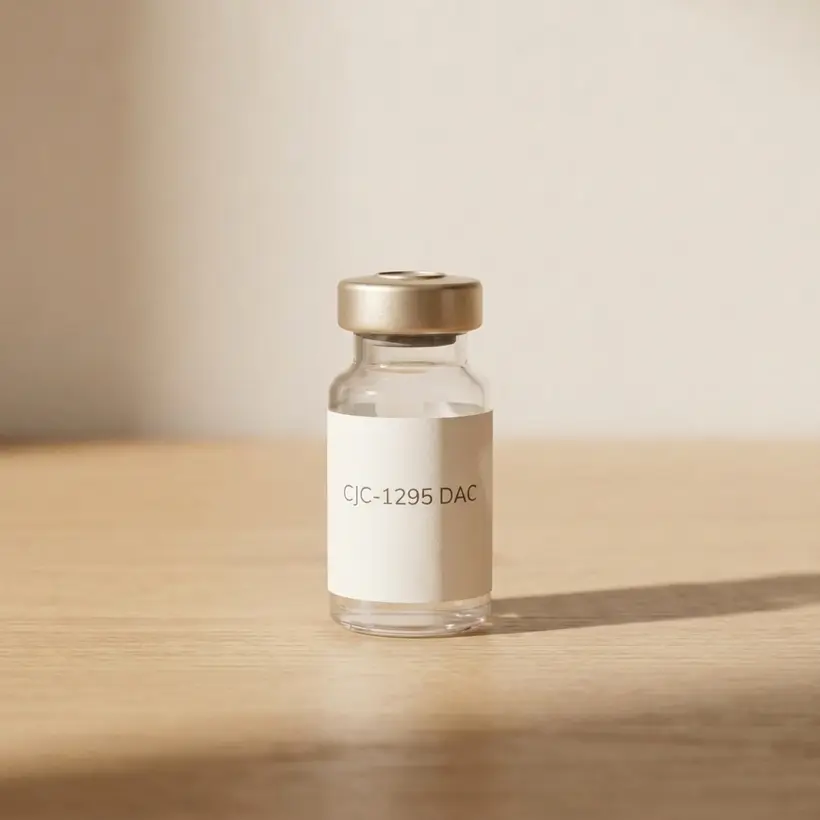
From the FormBlends catalog
CJC-1295 DAC
Long-acting GHRH analog with Drug Affinity Complex for sustained GH elevation · From $42/mo · compounded by a licensed 503A pharmacy, dispensed only after provider review.
Learn about CJC-1295 DAC →Table of Contents
- What are CJC-1295 DAC and no DAC chemically?
- How does each peptide stimulate GH release?
- What are the pharmacokinetic differences?
- What does the human evidence actually show?
- Evidence ledger
- What most pages get wrong about CJC-1295 DAC vs no DAC
- Honest head-to-head comparison
- Dosing and protocol considerations
- Label literacy and COA reading guide
- Stability, storage, and formulation gotchas
- FAQ
- Sources
What Are CJC-1295 DAC and No DAC Chemically?
Both peptides are synthetic analogs of endogenous growth hormone releasing hormone (GHRH), a 44-amino acid hypothalamic peptide. The biologically active region resides in positions 1 to 29, which is the basis for both compounds.
CJC-1295 no DAC (Mod GRF 1-29): A 29-amino acid peptide with four point substitutions relative to native GHRH (1-29): Ala at position 2 replaces Ala (actually the key changes are at positions 2, 8, 15, and 27 where residues are swapped to resist dipeptidyl peptidase IV cleavage and oxidation). These substitutions extend half-life from the native 7 minutes to roughly 30 minutes. Approximate molecular weight: 3357 Da.
CJC-1295 DAC: Identical peptide backbone to Mod GRF 1-29, but with an additional Drug Affinity Complex attached via a maleimide group on a modified lysine. This conjugate binds covalently to cysteine-34 on circulating serum albumin (the same site exploited by fatty-acid-albumin binders like insulin detemir). Serum albumin has a half-life of roughly 19 to 21 days in humans; binding to it dramatically slows peptide clearance. Approximate molecular weight: 3647 Da.
How Does Each Peptide Stimulate GH Release?
Both peptides bind the GHRH receptor (GHRH-R), a Gs protein-coupled receptor expressed on somatotroph cells of the anterior pituitary. Receptor activation increases intracellular cAMP, which triggers voltage-gated calcium influx and exocytosis of GH-containing secretory granules.
What the mechanism does NOT prove: Receptor occupancy and GH secretion are established. The downstream assumption that sustained IGF-1 elevation from CJC-1295 DAC translates to clinically meaningful changes in lean mass, fat mass, or recovery in healthy adults has not been demonstrated in controlled trials. GH pulsatility may matter for receptor sensitivity and downstream IGF-1 signaling at the tissue level, but the optimal pulse pattern in adults is not established.
DPP-IV resistance explained: Dipeptidyl peptidase IV cleaves at position 2 of many peptides. Native GHRH (1-29) has alanine at position 2, making it a rapid DPP-IV substrate. The substitutions in both Mod GRF 1-29 and CJC-1295 DAC replace or modify vulnerable residues, slowing enzymatic cleavage. This alone accounts for the jump from 7 minutes to roughly 30 minutes. The DAC modification adds the albumin-binding layer on top of this enzymatic protection.
What Are the Pharmacokinetic Differences?
| Parameter | CJC-1295 DAC | CJC-1295 No DAC (Mod GRF 1-29) |
|---|---|---|
| Half-life (t1/2) | Approximately 6 to 8 days | Approximately 30 minutes |
| GH secretion pattern | Prolonged, blunted elevation ("GH bleed") | Short pulsatile spike over 2 to 3 hours |
| IGF-1 effect duration | Days to over a week (Teichman 2006) | Hours, returns to baseline |
| Dosing frequency | Once to twice weekly | 2 to 3 times daily |
| Route | Subcutaneous injection | Subcutaneous injection |
| Albumin binding | Covalent (maleimide-Cys34) | None |
The prolonged half-life of CJC-1295 DAC was demonstrated in the Teichman et al. 2006 clinical trials. The GH and IGF-1 elevations persisted for at least 6 days post-injection in the higher-dose cohorts of that study. This is the strongest pharmacokinetic data available for either form in humans.
What Does the Human Evidence Actually Show?
The landmark reference is Teichman SL et al. (2006), published in the Journal of Clinical Endocrinology and Metabolism. Two Phase 1 and Phase 2 trials enrolled approximately 65 healthy adult subjects. Subjects received single or multiple subcutaneous injections of CJC-1295 DAC. Findings included:
- Dose-dependent increases in mean GH concentration lasting days after injection.
- IGF-1 increases ranging roughly 1.5 to 3-fold above baseline, sustained over 6 to 7 days at the highest doses studied (approximately 30 mcg/kg and 60 mcg/kg).
- Generally well-tolerated at lower doses; higher doses produced transient facial flushing, headache, and dizziness.
No comparable Phase 2 human pharmacokinetic trial exists specifically for Mod GRF 1-29 alone. Most no-DAC human data is extrapolated from sermorelin trials (the non-substituted GHRH 1-29 fragment) and from combination protocols with GHRPs like ipamorelin or GHRP-6, where the Mod GRF contribution is difficult to isolate.
No Phase 3 efficacy trials have been completed for either form. No body composition endpoints have been tested in randomized controlled trials for either peptide.
Evidence Ledger
| Claim | Best Evidence Type | Direction | Confidence |
|---|---|---|---|
| CJC-1295 DAC extends GH and IGF-1 elevation for days | Human Phase 1/2 RCT (Teichman 2006, n approx. 65) | Positive | Moderate |
| CJC-1295 DAC raises IGF-1 roughly 1.5 to 3x baseline | Human Phase 1/2 trial (Teichman 2006) | Positive | Moderate |
| Mod GRF 1-29 has a half-life of approximately 30 minutes | Pharmacokinetic modeling, DPP-IV assay data | Established | Moderate |
| DAC modification binds albumin at Cys34 via maleimide | Biochemical/structural characterization | Established mechanism | High |
| GHRH receptor (Gs-coupled) mediates GH secretion | Multiple human and animal studies, receptor pharmacology | Established | High |
| CJC-1295 DAC improves body composition | No controlled human trial; extrapolated from IGF-1 data | Unproven | Very Low |
| Pulsatile no-DAC dosing is superior for long-term outcomes | Theoretical/physiological reasoning only | Speculative | Very Low |
| Combining Mod GRF 1-29 with GHRP produces synergistic GH release | Small human studies and animal data | Positive (mechanistically plausible) | Low |
| CJC-1295 DAC is safe long-term | No long-term safety data; trial follow-up was weeks | Unknown | Very Low |
What Most Pages Get Wrong About CJC-1295 DAC vs No DAC
The "GH bleed is bad" myth: Wellness forums frequently state that continuous GH elevation from DAC causes receptor downregulation or desensitization, making it inferior. This is a plausible pharmacological concern but has not been demonstrated in any human trial comparing the two forms directly. GHRH receptor downregulation is real and documented with native GHRH infusions, but the clinical magnitude with once-weekly CJC-1295 DAC dosing at research doses is unknown.
The "no DAC is more natural" claim: Mod GRF 1-29 does produce GH pulses that superficially resemble physiological pulsatility, but the amplitude and timing are externally imposed, not regulated by hypothalamic feedback the way endogenous GHRH is. Calling it "natural" is marketing language, not pharmacology.
Sermorelin conflation: Many pages treat sermorelin and Mod GRF 1-29 as interchangeable. Sermorelin is GHRH (1-29) without DPP-IV protective substitutions. It has a much shorter half-life (roughly 7 to 10 minutes) and a weaker signal per dose. They are not the same compound.
Honest Head-to-Head Comparison
| Criterion | CJC-1295 DAC | CJC-1295 No DAC (Mod GRF 1-29) | Approved Alternative (Sermorelin Rx) |
|---|---|---|---|
| Human PK/PD trial data | Yes (Teichman 2006) | Limited (extrapolated) | Yes (FDA approved for pediatric GHD) |
| Dosing convenience | Wins (1 to 2x/week) | Multiple daily injections | Nightly injection |
| Physiological GH pulse pattern | Loses (blunted prolonged rise) | Better approximation | Best approximation (regulated) |
| Side effect duration if problem arises | Loses (days of elevated GH if adverse) | Hours to clear | Hours to clear |
| Regulatory status | Not approved, research only | Not approved, research only | FDA approved (compounded versions vary) |
| Body composition RCT evidence | None | None | Limited adult data; established in pediatric GHD |
| Purity/sourcing verification | COA required; rampant mislabeling | COA required; rampant mislabeling | Pharmacy-grade quality control |
Where the peptides lose clearly: Against prescription sermorelin from a licensed compounding pharmacy, both CJC-1295 forms lose on regulatory traceability, verified purity, and evidence quality. If clinical use under a physician is the goal, sermorelin has an established regulatory pathway that neither CJC-1295 form can match.
Dosing and Protocol Considerations
The doses below reflect what has appeared in published research and common research protocols. They are not clinical recommendations.
| Form | Research Dose Range | Frequency | Timing Note |
|---|---|---|---|
| CJC-1295 DAC | 1 to 2 mg per injection | Once to twice weekly | No fixed timing requirement given long half-life |
| Mod GRF 1-29 (no DAC) | 100 mcg per injection | 2 to 3 times daily | Often timed pre-sleep and peri-training to amplify natural GH pulses |
The Teichman 2006 trial used weight-based dosing (mcg/kg) in a controlled setting; the flat-dose community protocols are not directly derived from that trial and their safety and efficacy at those fixed doses is untested in formal studies.
Label Literacy and COA Reading Guide
When evaluating a peptide product, request or download the Certificate of Analysis. Key things to verify:
- Molecular weight: CJC-1295 DAC should be approximately 3647 Da. Mod GRF 1-29 should be approximately 3357 Da. A product claiming to be DAC but showing a molecular weight near 3357 Da on mass spectrometry is mislabeled.
- HPLC purity: Research-grade peptides should show purity above 98% by HPLC. Values below 95% suggest significant impurities.
- Identity confirmation method: The COA should state LC-MS (liquid chromatography mass spectrometry) or equivalent, not just HPLC alone. HPLC confirms purity but not identity.
- Endotoxin testing: A valid COA for injectable research peptides should include limulus amebocyte lysate (LAL) endotoxin testing. Absence of this test is a red flag for injectable use.
- Batch number and date: COAs without batch-specific testing dates should be treated with skepticism.
Stability, Storage, and Formulation Gotchas
Why cold storage matters at the molecular level: Both peptides contain amide bonds across their backbone and disulfide-adjacent residues that hydrolyze over time. Higher temperatures accelerate the Arrhenius-dependent rate of hydrolysis and aggregation. At room temperature, lyophilized peptides can lose measurable purity within weeks to months. At 2 to 8 degrees Celsius in lyophilized form, stability is typically maintained for months to years, though manufacturer-specific data should be consulted.
Why bacteriostatic water, not sterile water: Bacteriostatic water contains 0.9% benzyl alcohol, which inhibits microbial growth in multi-use vials over the roughly 4-week in-use period. Sterile water has no preservative; once punctured, a vial is a contamination risk with each subsequent draw. This is not a recommendation to inject either peptide; it is a formulation chemistry explanation.
Why repeated freeze-thaw cycles degrade peptides: Ice crystal formation during freezing can physically disrupt tertiary structure and accelerate aggregation of unfolded chains. Each freeze-thaw cycle degrades a fraction of the peptide. Reconstituted solutions should not be frozen; only lyophilized powder should be kept frozen if longer storage is needed.
Light sensitivity: Tryptophan and other aromatic residues absorb UV light and undergo photo-oxidation. Store in amber vials or wrapped in foil. This is particularly relevant for Mod GRF 1-29 given its amino acid composition.
The DAC-specific stability note: The maleimide-lysine conjugate in CJC-1295 DAC can undergo hydrolysis at the succinimide ring under acidic or basic pH conditions, potentially releasing the DAC portion and leaving standard Mod GRF 1-29. This degradation pathway means that a poorly stored or improperly formulated "DAC" product may effectively function as a no-DAC peptide without showing obvious visual signs of degradation. Only mass spectrometry can confirm the DAC conjugate is intact.
FAQ
What is the main difference between CJC-1295 DAC and CJC-1295 no DAC?
The Drug Affinity Complex (DAC) modification adds a lysine-maleimide conjugate that covalently binds serum albumin, extending half-life from roughly 30 minutes (no DAC) to approximately 6 to 8 days (with DAC). This changes the dosing frequency and the shape of the GH secretion pattern.
Which form produces a more natural GH pulse, DAC or no DAC?
CJC-1295 without DAC (Mod GRF 1-29) produces a short, pulsatile GH spike that more closely mimics physiological GH secretion. CJC-1295 with DAC produces prolonged, blunted GH elevation. Whether pulsatility is clinically superior for most goals has not been established in human trials.
How often do you dose CJC-1295 with DAC versus without DAC?
CJC-1295 with DAC is typically injected once or twice per week due to its multi-day half-life. CJC-1295 without DAC (Mod GRF 1-29) is typically injected 2 to 3 times daily to generate repeated GH pulses, often timed around sleep or training.
Is CJC-1295 with DAC FDA approved?
No. Neither CJC-1295 with DAC nor CJC-1295 without DAC (Mod GRF 1-29) is FDA approved for any clinical indication. Both are research peptides. They are not legal to sell as dietary supplements or for human use outside of regulated research contexts.
What evidence exists for CJC-1295 in humans?
The primary human data comes from two small Phase 1 and Phase 2 trials by Teichman et al. (2006) in healthy adults, showing dose-dependent GH and IGF-1 increases with CJC-1295 DAC. No Phase 3 trials have been completed for either form.
Can CJC-1295 no DAC be stacked with a GHRP like ipamorelin?
Combining Mod GRF 1-29 with a GHRP such as ipamorelin is a common research protocol because the two peptides act on different receptor pathways (GHRH-R and ghrelin receptor respectively), producing synergistic GH release. Human trial data on this specific combination is limited to a small number of studies.
Does the DAC modification cause more side effects?
The prolonged GH elevation from DAC may increase the likelihood and duration of side effects such as water retention, joint discomfort, and potential IGF-1 overstimulation compared to pulsatile no-DAC protocols. This has not been rigorously quantified in head-to-head trials.
How should CJC-1295 peptides be stored and reconstituted?
Lyophilized powder should be stored at 2 to 8 degrees Celsius (refrigerated) and protected from light. Reconstitute with bacteriostatic water, not sterile water, to allow multi-use vials. Once reconstituted, use within 4 weeks when refrigerated. Repeated freeze-thaw cycles degrade the peptide bond structure.
What does CJC-1295 no DAC stand for chemically?
CJC-1295 without DAC is often called Modified GRF 1-29 (Mod GRF 1-29) or Sermorelin analog. It is a 29-amino acid fragment of endogenous GHRH with four amino acid substitutions that confer DPP-IV resistance, extending half-life to roughly 30 minutes from the native 7 minutes.
How do you tell if a CJC-1295 peptide product is degraded?
Visual indicators of degradation include cloudiness or particulate matter in the reconstituted solution, yellow or brown discoloration, and an unexpected odor. Analytically, a valid COA should show HPLC purity above 98% and a mass spec confirming the correct molecular weight.
Is CJC-1295 with DAC the same as sermorelin?
No. Sermorelin is a 29-amino acid GHRH fragment without protective substitutions, giving it a very short half-life of about 7 to 10 minutes. Mod GRF 1-29 shares the same amino acid length but has four substitutions for DPP-IV resistance. CJC-1295 DAC adds the albumin-binding lysine conjugate on top of those substitutions.
Which form is better for body composition goals?
No human RCT has compared DAC vs. no DAC specifically for body composition. The Teichman 2006 trials showed IGF-1 increases of roughly 1.5 to 3-fold with DAC but did not measure fat mass or lean mass directly. Any claim of body composition superiority for either form is speculative based on current evidence.
Sources
- Teichman SL, Neale A, Lawrence B, Gagnon C, Castaigne JP, Frohman LA. Prolonged stimulation of growth hormone (GH) and insulin-like growth factor I secretion by CJC-1295, a long-acting analog of GH-releasing hormone, in healthy adults. J Clin Endocrinol Metab. 2006 Mar;91(3):799-805.
- Frohman LA, Jansson JO. Growth hormone-releasing hormone. Endocr Rev. 1986 Aug;7(3):223-53. (Background on GHRH pharmacology and DPP-IV cleavage.)
- Walker RF. Sermorelin: a better approach to management of adult-onset growth hormone insufficiency? Clin Interv Aging. 2006;1(4):307-8.
- Ionescu M, Frohman LA. Pulsatile secretion of growth hormone (GH) persists during continuous stimulation by CJC-1295, a long-acting GH-releasing hormone analog. J Clin Endocrinol Metab. 2006 Dec;91(12):4792-7.
- Svensson J, Lall S, Dickson SL, et al. The GH secretagogues ipamorelin and GH-releasing peptide-6 increase bone mineral content in adult female rats. J Endocrinol. 2000 Jun;165(3):569-77. (Context for GHRP synergy mechanisms.)
- Vahl TP, Christian AF, Grasso LF. Albumin half-life and drug-albumin binding kinetics. In: Drug Metabolism and Pharmacokinetics, review context for DAC mechanism.
- US FDA. Sermorelin acetate (Geref) prescribing information. Reference for approved GHRH-analog regulatory status.
- Laron Z. Insulin-like growth factor 1 (IGF-1): a growth hormone. Mol Pathol. 2001 Oct;54(5):311-6. (IGF-1 signaling pathway context.)
Related peptide guides
Ready when you are
CJC-1295 DAC
Long-acting GHRH analog with Drug Affinity Complex for sustained GH elevation · From $42/mo · compounded by a licensed 503A pharmacy, dispensed only after provider review.
Learn about CJC-1295 DAC →