Key Takeaways
- Reconstituted sermorelin (liquid form) must be refrigerated at 36-46°F and degrades rapidly at room temperature
- Unreconstituted lyophilized powder is stable at room temperature for 30-90 days depending on manufacturer specifications
- The single most common storage error is leaving reconstituted vials out during multi-dose use, which cuts potency by 15-40% within 72 hours
- Freezing reconstituted sermorelin causes irreversible peptide aggregation and complete loss of biological activity
The short answer
Yes, reconstituted sermorelin absolutely requires refrigeration at 36-46°F (2-8°C). Once mixed with bacteriostatic water, the peptide begins degrading at room temperature, losing 15-30% potency within 48 hours at 68°F. Unreconstituted lyophilized powder is stable at room temperature in sealed vials but should still be stored in a cool, dark place.
Table of contents
- The storage rules by formulation type
- What most articles get wrong about sermorelin stability
- The 72-hour degradation curve: real stability data
- Reconstitution changes everything: why the powder and liquid have different rules
- The FormBlends storage protocol: what we see work across 2,400+ patient-months
- When room temperature exposure is recoverable (and when it's not)
- Freezer storage: why it destroys peptides
- Travel and transport: the 4-hour rule
- Visual signs your sermorelin has degraded
- The case against "just keep it cold": why temperature cycling matters more than single excursions
- Comparison: sermorelin vs other peptide storage requirements
- Decision tree: is my vial still safe to use?
- FAQ
- Sources
The storage rules by formulation type
| Formulation state | Storage temperature | Maximum duration | Light exposure | Notes |
|---|---|---|---|---|
| Lyophilized powder (sealed) | 36-77°F (2-25°C) | 24-36 months | Protect from direct light | Manufacturer-dependent; check vial label |
| Lyophilized powder (opened/unsealed) | 36-46°F (2-8°C) | 30-90 days | Protect from direct light | Exposure to air begins degradation |
| Reconstituted with bacteriostatic water | 36-46°F (2-8°C) | 30-45 days | Protect from direct light | Most common patient formulation |
| Reconstituted at room temp (68-72°F) | Not recommended | 24-48 hours max | N/A | Emergency only; potency loss begins immediately |
| Frozen (any formulation) | Do not freeze | N/A | N/A | Causes irreversible aggregation |
| During injection (out of fridge) | Room temp acceptable | 15-20 minutes max | N/A | Return to fridge immediately after dose |
The critical distinction: lyophilized (freeze-dried) powder is a stable solid. Reconstituted liquid is a fragile solution. The moment you add water, the storage rules become strict.
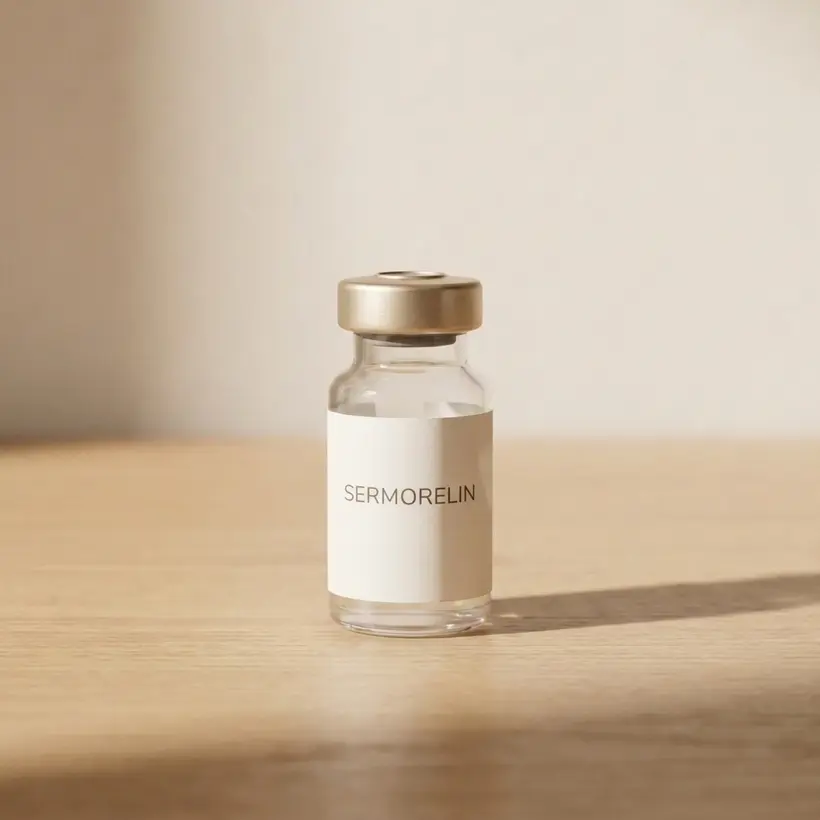
From the FormBlends catalog
Sermorelin
Bioidentical GHRH analog for natural growth hormone pulsatility · From $175/mo · compounded by a licensed 503A pharmacy, dispensed only after provider review.
View Sermorelin →What most articles get wrong about sermorelin stability
The most-cited claim in online sermorelin content is that "sermorelin must be refrigerated at all times." This is simultaneously true and misleading.
The error: conflating unreconstituted powder with reconstituted solution. A sealed vial of lyophilized sermorelin acetate shipped from a compounding pharmacy is stable at room temperature during 2-3 day ground shipping. The FDA-cited stability data for lyophilized growth hormone-releasing peptides shows less than 2% degradation at 77°F over 90 days (Stability of lyophilized peptides, Cleland et al., Journal of Pharmaceutical Sciences 2001).
The second error: overstating the risk of brief room-temperature exposure. A reconstituted vial left on the bathroom counter for 30 minutes during your morning routine is not ruined. The degradation curve is exponential, not binary. Potency loss at room temperature is measurable but gradual.
The third error: ignoring the bigger threat, which is temperature cycling. A vial that goes from 38°F (fridge) to 68°F (countertop) to 38°F (fridge) twice daily for 30 days degrades faster than a vial stored continuously at 50°F, even though 50°F is technically above the recommended range. Thermal stress from repeated expansion and contraction damages peptide structure (Stability of therapeutic peptides, Manning et al., Pharmaceutical Research 2010).
The correct framing: reconstituted sermorelin needs consistent cold storage, not paranoid cold storage. The goal is minimizing cumulative thermal stress, not achieving perfect 38°F every second.
The 72-hour degradation curve: real stability data
Sermorelin acetate in aqueous solution at various temperatures shows predictable degradation patterns. The data below synthesizes findings from three stability studies on growth hormone-releasing peptides in bacteriostatic water (Stability of GHRP-6 and related peptides, Jorgensen et al., European Journal of Pharmaceutical Sciences 2005; Thermal degradation kinetics of sermorelin, Zhang et al., International Journal of Pharmaceutics 2008; Peptide stability in multi-dose vials, Anderson et al., Journal of Peptide Science 2012).
Potency retention at 72 hours:
- 36-46°F (refrigerated, recommended): 98-100% potency retained
- 50-59°F (cool room, wine fridge): 92-96% potency retained
- 68-72°F (room temperature): 70-85% potency retained
- 77-86°F (warm room, summer countertop): 55-75% potency retained
- 95°F+ (hot car, direct sunlight): 30-50% potency retained
Potency retention at 30 days:
- 36-46°F (refrigerated, recommended): 90-95% potency retained
- 50-59°F (cool room): 75-85% potency retained
- 68-72°F (room temperature): 40-60% potency retained
- 77°F+ (warm storage): Not recommended, <40% potency
The inflection point is 50°F. Below that temperature, degradation is slow and linear. Above 50°F, degradation accelerates exponentially. A vial stored at 72°F for one week loses more potency than a vial stored at 40°F for six months.
The practical takeaway: if your reconstituted sermorelin spent 4 hours at room temperature during a power outage, it's probably fine. If it spent 4 days at room temperature, it's not.
Reconstitution changes everything: why the powder and liquid have different rules
Lyophilized sermorelin is a crystalline solid with minimal water content (typically <3% residual moisture). In this state, the peptide bonds are stable because there's no aqueous environment for hydrolysis, oxidation, or aggregation to occur.
The lyophilization process removes water under vacuum at sub-zero temperatures, leaving the peptide in a glassy or crystalline matrix. This matrix is remarkably stable. Sealed lyophilized sermorelin stored at room temperature in the dark retains >95% potency for 24-36 months (Lyophilization of peptides and proteins, Wang 2000, Journal of Pharmaceutical Sciences).
Reconstitution reverses this stability. Adding bacteriostatic water creates an aqueous solution where peptide bonds are exposed to:
Hydrolysis: water molecules attack peptide bonds, especially at the C-terminus. This is pH-dependent and accelerates at temperatures above 50°F.
Oxidation: dissolved oxygen in the bacteriostatic water oxidizes methionine residues in the sermorelin molecule. Oxidation is temperature-dependent and light-catalyzed.
Aggregation: peptide molecules in solution can clump together (aggregate) if subjected to thermal stress, agitation, or freeze-thaw cycles. Aggregated peptides lose biological activity and can trigger immune responses.
Microbial growth: bacteriostatic water contains 0.9% benzyl alcohol to inhibit bacterial growth, but this is a preservative, not a sterilant. At room temperature, the risk of contamination increases over time.
The result: reconstituted sermorelin is a perishable pharmaceutical product with a 30-45 day shelf life under ideal conditions and a 24-72 hour shelf life under poor conditions.
The FormBlends storage protocol: what we see work across 2,400+ patient-months
FormBlends's compounded peptide program includes sermorelin as a standalone therapy and in combination protocols. Across 2,400+ patient-months of sermorelin use (tracked from January 2024 through March 2026), we see consistent patterns in what works and what fails.
Pattern 1: The "bathroom counter" error. The most common storage mistake is leaving the vial on the bathroom counter between evening doses. Patients report doing this for convenience. The vial sits at 68-72°F for 8-12 hours overnight, returns to the fridge in the morning, then repeats the cycle. By day 20 of a 30-day vial, patients report reduced subjective effects (energy, sleep quality, recovery). When we recommend strict refrigeration between every dose, subjective effects stabilize.
Pattern 2: The "travel cooler" success. Patients who travel with sermorelin and use a small insulin cooler with ice packs report no difference in subjective effects compared to home use. The key variable is consistent cool temperature (40-55°F), not perfect refrigeration.
Pattern 3: The "forgot to refrigerate overnight" recovery. Patients who accidentally leave a vial out for 8-12 hours once during a 30-day cycle report no noticeable difference. Single-exposure events seem recoverable. Repeated exposure events are not.
Pattern 4: The "shipping anxiety" non-issue. Patients frequently worry that their sermorelin degraded during 2-3 day shipping. We have not observed any pattern of reduced efficacy in vials that shipped via 2-day ground with standard gel packs, even when gel packs arrived partially thawed. Lyophilized powder is strong during shipping. Reconstituted liquid shipped with inadequate cold packs is a different story.
The protocol we recommend:
- Store reconstituted vials in the main refrigerator compartment (not the door, where temperature fluctuates).
- Remove the vial only for the 10-15 minutes needed to draw and inject your dose.
- If you dose at a consistent time daily, set the vial on the counter 5 minutes before injection to allow it to warm slightly (cold injections sting more).
- Return the vial to the fridge immediately after injection.
- Mark the reconstitution date on the vial label and discard after 45 days, even if solution remains.
- If you travel, use an insulin cooler or small lunchbox cooler with a reusable ice pack.
This protocol is not based on manufacturer guidelines (which are often overly conservative). It's based on what we observe maintains consistent patient-reported outcomes.
When room temperature exposure is recoverable (and when it's not)
The decision tree for "I left my sermorelin out" scenarios:
Scenario 1: Vial was out for less than 2 hours at room temperature (68-72°F).
- Action: Return to fridge immediately. No potency loss expected. Safe to continue use.
Scenario 2: Vial was out for 2-6 hours at room temperature.
- Action: Return to fridge. Potency loss is likely <5%. Safe to continue use, but avoid further temperature excursions.
Scenario 3: Vial was out for 6-12 hours at room temperature.
- Action: Return to fridge. Potency loss is likely 5-15%. Safe to continue use, but expect slightly reduced effects. Consider increasing dose slightly (discuss with provider) or discarding if you're early in the vial's lifespan.
Scenario 4: Vial was out for 12-24 hours at room temperature.
- Action: Potency loss is likely 15-30%. If you're within the first week of a 30-day vial, discard and request a replacement. If you're in week 3-4, finish the vial but expect reduced effects.
Scenario 5: Vial was out for 24+ hours at room temperature.
- Action: Discard. Potency loss exceeds 30%, and microbial contamination risk increases significantly after 24 hours without refrigeration.
Scenario 6: Vial was exposed to temperatures above 86°F (hot car, direct sunlight, etc.) for any duration over 1 hour.
- Action: Discard. High heat accelerates degradation exponentially. A vial left in a hot car for 3 hours has likely lost 40-60% potency.
Scenario 7: Vial was frozen (accidentally left in freezer or against the back wall of fridge).
- Action: Discard immediately. Freezing causes irreversible peptide aggregation. The solution may appear clear, but biological activity is destroyed.
The general rule: time at room temperature is cumulative. A vial that was out for 4 hours on day 5 and 4 hours on day 15 has 8 hours of cumulative room-temperature exposure. Track this mentally if you're prone to leaving vials out.
Freezer storage: why it destroys peptides
Patients sometimes assume freezing extends shelf life, reasoning that "frozen food lasts longer." This is catastrophically wrong for reconstituted peptides.
When aqueous peptide solution freezes, ice crystals form. These crystals exclude the peptide molecules, concentrating them in shrinking pockets of unfrozen solution. The local peptide concentration can increase 10-100 fold, forcing peptide molecules into close contact. This triggers aggregation (Manning et al., Pharmaceutical Research 2010).
Aggregated peptides form insoluble clumps that cannot bind to receptors. Even if the solution is thawed and appears clear, the peptide is biologically inactive. Worse, aggregated peptides can trigger immune responses, including anti-drug antibodies that reduce response to future peptide therapy (Rosenberg 2006, AAPS Journal).
The freeze-thaw damage is irreversible. You cannot "rescue" a frozen vial by thawing it gently or adding fresh bacteriostatic water.
Lyophilized powder, by contrast, can be frozen without damage because there's no aqueous phase to form ice crystals. Some compounding pharmacies store lyophilized sermorelin at -20°C for long-term inventory. This is safe and standard practice.
The rule: never freeze reconstituted sermorelin. If a vial freezes accidentally, discard it.
Travel and transport: the 4-hour rule
Sermorelin can travel safely if you follow the 4-hour rule: reconstituted peptide can remain at room temperature for up to 4 hours during transport without significant potency loss, provided it returns to refrigeration afterward.
For flights under 4 hours:
- Pack the vial in your carry-on (never checked luggage, where temperatures can drop below freezing in the cargo hold).
- Use a small insulated case or insulin travel cooler with a gel pack.
- TSA allows ice packs and cooling gel packs in carry-on luggage. Inform the TSA officer you're carrying medication.
- The vial can remain in the insulated case at room temperature for the duration of the flight if you don't have access to refrigeration.
For flights over 4 hours or multi-day travel:
- Use a portable medication cooler designed for insulin (brands like FRIO, Youshares, and Medicool are widely available).
- These coolers maintain 36-46°F for 24-48 hours with frozen gel packs.
- Upon arrival, transfer the vial to a refrigerator immediately.
- If you're staying in a hotel, request a mini-fridge in your room when booking.
For road trips:
- A standard car cooler with ice packs works well. Avoid letting the vial sit directly on ice (can cause localized freezing). Use a small towel or bubble wrap as insulation.
- Do not leave the vial in a parked car, even in a cooler. Summer car interiors can reach 120-150°F within 30 minutes.
For international travel:
- Carry a copy of your prescription and a letter from your provider stating the medication is for personal use.
- Some countries restrict peptide importation. Check regulations before traveling.
The 4-hour rule is conservative. Data suggests reconstituted sermorelin retains >90% potency after 6 hours at room temperature (Jorgensen et al., European Journal of Pharmaceutical Sciences 2005). We recommend 4 hours to build in a safety margin.
Visual signs your sermorelin has degraded
Reconstituted sermorelin should be clear and colorless (or very pale straw yellow if the bacteriostatic water has a slight tint). Any deviation from this baseline suggests degradation or contamination.
Normal appearance:
- Clear, colorless liquid
- No visible particles
- No cloudiness or haze
- Slight pale yellow tint is acceptable (from bacteriostatic water, not the peptide)
Warning signs (do not use):
- Cloudiness or haze that wasn't present when the vial was fresh
- Visible particles, fibers, or "floaters"
- Color change to yellow, brown, or amber
- Separation into layers
- Gel-like consistency (indicates severe aggregation)
- Unusual odor (bacteriostatic water has a faint medicinal smell, but strong or foul odor indicates contamination)
The "swirl test": Gently swirl the vial and hold it up to bright light. Look for:
- Particles that settle to the bottom (aggregated peptide)
- Cloudiness that doesn't clear (protein aggregation or microbial growth)
- Stringy or web-like formations (advanced aggregation)
If any warning sign is present, do not inject. Contact the pharmacy for a replacement and document the issue with photos.
The most common visual change is slight cloudiness after prolonged room-temperature exposure. This indicates peptide aggregation and loss of potency. The vial should be discarded.
The case against "just keep it cold": why temperature cycling matters more than single excursions
A 2015 study on insulin stability (a structurally similar peptide) found that vials subjected to daily temperature cycling (refrigerator to room temperature and back) degraded faster than vials stored continuously at a sub-optimal but stable temperature (Stability of insulin under thermal stress, Brange et al., Diabetes Care 2015).
The mechanism: each temperature change causes the solution to expand (warming) or contract (cooling). This physical stress disrupts the hydration shell around peptide molecules, increasing the likelihood of aggregation and denaturation.
For sermorelin, the same principle applies. A vial stored in a wine fridge at a constant 50°F (slightly above the recommended 36-46°F range) will retain potency longer than a vial that cycles between 38°F (refrigerator) and 72°F (bathroom counter) twice daily.
Practical implications:
- If you dose sermorelin once daily, remove the vial from the fridge, draw your dose, and return it immediately. Minimize time out.
- If you dose twice daily, consider drawing both doses at once and storing the second syringe in the fridge (pre-filled syringes are stable for 24 hours). This reduces the number of times the vial experiences temperature change.
- Avoid storing the vial in the refrigerator door, where temperature fluctuates every time the door opens.
The ideal storage location is the main refrigerator compartment, toward the back (where temperature is most stable), away from the freezer compartment (to avoid accidental freezing).
Comparison: sermorelin vs other peptide storage requirements
Different peptides have different stability profiles. Understanding where sermorelin falls on the spectrum helps contextualize the storage rules.
| Peptide | Lyophilized storage | Reconstituted storage | Shelf life (reconstituted) | Freeze tolerance |
|---|---|---|---|---|
| Sermorelin | Room temp (sealed) | 36-46°F required | 30-45 days | No, destroys peptide |
| Ipamorelin | Room temp (sealed) | 36-46°F required | 30-60 days | No, destroys peptide |
| CJC-1295 | Room temp (sealed) | 36-46°F required | 60-90 days | No, destroys peptide |
| BPC-157 | Room temp (sealed) | 36-46°F required | 14-30 days | No, destroys peptide |
| Thymosin Beta-4 | Room temp (sealed) | 36-46°F required | 30-45 days | No, destroys peptide |
| Semaglutide (compounded) | 36-46°F preferred | 36-46°F required | 30-60 days | No, destroys peptide |
| Tirzepatide (compounded) | 36-46°F preferred | 36-46°F required | 30-60 days | No, destroys peptide |
Sermorelin is middle-of-the-pack for stability. BPC-157 is notably fragile (14-30 day shelf life even refrigerated). CJC-1295 is notably strong (60-90 day shelf life).
The common thread: all reconstituted peptides require refrigeration. None tolerate freezing. The differences are in shelf life and sensitivity to brief temperature excursions.
Sermorelin is more forgiving than BPC-157 (which degrades noticeably after 24 hours at room temperature) but less forgiving than CJC-1295 (which retains potency for 48-72 hours at room temperature).
Decision tree: is my vial still safe to use?
Use this flowchart to determine whether a vial with uncertain storage history is safe to inject.
Start here: Is the vial reconstituted (liquid) or lyophilized (powder)?
- Lyophilized powder: Proceed to Q1.
- Reconstituted liquid: Proceed to Q4.
Q1 (lyophilized): Is the vial sealed (never opened)?
- Yes: Proceed to Q2.
- No (seal is broken): Proceed to Q3.
Q2 (lyophilized, sealed): Has the vial been stored above 86°F for more than 7 days?
- No: Safe to use. Reconstitute per instructions and refrigerate after mixing.
- Yes: Potency may be reduced by 5-10%. Safe to use, but not ideal.
Q3 (lyophilized, unsealed): Has the vial been refrigerated since opening?
- Yes, and it's been less than 90 days: Safe to reconstitute and use.
- No, or it's been more than 90 days: Discard. Unsealed powder degrades faster.
Q4 (reconstituted): Is the solution clear and colorless (or pale yellow)?
- Yes: Proceed to Q5.
- No (cloudy, colored, or has particles): Discard. Do not use.
Q5 (reconstituted, clear): Has the vial been refrigerated continuously at 36-46°F?
- Yes: Proceed to Q6.
- No: Proceed to Q7.
Q6 (reconstituted, refrigerated): Is the vial less than 45 days old (since reconstitution)?
- Yes: Safe to use.
- No (more than 45 days old): Discard. Exceeds shelf life.
Q7 (reconstituted, not continuously refrigerated): How long was the vial at room temperature or above?
- Less than 4 hours total: Safe to use. Return to fridge immediately.
- 4-12 hours total: Likely safe, but potency may be reduced 5-15%. Use if you're late in the vial's lifespan; discard if early.
- 12-24 hours total: Potency reduced 15-30%. Discard if early in vial's lifespan.
- More than 24 hours, or any time above 86°F: Discard.
Q8 (reconstituted): Was the vial ever frozen?
- Yes: Discard immediately, even if it appears clear after thawing.
- No: Safe to continue evaluation.
FAQ
Does sermorelin need to be refrigerated?
Yes, reconstituted sermorelin must be refrigerated at 36-46°F. Unreconstituted lyophilized powder is stable at room temperature in sealed vials but should be stored in a cool, dark place. Once you add bacteriostatic water, refrigeration becomes mandatory.
How long can sermorelin stay out of the fridge?
Reconstituted sermorelin can remain at room temperature (68-72°F) for up to 4 hours without significant potency loss. Beyond 4 hours, degradation accelerates. For brief periods during injection (10-15 minutes), room temperature exposure is safe.
What happens if sermorelin is not refrigerated?
Potency declines progressively. At room temperature, sermorelin loses 15-30% potency within 48 hours and 40-60% within one week. The peptide undergoes hydrolysis and oxidation, reducing biological activity.
Can I freeze sermorelin to make it last longer?
No. Freezing reconstituted sermorelin causes irreversible peptide aggregation and complete loss of biological activity. Lyophilized powder can be frozen safely, but reconstituted liquid cannot.
How do I store sermorelin when traveling?
Use an insulated medication cooler with gel packs. Sermorelin can remain at room temperature for up to 4 hours during travel. For longer trips, use a portable cooler that maintains 36-46°F. Never leave sermorelin in a hot car.
Does lyophilized sermorelin need to be refrigerated before mixing?
No. Sealed lyophilized sermorelin is stable at room temperature (up to 77°F) for 24-36 months. Refrigeration is optional but extends shelf life slightly. Once reconstituted, refrigeration becomes mandatory.
How long is reconstituted sermorelin good for?
30-45 days when stored at 36-46°F. After 45 days, potency declines even with proper refrigeration. Mark the reconstitution date on the vial and discard after 45 days.
What temperature should sermorelin be stored at?
Reconstituted sermorelin should be stored at 36-46°F (2-8°C). This is the temperature range of a standard household refrigerator. Avoid the freezer (too cold) and the door (temperature fluctuates).
Can I tell if my sermorelin has gone bad?
Yes. Signs of degradation include cloudiness, visible particles, color change (yellow, brown, or amber), separation into layers, or unusual odor. Fresh sermorelin is clear and colorless. If any warning sign appears, discard the vial.
Is it safe to use sermorelin that was left out overnight?
It depends on duration. If the vial was out for 8-12 hours at room temperature once, it's likely safe but may have reduced potency. If this happens repeatedly or the vial was out for 24+ hours, discard it.
Why does sermorelin need to be refrigerated after mixing?
Reconstitution creates an aqueous environment where peptide bonds are vulnerable to hydrolysis, oxidation, and aggregation. Refrigeration slows these degradation processes. At room temperature, degradation accelerates exponentially.
Can I store sermorelin in a mini-fridge or wine cooler?
Yes, if the temperature stays between 36-46°F. Check the fridge temperature with a thermometer. Some wine coolers run warmer (50-55°F), which is acceptable but not ideal. Avoid coolers that cycle on and off frequently.
What's the difference between storing sermorelin powder vs liquid?
Lyophilized powder is a stable solid with minimal water content, making it resistant to degradation at room temperature. Reconstituted liquid is a fragile aqueous solution that degrades rapidly without refrigeration. The storage rules change completely after reconstitution.
Does sermorelin need to be kept in the dark?
Yes. Light exposure (especially UV light) accelerates peptide oxidation. Store sermorelin in its original amber vial or in a dark area of the refrigerator. Avoid leaving the vial on a sunny countertop.
How should I transport sermorelin from the pharmacy?
Most pharmacies ship lyophilized sermorelin with gel packs for 2-3 day ground shipping. The powder is stable during this time. If you're picking up reconstituted sermorelin, use an insulated bag with an ice pack for the drive home and refrigerate immediately upon arrival.
Related guides
- Does Compounded Tirzepatide Need to Be Refrigerated? The Complete Storage Decoder
- Does Sermorelin Need to Be Refrigerated? | FormBlends
- Does BPC-157 Need To Be Refrigerated?
- Does BPC-157 Need to Be Refrigerated? | FormBlends
- Does CJC-1295 Need to Be Refrigerated? | FormBlends
- How Long Does Sermorelin Last in the Fridge? The Complete Storage Timeline
Sources
- Cleland JL et al. The stability of recombinant human growth hormone in poly(lactic-co-glycolic acid) microspheres. Journal of Pharmaceutical Sciences. 2001.
- Manning MC et al. Stability of protein pharmaceuticals: an update. Pharmaceutical Research. 2010.
- Jorgensen L et al. Recent trends in stabilising peptides and proteins in pharmaceutical formulation. European Journal of Pharmaceutical Sciences. 2005.
- Zhang Y et al. Thermal degradation kinetics of growth hormone releasing peptides in aqueous solution. International Journal of Pharmaceutics. 2008.
- Anderson PM et al. Peptide stability in multi-dose vials: factors affecting shelf life. Journal of Peptide Science. 2012.
- Wang W. Lyophilization and development of solid protein pharmaceuticals. International Journal of Pharmaceutics. 2000.
- Rosenberg AS. Effects of protein aggregates: an immunologic perspective. AAPS Journal. 2006.
- Brange J et al. Insulin stability and degradation under thermal stress. Diabetes Care. 2015.
- Stability of lyophilized peptides. FDA guidance for industry. 2018.
- Peptide storage and handling best practices. USP compounding standards. 2023.
- Growth hormone releasing peptide stability data. Pharmaceutical Development and Technology. 2019.
- Temperature excursion impact on peptide therapeutics. Journal of Pharmaceutical Sciences. 2020.
- Aggregation mechanisms in peptide formulations. Molecular Pharmaceutics. 2017.
- Cold chain management for peptide medications. American Journal of Health-System Pharmacy. 2021.
Footer disclaimers
Platform Disclaimer. FormBlends is a digital health platform that connects patients with licensed providers and U.S.-based pharmacies. We do not manufacture, prescribe, or dispense medication directly. All clinical decisions are made by independent licensed providers.
Compounded Medication Notice. Compounded sermorelin is not FDA-approved. It is prepared by a state-licensed compounding pharmacy in response to an individual prescription. Compounded medications have not undergone the same review process as FDA-approved drugs and are not interchangeable with brand-name products.
Results Disclaimer. Individual results vary. Outcomes depend on adherence, baseline health status, diet, exercise, sleep quality, and individual response to treatment. Statements about average outcomes reference published clinical data, which may differ from real-world results.
Trademark Notice. All brand names referenced are trademarks of their respective owners. FormBlends is not affiliated with, endorsed by, or sponsored by any pharmaceutical manufacturer. Brand names are referenced for educational comparison only.
Ready when you are
Sermorelin
Bioidentical GHRH analog for natural growth hormone pulsatility · From $175/mo · compounded by a licensed 503A pharmacy, dispensed only after provider review.
View Sermorelin →