Key Takeaway
You have tried the melatonin. You have limited the screen time. You have done the sleep hygiene thing. And you're still staring at the ceiling at 2 AM. If poor sleep is wrecking your health, the DSIP delta sleep-inducing peptide is worth understanding.
You have tried the melatonin. You have limited the screen time. You have done the sleep hygiene thing. And you're still staring at the ceiling at 2 AM. If poor sleep is wrecking your health, the DSIP delta sleep-inducing peptide is worth understanding.
Key Takeaways: - Understand what is dsip and how does it affect sleep - Discover why deep sleep matters for your health - DSIP Beyond Sleep: Stress and Hormonal Balance - DSIP Dosing, Administration, and Practical Considerations - Combining DSIP with Other Therapies
DSIP was first discovered in 1977 when researchers isolated it from the brains of rabbits during induced sleep. It's a neuropeptide made of nine amino acids that appears to play a role in sleep regulation, stress response, and hormonal balance. Here is what the current science tells us about this intriguing peptide.
What Is DSIP and How Does It Affect Sleep?
DSIP stands for Delta Sleep-Inducing Peptide. Delta sleep refers to the deepest stage of non-REM sleep, also known as slow-wave sleep. This is the stage where your body does its most critical repair work. Growth hormone is released, tissues heal, and memories consolidate.
Unlike sleeping pills, DSIP doesn't knock you out. Research suggests it works by normalizing sleep architecture. That means it may help you spend more time in the deep, restorative stages of sleep rather than simply increasing total sleep time.
A study published in the European Journal of Pharmacology found that DSIP administration in animal models increased delta wave activity during sleep without causing sedation during waking hours. This distinction is important. You want better sleep quality, not a chemical crutch that leaves you groggy.
DSIP also appears to cross the blood-brain barrier, which means it can directly influence brain chemistry related to sleep regulation. It interacts with multiple neurotransmitter systems including GABA, serotonin, and the endogenous opioid system.
"We now have cardiovascular outcomes data showing semaglutide reduces MACE events by 20% in people with obesity, independent of diabetes status. The SELECT trial[1] changed how we think about these medications.") Dr. A. Michael Lincoff, MD, Cleveland Clinic, lead author of SELECT
Why Deep Sleep Matters for Your Health
Most adults don't get enough deep sleep. And the consequences go far beyond feeling tired.
Deep sleep is when your body releases the majority of its daily growth hormone. Growth hormone supports muscle repair, fat metabolism, immune function, and cellular regeneration. If you're on a , poor sleep can undermine your results.
Chronic sleep deprivation is also linked to weight gain. Clinical data indicate that inadequate sleep disrupts the hormones leptin and ghrelin, which regulate appetite. If you're using , improving sleep may amplify your outcomes.
Your cognitive function depends on deep sleep too. Memory consolidation happens during slow-wave sleep. Without enough of it, you may notice brain fog, difficulty concentrating, and impaired decision-making.
Sleep isn't optional. It's foundational to nearly every health goal you're pursuing.
Free Download: Protocol Planner Map out your peptide protocol including DSIP dosing, sleep tracking, and notes for your provider. Get yours free -- we'll email it to you instantly.
[Download Your Free Protocol Planner]
DSIP Beyond Sleep: Stress and Hormonal Balance
DSIP does more than promote sleep. Research suggests it may help regulate your body's stress response.
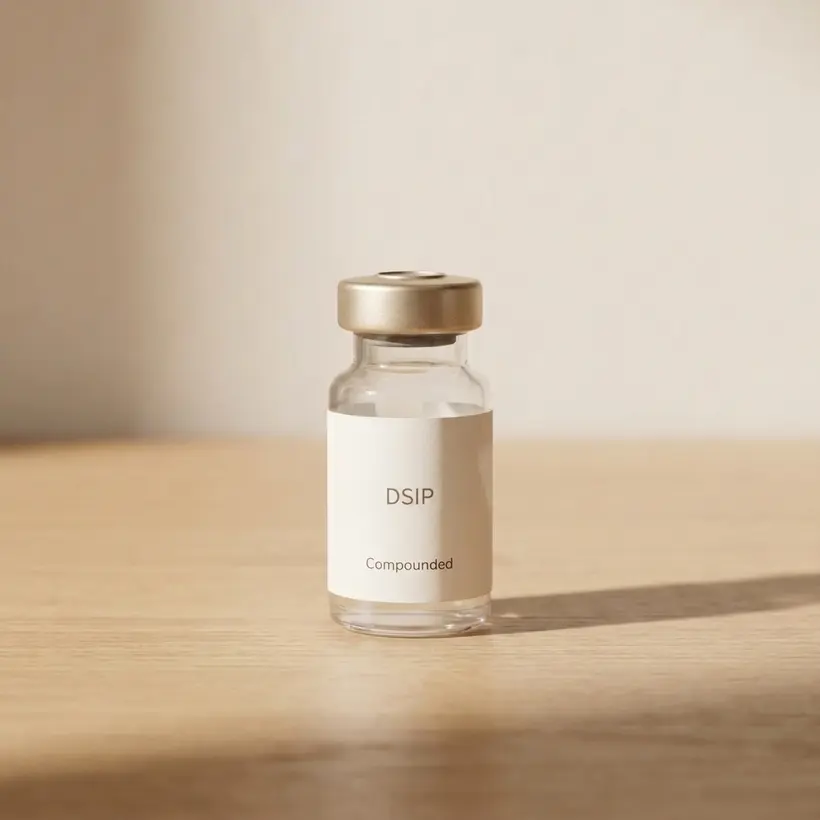
From the FormBlends catalog
DSIP (Delta Sleep-Inducing Peptide)
Restore deep, restorative delta wave sleep · From $179/mo · compounded by a licensed 503A pharmacy, dispensed only after provider review.
View DSIP (Delta Sleep-Inducing Peptide) →Studies have shown that DSIP can modulate cortisol and ACTH (adrenocorticotropic hormone) levels. Cortisol is your primary stress hormone. When cortisol stays improved at night, it directly interferes with your ability to fall and stay asleep. DSIP may help normalize cortisol patterns so they follow a healthier daily rhythm.
DSIP also appears to have analgesic (pain-reducing) properties. A study in Peptides journal found that DSIP administration reduced pain perception in both animal models and human subjects. If chronic pain is contributing to your sleep problems, this dual benefit could be relevant.
Some research suggests DSIP may support the regulation of other hormones including luteinizing hormone (LH) and growth hormone. This has made it of interest to providers working with patients on full hormone improvement protocols.
DSIP Dosing, Administration, and Practical Considerations
DSIP is typically administered via subcutaneous or intramuscular injection. Some providers also use intravenous administration in clinical settings.
Common dosing protocols range from 100-400 mcg administered in the evening, about 1-2 hours before desired sleep time. Protocols vary, with some providers recommending daily use for a set period and others using a cycling approach.
Many people report improved sleep quality within the first few nights of use. But the full benefits may take 1-2 weeks to become apparent as your sleep architecture adjusts.
Side effects are generally mild. Some people report a mild headache or warmth at the injection site. DSIP doesn't appear to cause the hangover effect common with many sleep medications.
It's important to combine DSIP with good sleep hygiene practices. No peptide can overcome a bedroom that's too bright, too warm, or full of electronic distractions. Think of DSIP as a tool that works best alongside healthy sleep habits.
Track your sleep quality, timing, and any side effects using the . This data helps your provider fine-tune your protocol for optimal results.
Combining DSIP with Other Therapies
DSIP doesn't exist in a vacuum. Your provider may recommend it as part of a broader protocol.
Some providers combine DSIP with melatonin support, particularly for patients whose pineal gland function has declined with age. DSIP and melatonin work through different mechanisms, so they may complement each other.
If you're on a peptide protocol that requires quality recovery, such as , improving your sleep with DSIP could enhance your overall results. Recovery happens during sleep, and better sleep means better recovery.
Always discuss combination protocols with your provider. Peptide interactions are an evolving field, and medical supervision ensures safety. Your provider can obtain quality DSIP from a .
Frequently Asked Questions
Is DSIP a sleeping pill?
No. DSIP is a neuropeptide that may help normalize sleep architecture and promote deeper sleep stages. Unlike traditional sleeping pills, it doesn't cause sedation during waking hours or appear to carry dependency risks based on current research.
How long does it take for DSIP to work?
Some people notice improved sleep quality within the first few nights. Full effects may take 1-2 weeks as your sleep patterns adjust. Your provider can help set realistic expectations based on your specific sleep issues.
Can DSIP be used long-term?
Long-term safety data on DSIP is limited. Some providers use cycling protocols with periods of use followed by breaks. Your provider will determine the most appropriate duration for your situation based on available evidence.
Does DSIP have side effects?
Reported side effects are generally mild and may include headache, injection site warmth, or occasional dizziness. DSIP doesn't appear to cause the grogginess or dependency associated with many sleep medications. Always report any side effects to your provider.
Is DSIP better than melatonin?
DSIP and melatonin work through different mechanisms. Melatonin primarily helps with sleep onset and circadian rhythm regulation. DSIP may help improve sleep quality and deep sleep duration. Some providers use both together. The best choice depends on your specific sleep issues.
Let's Make This Happen
The research is clear. The options are available. The only question is whether it's right for you. A FormBlends provider can help you decide (no pressure, no commitment.
Medical References
- Lincoff AM, Brown-Frandsen K, Colhoun HM, et al. Semaglutide and Cardiovascular Outcomes in Obesity without Diabetes. N Engl J Med. 2023;389(24):2221-2232. [PubMed | ClinicalTrials.gov | DOI]
Sources &. References
- Pickart L, Vasquez-Soltero JM, Margolina A. GHK Peptide as a Natural Modulator of Multiple Cellular Pathways in Skin Regeneration. BioMed Res Int. 2015;2015:648108. Doi:10.1155/2015/648108
- Pickart L, Vasquez-Soltero JM, Margolina A. GHK and DNA: Resetting the Human Genome to Health. BioMed Res Int. 2014;2014:151479. Doi:10.1155/2014/151479
- Sikiric P, Hahm KB, Blagaic AB, et al. Stable Gastric Pentadecapeptide BPC 157, Robert's Cytoprotection, Adaptive Cytoprotection, and Therapeutic Effects. Curr Pharm Des. 2018;24(18):1990-2001. Doi:10.2174/1381612824666180515125918
- Chang CH, Tsai WC, Lin MS, et al. The promoting effect of pentadecapeptide BPC 157 on tendon healing involves tendon outgrowth, cell survival, and cell migration. J Appl Physiol. 2011;110(3):774-780. Doi:10.1152/japplphysiol.00945.2010
- Seiwerth S, Brcic L, Vuletic LB, et al. BPC 157 and blood vessels. Curr Pharm Des. 2014;20(7):1121-1125. Doi:10.2174/13816128113199990421
- Bock-Marquette I, Saxena A, White MD, et al. Thymosin beta4 activates integrin-linked kinase and promotes cardiac cell migration, survival and cardiac repair. Nature. 2004;432(7016):466-472. Doi:10.1038/nature03000
- Malinda KM, Sidhu GS, Mani H, et al. Thymosin beta4 accelerates wound healing. J Invest Dermatol. 1999;113(3):364-368. Doi:10.1046/j.1523-1747.1999.00708.x
The information in this article is intended for educational use only and shouldn't be considered medical advice. Consult a qualified healthcare provider before making any changes to your medication or supplement regimen. FormBlends helps with connections with licensed providers for personalized medical guidance.
Last updated: 2026-03-24
Ready when you are
DSIP (Delta Sleep-Inducing Peptide)
Restore deep, restorative delta wave sleep · From $179/mo · compounded by a licensed 503A pharmacy, dispensed only after provider review.
View DSIP (Delta Sleep-Inducing Peptide) →