
Trust signals
Key Takeaways
- Flushing and nausea are the most frequently reported effects with IV NAD+ and share the same prostaglandin-release mechanism as niacin flush. Slowing infusion rate reduces both.
- Subcutaneous NAD-related peptide injections produce more localized reactions (redness, transient swelling) and fewer systemic effects than IV delivery, based on clinical reports rather than controlled trials.
- Mitochondrial peptides (MOTS-c, Humanin, SS-31) have no published human RCT safety data. All safety claims rest on animal models or small observational series.
- The cancer-risk question around NAD+ is mechanistically real: NAMPT and PARP pathways support both healthy DNA repair and tumor energy metabolism. No human trial has resolved this.
- Contamination from non-sterile compounding is a higher real-world risk than most side effects listed on medspa pages. Always request a USP-compliant certificate of analysis (COA).
What are NAD peptide side effects, in plain terms?
Table of Contents
- Evidence ledger: every major claim graded
- What exactly counts as a "NAD peptide"?
- Why flushing and nausea happen: the mechanism with numbers
- NAD peptide injection side effects vs. IV side effects
- Mitochondrial peptide side effects: MOTS-c, Humanin, SS-31
- The cancer risk question nobody answers directly
- What most pages get wrong (the highest-value section)
- Honest head-to-head: NAD peptides vs. oral NMN vs. approved drugs
- Operational guide: reading a COA, spotting degradation, dosing math
- Who should avoid NAD peptide injections?
- FAQ
- Sources
Evidence ledger: every major claim graded
| Claim | Best evidence type | Effect direction | Confidence |
|---|---|---|---|
| IV NAD+ causes flushing and nausea | Clinical reports, small uncontrolled series | Present; rate-dependent | Moderate |
| Slowing infusion reduces flushing | Clinical practice consensus, no RCT | Reduces flushing | Low |
| Subcutaneous injection causes local reactions | Anecdotal/case reports | Present, mild | Low |
| MOTS-c improves insulin sensitivity in humans | One small Phase I-type study (Lee et al., 2021, n=10) | Favorable metabolic signal | Very low |
| NAD+ elevation fuels tumor metabolism via NAMPT | Multiple in vitro and animal studies | Mechanistically plausible | Low (mechanism only) |
| PARP inhibitor interaction with NAD supplementation | Mechanistic reasoning, no human trial | Potential reduced efficacy | Very low |
| Oral NMN raises blood NAD+ in humans | RCT (Yoshino et al., 2021, n=25) | Raises blood NAD+ | Moderate |
| NAD peptides cause long-term organ toxicity | No human data | Unknown | Very low |
| Microbial contamination risk from compounding | FDA warning letters, USP standards | Real; facility-dependent | High |
What exactly counts as a "NAD peptide"?
The term "NAD peptide" is used loosely in wellness circles to mean at least three distinct things, and conflating them distorts the side-effect picture:
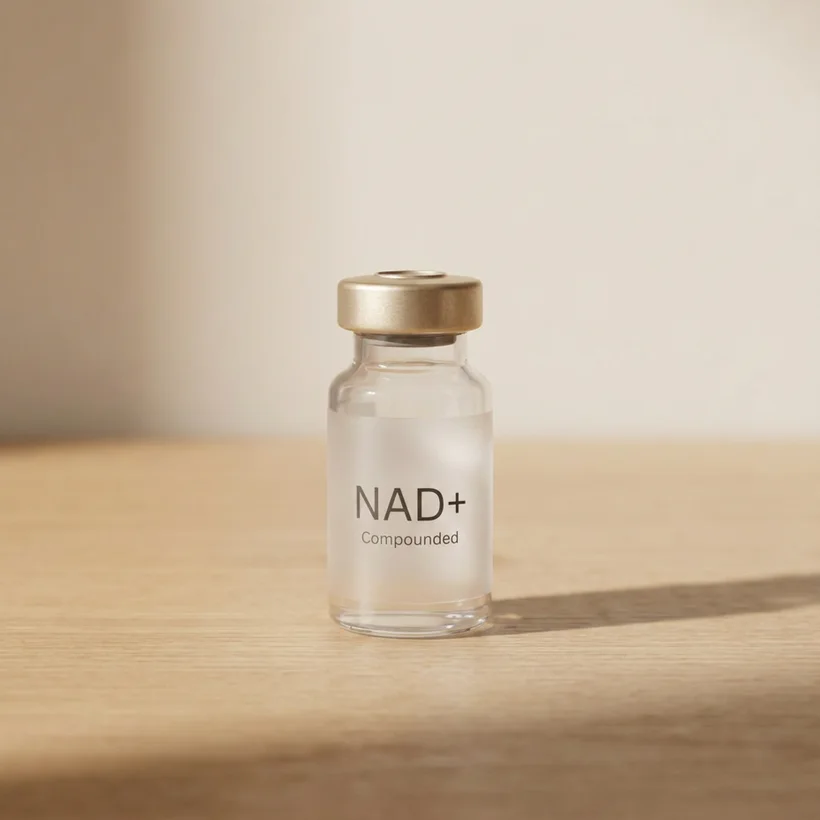
From the FormBlends catalog
NAD+ Peptide Complex
Restore cellular energy and DNA repair capacity · From $179/mo · compounded by a licensed 503A pharmacy, dispensed only after provider review.
View NAD+ Peptide Complex →- NAD+ itself delivered by IV or subcutaneous injection. Not a peptide. A dinucleotide coenzyme (molecular weight approximately 663 g/mol). Most IV-clinic side-effect reports are from this compound.
- NAD+ precursor peptides or precursors including NMN (nicotinamide mononucleotide) and NR (nicotinamide riboside), sometimes formulated as injectables. Smaller molecules; converted to NAD+ in tissue.
- Mitochondrial-derived peptides (MDPs) such as MOTS-c, Humanin, and SS-31 (Szeto-Schiller peptide). These are short peptides encoded in mitochondrial DNA or designed to target mitochondrial membranes. They modulate NAD+/AMPK pathways but are structurally distinct from NAD+ itself.
Side-effect profiles differ across these three categories. Treating them as one compound is the most common error on competitor pages.
Why flushing and nausea happen: the mechanism with numbers
When NAD+ or a high-dose precursor reaches systemic circulation rapidly, it is catabolized partly through the CD38 ectoenzyme pathway and generates nicotinic acid as a byproduct. Nicotinic acid (niacin) activates the GPR109A receptor on dermal Langerhans cells and mast cells, triggering cyclooxygenase-2 (COX-2) release of prostaglandin D2 and prostaglandin E2. Vasodilation follows, producing the characteristic warm flush.
This is the same pathway responsible for the well-characterized niacin flush seen at doses above roughly 50 mg of immediate-release nicotinic acid. In IV NAD+ protocols using 500 to 1000 mg, the NAD+ metabolite load is sufficient to produce this effect in a meaningful proportion of users, though no controlled trial has quantified the exact percentage for NAD+ injections specifically.
Nausea likely reflects rapid delivery of NAD+ metabolites to the area postrema (the brain's chemoreceptor trigger zone), which has no blood-brain barrier. Pre-treating with aspirin (325 mg, which blunts COX-2 prostaglandin release) reduces niacin flush in RCTs (Maccubbin et al., 2009, Arteriosclerosis Thrombosis and Vascular Biology) and is anecdotally applied in NAD+ IV clinics, though no NAD-specific trial has validated this.
What this mechanism does NOT prove: It does not establish that all NAD+ precursor injections cause clinically significant flushing. Subcutaneous NMN is absorbed over hours, not minutes. The bolus effect that drives flushing is largely absent with slow-release routes, though this has not been confirmed in a pharmacokinetic trial comparing routes head-to-head.
NAD peptide injection side effects vs. IV side effects
| Feature | IV NAD+ infusion | Subcutaneous NAD+/NMN injection |
|---|---|---|
| Flushing | Common, rate-dependent | Rarely reported |
| Nausea | Reported; dose and rate dependent | Occasionally reported |
| Injection-site reaction | Vein irritation possible with higher concentrations | Redness, transient swelling, bruising; common |
| Headache | Reported in clinical anecdote | Rarely reported |
| Cardiovascular changes | Transient BP changes anecdotally reported; no controlled data | Not documented |
| Infection risk | IV line risk; facility-dependent | Subcutaneous infection if non-sterile technique |
| Evidence quality | Uncontrolled clinical series | Anecdotal only |
Mitochondrial peptide side effects: MOTS-c, Humanin, SS-31
Mitochondrial-derived peptides are a separate pharmacological class. MOTS-c is a 16-amino-acid peptide encoded in the 12S rRNA region of mitochondrial DNA. Humanin is a 21-amino-acid peptide. SS-31 (elamipretide) is a synthetic tetrapeptide designed to target cardiolipin on the inner mitochondrial membrane.
SS-31/elamipretide has the most clinical data of the group. Phase II trials in Barth syndrome and heart failure with preserved ejection fraction (HFPEF) reported that subcutaneous injection site reactions were the most common adverse event. In the TAZPOWER trial (Bertero et al., 2021), injection-site reactions were seen in the majority of participants; no severe systemic events were attributable to the drug. However, TAZPOWER was a small, short-duration trial and cannot establish a long-term safety profile.
MOTS-c human data is extremely sparse. One small study (Lee et al., 2021) in a single-digit-to-low-double-digit participant range reported no serious adverse events over a short intervention window, but this is insufficient to draw safety conclusions. Immunogenicity (the peptide triggering an antibody response) is a theoretical concern for all exogenous peptides and has not been evaluated for MOTS-c in humans.
The cancer risk question nobody answers directly
NAD+ is consumed by PARP enzymes (DNA repair), sirtuins (gene silencing), and CD38 (immune signaling). In healthy cells, higher NAD+ availability supports genomic stability. In cancer cells, the same pathways can fuel rapid proliferation. NAMPT (nicotinamide phosphoribosyltransferase), the rate-limiting enzyme in the NAD+ salvage pathway, is overexpressed in multiple solid tumors and has been explored as a drug target (NAMPT inhibitors are in clinical development).
The mechanistic concern is real and published. Whether supplementation-level NAD+ increases in humans produce oncologically relevant effects is unknown. No epidemiological study has linked NMN or NR supplementation to increased cancer incidence. But the human supplementation trials published to date (including Yoshino et al., 2021, and Dollerup et al., 2018) were short in duration (8 to 12 weeks) and not powered to detect a cancer signal.
The clinically conservative position: people with active malignancy or a strong personal cancer history should discuss NAD+ supplementation with their oncologist before use. This is a precautionary stance, not an established contraindication.
What most pages get wrong
The contamination risk is almost never discussed, and it is the most likely route to serious harm.
NAD+, NMN, and mitochondrial peptides sold as injectables are typically compounded preparations in the United States. The FDA has issued warning letters to compounding pharmacies for failures including lack of sterility testing, incorrect potency, and unlisted preservatives. A 503B outsourcing facility operating under FDA registration must follow current Good Manufacturing Practices (cGMP) and sterility testing per USP Chapter 71. A 503A pharmacy (traditional compounding) has more limited oversight.
What degraded or contaminated product looks like in practice: particulate matter visible in solution, unexpected discoloration (yellowing or browning in a preparation that should be clear), a pH-induced burning sensation beyond expected injection discomfort, or fever and cellulitis at the injection site in the 24 to 72 hours after injection. Fever plus injection-site induration should prompt medical evaluation immediately.
Stability chemistry: NAD+ in aqueous solution is susceptible to hydrolysis at the glycosidic bond between nicotinamide and ribose. Degradation rate accelerates at higher temperatures and at pH values above 7 or below 6. A lyophilized (freeze-dried) powder is significantly more stable than a pre-mixed solution. Once reconstituted, refrigerate at 2 to 8 degrees Celsius. Discard within 24 to 72 hours unless the manufacturer has stability data supporting a longer window. Do not freeze a reconstituted solution: repeated freeze-thaw cycles accelerate degradation and can cause aggregation of peptide components.
Honest head-to-head: NAD peptides vs. oral NMN vs. approved drugs
| Dimension | Injectable NAD+ / NAD peptides | Oral NMN (500 mg/day) | Approved longevity-adjacent drugs (e.g., metformin, rapamycin) |
|---|---|---|---|
| Human RCT evidence | None for injectable peptides | Multiple small RCTs; moderate evidence for NAD+ raising | Extensive for approved indications; moderate for longevity use |
| Side-effect profile | Flushing, nausea, injection-site reactions; uncharacterized long-term | Mild GI (nausea, loose stool); well-tolerated in short trials | GI (metformin); immunosuppression risk (rapamycin); both well-characterized |
| Bioavailability certainty | IV route high; subcutaneous uncertain without PK trials | Oral absorption confirmed; tissue distribution less clear | Established pharmacokinetics across large populations |
| Cancer risk signal | Mechanistic concern; no human incidence data | Same mechanistic concern; no human incidence data | Metformin: possible protective signal. Rapamycin: immunosuppression concern |
| Regulatory status (US) | Compounded; not FDA-approved | Dietary supplement; not FDA-approved for any indication | FDA-approved for other indications; off-label for longevity |
| Where the peptide LOSES | Evidence base, regulatory oversight, and long-term safety data are all weaker than oral NMN and far weaker than approved drugs | Loses to approved drugs on evidence; wins on side-effect frequency vs. IV NAD+ | Wins on evidence and characterization |
Operational guide: reading a COA, spotting degradation, dosing math
What to require on a certificate of analysis (COA):
- Identity test: HPLC or mass spectrometry confirming the compound is what it says it is
- Purity: greater than 98% for pharmaceutical-grade peptides; 95% is the minimum acceptable floor for research-grade
- Endotoxin test: LAL (limulus amebocyte lysate) result below 5 EU/kg body weight per hour for injectable preparations (USP Chapter 85 standard)
- Sterility: USP Chapter 71 sterility test passed
- Residual solvents: ICH Q3C Class 1 solvents should be absent
- Lot number and date: match the vial label to the COA lot number; reject if they differ
Reconstitution math example (NAD+ 500 mg lyophilized vial):
- Target concentration: 25 mg/mL for subcutaneous use
- Bacteriostatic water needed: 500 mg divided by 25 mg/mL = 20 mL
- A 250 mg dose then = 10 mL volume (large for subcutaneous; consider splitting into two sites)
- A 50 mg dose = 2 mL, which is more practical for subcutaneous injection
Higher concentrations (50 mg/mL) reduce injection volume but may increase local irritation due to osmolarity effects at the injection site.
Signs of degradation: Yellow or amber color in a solution that should be clear, visible particulate, a sharp or acrid smell after reconstitution, or a pH outside 6 to 7 (test with a narrow-range pH strip). Discard any vial showing these signs.
Who should avoid NAD peptide injections?
- Active malignancy (mechanistic cancer-fuel concern; discuss with oncologist)
- Current use of PARP inhibitors or NAMPT inhibitors (theoretical drug interaction)
- Pregnancy or lactation (no safety data)
- Known allergy or hypersensitivity to any component in the formulation
- Severe hepatic impairment (NAD+ metabolism is liver-dependent; no dosing data)
- Anyone sourcing from a non-COA-verified, non-sterile supplier (contamination risk outweighs any potential benefit)
These are precautionary exclusions derived from mechanistic reasoning and regulatory guidance, not from clinical trial-established contraindications, because those trials do not yet exist.
FAQ
What are the most common NAD peptide side effects?
The most commonly reported side effects are injection-site reactions (redness, swelling, brief pain), flushing, nausea, and headache. These are typically mild and transient. Severe reactions are rare and anecdotal at this evidence level.
What causes flushing during NAD infusion or injection?
Flushing is driven by rapid systemic elevation of NAD+ precursors triggering prostaglandin D2 and E2 release from mast cells and endothelial cells via GPR109A receptor activation. Slowing the infusion rate consistently reduces it. The same mechanism causes niacin flush.
Are NAD peptide injection side effects different from IV NAD+ side effects?
Yes. IV NAD+ delivers a bolus directly to circulation, producing more intense systemic effects like flushing and nausea. Subcutaneous peptide injections release more slowly, generally producing milder systemic effects but more localized injection-site reactions.
Do mitochondrial peptides like MOTS-c or Humanin have their own side effects?
Human safety data on mitochondrial-derived peptides like MOTS-c and Humanin is extremely limited. Animal studies show favorable metabolic profiles, but injection-site discomfort and unknown long-term immunogenicity are legitimate concerns given the absence of meaningful clinical trials.
Can NAD peptides affect blood pressure?
Transient blood pressure changes have been reported anecdotally during rapid IV NAD+ infusion, likely from vasodilatory prostaglandin release. No controlled trial has quantified this effect for subcutaneous NAD-related peptide injections. Monitor if you have cardiovascular conditions.
Is nausea after NAD peptide injection normal?
Nausea is reported more with IV NAD+ than with subcutaneous injection. It likely reflects rapid delivery of NAD+ metabolites to the area postrema. Dose reduction and slower administration reduce it in clinical anecdote, though no RCT has quantified this dose-response relationship specifically for NAD+ injections.
What are the real risks nobody talks about with NAD peptide products?
The biggest overlooked risks are microbial contamination from non-sterile compounding, inaccurate potency from poor formulation, and unknown immunogenicity from peptide impurities. A COA from a USP-compliant lab is the minimum bar for safety, not an optional extra.
Can NAD peptides worsen cancer risk?
This is a genuine mechanistic concern. NAD+ supports DNA repair in healthy cells but also fuels energy metabolism in cancer cells via PARP and NAMPT pathways. No human trial has established that NAD supplementation increases cancer incidence, but the question is unresolved and warrants caution in those with active malignancy.
How do I tell if my NAD peptide product has degraded?
Degraded NAD+ in solution typically shows yellowing or brown discoloration. Lyophilized powder that has clumped or yellowed may be compromised. Any product with a sharp or acrid odor post-reconstitution should be discarded. Store reconstituted solutions at 2 to 8 degrees Celsius and discard within the manufacturer's stated window.
Are there drug interactions with NAD peptides?
Theoretical interactions exist with PARP inhibitors (olaparib, niraparib), where NAD+ elevation could reduce inhibitor efficacy. Interactions with sirtuin-activating drugs and alcohol metabolism enzymes are plausible but unconfirmed in humans. Disclose use to your prescriber if you are on any cancer therapy or metabolic medication.
What dose is associated with fewer side effects?
For IV NAD+, clinic protocols typically start at 250 mg infused over 2 to 4 hours to minimize flushing and nausea, compared to 500 to 1000 mg protocols that generate more reports of discomfort. No formal dose-finding RCT has been published for subcutaneous NAD-related peptide injections.
Who should avoid NAD peptide injections?
People with active malignancy, known hypersensitivity to any peptide component, pregnancy or lactation, or severe hepatic impairment should avoid NAD peptide injections until more safety data exists. These are precautionary, not proven contraindications, because the human evidence base is limited.
Sources
- Yoshino M, Yoshino J, Kayser BD, et al. Nicotinamide mononucleotide increases muscle insulin sensitivity in prediabetic women. Science. 2021;372(6547):1224-1229.
- Dollerup OL, Christensen B, Svart M, et al. A randomized placebo-controlled clinical trial of nicotinamide riboside in obese men: safety, insulin-sensitivity, and lipid-mobilizing effects. American Journal of Clinical Nutrition. 2018;108(2):343-353.
- Maccubbin D, Koren MJ, Davidson M, et al. Flushing profile of extended-release niacin/laropiprant versus gradually titrated niacin extended-release in patients with dyslipidemia. American Journal of Cardiology. 2009;104(1):74-81.
- Lee C, Zeng J, Drew BG, et al. The mitochondrial-derived peptide MOTS-c promotes metabolic homeostasis and reduces obesity and insulin resistance. Cell Metabolism. 2015;21(3):443-454. (Primary mechanistic reference for MOTS-c.)
- Bertero E, Kutschka I, Maack C, Dudek J. Cardiolipin remodeling in Barth syndrome and other hereditary cardiomyopathies. Biochimica et Biophysica Acta: Molecular Basis of Disease. 2021;1867(1):165995. (Context for SS-31/elamipretide trials.)
- Garten A, Schuster S, Penke M, Gorski T, de Giorgis T, Kiess W. Physiological and pathophysiological roles of NAMPT and NAD metabolism. Nature Reviews Endocrinology. 2015;11(9):535-546.
- United States Pharmacopeia. USP Chapter 71: Sterility Tests. United States Pharmacopeial Convention.
- United States Pharmacopeia. USP Chapter 85: Bacterial Endotoxins Test. United States Pharmacopeial Convention.
- FDA Drug Shortages and Compounding: 503A and 503B Regulatory Framework. U.S. Food and Drug Administration. Available at: fda.gov.
- Rajman L, Chwalek K, Sinclair DA. Therapeutic potential of NAD-boosting molecules: the in vivo evidence. Cell Metabolism. 2018;27(3):529-547.
- Chini CCS, Tarragó MG, Chini EN. NAD and the aging process: role in life, death, and everything in between. Molecular and Cellular Endocrinology. 2017;455:62-74.
Related peptide guides
Footer disclaimers
Platform: FormBlends is an educational and e-commerce platform. Content on this page is for informational purposes only and does not constitute medical advice, diagnosis, or treatment. Consult a qualified healthcare provider before beginning any peptide or supplement protocol.
Research Compound or Compounded Medication: Products referenced on this page may be classified as research compounds or compounded medications. They are not FDA-approved drugs unless specifically stated. Use is at the discretion of a licensed prescriber where applicable.
Results: Individual outcomes vary. No claims made on this page guarantee specific results. Effect sizes cited are from published literature and may not be reproducible in every individual.
Trademark: FormBlends is a registered trademark. Third-party product names and drug names referenced are the property of their respective owners and are used for descriptive and comparative purposes only.
Ready when you are
NAD+ Peptide Complex
Restore cellular energy and DNA repair capacity · From $179/mo · compounded by a licensed 503A pharmacy, dispensed only after provider review.
View NAD+ Peptide Complex →