
Trust Signals
Key Takeaways
- The most documented DSIP side effects in small human studies are daytime sedation and transient hypotension, not rare idiosyncratic reactions.
- All human DSIP research was conducted with intravenous or subcutaneous administration; oral bioavailability is negligible due to gastrointestinal proteolysis.
- DSIP has a molecular weight of 848.9 g/mol (Trp-Ala-Gly-Gly-Asp-Ala-Ser-Gly-Glu) and degrades in aqueous solution; a visually clear vial does not confirm peptide integrity.
- No adequately powered, placebo-controlled human RCT on DSIP safety or efficacy exists as of 2026; the largest human studies involved fewer than 20 subjects.
- Long-term side-effect data, dependence potential, and drug-interaction profiles are entirely unknown in humans.
What Are DSIP Peptide Side Effects? (Direct Answer)
DSIP peptide side effects documented in humans include daytime sedation, transient blood pressure reduction, and headache, all from very small 1970s to 1990s studies. Long-term safety is unstudied. The honest answer is that the human side-effect profile is underdetermined, and any product sold for self-administration carries risks that cannot be fully quantified from current literature.
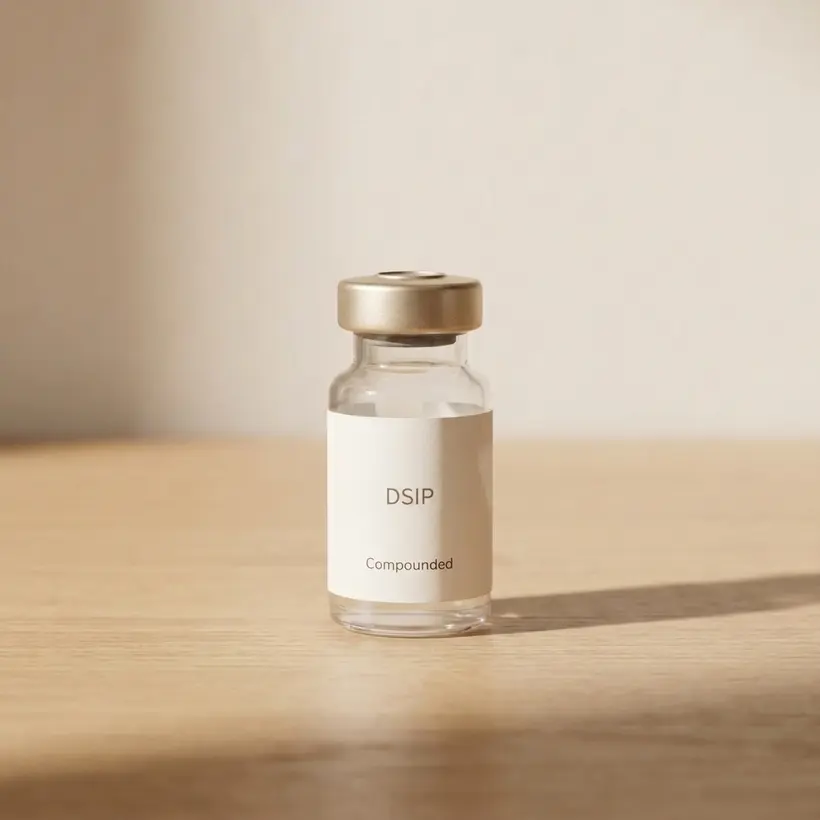
From the FormBlends catalog
DSIP (Delta Sleep-Inducing Peptide)
Restore deep, restorative delta wave sleep · From $179/mo · compounded by a licensed 503A pharmacy, dispensed only after provider review.
View DSIP (Delta Sleep-Inducing Peptide) →Table of Contents
Evidence Ledger: Every Major Claim Graded
| Claim | Best Evidence Type | Effect Direction | Confidence |
|---|---|---|---|
| DSIP promotes sleep onset | Small human studies (fewer than 20 subjects), animal RCT | Positive trend in some studies, inconsistent overall | Very Low |
| DSIP causes transient hypotension | Small human studies, animal data | Blood pressure lowering observed | Low |
| DSIP causes daytime sedation | Case series, self-report, small trials | Sedation reported after dosing | Low |
| DSIP modulates cortisol/stress axis | Animal mechanistic studies | Attenuates some stress responses in rodents | Very Low (human translation unproven) |
| Oral bioavailability is negligible | Pharmacokinetic mechanism (proteolysis), no human oral PK study | Strongly negative for oral route | Moderate (mechanism is clear; human oral PK unquantified) |
| Tolerance develops with repeated use | Animal data only | Suggested in rodent models | Very Low |
| No approved human therapeutic use | FDA/EMA regulatory record | Confirmed: no approval | High |
| Long-term safety is unknown | Absence of evidence (no long-term trials exist) | Cannot be assessed | High confidence in the knowledge gap itself |
Mechanism With Numbers: How DSIP Acts on the Brain
DSIP (Delta Sleep-Inducing Peptide) is a nonapeptide originally isolated from rabbit cerebral venous blood by Monnier and colleagues in 1977. The sequence is Trp-Ala-Gly-Gly-Asp-Ala-Ser-Gly-Glu, with a molecular weight of 848.9 g/mol. It is distributed across multiple brain regions including the hypothalamus, limbic system, and brainstem, and has been detected in peripheral tissues.
DSIP does not bind a single identified, cloned receptor with a confirmed Kd value; no dedicated DSIP receptor has been unambiguously characterized as of current literature. Its proposed mechanisms include modulation of delta-wave sleep via hypothalamic circuits, interaction with opiate and serotonergic pathways, and possible effects on the hypothalamic-pituitary-adrenal axis in rodents. The honest caveat: demonstrating a mechanism in isolated tissue or rodents does not confirm the same pathway is engaged at doses humans self-administer.
Plasma half-life after intravenous injection is short, measured in minutes in animal studies, largely due to rapid enzymatic cleavage. This short half-life is mechanistically relevant to the side-effect question: a fast-degrading peptide can still cause acute cardiovascular and CNS effects during its brief active window.
Documented Side Effects in Human Data
The human literature on DSIP is small and old. Most studies were conducted in Europe between the late 1970s and early 1990s, used IV or subcutaneous routes, and enrolled fewer than 20 subjects. With that framing, the following effects have been reported:
- Daytime sedation and drowsiness: Reported in subjects given DSIP during waking hours. This is the most consistent subjective adverse effect across multiple small trials.
- Hypotension: Graf and colleagues noted blood pressure reductions in early human administration studies. The degree was described as transient but clinically noticeable in some subjects.
- Headache: Reported in a subset of subjects; causality is difficult to establish given small sample sizes.
- Altered sleep architecture: Some subjects reported changes in dream character or sleep quality that were not uniformly positive. Not all subjects experienced improved sleep.
- Injection-site reactions: Consistent with subcutaneous peptide administration generally; not uniquely characterized for DSIP.
Critically, no study has characterized rates of serious adverse events because no study was large enough or long enough to detect them at meaningful power. The absence of reported serious events in small, short trials cannot be interpreted as confirmed safety.
What Most Pages Get Wrong About DSIP Safety
Almost every medspa or peptide vendor page on DSIP repeats two errors that matter clinically.
Error 1: Treating negligible oral bioavailability as a minor caveat. Most pages mention that DSIP is "best injected" without explaining that oral DSIP is essentially pharmacologically inactive. DSIP is a nonapeptide with no protective modifications (no PEGylation, no N-methylation, no cyclic structure). Gastrointestinal proteases, particularly those in the small intestine, will cleave it into fragments before meaningful systemic concentrations can be achieved. When someone reports subjective effects from oral DSIP capsules, they are most likely experiencing a placebo response or responding to excipients in the product. This matters because it affects both efficacy and risk interpretation.
Error 2: Conflating "no reported deaths" with "established as safe." DSIP has never been studied in populations with comorbidities, on polypharmacy, at high doses, or over extended periods. The drug-interaction profile with antihypertensives, benzodiazepines, or serotonergic medications is completely unstudied. The self-administration doses circulating in research-chemical communities are not derived from dose-escalation safety studies; they are extrapolations from animal literature or from early IV infusion protocols not designed for subcutaneous self-injection.
The Chemistry Behind Stability and Why Your Storage Protocol Matters
DSIP contains a tryptophan residue at position 1 of its sequence. Tryptophan is the amino acid most vulnerable to oxidative degradation among the 20 standard amino acids. Exposure to light (particularly UV), oxygen, and elevated temperatures accelerates oxidation of the indole ring, producing products including kynurenine and N-formylkynurenine. These oxidation products are not the parent peptide and have not been characterized for safety.
In aqueous solution, DSIP is also subject to aspartate isomerization (the Asp residue at position 5 can convert from alpha to beta linkage over time, altering backbone geometry) and to peptide bond hydrolysis near Gly-Asp sequences, which are known hydrolytic weak points in peptide chemistry.
The practical rules this chemistry generates:
- Store lyophilized powder away from light and at temperatures below freezing if long-term storage is intended; refrigeration alone is a compromise.
- Once reconstituted in bacteriostatic water, use within a time frame consistent with peptide stability, typically days to a few weeks under refrigeration, not months.
- A clear, colorless solution does not confirm peptide integrity; tryptophan oxidation and isomerization are not visually detectable at low concentrations.
- Adding antioxidants (such as acetic acid-based reconstitution buffers) can slow but not eliminate degradation.
This chemistry is why a certificate of analysis obtained at manufacture does not guarantee what you are injecting weeks later.
Honest Head-to-Head: DSIP vs. Established Sleep Interventions
| Intervention | Human RCT Evidence | Characterized Side Effects | Regulatory Status | Where It Wins vs. DSIP |
|---|---|---|---|---|
| Melatonin (0.5 to 5 mg oral) | Dozens of RCTs, meta-analyses in jet lag and sleep-onset insomnia | Drowsiness, headache, mild hormonal effects at high doses; well characterized | OTC (US); prescription in some EU countries | Evidence quality, oral activity, safety data, cost |
| CBT-I (Cognitive Behavioral Therapy for Insomnia) | Multiple high-quality RCTs; first-line per American Academy of Sleep Medicine | Temporary sleep restriction phase can cause short-term fatigue | Recommended standard of care | Durable effect, no pharmacological risk, treats root cause |
| Low-dose doxepin (3 to 6 mg) | Two FDA registration RCTs (Silenor); adequate power | Somnolence, nausea, upper respiratory infection; fully characterized | FDA-approved for sleep maintenance insomnia | Regulatory approval, known pharmacology, prescriber oversight |
| DSIP (subcutaneous, research use) | No adequately powered human RCT | Sedation, hypotension, headache; sample sizes too small to characterize rates | Not approved anywhere for therapeutic use | Theoretical: possibly different mechanism, no next-day cognitive impairment in some reports (uncontrolled) |
DSIP does not win this comparison on any evidence-based criterion. The only honest reason someone might consider it is theoretical mechanism novelty or failure of established therapies, and even then the risk-benefit calculation is unfavorable given the absent safety database.
Label and COA Literacy: How to Judge a DSIP Product
If you are evaluating a DSIP product for research purposes, the following elements should appear on a legitimate certificate of analysis (COA). Absence of any item is a meaningful red flag.
| COA Element | What to Look For | Why It Matters |
|---|---|---|
| HPLC purity | Greater than 98% by area under the curve | Confirms the dominant species is DSIP, not synthesis byproducts |
| Mass spectrometry | Confirmed molecular weight of 848.9 Da (monoisotopic 848.37 Da) | Confirms correct sequence, not a truncated or scrambled peptide |
| Endotoxin (LAL assay) | Below 1 EU/mg is a common standard for research peptides | Endotoxin contamination causes fever, inflammation, and systemic reactions on injection |
| Amino acid analysis | Matches Trp-Ala-Gly-Gly-Asp-Ala-Ser-Gly-Glu composition | Independent confirmation beyond mass alone |
| Sterility or microbial limits | No growth on standard bacterial/fungal media | Critical for any injectable product |
| Lot number and date | Traceable, recent | Enables follow-up if a batch issue arises |
Reconstitution math: A common vial size is 5 mg lyophilized powder. To make a 1 mg/mL solution, add 5 mL bacteriostatic water. A 25-nanomole-per-kilogram dose for a 75 kg individual equals approximately 1.9 micromoles total, or roughly 1.6 mg. These figures are drawn from early research IV protocols and are not validated self-administration doses. Treat any circulating "standard dose" with appropriate skepticism.
Who Should Avoid DSIP Entirely
The following groups should not use DSIP under any circumstances, because the risk is clear even without a full safety database:
- Individuals with hypotension or orthostatic instability (confirmed hypotensive effect)
- Anyone taking antihypertensive medications (additive blood pressure lowering, unstudied interaction)
- Anyone taking CNS depressants including benzodiazepines, Z-drugs, or sedating antihistamines (additive sedation, unstudied interaction)
- Pregnant or breastfeeding individuals (no safety data; peptides can cross placental barrier)
- Individuals with known peptide hypersensitivity or mast cell disorders
- Anyone without access to a clinical setting for initial administration, given the hypotensive risk
FAQ
What are the most commonly reported side effects of DSIP peptide?
The most frequently reported effects in small human studies and case reports include daytime sedation, transient blood pressure lowering, and headache. Most reports come from very small sample sizes and the overall side-effect profile in humans is poorly characterized.
Is DSIP peptide safe for human use?
Safety has not been established by any large, controlled human trial. Available data come from small 1980s studies and anecdotal reports. Regulatory agencies including the FDA have not approved DSIP for any therapeutic indication.
Can DSIP cause dependence or withdrawal?
Animal data suggest tolerance may develop with repeated administration. There is no controlled human data on dependence or withdrawal. This remains a real unknown, not a confirmed safe outcome.
Does DSIP lower blood pressure?
Yes. Early human and animal studies, including work by Graf and colleagues in the 1980s, noted hypotensive effects. The magnitude and clinical significance in modern dosing contexts is unknown.
What happens if DSIP degrades before use?
DSIP is a nonapeptide that degrades through proteolytic cleavage in aqueous solution at room temperature. A degraded vial may deliver uncharacterized fragments with unknown activity or inflammatory potential. Visual clarity does not confirm peptide integrity.
Can DSIP be taken orally?
Oral bioavailability of DSIP is very low. The peptide is rapidly cleaved by gastrointestinal proteases before meaningful systemic absorption can occur. Subcutaneous or intravenous administration was used in all clinical research.
How does DSIP compare to melatonin for sleep?
Melatonin has dozens of randomized controlled trials demonstrating modest but real improvements in sleep onset latency. DSIP has no adequately powered RCT in humans. Melatonin's safety profile is far better characterized.
What is the correct dose of DSIP?
No validated human dosing protocol exists. Early studies used intravenous infusions in the range of roughly 25 nanomoles per kilogram. Self-administration doses circulating online have not been tested in controlled trials.
Are there any long-term side effect studies on DSIP?
No. Long-term controlled safety data in humans does not exist. This is one of the most significant evidence gaps for this peptide.
What contaminants should I look for in a DSIP product?
A certificate of analysis should include HPLC purity above 98%, endotoxin testing (LAL assay, ideally below 1 EU/mg), and mass spectrometry confirmation of the correct molecular weight (848.9 g/mol for DSIP). Missing any of these is a red flag.
Does DSIP affect cortisol?
Animal studies suggest DSIP may modulate the stress axis and attenuate some corticotropin responses. Whether this translates to clinically meaningful cortisol changes in humans at typical doses is not established.
Who should absolutely avoid DSIP?
Anyone with hypotension, cardiovascular instability, pregnancy, or who is taking antihypertensives or CNS depressants should avoid DSIP. The interaction profile is completely unstudied in these populations.
Sources
- Monnier M, Dudler L, Gaechter R, Maier PF, Tobler HJ, Schoenenberger GA. The delta sleep-inducing peptide (DSIP): comparative properties of the original and synthetic nonapeptide. Experientia. 1977;33(4):548-552.
- Graf MV, Schoenenberger GA. Delta sleep-inducing peptide (DSIP) in clinical studies. European Neurology. 1987;26(3):120-129. (Describes early human administration, hypotension and sedation observations.)
- Schoenenberger GA. Characterization, properties and multivariate functions of delta-sleep-inducing peptide (DSIP). European Neurology. 1984;23(5):321-345.
- Kastin AJ, Nissen C, Schally AV, Coy DH. Blood-brain barrier, half-time disappearance, and brain distribution for labeled enkephalin and a potent analog. Brain Research Bulletin. 1976;1(6):583-589. (General peptide CNS pharmacokinetics context.)
- Steiger A. Neurochemical regulation of sleep. Journal of Psychiatric Research. 2007;41(7):537-552. (Reviews sleep peptides including DSIP within broader sleep neuroscience.)
- Bjorvatn B, Pallesen S. A practical approach to circadian rhythm sleep disorders. Sleep Medicine Reviews. 2009;13(1):47-60. (Provides comparative context for melatonin evidence base.)
- Sateia MJ, Buysse DJ, Krystal AD, Neubauer DN, Heald JL. Clinical Practice Guideline for the Pharmacologic Treatment of Chronic Insomnia in Adults. Journal of Clinical Sleep Medicine. 2017;13(2):307-349. (AASM guideline; basis for CBT-I and approved pharmacotherapy comparisons.)
- US Food and Drug Administration. Silenor (doxepin) prescribing information. NDA 022036. 2010. (Regulatory basis for doxepin comparison.)
- United States Pharmacopeia. General Chapter 85: Bacterial Endotoxins Test. USP-NF. (Basis for LAL assay standards cited in COA section.)
Footer Disclaimers
Platform: This content is published by FormBlends for informational and educational purposes only. It does not constitute medical advice, diagnosis, or treatment recommendation. Consult a licensed healthcare provider before making any health-related decision.
Research Compound: DSIP is an unscheduled research compound in most jurisdictions. It is not approved by the FDA, EMA, or equivalent regulatory body for any therapeutic indication in humans. Its legal status varies by country. It is sold for research purposes only.
Results: Individual responses to any compound vary. No outcomes described on this page are guaranteed or typical. Information about effects observed in research studies does not imply those effects will occur in any individual.
Trademark: FormBlends is a registered trademark. All third-party product names, drug names, and regulatory body names are the property of their respective owners and are used here for descriptive purposes only.
Related peptide guides
Ready when you are
DSIP (Delta Sleep-Inducing Peptide)
Restore deep, restorative delta wave sleep · From $179/mo · compounded by a licensed 503A pharmacy, dispensed only after provider review.
View DSIP (Delta Sleep-Inducing Peptide) →