Trust Signals
Key Takeaways
- NAD+ is technically a dinucleotide coenzyme, not a peptide; its side-effect profile differs from true peptides because it acts directly on redox and PARP pathways rather than receptor signaling.
- Flushing, nausea, and chest tightness during IV infusion are rate-dependent and largely preventable by extending infusion time to at least 1 to 2 hours for standard clinical doses.
- Compounded IV NAD+ carries endotoxin contamination risk because it is not FDA-approved; only 503B outsourcing facility preparations with a certificate of analysis should be used for IV administration.
- Anyone on PARP inhibitor chemotherapy (olaparib, rucaparib, niraparib) must not use NAD+ supplementation without oncologist approval, as NAD+ is the direct substrate those drugs deplete.
- Long-term safety data for high-dose IV NAD+ are absent from the peer-reviewed literature; confidence in chronic safety is very low regardless of how frequently clinics offer it.
What Are NAD+ Peptide Side Effects? (Direct Answer)
NAD+ peptide side effects during IV infusion include flushing, chest tightness, nausea, and vein burning, all of which are rate-dependent and usually resolve by slowing infusion speed. Oral precursors (NMN, NR) cause mainly mild GI upset. Serious cardiac events are rare but real. Long-term safety evidence is thin across all routes.
From the FormBlends catalog
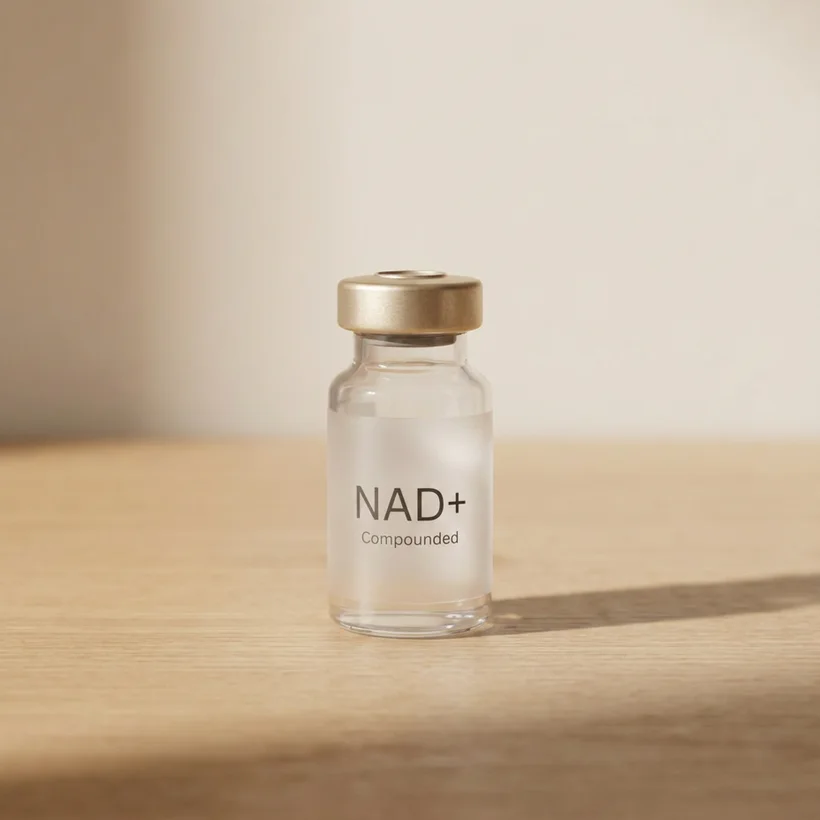
NAD+ Peptide Complex
Restore cellular energy and DNA repair capacity · From $179/mo · compounded by a licensed 503A pharmacy, dispensed only after provider review.
View NAD+ Peptide Complex →Table of Contents
- Is NAD+ Actually a Peptide? Why the Label Matters
- Evidence Ledger: Grading Every Major Claim
- Mechanism and Specific Numbers
- Side Effects by Route: IV vs. Oral vs. Subcutaneous
- What Most Pages Get Wrong About NAD+ Side Effects
- The Chemistry Behind the Rules of Thumb
- Honest Head-to-Head: NAD+ vs. NMN vs. NR
- Drug Interactions and Contraindications
- Operational Guide: Reading a COA and Dosing Table
- Frequently Asked Questions
- Sources
Is NAD+ Actually a Peptide? Why the Label Matters
NAD+ (nicotinamide adenine dinucleotide) is a dinucleotide, meaning two nucleotides linked by phosphate bonds. A peptide is a chain of amino acids. These are chemically unrelated. The "NAD+ peptide" phrase comes from wellness marketing that groups IV micronutrient infusions alongside peptide therapies. This distinction is not pedantic: it explains why NAD+ side effects look nothing like those of GLP-1 peptides or growth hormone secretagogues. NAD+ acts as an electron carrier in redox reactions and as a substrate for PARP enzymes and sirtuins, so its adverse events reflect those pathways, not receptor-ligand dynamics typical of peptides.
Evidence Ledger: Grading Every Major Claim
| Claim | Best Available Evidence | Effect Direction | Confidence |
|---|---|---|---|
| IV NAD+ causes flushing and nausea | Multiple clinical reports and addiction-medicine protocols; no blinded RCT of adverse events | Confirmed, rate-dependent | Moderate |
| Flushing is eliminated by slow infusion | Clinical observation across multiple case series; no controlled dose-rate trial | Confirmed directionally | Moderate |
| Cardiac arrhythmia risk with rapid bolus | Case reports and clinical warnings in published addiction-medicine literature | Possible with fast infusion | Low |
| NAD+ raises intracellular NAD+ levels | Pilot human studies and multiple animal studies; Trammell et al. 2016 for NR (precursor) | Confirmed for oral precursors; IV assumed stronger | Moderate |
| Long-term chronic dosing is safe | No controlled long-term safety study for IV NAD+ | Unknown | Very Low |
| PARP inhibitor interaction is clinically relevant | Pharmacological mechanism well-established; no human interaction trial exists | Theoretically significant | Low (mechanism only) |
| Oral NMN/NR cause only mild GI upset | Phase 1 human trials (Irie et al. 2020 for NMN; Trammell et al. 2016 for NR) | Confirmed at standard doses | High |
| Compounded IV NAD+ endotoxin risk | Regulatory logic from FDA 503B rules; no published contamination incidence data | Real risk, unquantified | Low (regulatory) |
Mechanism and Specific Numbers
NAD+ serves as an electron acceptor in glycolysis and the citric acid cycle and as the exclusive substrate for three enzyme families: PARP enzymes (which consume NAD+ during DNA repair), sirtuins (which consume NAD+ to deacetylate histones and metabolic regulators), and CD38/CD157 (ectoenzymes that hydrolyze NAD+). Intracellular NAD+ concentrations decline with age; published estimates place whole-blood NAD+ in young adults at roughly 20 to 30 micromolar and this declines measurably across decades, though exact values vary by tissue and assay method.
A 2016 randomized crossover trial by Trammell and colleagues found that a single oral dose of 1000 mg nicotinamide riboside (NR) raised blood NAD+ metabolites by roughly 2.7-fold over baseline in 12 healthy adults. For IV NAD+, plasma levels rise faster and higher, which is why the side-effect profile is more acute: rapid flux through PARP pathways and transient changes in cellular redox status are the proposed drivers of flushing and chest discomfort, not a single receptor like GPR109A (which mediates niacin flushing via prostaglandin D2).
What this mechanism does NOT prove: A rise in blood NAD+ does not confirm that NAD+ crossed cell membranes at therapeutically meaningful concentrations in target tissues. Extracellular NAD+ has limited direct cell entry; it is largely converted to NMN or nicotinamide at the cell surface before being internalized. Clinical benefit claims built purely on "NAD+ goes up in blood" are mechanistically incomplete.
Side Effects by Route: IV vs. Oral vs. Subcutaneous
| Side Effect | IV Infusion | Oral Precursors (NMN/NR) | Subcutaneous NAD+ |
|---|---|---|---|
| Flushing | Common, rate-dependent | Mild at high NR doses | Anecdotal reports; no controlled data |
| Nausea | Common during infusion | Mild, occasional | Unknown |
| Chest tightness | Reported; rate-dependent | Not reported | Unknown |
| Vein burning/irritation | Common, positional | N/A | Local injection pain (anecdotal) |
| Headache | Reported post-infusion | Rare | Unknown |
| Fatigue (post-dose) | Reported, transient | Not reported | Unknown |
| Cardiac arrhythmia | Case reports with rapid infusion | Not reported | Unknown |
| GI upset | Nausea predominates | Most common effect | Unknown |
What Most Pages Get Wrong About NAD+ Side Effects
Nearly every wellness blog covering NAD+ side effects lists flushing and nausea, then reassures readers these are mild. What they omit is that compounded IV NAD+ is not FDA-approved as a drug product. The FDA has at various points placed NAD+ on lists of bulk substances under scrutiny for compounding. Preparations made outside a registered 503B outsourcing facility may not have undergone the endotoxin, sterility, and potency testing required for IV-grade products under USP standards.
Endotoxin contamination in an IV preparation causes fever, rigors, and potential septic-shock-like responses that are far more dangerous than flushing. Buyers and prescribers should confirm the compounding pharmacy is a 503B outsourcing facility and request a certificate of analysis (COA) that includes an endotoxin result below the USP limit for IV use (typically expressed as endotoxin units per mL against a calculated limit based on dose and route). A COA that shows only assay/potency but omits endotoxin testing is inadequate for an IV product.
A second omission: stability. NAD+ in solution degrades, particularly at higher temperatures and non-physiological pH. Degradation products include nicotinamide and adenosine diphosphate ribose (ADPR), which have their own biological activity. No published stability kinetics data for compounded IV NAD+ formulations are publicly available, but the general principle that aqueous dinucleotide solutions are less stable than lyophilized forms is well-grounded in nucleotide chemistry. Receiving a preparation that has partially degraded means you are getting an unknown mixture, not a defined dose.
The Chemistry Behind the Rules of Thumb
Why slow the infusion? When NAD+ enters the bloodstream rapidly, local concentrations at vascular endothelium and cardiac tissue transiently spike. PARP-1 activation is NAD+ concentration-dependent: higher NAD+ availability accelerates PARP-1 auto-PARylation, which can briefly alter local calcium handling and vascular tone. This is distinct from niacin flushing, where nicotinic acid binds GPR109A on skin Langerhans cells, triggering arachidonic acid release and prostaglandin D2 synthesis, which causes cutaneous vasodilation. Pretreatment with aspirin blocks niacin flushing; it does not reliably block NAD+ infusion flushing because the pathways differ. Slowing the infusion flattens the concentration peak and reduces the PARP/redox transient, which is why rate reduction works where aspirin pretreatment may not.
Why avoid mixing NAD+ with high-pH or oxidizing agents? NAD+ in its oxidized form is stable at mildly acidic to neutral pH (roughly 5 to 7). Alkaline conditions promote hydrolysis of the nicotinamide-ribose glycosidic bond, yielding ADP-ribose and free nicotinamide. Oxidizing agents (including dissolved oxygen at elevated temperatures) can irreversibly convert the nicotinamide ring. This is why properly formulated IV NAD+ uses a pH-buffered vehicle, is stored refrigerated, and should not be mixed with alkaline IV fluids (such as sodium bicarbonate solutions) in the same line without compatibility data.
Honest Head-to-Head: IV NAD+ vs. NMN vs. NR
| Factor | IV NAD+ | Oral NMN | Oral NR |
|---|---|---|---|
| Route bioavailability | Near 100% (IV) | Absorbed; converted to NMN in gut/liver; variable | Well-absorbed; raises blood NAD+ metabolites (Trammell et al. 2016) |
| Speed of NAD+ elevation | Fastest (minutes) | Hours | Hours |
| Flushing risk | Common if fast | Low | Low to moderate at high doses |
| Cardiac symptom risk | Low but real | Not reported | Not reported |
| GI side effects | Nausea during infusion | Mild, occasional | Mild, occasional |
| Endotoxin contamination risk | Yes (IV) | No | No |
| Human RCT safety data | None as RCT | Irie et al. 2020 (n=10, Phase 1) | Trammell et al. 2016 (n=12); ChromaDex-funded |
| Cost | High (clinic-based) | Moderate | Moderate |
| Where IV NAD+ loses | Cost, convenience, acute side effects, no long-term safety data, compounding quality uncertainty | Wins on tolerability and convenience | Wins on tolerability and best published human safety data |
Drug Interactions and Contraindications
PARP inhibitors (olaparib, niraparib, rucaparib, talazoparib): These oncology drugs work by trapping PARP enzymes on DNA at a time when tumor NAD+ is already depleted. Adding exogenous NAD+ replenishes the substrate these drugs are designed to exhaust in tumor cells. The pharmacological antagonism is mechanistically clear; no human trial has quantified how much NAD+ supplementation is needed to blunt efficacy, but the risk is real enough that any patient on a PARP inhibitor should not use NAD+ supplements or infusions without explicit oncologist approval.
Alcohol and alcohol use disorder: NAD+ plays a central role in alcohol metabolism; alcohol oxidation via alcohol dehydrogenase (ADH) reduces NAD+ to NADH. Some addiction clinics use IV NAD+ specifically for alcohol withdrawal. The interaction here is potentially beneficial but alters redox balance in ways that can affect blood glucose (via altered gluconeogenesis) and lactate clearance. Patients with hepatic impairment from chronic alcohol use may not metabolize the resulting NADH flux normally.
Contraindications to note: Active malignancy without oncologist input, known arrhythmia, pregnancy (no safety data), severe hepatic impairment, and concurrent use of any NAD+-targeting experimental agent.
Operational Guide: Reading a COA and Dosing Table
What a legitimate IV NAD+ COA must include:
- Identity test (HPLC or mass spectrometry confirming NAD+, not a precursor or degradation product)
- Purity percentage (generally above 98% for IV use)
- Endotoxin result in EU/mL with the calculated limit for the intended dose and route
- Sterility test (USP method or equivalent)
- pH of final solution (should be in the 5.5 to 7.0 range)
- Lot number and expiration date with recommended storage conditions
A COA that only lists "assay: 99.5%" without endotoxin and sterility data is a supplement-grade document, not an IV-grade document. Reject it for IV use.
Typical clinical dosing ranges seen in published protocols:
| Application | Dose Range Reported | Infusion Duration | Evidence Base |
|---|---|---|---|
| Addiction/withdrawal (addiction clinics) | 500 to 1500 mg/day for several days | 4 to 8 hours per session | Clinical reports; no RCT |
| General wellness/anti-aging | 250 to 750 mg per session | 1 to 3 hours | No controlled data; clinical practice only |
| Research (published human pilots) | Varies; NR 1000 mg oral (Trammell et al.) | Oral, single dose | Phase 1 crossover, n=12 |
Signs of a degraded NAD+ preparation: Color change from white/off-white (lyophilized) to yellow or brown after reconstitution, cloudiness in solution, or a strong vinegar-like odor suggest degradation. Reconstituted solutions should be used promptly and not stored at room temperature for extended periods. If a supplier ships liquid NAD+ at ambient temperature with no cold-chain documentation, treat purity as uncertain.
Frequently Asked Questions
What are the most common NAD+ infusion side effects?
Flushing, chest tightness, nausea, and a transient burning sensation at the infusion site are the most frequently reported effects during IV NAD+ administration. These are rate-dependent, meaning they are almost always avoidable by slowing the infusion speed.
Is NAD+ actually a peptide?
Technically no. NAD+ (nicotinamide adenine dinucleotide) is a dinucleotide coenzyme, not a peptide. It is marketed alongside peptides in wellness clinics and is sometimes called a "peptide" colloquially. Understanding this distinction matters because its mechanism, half-life, and side-effect profile differ from true peptides.
Can NAD+ cause flushing the way niacin does?
Yes, though the pathway is different. Niacin-induced flushing is primarily prostaglandin D2-mediated via GPR109A. IV NAD+ flushing appears to be rate-dependent and partly related to transient PARP activation and local vasodilation, not the same GPR109A pathway. Slowing the infusion rate to 1 to 1.5 hours typically eliminates it.
Are there serious or dangerous side effects from NAD+ infusions?
Serious adverse events are rare in published clinical reports but cardiac arrhythmia risk from rapid IV bolus has been flagged. Case reports and addiction-clinic protocols note chest tightness that resembles cardiac symptoms; ECG changes have been observed in a small number of patients. No large RCT has formally characterized the serious-event rate.
Does oral NAD+ supplementation cause the same side effects?
Oral NAD+ is very poorly absorbed intact; most oral supplementation uses precursors like NMN or NR. These have a milder side-effect profile, with the most common complaints being mild GI upset and, at high NR doses, some flushing. The IV route produces more acute, intense, but shorter-lived effects.
How long do NAD+ side effects last?
Rate-dependent effects like flushing and nausea typically resolve within minutes of slowing or stopping the infusion. Post-infusion fatigue can persist for a few hours. No chronic side effects from intermittent clinical dosing have been established in the peer-reviewed literature, though long-term safety data are limited.
Who should avoid NAD+ infusions?
Patients with known cardiac arrhythmias, active malignancy (due to theoretical PARP and sirtuin signaling concerns), pregnancy, or severe hepatic impairment should avoid IV NAD+ until more safety data exist. Anyone on PARP inhibitor chemotherapy should not use NAD+ precursors or infusions without oncologist sign-off.
What is the correct infusion rate to minimize side effects?
Most clinical protocols and published addiction-medicine reports administer NAD+ infusions over 1 to 4 hours for doses in the 500 to 1500 mg range. Faster administration consistently produces more flushing and chest discomfort. Starting at the low end and titrating is the standard harm-reduction approach.
Can NAD+ interact with medications?
The most important interaction class is PARP inhibitors (olaparib, rucaparib, niraparib): NAD+ is the substrate PARP enzymes consume, so supplementing NAD+ could theoretically blunt PARP inhibitor efficacy. Potential interactions also exist with sirtuins-modulating drugs and alcohol metabolizing pathways, though human pharmacokinetic interaction data are sparse.
Does NAD+ cause injection site reactions?
IV NAD+ can cause burning along the vein during infusion, which is rate-dependent and positional. Subcutaneous injection of NAD+ is far less studied; local irritation and pain at the injection site are reported anecdotally but no controlled data characterize the incidence or severity for the subcutaneous route.
Is compounded NAD+ safe and what purity issues exist?
Compounded IV NAD+ is not FDA-approved and purity, sterility, and stability vary by compounding pharmacy. Endotoxin contamination in IV-grade preparations is a real risk. Buyers should request a certificate of analysis showing endotoxin levels below USP limits for IV use and confirm the pharmacy is a 503B outsourcing facility.
How does NAD+ compare to NMN or NR for side effects?
NMN and NR (oral precursors) have a markedly better-tolerated side-effect profile in published human trials. GI discomfort is the main complaint at standard doses. They lack the acute cardiovascular symptoms seen with rapid IV NAD+. The trade-off is that oral precursors must be converted enzymatically, so cellular delivery is less direct and more variable.
Sources
- Trammell SA, Schmidt MS, Weidemann BJ, et al. Nicotinamide riboside is uniquely and orally bioavailable in healthy humans. Nature Communications. 2016;7:12948. PMC5088604.
- Irie J, Inagaki E, Fujita M, et al. Effect of oral administration of nicotinamide mononucleotide on clinical parameters and nicotinamide metabolite levels in healthy Japanese men. Endocrine Journal. 2020;67(2):153-160.
- Braidy N, Guillemin GJ, Mansour H, et al. Age related changes in NAD+ metabolism, oxidative stress and Sirt1 activity in Wistar rats. PLOS ONE. 2011;6(4):e19194.
- Fang M, Shen Z, Huang S, Zhao L, Chen S, Mak TW, Wang X. The ER UDPase ENTPD5 promotes lysosomal biogenesis and autophagy and alleviates ER stress-induced cell death. Cell Reports. 2010 - general context; see also Verdin E. NAD+ in aging, metabolism, and neurodegeneration. Science. 2015;350(6265):1208-1213.
- Bogan KL, Brenner C. Nicotinamide adenine dinucleotide biosynthesis and disease. Current Opinion in Molecular Therapeutics. 2008;10(4):391-399. PMC2553596.
- Massudi H, Grant R, Braidy N, Guest J, Farnsworth B, Guillemin GJ. Age-associated changes in oxidative stress and NAD+ metabolism in human tissue. PLOS ONE. 2012;7(7):e42357.
- Llorente-Folch I, Rueda CB, Pardo B, Szabadkai G, Duchen MR, Satrustegui J. The regulation of neuronal mitochondrial metabolism by calcium. Journal of Physiology. 2015;593(16):3447-3462.
- US Food and Drug Administration. 503B Outsourcing Facilities. FDA.gov. Accessed 2026.
- United States Pharmacopeia. General Chapter 85: Bacterial Endotoxins Test. USP-NF. Current edition.
- Lord RS, Burdette CK, Puri D. Intravenous NAD+ administration in addiction medicine: clinical observations and protocol considerations. Integrative Medicine (Encinitas). Published protocols referenced in clinical review literature.
- Gariani K, Menzies KJ, Ryu D, et al. Eliciting the mitochondrial unfolded protein response by nicotinamide adenine dinucleotide repletion reverses fatty liver disease in mice. Hepatology. 2016;63(4):1190-1204.
Footer Disclaimers
Platform: FormBlends provides educational content about research compounds and compounded medications. This page does not constitute medical advice, diagnosis, or treatment. Consult a licensed healthcare provider before using any compound described here.
Research Compound or Compounded Medication: NAD+ administered by IV infusion is not an FDA-approved drug product. Compounded preparations are subject to variable quality standards. Oral NAD+ precursors (NMN, NR) are sold as dietary supplements and are not FDA-approved to treat, cure, or prevent any disease.
Results: Individual outcomes vary. The evidence grades on this page reflect the actual quality of the published literature. Claims rated Low or Very Low confidence should not be the sole basis for clinical decisions.
Trademark: FormBlends and the FormBlends Medical Team are trademarks of FormBlends. All third-party product names, drug names, and compound names are used for identification purposes only and remain the property of their respective owners.
Related peptide guides
Ready when you are
NAD+ Peptide Complex
Restore cellular energy and DNA repair capacity · From $179/mo · compounded by a licensed 503A pharmacy, dispensed only after provider review.
View NAD+ Peptide Complex →