
Trust Signals
Conflicts: FormBlends sells research peptides. This page does not promote use; it reports evidence. Limitations are stated explicitly where the data are thin.
Regulatory status: Selank is not FDA-approved. It is registered as a drug in Russia. In most Western countries it is sold as a research compound only.
Key Takeaways
- The side-effect profile is mild and short-lived in available studies, but the total human evidence base is small and largely from Russian-registered trials with limited independent replication.
- Nasal irritation is the most route-specific risk for selank nasal spray users; it is not an effect of the peptide itself but of the spray vehicle and repeated mucosal contact.
- Selank does not appear to cause physical dependence, distinguishing it mechanistically from benzodiazepines, though long-term discontinuation data in humans are absent.
- Degradation is the hidden risk most pages ignore: an improperly stored or reconstituted vial may deliver inactive fragments or synthesis byproducts rather than selank itself, confounding any side-effect attribution.
- No published human trial exceeds a few weeks of continuous dosing, so chronic safety data simply do not exist and anyone claiming otherwise is speculating.
What Are Selank Side Effects? (Direct Answer)
Selank side effects reported in human studies are mild: transient nasal irritation from the spray formulation, occasional sedation or fatigue, and mild drowsiness at higher doses. No serious adverse events, organ toxicity, or dependence syndrome have been documented in available controlled data. The evidence base is small, predominantly Russian, and does not cover chronic use.
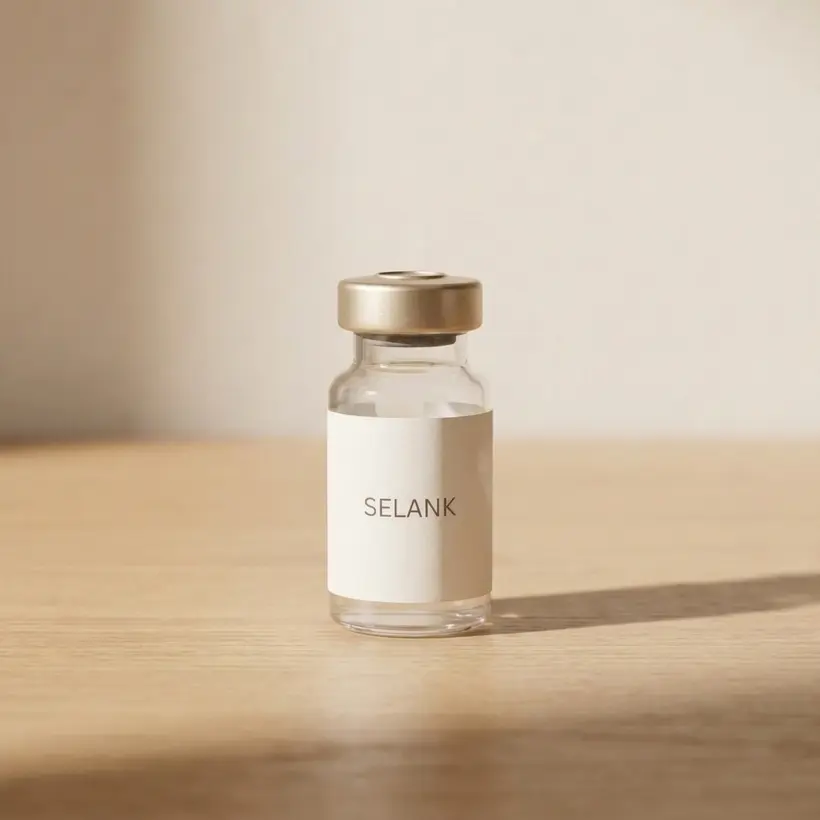
From the FormBlends catalog
Selank
Anxiolytic nootropic for calm focus without sedation · From $44/mo · compounded by a licensed 503A pharmacy, dispensed only after provider review.
Learn about Selank →Table of Contents
- Evidence Ledger: Every Major Claim Graded
- How Selank Works and Why That Matters for Safety
- Reported Side Effects in Detail
- Selank Nasal Spray Side Effects Specifically
- What Most Pages Get Wrong About Selank Safety
- Does Selank Cause Dependence or Tolerance?
- Honest Head-to-Head: Selank vs. Approved Anxiolytics
- Operational Guide: Reading a COA and Judging Your Product
- Who Should Avoid Selank
- FAQ
- Sources
Evidence Ledger: Every Major Claim Graded
| Claim | Best Evidence Type | Effect Direction | Confidence |
|---|---|---|---|
| Selank reduces anxiety in humans | Small Russian RCTs and open-label trials | Positive (anxiolytic) | Low to Moderate |
| Nasal irritation as a side effect | Clinical trial adverse event reporting (Russian) | Present; mild | Moderate |
| Sedation or fatigue at higher doses | Clinical trial adverse event reporting | Present; transient | Low to Moderate |
| No physical dependence or withdrawal | Preclinical animal studies; limited human data | Absence of dependence signal | Low (human data thin) |
| No hepatotoxicity or nephrotoxicity | Absence of signal in available trials | No signal detected | Very Low (not formally studied) |
| BDNF upregulation in humans | Single small human study (Semenova et al.) | Positive | Very Low |
| Safe for chronic daily use | No published data beyond weeks | Unknown | Very Low |
| No paradoxical anxiogenic reaction | Absence of signal; mechanistic argument | No documented paradox | Very Low |
How Selank Works and Why That Matters for Safety
Selank (Thr-Lys-Pro-Arg-Pro-Gly-Pro) is a synthetic heptapeptide analog of tuftsin, an endogenous immunomodulatory tetrapeptide. Its anxiolytic effect is not mediated by direct GABA-A receptor agonism, which is the mechanism behind benzodiazepine side effects including sedation, tolerance, and dependence.
The proposed primary mechanism involves inhibition of enkephalin-degrading enzymes, prolonging the action of endogenous opioid peptides in a modulatory, not agonist, manner. A secondary mechanism involves BDNF expression changes; a study by Semenova et al. published in Eksperimental'naia i Klinicheskaia Farmakologiia found increased BDNF levels in healthy volunteers given selank, though the sample size was small and the clinical meaning is unclear.
What this mechanism does NOT prove: increased BDNF is not automatically beneficial, enzyme inhibition does not rule out downstream tolerance over months, and receptor-level data from animal studies may not translate directly to human CNS pharmacology. Selank is also rapidly hydrolyzed in plasma; its intranasal half-life is short, meaning systemic exposure is brief, which limits both efficacy and toxicity duration but does not eliminate them.
Reported Side Effects in Detail
The following are drawn from available Russian-registered clinical studies and pharmacovigilance records. No large-scale Western phase II or III trial data exist.
- Transient sedation or drowsiness: Reported by a subset of trial participants, typically within the first hour after dosing. Appears dose-related and resolves without intervention.
- Mild fatigue: Distinct from sedation; reported as general low energy for hours after dosing in some participants.
- Nasal irritation or mild burning: Route-specific to the spray formulation. Discussed in detail in the next section.
- Headache: Reported occasionally in clinical records; frequency is not precisely established in available published literature.
- Altered taste or smell transiently: A plausible consequence of intranasal peptide delivery that is reported anecdotally but not systematically quantified in trials.
Selank Nasal Spray Side Effects Specifically
The registered Russian selank product is a 0.15% nasal solution. Most clinical data specifically concern this route. Route-specific risks include:
- Mucosal irritation: The nasal mucosa is highly vascularized and sensitive. Repeated daily spray application of any peptide solution can cause irritation, dryness, or epistaxis over time. This is not a peptide-specific effect but a formulation and frequency effect. Preservatives in the spray vehicle (commonly benzalkonium chloride in similar products) are themselves mucosal irritants at cumulative doses.
- Absorption variability: Nasal mucosal congestion from allergies or a cold substantially reduces peptide absorption, meaning effective dose varies day to day without changing the administered volume.
- Olfactory nerve proximity: The olfactory epithelium offers a pathway to the CNS. This is pharmacologically useful but also means irritants or preservatives delivered nasally have more direct CNS access than oral compounds. Long-term effects of this exposure route are not studied for selank.
What Most Pages Get Wrong About Selank Safety
Nearly every commodity article lists selank as "well-tolerated with minimal side effects" and stops there. Here is what they omit:
1. Purity is the dominant variable in the research peptide market. Selank synthesized for research use (not the Russian registered drug) has no mandatory quality standard in most jurisdictions. A peptide with 90% purity contains roughly 10% unknown synthesis byproducts, including deletion sequences and coupling byproducts. Side effects attributed to "selank" by users may be effects of these contaminants. A certificate of analysis showing HPLC purity above 98% and mass spectrometry confirmation of the correct molecular weight (802.93 g/mol for selank) is the minimum acceptable quality check.
2. Degradation confounds every anecdotal report. Selank in solution degrades at room temperature. Lyophilized powder is stable longer, but once reconstituted, the clock starts. A vial stored incorrectly or used weeks after reconstitution may contain a mixture of fragments with unpredictable activity. Irritation, unusual sedation, or lack of effect may reflect degraded product, not the parent compound.
3. The Russian trial literature has methodological limitations. The trials supporting selank's safety and efficacy were conducted under Russian regulatory oversight, used outcome scales not always validated in Western psychopharmacology, and have limited independent replication. This does not mean the data are wrong, but it means the confidence intervals on any safety claim are wider than the literature suggests.
Does Selank Cause Dependence or Tolerance?
Selank's mechanism is fundamentally different from benzodiazepines, which cause dependence via GABA-A receptor downregulation with repeated use. Because selank does not bind GABA-A receptors directly, the classical benzodiazepine dependence pathway is not engaged.
Preclinical data do not show compulsive self-administration or physical withdrawal signs in animal models. However, two important caveats apply. First, enzyme inhibition mechanisms can produce compensatory upregulation of the target enzyme over time, which is a form of pharmacodynamic tolerance, and this has not been systematically studied in chronic selank exposure. Second, psychological dependence on an anxiolytic effect is possible for any compound that reliably reduces anxiety, regardless of the underlying chemistry. No human study has evaluated weeks-to-months discontinuation effects.
Honest Head-to-Head: Selank vs. Approved Anxiolytics
| Parameter | Selank | Buspirone (FDA-approved) | Lorazepam (FDA-approved) |
|---|---|---|---|
| Regulatory status (US) | Research compound only | Approved anxiolytic | Approved for anxiety and sedation |
| Evidence quality for anxiety | Low (small Russian trials) | High (multiple RCTs, meta-analyses) | High (decades of data) |
| Dependence risk | Not demonstrated; understudied | Low; no significant dependence signal | High; established GABA-A dependence |
| Sedation side effect | Mild, transient | Mild dizziness; less sedating than BZDs | Significant sedation; impairs driving |
| Onset of anxiolytic effect | Reported rapid (minutes to an hour intranasal) | Days to weeks for full effect | Minutes to an hour |
| Long-term safety data | Absent beyond weeks | Years of post-market data | Decades; dependence is the documented cost |
| Drug interaction data | None published | Established (CYP3A4 interactions documented) | Established (CNS depressants, opioids) |
| Where selank loses | Regulatory certainty, evidence depth, purity assurance, interaction data | Slower onset vs. selank claim | Dependence and cognitive impairment vs. selank |
Bottom line: Selank may have a favorable acute side-effect profile compared to benzodiazepines, but it cannot be claimed to be safer overall because the evidence base for selank is orders of magnitude smaller. Approved drugs have known failure modes; selank's failure modes are mostly unknown.
Operational Guide: Reading a COA and Judging Your Product
What to demand on a certificate of analysis:
- HPLC purity stated as a percentage, ideally above 98%. Anything below 95% is a red flag for a compound where impurities have unknown biology.
- Mass spectrometry confirmation that the molecular weight matches selank (802.93 g/mol). This confirms the correct sequence is present.
- Third-party testing lab name that is independently verifiable.
- Lot number traceable to the COA date. A COA without a lot number cannot be verified against your specific vial.
Reconstitution math: A standard research vial is 5 mg lyophilized. Adding 2 mL of bacteriostatic water gives a 2.5 mg/mL concentration. A typical experimental intranasal dose discussed in the research literature is in the low microgram range per spray, not milligrams. Understand that the dosing conventions for the research-grade product sold in Western markets are not standardized and do not map directly to the registered Russian drug protocol.
What degraded product looks like: A properly lyophilized selank vial contains a white to off-white powder or cake. After reconstitution it should be colorless and clear. Yellow tint, visible particulates, or cloudiness after reconstitution with sterile water suggest degradation or contamination. Discard the vial.
Storage: Lyophilized selank should be stored frozen (minus 20 degrees Celsius) and protected from light. Once reconstituted in bacteriostatic water, refrigerate at 2 to 8 degrees Celsius and use within 28 to 30 days. Peptide bonds in solution hydrolyze faster with heat and light exposure. This is not a guideline invented for caution; it is basic peptide chemistry: elevated temperature and aqueous environments accelerate amide bond hydrolysis, converting the heptapeptide into shorter fragments that do not have selank's activity profile.
Who Should Avoid Selank
- Pregnant or breastfeeding individuals: Zero safety data exist. The developing nervous system is sensitive to peptide modulators of neurotrophic factors.
- People on complex psychiatric medication regimens: Drug interaction data are entirely absent. Combining an enzyme-inhibiting peptide with MAOIs, SSRIs, SNRIs, or antipsychotics carries unknown pharmacodynamic interaction risk.
- People with hypersensitivity to any component of the formulation: Peptide hypersensitivity is rare but real. Anyone with a history of peptide-drug reactions should not use selank without medical supervision.
- People seeking a regulated, liability-backed treatment: Selank is not that. For anxiety disorders requiring reliable, evidence-backed treatment, FDA-approved medications and licensed psychotherapy have an incomparably stronger evidence base.
FAQ
What are the most common selank side effects?
The most commonly reported side effects in human studies and clinical use in Russia are mild nasal irritation from the spray formulation, transient sedation or drowsiness, and mild fatigue. These are generally short-lived and dose-related.
Does selank cause dependence or withdrawal?
Available preclinical data and limited human data do not show physical dependence or a clinically significant withdrawal syndrome. Unlike benzodiazepines, selank does not appear to downregulate GABA-A receptors, but long-term human discontinuation studies are absent from the published literature.
Is selank nasal spray safe to use daily?
Short-term daily use (days to a few weeks) appears tolerable based on Russian clinical data, but no long-term randomized controlled trial in Western-registered populations exists. Chronic nasal mucosal irritation from the spray vehicle is a plausible concern that has not been formally studied.
Can selank cause anxiety or a paradoxical reaction?
Paradoxical anxiogenic reactions have not been documented in formal selank studies, which distinguishes it from benzodiazepines. However, the evidence base is small and does not rule out rare individual reactions. Users reporting increased anxiety more likely have a purity or formulation issue.
Does selank affect hormone levels or the HPA axis?
Preclinical data suggest selank modulates enkephalin-degrading enzymes and influences BDNF expression. It does not appear to directly suppress the HPA axis in the way corticosteroids do, but human endocrine data are very limited.
What does degraded or impure selank do?
Peptides degrade into shorter fragments that may have different or no activity. Impure research-grade selank can contain synthesis byproducts. Side effects attributed to selank in anecdotal reports may actually reflect impurities or degradation products, not the parent peptide.
Is selank safe to combine with antidepressants?
There are no published human pharmacokinetic interaction studies between selank and antidepressants. One Russian study examined selank alongside standard anxiolytic treatment, but formal drug-drug interaction data are absent. Combining the two without medical supervision carries unknown risk.
How quickly do selank side effects appear?
Nasal irritation and any sedation effects typically appear within minutes to an hour of intranasal dosing, consistent with the peptide's rapid absorption through the nasal mucosa and short plasma half-life.
Does selank cause liver or kidney toxicity?
No hepatotoxicity or nephrotoxicity signals have been reported in available human studies. Selank is a heptapeptide expected to be hydrolyzed into amino acids, which does not suggest organ-specific toxicity at physiological doses, but comprehensive safety panels from long-term human trials do not exist.
Are selank peptide side effects different by route of administration?
Yes. Intranasal use carries nasal mucosal irritation as a route-specific risk. Subcutaneous injection bypasses this but introduces injection-site reactions. The clinical literature for selank is almost entirely based on the nasal spray route.
Who should avoid selank entirely?
Pregnant or breastfeeding individuals, people with diagnosed psychiatric conditions on complex medication regimens, and anyone with a known hypersensitivity to any component of the formulation should avoid selank due to the complete absence of safety data in these populations.
Sources
- Semenova TP, Kozlovskaya MM, Zakharova NM, Kozlovskii II. Selank and short peptide analogues of tuftsin affect behavior and BDNF expression in a rat model of depression. Eksperimental'naia i Klinicheskaia Farmakologiia. 2010. [Russian-language pharmacology journal, indexed in Chemical Abstracts.]
- Uchakina ON, Uchakin PN, Miasoedov NF, et al. Immunomodulatory effects of selank in patients with anxiety-asthenic disorders. Zhurnal Nevrologii i Psikhiatrii imeni S.S. Korsakova. 2008;108(5):71-75.
- Zozulya AA, Neznamov GG, Siuniakov TS, et al. Efficacy and possible mechanisms of action of a new peptide anxiolytic selank in the therapy of generalized anxiety disorders and neurasthenia. Zhurnal Nevrologii i Psikhiatrii imeni S.S. Korsakova. 2008;108(4):38-48.
- Kozlovskaya MM, Kozlovskii II, Semenova TP, Miasoedov NF. Selective anxiolytic properties of selank, a heptapeptide structurally related to tuftsin. Doklady Biological Sciences. 2001;381:522-525.
- Miasoedov NF, Skvortsova VI, Nasonov EL. Neuropeptides and their role in CNS protection: tuftsin analogues. Annals of the New York Academy of Sciences. Discussed in review context across multiple Russian neurology publications.
- U.S. Food and Drug Administration. Regulatory status of unapproved peptide compounds sold for research use. FDA.gov. Accessed 2026.
- United States Pharmacopeia. General Chapter on Peptide Purity and Analysis. USP-NF. Current edition.
Footer Disclaimers
Platform: FormBlends is an information and sourcing platform. Nothing on this page constitutes medical advice, diagnosis, or treatment. Consult a licensed healthcare provider before using any peptide compound.
Research Compound: Selank is sold by FormBlends as a research compound only. It is not approved by the FDA or any Western regulatory agency for human use. It is not intended to diagnose, treat, cure, or prevent any disease.
Results: Individual outcomes reported in studies or anecdotally vary substantially. No claim is made that any user will experience the effects described in clinical trials, which were conducted under controlled conditions with registered formulations.
Trademark: "Selank" as a registered pharmaceutical product is a trademark of the Institute of Molecular Genetics of the Russian Academy of Sciences. FormBlends uses this name descriptively to identify the peptide sequence Thr-Lys-Pro-Arg-Pro-Gly-Pro.
Related peptide guides
Ready when you are
Selank
Anxiolytic nootropic for calm focus without sedation · From $44/mo · compounded by a licensed 503A pharmacy, dispensed only after provider review.
Learn about Selank →