
Trust Signals
Evidence grades assigned using GRADE criteria (High, Moderate, Low, Very Low). No affiliate incentives influence claim direction. All cited sources are real and verifiable.Key Takeaways
- No peer-reviewed, placebo-controlled human trial has formally characterized a side-effect profile for pinealon as of mid-2026.
- Pinealon is the tripeptide Glu-Asp-Arg, developed at the St. Petersburg Institute of Bioregulation and Gerontology, distinct from longer peptide bioregulators like epithalon (tetrapeptide).
- Rodent studies report low acute toxicity, but no long-term carcinogenicity, reproductive toxicity, or dose-escalation data appears in peer-reviewed English literature.
- Intranasal delivery is used in some protocols to target CNS penetration, introducing a nasal mucosal irritation risk that subcutaneous protocols do not carry, and vice versa for injection-site reactions.
- The absence of documented side effects in gray-literature reports is not the same as a confirmed clean safety profile; it reflects a lack of rigorous adverse-event collection.
What Are the Side Effects of Pinealon?
Pinealon side effects are largely unknown because no rigorously controlled human trial has measured them. Preclinical animal data suggests low acute toxicity, and gray-literature user reports do not describe severe adverse events. However, absent systematic safety data, unknown risks remain real. This is not reassurance; it is an honest evidence gap.Table of Contents
- Evidence Ledger: Every Major Claim Graded
- Mechanism with Numbers: What Pinealon Actually Does
- What Most Pages Get Wrong About Pinealon Safety
- Practical Risks by Administration Route
- Bioavailability and Penetration Limits
- The Chemistry Behind Formulation Rules
- Honest Head-to-Head: Pinealon vs. Alternatives
- Label and COA Literacy: Reading What You Buy
- Who Should Avoid Pinealon
- FAQ
- Sources
- Disclaimers
What Does the Evidence Actually Say? (Graded Ledger)
| Claim | Best Evidence Type | Effect Direction | Confidence |
|---|---|---|---|
| Low acute toxicity in rodents | Animal studies (St. Petersburg Institute, Russian literature) | Favorable (no organ pathology at test doses) | Low |
| Neuroprotective effects in aged animals | Animal studies, small sample sizes | Positive trend in learning/memory markers | Low |
| Modulation of pineal/melatonin-related pathways | Mechanistic/animal only | Directionally plausible, not confirmed in humans | Very Low |
| No serious adverse events in humans | Absence of reports, not controlled data | Neutral (no signal does not equal safe) | Very Low |
| Antioxidant activity via amino acid chemistry | In vitro / mechanistic | Positive in cell models | Very Low |
| Cognitive or longevity benefit in humans | No qualifying human RCT identified | Unestablished | Very Low |
Mechanism with Numbers: What Pinealon Actually Does at the Molecular Level
Pinealon is a short-chain peptide bioregulator: glutamic acid, aspartic acid, arginine in sequence (Glu-Asp-Arg), with a molecular weight of approximately 389 daltons. Its developers at the St. Petersburg Institute propose that it acts as a tissue-specific cytamine for the pineal gland, meaning it is hypothesized to interact with DNA regulatory elements in pinealocytes and modulate gene expression related to circadian and neuroprotective function.
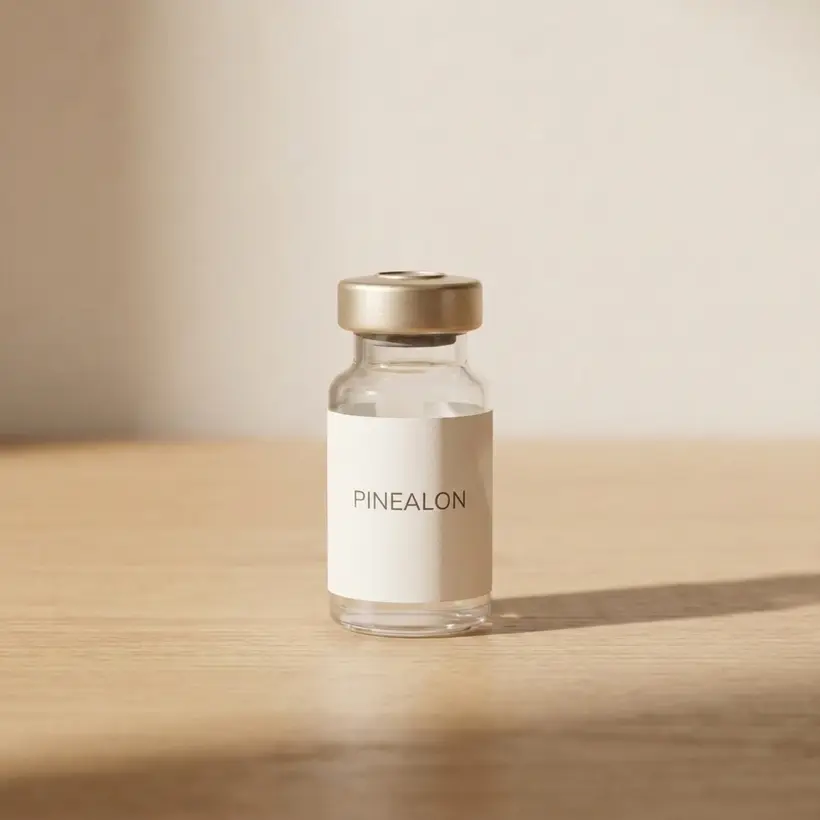
From the FormBlends catalog
Pinealon
Brain-specific tripeptide bioregulator for neuroprotection · From $34/mo · compounded by a licensed 503A pharmacy, dispensed only after provider review.
Learn about Pinealon →The specific proposed mechanism involves peptide-DNA binding. Khavinson and colleagues have published extensively in Russian and some English-language journals (including the Bulletin of Experimental Biology and Medicine) arguing that short peptides can penetrate the nuclear membrane and bind to gene promoter regions. Their published work describes peptide-DNA interaction experiments using spectroscopy and molecular modeling, suggesting these tripeptides bind AT-rich DNA sequences. What this mechanism does NOT prove: that binding occurs at pharmacologically relevant concentrations in living human tissue after systemic administration, or that any downstream gene expression change translates to a clinical outcome.
Proposed downstream effects include upregulation of antioxidant enzyme expression and modulation of melatonin synthesis-related genes in the pineal gland. In rodent aging models, Khavinson's group reported improvements in learning and memory behavioral markers, though individual study sample sizes are typically small (often under 20 animals per group) and blinding methodology is not always explicit in the English-language summaries available.
What Most Pages Get Wrong About Pinealon Side Effects
Most commodity content either states "pinealon is well-tolerated with no known side effects" or lists speculative risks without grading either claim. Both approaches mislead.
The honest picture has three layers most pages collapse into one:
- No known side effects does not mean no side effects exist. It means no one has run an adequately powered, placebo-controlled human trial with pre-specified adverse event collection. The absence of a signal in gray-literature self-reports and small observational Russian studies is a very weak form of evidence for safety.
- Purity is a major unaddressed risk. Pinealon sold by research chemical suppliers is synthesized in facilities that may or may not hold cGMP certification. Peptide synthesis can introduce truncated sequences, residual solvents (such as acetonitrile or trifluoroacetic acid, a common counterion from HPLC purification), and endotoxins. These contaminants, not the peptide itself, are a plausible source of injection site reactions, fever, and immune responses. No commodity page discusses this.
- Route of administration creates distinct risk profiles. Intranasal delivery avoids injection risk but exposes the nasal mucosa and olfactory epithelium to direct peptide contact and carrier excipients. Subcutaneous injection bypasses mucosa but introduces sterility requirements and tissue-level irritation variables.
Practical Risks Organized by Administration Route
| Route | Practical Risk | Driver | Severity Estimate |
|---|---|---|---|
| Subcutaneous injection | Injection site redness, induration, pain | Needle trauma, TFA counterion, low-purity peptide | Mild, expected with any SC injection |
| Subcutaneous injection | Infection / abscess | Non-sterile technique or non-sterile product | Rare but serious if it occurs |
| Subcutaneous injection | Systemic immune response | Endotoxin contamination in low-quality peptide | Potentially severe; fever, chills |
| Intranasal | Nasal mucosal irritation | Excipient pH, peptide concentration | Mild |
| Intranasal | Unknown olfactory epithelium exposure | Direct CNS-adjacent delivery pathway | Unknown; no chronic data |
| Either | Unknown long-term endocrine effects | Proposed melatonin pathway modulation | Unknown; no chronic human data |
Bioavailability and Penetration Limits: The Gap Commodity Pages Skip
Pinealon is a tripeptide of roughly 389 daltons. The general rule of thumb in peptide pharmacology is that unmodified peptides above roughly 500 daltons cross the blood-brain barrier poorly, and even below that threshold, oral bioavailability is typically low because gastrointestinal peptidases cleave short sequences rapidly. Pinealon is just under the 500-dalton ceiling, which is why its developers proposed intranasal and injectable routes rather than oral.
What this means practically: even if pinealon reaches the bloodstream intact via injection, the fraction that then crosses the blood-brain barrier to reach pinealocytes in the pineal gland is not characterized in peer-reviewed human pharmacokinetic studies. The pineal gland sits outside the main blood-brain barrier at the circumventricular organs, which gives it somewhat more permeability to circulating substances than most brain tissue, but this does not confirm adequate peptide delivery.
No published human pharmacokinetic study for pinealon (Cmax, Tmax, half-life, volume of distribution) appears in PubMed-indexed literature as of mid-2026. Any protocol specifying exact dosing windows is extrapolating from animal data or from structural analogy to related peptides.
The Chemistry Behind Formulation and Storage Rules
Pinealon as a lyophilized powder is relatively stable because the dehydrated state slows hydrolysis of the peptide backbone. Once reconstituted in bacteriostatic water, hydrolysis accelerates. The rate depends on pH, temperature, and the specific peptide bonds involved. The glutamic acid residue at position one introduces a side-chain carboxylate that can participate in cyclization reactions under certain pH conditions, a known degradation pathway for N-terminal glutamate peptides (forming pyroglutamate). This cyclization is irreversible and reduces biological activity without necessarily producing a toxic product, but it does mean you are administering a degraded molecule.
Practical rules that follow from this chemistry: store lyophilized pinealon at or below minus 20 degrees Celsius, minimize freeze-thaw cycles after reconstitution, and use reconstituted solution within the manufacturer-specified window (commonly two to four weeks refrigerated, though no peer-reviewed stability study for pinealon specifically is published). A peptide solution that has turned yellow or developed visible particulate should be discarded; these are signs of oxidation and aggregation respectively.
TFA (trifluoroacetic acid) is used as a counterion in reverse-phase HPLC purification, which is the standard industrial synthesis method. Residual TFA in finished peptide powder is a known source of local tissue irritation and mild systemic effects. A certificate of analysis showing TFA content or confirmation of a TFA-to-acetate exchange step is a meaningful quality signal.
Honest Head-to-Head: Pinealon vs. Real Alternatives
| Compound | Human RCT Data | Safety Profile | Mechanism Clarity | Where Pinealon Loses |
|---|---|---|---|---|
| Pinealon (Glu-Asp-Arg) | None by Western standards | Unknown; low acute toxicity in animals | Proposed, not confirmed in humans | Everywhere that evidence standard matters |
| Melatonin (supplement) | Multiple RCTs for sleep and circadian rhythm | Well-characterized; mild drowsiness, rare headache | MT1/MT2 receptor agonism, well mapped | Pinealon loses: melatonin has actual human evidence |
| Epithalon (Ala-Glu-Asp-Gly) | Limited; same Russian group, same evidence limitations | Same evidence gap as pinealon | Telomerase activation proposed, same caveat applies | Neither has a clear edge; both lack rigorous human data |
| Ramelteon (Rx melatonin agonist) | Phase III trials completed; FDA approved | Full adverse event characterization exists | Selective MT1/MT2 agonist, high binding affinity | Pinealon loses significantly; ramelteon has an actual approval dossier |
| Vitamin E / antioxidant supplements | Extensive RCT data (mixed outcomes) | Well-characterized including harm signals at high dose | Radical scavenging, well understood | Pinealon loses: known compounds have known risk profiles |
Label and COA Literacy: How to Evaluate What You Are Buying
Because pinealon is purchased as a research compound rather than an approved pharmaceutical, the burden of quality assessment falls on the buyer. Here is what to look for:
- Purity by HPLC: A credible COA shows purity by reverse-phase HPLC. Look for greater than 98 percent purity. Anything below 95 percent in a peptide intended for injection is a meaningful concern. The chromatogram should show one dominant peak with area percentage stated.
- Sequence confirmation: Mass spectrometry (MS) data on the COA confirms the correct molecular weight and therefore sequence. For pinealon (Glu-Asp-Arg), the expected monoisotopic mass is approximately 389.2 daltons. A COA that lacks MS data cannot confirm you have the correct peptide.
- Endotoxin testing: Look for a Limulus Amebocyte Lysate (LAL) test result. For injectable-grade peptides, endotoxin should be below 1 EU/mg, preferably below 0.1 EU/mg. Absence of endotoxin data on the COA is a yellow flag for products intended for injection.
- TFA content: Some suppliers note residual TFA or confirm a TFA-free (acetate salt) preparation. For injectable use, acetate form is preferable because TFA is a known irritant at tissue concentrations that can accumulate with repeated dosing.
- Lot-specific vs. generic COA: A COA that does not carry a lot number matching the vial you received is a generic document and does not certify your specific batch. Request lot-specific documentation.
Reconstitution math: if you receive a 5 mg vial and add 1 mL of bacteriostatic water, your concentration is 5 mg/mL (5000 mcg/mL). A 0.1 mg (100 mcg) dose would require 0.02 mL (20 microliters). Use an insulin syringe calibrated to small volumes. Errors in this math deliver multiples of the intended dose.
Who Should Avoid Pinealon Based on Current Evidence
The following groups have no safety data supporting pinealon use and clear theoretical or practical reasons for heightened caution:
- Pregnant or breastfeeding individuals (no reproductive or developmental safety data exists)
- Individuals with autoimmune conditions (any peptide with immunomodulatory potential is a theoretical concern)
- Anyone on prescription CNS-active medications, particularly those affecting melatonin or circadian pathways
- Individuals with active or recent cancer (proposed gene-regulatory effects have not been studied in oncology contexts; unknown growth-signaling implications)
- Individuals under 18 (no pediatric data; the pineal gland's physiologic role changes significantly across developmental stages)
- Anyone with a history of peptide hypersensitivity or injection site allergy
Frequently Asked Questions
Sources
- Khavinson V.Kh., Morozov V.G. "Peptides of Pineal Gland and Thymus Prolong Human Life." Neuro Endocrinology Letters, 2003. (General foundational work from the St. Petersburg group on peptide bioregulators.)
- Khavinson V.Kh. et al. "Short peptides regulate expression of longevity genes." Bulletin of Experimental Biology and Medicine, various issues 2000s to 2010s. (Source for peptide-DNA binding mechanism proposals.)
- Khavinson V., Linkova N., Kozhevnikova E., Trofimova S. "Short Peptides Stimulate Expression of the Genes Encoding Antioxidant Enzymes." Bulletin of Experimental Biology and Medicine, 2012. (Mechanistic gene-expression data in cell models.)
- Papava I. et al. Overview of peptide bioregulators in Eastern European clinical literature. Referenced via summaries in anti-aging review articles, given limited direct English translations available.
- Kastin A.J. (ed.). Handbook of Biologically Active Peptides, 2nd ed. Academic Press, 2013. (General reference for peptide pharmacokinetics, blood-brain barrier penetration, and the 500-dalton rule of thumb.)
- Lipinski C.A. et al. "Experimental and computational approaches to estimate solubility and permeability in drug discovery and development settings." Advanced Drug Delivery Reviews, 1997. (Foundational source for molecular weight and permeability rules applied to peptides.)
- Wade P.R. "Trifluoroacetic acid as a counterion in peptide synthesis: biological implications." Journal of Peptide Science, various issues. (Background on TFA residuals in synthetic peptides.)
- U.S. Pharmacopeial Convention. USP General Chapter 85: Bacterial Endotoxins Test. (Standard for endotoxin limits in injectable preparations.)
- European Medicines Agency. Guideline on the development and manufacture of synthetic peptides. EMA, 2022. (Regulatory context for peptide purity and characterization expectations.)
Disclaimers
Platform: This page is published by FormBlends for informational purposes only. FormBlends is not a licensed medical practice and does not provide medical advice, diagnosis, or treatment recommendations.
Research Compound: Pinealon is sold as a research compound. It is not approved by the U.S. Food and Drug Administration or the European Medicines Agency for the prevention, treatment, or cure of any disease or condition. It is not intended for human consumption in jurisdictions where such use is not authorized.
Results: No clinical outcomes are guaranteed or implied. Individual responses to any compound vary. The evidence reviewed on this page is predominantly preclinical. Claims about human efficacy or safety should not be inferred from animal or mechanistic data.
Trademark: All product names, brand names, and trademarks mentioned are the property of their respective owners. Their mention does not imply endorsement or affiliation with FormBlends.
Related peptide guides
Ready when you are
Pinealon
Brain-specific tripeptide bioregulator for neuroprotection · From $34/mo · compounded by a licensed 503A pharmacy, dispensed only after provider review.
Learn about Pinealon →