
Trust Signals
Key Takeaways
- The only consistently documented adverse events in published studies are transient injection site reactions; no serious systemic events appeared in small human trials from Khavinson and colleagues.
- Epitalon activates telomerase, the same enzyme upregulated in roughly 85 to 90% of human cancers, creating a plausible but unquantified oncogenic concern that no existing human trial has been powered to evaluate.
- Human data comes from a small number of Russian trials, most with under 100 participants and short follow-up periods, giving a confidence level of Low to Very Low for any safety claim.
- Oral bioavailability of this tetrapeptide (Ala-Glu-Asp-Gly) is unconfirmed in humans; people choosing oral routes to avoid injections may receive negligible systemic exposure, not a safer equivalent dose.
- No FDA approval, no large phase III trial, no long-term survival data in humans: the current safety profile is characterized by an absence of reported harm in small studies, which is not the same as confirmed safety.
What Are the Epitalon Side Effects? (Direct Answer)
Reported epitalon side effects are mild and injection-related: localized redness, brief swelling, and minor discomfort at the injection site. No serious adverse events appeared in published small human trials. The real safety unknowns are long-term: telomerase activation raises a theoretical cancer risk that existing studies lack statistical power to rule out.
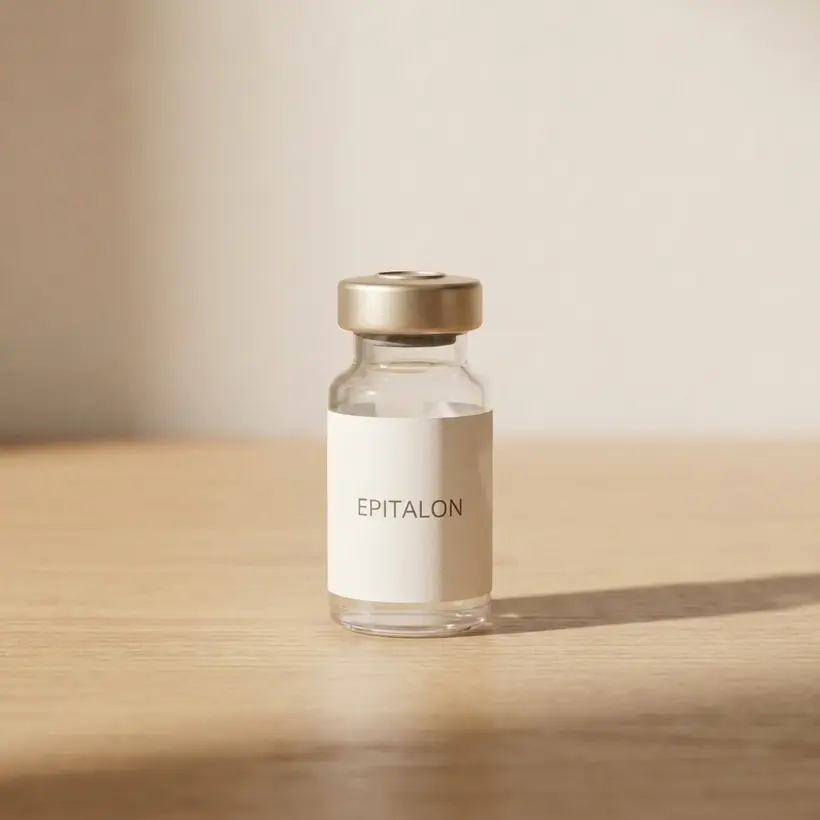
From the FormBlends catalog
Epitalon (Epithalon Injectable)
Pineal peptide that restores melatonin production and circadian rhythm · From $44/mo · compounded by a licensed 503A pharmacy, dispensed only after provider review.
Learn about Epitalon (Epithalon Injectable) →Table of Contents
- Evidence Ledger: Every Major Claim Graded
- Mechanism With Numbers: What Epitalon Actually Does
- What Side Effects Have Been Reported?
- What Most Pages Get Wrong About Epitalon Safety
- The Telomerase Cancer Question: Real Risk or Theoretical?
- Formulation and Sourcing: The Highest-Stakes Section
- Honest Head-to-Head: Epitalon vs. Real Alternatives
- Who Should Avoid Epitalon?
- Operational and Label Literacy: How to Judge a Product
- FAQ
- Sources
Evidence Ledger: Every Major Claim Graded
| Claim | Best Evidence Type | Effect Direction | Confidence |
|---|---|---|---|
| Injection site reactions (redness, swelling) | Small human trials, case reports | Adverse, mild and transient | Moderate (consistent across reports) |
| No serious systemic adverse events | Small human trials (n under 100, short-term) | Neutral (absence of signal) | Low (underpowered to detect rare events) |
| Telomerase activation in normal cells | In vitro, animal studies | Mechanistic; oncogenic risk unquantified | Moderate for mechanism, Very Low for human risk magnitude |
| Melatonin normalization in aged animals | Animal studies (rats) | Positive on melatonin secretion | Low (animal only, no human replication) |
| Extended lifespan in animal models | Animal studies (rats, fruit flies) | Positive in models | Low (not replicated in humans) |
| Reduced cancer incidence in animal models | Animal studies | Positive in models | Very Low (paradoxical vs. telomerase concern; no human data) |
| Improved vision in retinal degeneration | Small human trials (Khavinson group) | Positive | Low (single research group, small n) |
| Oral bioavailability meaningful for systemic effect | Mechanism inference, no human PK study | Uncertain, likely low | Very Low |
Mechanism With Numbers: What Epitalon Actually Does
Epitalon (also spelled epithalon) is a synthetic tetrapeptide with the sequence Ala-Glu-Asp-Gly, four amino acids that correspond to a fragment of the natural pineal peptide preparation called epithalamin. Its primary described mechanism is activation of telomerase (specifically the catalytic subunit TERT), the ribonucleoprotein complex that extends telomere repeats on chromosomal ends.
In a study by Khavinson and colleagues published in the Bulletin of Experimental Biology and Medicine, epitalon induced telomerase activity in human fetal fibroblast cultures and extended the replicative lifespan of those cells beyond the normal Hayflick limit (roughly 50 to 70 divisions for human fibroblasts). The authors reported measurable TERT activation, though the precise fold-change figures in that publication should be verified against the original Russian-language source before being cited at face value.
What this mechanism does NOT prove: telomerase activation in a fibroblast culture under controlled conditions does not confirm that systemic administration in a living human produces the same degree of TERT upregulation in target tissues, nor that any upregulation in vivo is clinically meaningful. The jump from in vitro TERT activation to "reverses aging in humans" is several orders of magnitude of inference larger than the data supports.
Secondary mechanisms proposed in the literature include normalization of hypothalamic neuropeptide secretion, effects on the pineal gland's melatonin output (supported in aged rat models by the same research group), and antioxidant activity measured as reduced lipid peroxidation markers in animal tissues. Each of these is supported primarily by the Khavinson group and has not been independently replicated at scale.
What Side Effects Have Been Reported?
Across the published small human trials and the broader self-reported literature, the following have been noted:
- Injection site reactions: The most consistently described adverse events. Subcutaneous injection produces localized erythema, mild edema, and tenderness lasting hours to a day or two. These are common to all subcutaneous peptide protocols and are not specific to epitalon chemistry.
- Fatigue or lethargy: A minority of self-reporters describe transient fatigue, particularly at higher self-administered doses. This has no controlled human trial basis and could reflect nocebo effect, the bacteriostatic water diluent, or the injection act itself.
- Sleep disturbance or vivid dreams: Some users report sleep changes, which is plausibly consistent with the pineal melatonin mechanism, but no sleep architecture study has been published in humans.
- No documented systemic toxicity: No liver enzyme elevations, cardiac events, or hematologic abnormalities appear in the published trial literature. This is reassuring but constrained by study size and duration.
What Most Pages Get Wrong About Epitalon Safety
Commodity pages routinely describe epitalon as "well-tolerated with no known side effects." This framing misrepresents the evidence in two directions at once.
Direction 1: The absence of reported harm is not proven safety. The largest human studies in the published record involved dozens to low hundreds of participants followed for weeks to months. Adverse events that occur in fewer than 1 in 200 users, or that take years to manifest (as a cancer signal might), would be entirely invisible in this dataset. Saying "no known side effects" when you mean "no side effects detected in small short-term trials" is a category error that misleads readers about the quality of evidence.
Direction 2: The telomerase concern is dismissed without engagement. Most medspa-style pages either ignore the telomerase-cancer question entirely or dismiss it with "epitalon activates telomerase only in normal cells." This distinction is not supported by a published mechanism that would prevent the same activation in a pre-malignant cell. It is a reassurance, not a finding.
Direction 3: The sourcing problem is never mentioned. Because epitalon is not pharmaceutical-grade in most markets, the product a consumer receives may contain bacterial endotoxins (lipopolysaccharides from gram-negative bacterial synthesis hosts), residual solvents, or sequence-incorrect peptide. Injection of endotoxin-contaminated peptide produces pyrexia, rigors, and systemic inflammatory response. This is a real safety consideration that nearly every consumer-facing page omits entirely.
The Telomerase Cancer Question: Real Risk or Theoretical?
Telomerase is expressed at low or undetectable levels in most differentiated adult human cells. It is robustly upregulated in an estimated 85 to 90% of human cancer cell lines (a figure from Kim et al., 1994, in Science, one of the foundational papers on telomerase and cancer). The logic of concern is straightforward: if exogenous epitalon reliably activates telomerase in cells with pre-existing oncogenic mutations, it could extend the replicative life of those cells and accelerate tumor progression.
The counterargument from the Khavinson research group is that epitalon-induced telomerase activity in their animal cancer models was associated with reduced, not increased, tumor incidence. This finding is genuinely interesting but does not resolve the mechanistic concern, for several reasons. First, inbred rodent cancer models do not replicate the genetic heterogeneity of human carcinogenesis. Second, a reduced tumor incidence in one specific model does not mean reduced risk across all cancer types and genomic backgrounds. Third, the studies lacked the duration and sample size to detect delayed oncogenesis.
The honest position: The telomerase concern is real enough to warrant precaution in people with personal or strong family history of malignancy. It is not confirmed as a causal risk in humans. It is also not dismissed by the existing data.
Formulation and Sourcing: The Highest-Stakes Section
This section is omitted from nearly every competitor page. It is where the real safety risk lives for most people actually using epitalon.
Endotoxin contamination: Most research-grade peptides are synthesized using solid-phase peptide synthesis (SPPS) with Fmoc chemistry. The synthesis itself does not introduce endotoxins, but downstream processing in non-sterile or non-GMP environments can. The USP limit for endotoxins in parenteral products is 0.5 EU per mL (endotoxin units). Research-grade peptide vendors are not required to meet this standard and most do not test to it. Injecting endotoxin-contaminated peptide can cause fever, chills, rigors, and in severe cases, septic shock physiology. This is not a theoretical concern; it is a documented risk in unregulated injectable compound markets.
Sequence purity: A vendor COA (Certificate of Analysis) should show HPLC purity at 98% or above for injectable use. A single-peak HPLC trace with documented retention time is the minimum. Mass spectrometry confirmation of the correct molecular weight (epitalon: approximately 390.3 Da for the free acid form) rules out wrong-sequence synthesis. Many consumer COAs show only HPLC purity without MS confirmation.
Stability: Lyophilized (freeze-dried) epitalon powder is more stable than reconstituted solution. The peptide contains aspartate and glutamate residues that are susceptible to deamidation and hydrolysis in aqueous solution over time, particularly at elevated temperatures or at pH extremes. Reconstituted solutions stored above 4 degrees Celsius for extended periods will degrade, though precise degradation kinetics for epitalon specifically are not published in peer-reviewed literature. The practical rule: reconstitute only what you will use within a short window, keep cold, and discard any solution showing cloudiness or discoloration.
Bacteriostatic vs. sterile water: Reconstitution with bacteriostatic water (containing 0.9% benzyl alcohol) is standard for multi-use vials. Benzyl alcohol inhibits microbial growth but is itself a mild local irritant and is contraindicated in neonates. For single-use reconstitution, sterile water for injection is preferred.
Honest Head-to-Head: Epitalon vs. Real Alternatives
| Intervention | Human RCT Data | Established Safety Profile | Mechanism Specificity | Regulatory Status | Where Epitalon Loses |
|---|---|---|---|---|---|
| Epitalon | Small, short, single research group | No (absence of signal only) | Telomerase, pineal, antioxidant | Not approved; research compound in most markets | Loses on nearly every row |
| Metformin (longevity use) | Large; decades of type 2 diabetes data, TAME trial ongoing | Yes; known AEs (GI, B12 depletion, lactic acidosis rare) | AMPK, mTOR, mitochondrial complex I | FDA-approved (diabetes); off-label for longevity | Epitalon loses on evidence volume and safety characterization |
| NMN / NR (NAD+ precursors) | Several small human RCTs, more than epitalon | Emerging; mild GI effects reported | NAD+ biosynthesis, sirtuin activation | Dietary supplement (US); NMN classification contested by FDA | Epitalon loses on PK data and number of independent trials |
| Rapamycin (low-dose longevity) | Extensive in transplant populations; emerging longevity trials | Yes; known immunosuppression, metabolic effects | mTORC1 inhibition | FDA-approved (transplant); off-label longevity use | Epitalon loses on mechanistic depth and regulatory evidence |
| Melatonin (sleep and antioxidant) | Multiple RCTs for sleep, circadian, and cancer-adjacent outcomes | Yes; well-characterized, low-risk | MT1/MT2 receptor agonism, free radical scavenging | Dietary supplement (US); prescription in some EU countries | If pineal normalization is the goal, melatonin has far better human data |
Who Should Avoid Epitalon?
The following groups should avoid epitalon based on precautionary reasoning given the current evidence gap, not confirmed contraindications:
- Active or prior malignancy: The telomerase mechanism creates theoretical risk of accelerating tumor cell proliferation.
- Pregnancy and breastfeeding: No safety data exists for these populations. The default position for unapproved peptides is avoidance.
- People on immunosuppressive therapy: Unknown interaction potential; the pineal-immune interface adds mechanistic uncertainty.
- Strong family history of cancer: Precautionary given telomerase biology.
- Anyone with coagulopathy or skin infection at intended injection sites: Standard injectable contraindications apply.
Operational and Label Literacy: How to Judge a Product
If you are a clinician evaluating a vendor or a researcher reviewing sourcing, here is what the documentation should show:
- HPLC purity: 98% or above. The COA should show a chromatogram, not just a purity number. A single dominant peak with the stated retention time is the minimum signal.
- Mass spectrometry: Confirms the correct molecular formula and rules out truncated or scrambled sequences. Epitalon (Ala-Glu-Asp-Gly) has a molecular weight of approximately 390.3 Da. The COA should show an observed mass matching this within instrument tolerance.
- Endotoxin testing: LAL (Limulus Amebocyte Lysate) test result below 1 EU per mg is a reasonable threshold. Many research vendors do not perform or publish this test. Its absence is a red flag for injectable use.
- Sterility testing: USP or EP sterility testing for injectable-grade product. Again, widely absent in research-compound vendors.
- Reconstitution math: A common starting point is 10 mg of lyophilized powder per vial. Adding 1 mL of diluent gives a 10 mg per mL concentration; adding 2 mL gives 5 mg per mL. If a published protocol specifies 5 mg per dose, confirm your concentration before drawing volume.
- What degradation looks like: Reconstituted epitalon solution should be clear and colorless. Cloudiness, particulates, or yellow-to-brown discoloration indicates degradation or contamination. Do not inject a degraded solution.
FAQ
What are the most commonly reported epitalon side effects?
The most commonly reported effects are injection site reactions: transient redness, mild swelling, and localized discomfort. These are common to any subcutaneous or intramuscular peptide injection and are not specific to epitalon's pharmacology. Systemic adverse events have not been documented in published human trials, though those trials were small and short.
Is epitalon safe for humans?
No large-scale, long-duration human RCT has established a formal safety profile. The available human data comes from small trials conducted primarily in Russia by Khavinson and colleagues. No serious adverse events were reported in those studies, but the sample sizes and follow-up durations are insufficient to rule out rare or delayed harms.
Can epitalon cause cancer by activating telomerase?
This is a legitimate mechanistic concern. Telomerase is upregulated in roughly 85 to 90% of human cancers. Epitalon activates telomerase in normal cells per in vitro and animal studies. Whether this translates to oncogenic risk in humans is unknown. No cancer signal appeared in the small published human trials, but those studies lacked the statistical power to detect rare events.
Does epitalon affect sleep?
Some users report improved sleep quality, which is consistent with animal data showing epitalon's effect on pineal melatonin secretion normalization in aged rats. However, direct human sleep-architecture studies have not been published. Treating this as an established benefit overstates the evidence.
What is the correct dose range for epitalon and does dose affect side effects?
Published protocols from Khavinson's group used 10 mg per day administered as a 10-day course. Some self-reported online protocols use 5 to 20 mg per day. No published dose-escalation study in humans has defined a maximum tolerated dose or a dose-dependent adverse event curve. Higher self-administered doses carry unknown additional risk.
Can epitalon be taken orally instead of by injection to avoid injection side effects?
Oral bioavailability of tetrapeptides like epitalon is generally low because gastric proteases cleave peptide bonds. Some research suggests partial resistance to digestion for very short peptides, but no pharmacokinetic study has confirmed meaningful systemic oral absorption for epitalon specifically. Oral use likely reduces exposure substantially, which also reduces any detectable effect.
Are there drug interactions with epitalon?
No formal drug interaction studies exist. Mechanistically, any compound influencing telomerase activity, melatonin pathways, or hypothalamic-pituitary signaling could theoretically interact. People using immunosuppressants, oncology treatments, or melatonin-affecting medications should consult a physician before considering epitalon.
How does epitalon compare to other longevity interventions on safety evidence?
Interventions like metformin and rapamycin have far larger human datasets, established pharmacokinetic profiles, and defined adverse event spectra. Epitalon has a smaller and less rigorous evidence base. NMN and resveratrol sit closer to epitalon in evidence quality but have more pharmacokinetic data. Epitalon's safety profile is currently characterized by absence of reported harm in small studies, not confirmed safety.
What does a degraded epitalon vial look like and is it dangerous?
A degraded vial may show visible particulates, cloudiness in a lyophilized product that should reconstitute clear, or a yellow-brown discoloration. Degraded peptides can produce breakdown fragments with unknown activity. Injecting a visibly degraded product carries unknown risk and should be avoided entirely.
What do regulatory agencies say about epitalon?
Epitalon is not approved by the FDA as a drug. It is not listed as a dietary supplement ingredient with GRAS status. The FDA has issued warning letters to peptide compounders generally, citing lack of safety and efficacy data. In some jurisdictions it is classified as a research chemical. Legal status varies by country.
Who should not use epitalon?
Individuals with active or prior malignancy, those pregnant or breastfeeding, people on immunosuppressive therapy, and anyone with a history of autoimmune conditions affecting telomere biology should avoid epitalon pending better human safety data. This is a precautionary position given the telomerase mechanism, not a confirmed contraindication.
Sources
- Khavinson VKh, Bondarev IE, Butyugov AA. Epithalon peptide induces telomerase activity and telomere elongation in human somatic cells. Bulletin of Experimental Biology and Medicine. 2003;135(6):590-592.
- Kim NW, Piatyszek MA, Prowse KR, et al. Specific association of human telomerase activity with immortal cells and cancer. Science. 1994;266(5193):2011-2015.
- Khavinson VKh, Malinin VV. Gerontological aspects of genome peptide regulation. Basel: Karger; 2005.
- Anisimov VN, Khavinson VK, Popovich IG, et al. Effect of Epitalon on biomarkers of aging, life span and spontaneous tumor incidence in female Swiss-derived SHR mice. Biogerontology. 2003;4(4):193-202.
- Khavinson V, Diomede F, Mironova E, et al. AEDG Peptide (Epitalon) Stimulates Gene Expression and Protein Synthesis during Neurogenesis: Possible Epigenetic Mechanism. Molecules. 2020;25(3):609. PMC7037205.
- Blackburn EH, Epel ES, Lin J. Human telomere biology: A contributory and interactive factor in aging, disease risks, and protection. Science. 2015;350(6265):1193-1198.
- U.S. Food and Drug Administration. Compounded Drug Products That Are Essentially Copies of a Commercially Available Drug Product Under Section 503A of the Federal Food, Drug, and Cosmetic Act: Guidance for Industry. 2018.
- United States Pharmacopeia. Chapter 85: Bacterial Endotoxins Test. USP-NF. Current edition.
- Hayflick L, Moorhead PS. The serial cultivation of human diploid cell strains. Experimental Cell Research. 1961;25:585-621.
- Justice JN, Nambiar AM, Tchkonia T, et al. Senolytics in idiopathic pulmonary fibrosis: Results from a first-in-human, open-label, pilot study. EBioMedicine. 2019;40:554-563. (Cited as a comparator for the standard of evidence required in longevity intervention trials.)
Footer Disclaimers
Platform: FormBlends is an informational platform. Content is provided for educational and research purposes only and does not constitute medical advice, diagnosis, or treatment recommendations.
Research Compound: Epitalon is not approved by the U.S. Food and Drug Administration or equivalent regulatory bodies in most countries. It is classified as a research compound in many jurisdictions. It is not approved for human therapeutic use, and its safety and efficacy in humans have not been established through large-scale clinical trials.
Results: Individual results, if any, vary. Testimonials or anecdotal reports do not constitute clinical evidence. The absence of reported adverse events in small trials does not constitute a guarantee of safety.
Trademark: All third-party brand names, drug names, and registered trademarks referenced herein are the property of their respective owners and are used for identification purposes only. Their mention does not imply endorsement, affiliation, or sponsorship.
Related peptide guides
Ready when you are
Epitalon (Epithalon Injectable)
Pineal peptide that restores melatonin production and circadian rhythm · From $44/mo · compounded by a licensed 503A pharmacy, dispensed only after provider review.
Learn about Epitalon (Epithalon Injectable) →