
Trust Signals
Key Takeaways
- GHRP-6 is a GHS-R1a agonist with a molecular weight of approximately 873 Da; its GH-releasing effect is confirmed in human pharmacology studies but body-composition outcomes in healthy adults are not established by controlled trials.
- GHRP-6 produces a stronger hunger response than GHRP-2 or Ipamorelin because GHS-R1a receptors in the hypothalamic arcuate nucleus directly drive appetite, making caloric discipline harder during use.
- A trustworthy GHRP-6 Certificate of Analysis includes HPLC purity above 98%, mass-spec confirmation of the 873 Da molecular weight, and a named third-party testing laboratory on a batch-specific document.
- Reconstituted GHRP-6 in bacteriostatic water is subject to oxidative and hydrolytic degradation; most researchers limit storage to 28 days refrigerated.
- WADA prohibits GHRP-6 under the GH secretagogue class; athletes subject to testing carry a meaningful risk even with research-context purchasing.
What Is GHRP-6 and Should You Buy It?
If you want to buy GHRP-6, understand this first: it is a research peptide with real human pharmacology data on GH release but no approved therapeutic use and no robust human RCT proving body-composition benefits. It is legally sold as a research compound in the US, not for human consumption. The mechanism is well-characterized; the outcome claims made by most sellers are not.
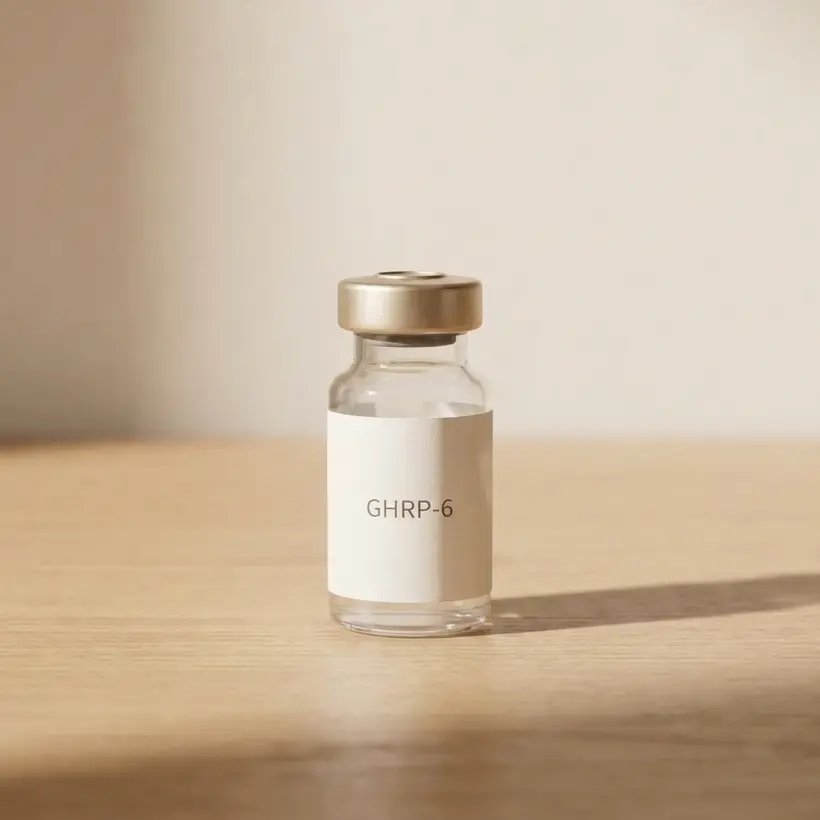
From the FormBlends catalog
GHRP-6
Growth hormone secretagogue with appetite-stimulating properties · From $29/mo · compounded by a licensed 503A pharmacy, dispensed only after provider review.
Learn about GHRP-6 →Table of Contents
- Mechanism: What GHRP-6 Actually Does and With What Specificity
- Evidence Ledger: Every Major Claim, Graded
- What Most GHRP-6 Pages Get Wrong
- Stability and Formulation: The Chemistry Behind Storage Rules
- Honest Head-to-Head: GHRP-6 vs GHRP-2 vs Ipamorelin
- Label and COA Literacy: How to Evaluate GHRP-6 for Sale
- Dosing and Reconstitution Math
- Legal and Anti-Doping Status
- Frequently Asked Questions
- Sources
Mechanism: What GHRP-6 Actually Does and With What Specificity
GHRP-6 (His-D-Trp-Ala-Trp-D-Phe-Lys-NH2) is a synthetic hexapeptide first characterized in the early 1980s by Bowers and colleagues as a GH-releasing compound structurally distinct from growth hormone-releasing hormone (GHRH). It binds the ghrelin receptor, GHS-R1a, as an agonist. GHS-R1a is a Gq-coupled GPCR; activation raises intracellular calcium and triggers GH granule exocytosis from pituitary somatotrophs.
Two simultaneous mechanisms amplify the GH pulse. First, direct pituitary stimulation via GHS-R1a. Second, suppression of somatostatin tone at the hypothalamic level, which removes the brake on GH release. Together these produce a pulse larger than either mechanism alone. Studies by Bowers and by the Growth Hormone Research Society's pharmacology work showed peak GH elevations typically within 15 to 30 minutes of subcutaneous administration, returning toward baseline within 60 to 90 minutes.
What the mechanism does NOT prove: A transient GH pulse does not automatically translate to sustained IGF-1 elevation, muscle hypertrophy, or fat loss in a metabolically normal adult. Endogenous GH pulsatility is already present; layering additional pulses on top does not linearly add anabolic output, and tachyphylaxis (receptor desensitization) with repeated dosing has been observed in secretagogue research.
Evidence Ledger: Every Major Claim, Graded
| Claim | Best Evidence Type | Effect Direction | Confidence |
|---|---|---|---|
| GHRP-6 raises plasma GH acutely in humans | Human controlled pharmacology studies (Bowers et al., multiple labs) | Positive, dose-dependent | High |
| GHRP-6 suppresses somatostatin to amplify GH pulse | Animal models, human mechanistic inference | Positive (mechanistic) | Moderate |
| GHRP-6 increases hunger via hypothalamic GHS-R1a | Human subjective reports + mechanistic (ghrelin receptor density in arcuate nucleus) | Strong positive (hunger) | High |
| GHRP-6 raises cortisol and prolactin transiently | Human pharmacology studies | Positive (transient elevation) | High |
| GHRP-6 improves body composition (fat loss / muscle gain) in healthy adults | Animal studies, extrapolation from GH physiology; no qualifying human RCT found | Unproven in humans | Very Low |
| GHRP-6 has cardioprotective effects | Preclinical (rodent ischemia models); one early human exploratory study in cardiac surgery | Positive signal (preclinical) | Low |
| GHRP-6 combined with GHRH produces synergistic GH release | Human pharmacology (well-replicated across labs) | Positive, synergistic | High |
| Sustained GHRP-6 use causes meaningful IGF-1 elevation in healthy adults | Limited human data; response attenuates with desensitization | Modest and diminishing | Low |
What Most GHRP-6 Pages Get Wrong
Purity theater vs. purity reality. Vendor pages display HPLC chromatograms and call the product "99% pure," but HPLC purity describes the percentage of the detected signal attributed to the target compound, not the absence of non-UV-active contaminants. Endotoxins (bacterial lipopolysaccharides from gram-negative fermentation media) are invisible to standard HPLC. A product can be 99% HPLC-pure and still contain pyrogenic endotoxins that produce fever, chills, or systemic inflammation on injection. A credible COA requires a separate Limulus Amebocyte Lysate (LAL) endotoxin test result, typically expressed in EU/mg. Most commodity GHRP-6 pages never mention this.
The hunger effect is not a niche concern. Because GHRP-6 is a close ghrelin mimetic, the hunger response is mechanistically baked in and proportional to receptor engagement. Users who buy GHRP-6 expecting a "clean" GH pulse for fat loss frequently report caloric overeating that negates any theoretical lipolytic benefit. Ipamorelin's more selective GH-receptor profile was specifically developed, in part, to avoid this issue.
Bioavailability by route. GHRP-6 has poor oral bioavailability due to proteolytic degradation in the GI tract. Subcutaneous injection is the route used in human pharmacology research. Intranasal and sublingual preparations are sometimes marketed commercially; human bioavailability data for these routes is sparse and the evidence base does not support equating their effect to parenteral dosing. Sellers who promote oral capsules of GHRP-6 are marketing a product with negligible expected pharmacological activity.
Stability and Formulation: The Chemistry Behind Storage Rules
Lyophilized (freeze-dried) GHRP-6 is stabilized by removal of water, which arrests the two dominant degradation pathways: hydrolysis and oxidation.
Hydrolysis: The peptide bond between amino acids is susceptible to water-catalyzed cleavage, especially at elevated temperature. In solution, this proceeds slowly at 4 degrees C but meaningfully faster above 25 degrees C or at pH extremes. This is why reconstituted peptide should remain refrigerated, not left at room temperature.
Oxidation: The D-Trp and Trp residues in GHRP-6's sequence are susceptible to reactive oxygen species. Bacteriostatic water (0.9% benzyl alcohol) does not protect against oxidation; light exposure accelerates it. This is why reconstituted peptide should be stored in amber or opaque vials away from light, and why repeated freeze-thaw cycles accelerate degradation.
Practical shelf guidance: Lyophilized, sealed, and stored at or below -20 degrees C with desiccant, GHRP-6 is stable for periods extending to years. Once reconstituted in bacteriostatic water and held at 2 to 8 degrees C, significant degradation accumulates over weeks. Most researchers cite a 28-day use window as a reasonable outer limit, though actual kinetic data specific to GHRP-6 in solution is not widely published. If a reconstituted solution turns cloudy or produces visible particulate, it should be discarded.
Honest Head-to-Head: GHRP-6 vs GHRP-2 vs Ipamorelin
| Property | GHRP-6 | GHRP-2 | Ipamorelin |
|---|---|---|---|
| GH pulse magnitude | Moderate | Larger than GHRP-6 | Moderate (similar to GHRP-6) |
| Receptor selectivity | Low (GHS-R1a plus off-target appetite circuits) | Low to moderate | High (most selective of the three) |
| Cortisol elevation | Moderate | Highest of the three | Minimal |
| Prolactin elevation | Moderate | Moderate to high | Minimal |
| Hunger side effect | Strong (ghrelin-mimetic; a predictable mechanism) | Moderate | Minimal |
| Human evidence base | Well-characterized pharmacology (decades of data) | Solid pharmacology data | Solid; most body-composition research here is animal-level |
| Where GHRP-6 wins | Lower cost per mg; longer track record in research literature | Larger GH pulse if peak response is the goal | Cleaner side effect profile wins for most applications |
| Where GHRP-6 loses | Hunger and cortisol burden make it a poor choice for fat-loss-focused protocols | Cortisol/prolactin load exceeds GHRP-6 | Ipamorelin is superior for side effect profile |
Honest verdict: For most research purposes where clean GH stimulation without appetite confounders is desired, Ipamorelin has a more favorable profile. GHRP-6 retains value in research studying the hunger/GH axis or in stacked GHRH protocols where its strong somatostatin suppression is the variable of interest.
Label and COA Literacy: How to Evaluate GHRP-6 for Sale
When evaluating any GHRP-6 for sale, apply this checklist:
| COA Element | What to Look For | Red Flag |
|---|---|---|
| HPLC purity | Greater than 98%, with an actual chromatogram | No chromatogram; only a text claim of "99% pure" |
| Mass spectrometry | Confirms molecular ion around 873 Da for GHRP-6 | Absent; means identity is unconfirmed |
| Endotoxin (LAL) test | Result in EU/mg from a named lab | No endotoxin data at all |
| Batch specificity | Lot number matching the vial, dated within the current production run | Generic or undated COA used for all batches |
| Third-party testing lab | Named, verifiable laboratory (Janssen, Intertek, or equivalent) | In-house testing only with no independent verification |
| Peptide content / fill weight | Net weight of active peptide confirmed by assay, not just labeled claim | Fill weight stated but not verified by assay |
Reading the label: The vial label should state the peptide name, lot number, fill weight (e.g., 5 mg), and recommended storage condition. If the label states only "for research use" without a lot number traceable to a COA, the supply chain accountability is essentially zero.
Dosing and Reconstitution Math
The following figures reflect doses used in human pharmacology research and published protocols. They are not prescriptions and are provided for research-literacy purposes only.
| Parameter | Research Context Figure | Notes |
|---|---|---|
| Single-dose range (human pharmacology studies) | 0.1 to 1.0 mcg/kg subcutaneous | Used for GH pharmacodynamic characterization; ~7 to 70 mcg for a 70 kg subject |
| Repeated-dose protocols (research context) | 100 to 300 mcg per injection, 2 to 3 times daily | Drawn from published research protocols; desensitization risk increases with frequency |
| Reconstitution: 5 mg vial with 2 mL bacteriostatic water | 2500 mcg/mL (2.5 mcg/microliter) | A 100 mcg dose = 40 microliters from this dilution |
| Reconstitution: 5 mg vial with 5 mL bacteriostatic water | 1000 mcg/mL (1.0 mcg/microliter) | A 100 mcg dose = 100 microliters; easier to measure on a 1 mL insulin syringe |
| Preferred reconstitution solvent | Bacteriostatic water (0.9% benzyl alcohol) | Sterile water is acceptable for immediate use only; lacks preservative |
| Reconstituted product storage | 2 to 8 degrees C, away from light, up to approximately 28 days | Discard if cloudy or particulate appears |
Is GHRP-6 Legal to Buy? Status and Anti-Doping Risk
In the United States, GHRP-6 is not a controlled substance under the Controlled Substances Act and is not FDA-approved. It is legally sold as a research chemical for laboratory or in-vitro research use. It is not approved for human consumption, and selling it with labeling or claims that imply human use can trigger regulatory action by the FDA under the Federal Food, Drug, and Cosmetic Act.
WADA classifies all GH secretagogues, including GHRPs, under Section S2 (Peptide Hormones, Growth Factors, Related Substances and Mimetics) of the Prohibited List. This prohibition applies in-competition and out-of-competition. Athletes subject to WADA-governed testing who purchase GHRP-6 face a meaningful anti-doping risk regardless of its research-compound legal status.
Frequently Asked Questions
What is GHRP-6 and how does it work?GHRP-6 is a synthetic hexapeptide that acts as a ghrelin receptor (GHS-R1a) agonist. It stimulates the pituitary to release growth hormone in a dose-dependent, pulsatile fashion and also suppresses somatostatin, the hormone that blocks GH release.
Is GHRP-6 legal to buy?In the US, GHRP-6 is not FDA-approved and is sold as a research compound for laboratory use only. It is not scheduled under the Controlled Substances Act but is banned by WADA in sport. Laws differ by country; consult a qualified attorney or physician before purchasing.
What dose of GHRP-6 is used in human research?Early clinical pharmacology studies used single subcutaneous doses from 0.1 mcg/kg to 1.0 mcg/kg to characterize the GH pulse. Repeated dosing schedules used in research have ranged from 100 mcg to 300 mcg per injection, given two to three times daily, though these are research-context figures, not prescriptions.
How do I reconstitute GHRP-6?Add bacteriostatic water to the lyophilized vial slowly along the glass wall, not directly onto the pellet. A common research dilution is 2 mL per 5 mg vial, yielding 2500 mcg/mL. Swirl gently; never vortex. Store reconstituted peptide refrigerated and use within 28 days.
Does GHRP-6 cause hunger and why?Yes, significantly. GHRP-6 is a potent GHS-R1a agonist and ghrelin mimetic. Because GHS-R1a receptors are dense in the hypothalamic arcuate nucleus governing appetite, GHRP-6 produces stronger hunger than more selective GH secretagogues like Ipamorelin. This is a predictable mechanistic effect, not a side effect unique to any vendor.
How does GHRP-6 compare to GHRP-2 and Ipamorelin?GHRP-2 produces a larger GH pulse than GHRP-6 gram-for-gram but also raises cortisol and prolactin more. Ipamorelin is the most receptor-selective of the three and produces minimal cortisol or prolactin elevation, making it a cleaner research tool despite a modestly smaller GH pulse.
What are the main side effects of GHRP-6?Documented effects in clinical studies include strong hunger within 30 minutes of dosing, water retention, transient elevations in cortisol and prolactin, and injection-site discomfort. Longer-term endocrine effects from sustained use are not well-characterized in human trials.
What should a GHRP-6 COA include to be trusted?A credible Certificate of Analysis should include HPLC purity above 98%, mass spectrometry confirming molecular weight of 873.0 Da, endotoxin testing (LAL assay), and the testing lab name. Batch-specific COAs are more trustworthy than generic or undated ones.
Can GHRP-6 be stacked with a GHRH?In research settings, combining a GHRH analog like Mod GRF 1-29 with GHRP-6 amplifies the GH pulse compared to either compound alone. The two act at distinct receptor sites and have a synergistic rather than additive effect on GH release, as shown in pharmacodynamic studies.
How stable is GHRP-6 once reconstituted?Lyophilized GHRP-6 is stable for extended periods when stored below freezing with desiccant. Once reconstituted in bacteriostatic water, meaningful degradation can occur over weeks at refrigerator temperature. Oxidation and hydrolysis are the primary degradation pathways. Most researchers use reconstituted product within 28 days.
Is the fat-loss effect of GHRP-6 proven in humans?No robust human RCT has demonstrated body composition changes attributable specifically to GHRP-6 alone. GH elevation from any secretagogue can theoretically shift substrate utilization, but the strong hunger effect of GHRP-6 often counteracts any lipolytic benefit. Evidence for fat loss is animal-level and mechanistic, not human clinical.
What is GHRP-6 for sale as and who can buy it?GHRP-6 is sold commercially as a research chemical for in-vitro and laboratory research purposes. It is not sold for human consumption under US law. Buyers are typically researchers, licensed laboratories, or compounding pharmacies working under physician oversight in applicable regulatory frameworks.
Sources
- Bowers CY, Momany FA, Reynolds GA, Hong A. On the in vitro and in vivo activity of a new synthetic hexapeptide that acts on the pituitary to specifically release growth hormone. Endocrinology. 1984;114(5):1537-1545.
- Bowers CY. GH releasing peptides: structure and kinetics. J Pediatr Endocrinol. 1993;6(1):21-31.
- Arvat E, et al. Endocrine activities of ghrelin, a natural growth hormone secretagogue (GHS), in humans: comparison and interactions with hexarelin, a nonnatural peptidyl GHS, and GH-releasing hormone. J Clin Endocrinol Metab. 2001;86(3):1169-1174.
- Ghigo E, Arvat E, Camanni F. Orally active growth hormone secretagogues: state of the art and clinical perspectives. Ann Med. 1998;30(2):159-168.
- Korbonits M, et al. The effect of growth hormone secretagogues on GH release in the sheep hypothalamo-pituitary axis. J Neuroendocrinol. 1994;6(2):179-185.
- Kojima M, Hosoda H, Kangawa K. Ghrelin, a novel growth hormone-releasing acylated peptide, is secreted from stomach. Nature. 1999;402(6762):656-660. (Establishing GHS-R1a biology underpinning GHRP-6 mechanism.)
- World Anti-Doping Agency. Prohibited List 2026. S2: Peptide Hormones, Growth Factors, Related Substances and Mimetics. WADA, 2026. Available at: wada-ama.org.
- Nass R, et al. Evidence for acyl-ghrelin modulation of growth hormone release in the fed state. J Clin Endocrinol Metab. 2008;93(5):1988-1994.
- US Food and Drug Administration. Federal Food, Drug, and Cosmetic Act, Section 201(g): definition of drug. FDA.gov.
- Camanni F, Ghigo E, Arvat E. Growth hormone-releasing peptides and their analogs. Front Neuroendocrinol. 1998;19(1):47-72. (Review of GHRP pharmacology including cortisol and prolactin effects.)
Related peptide guides
Ready when you are
GHRP-6
Growth hormone secretagogue with appetite-stimulating properties · From $29/mo · compounded by a licensed 503A pharmacy, dispensed only after provider review.
Learn about GHRP-6 →