
Trust Signals
Every confidence rating in the evidence ledger reflects evidence type, not promotional intent. Where human RCT data for LR3 specifically do not exist, we say so plainly. This page does not constitute medical advice.
Key Takeaways
- IGF-1 LR3 is a synthetic 83-amino-acid analogue of human IGF-1 with approximately 1,000-fold lower IGFBP binding affinity than native IGF-1, extending its half-life from minutes to roughly 20-30 hours in preclinical models.
- No published human RCT of IGF-1 LR3 for muscle hypertrophy or body composition in healthy adults exists; the best human evidence comes from native rhIGF-1 (mecasermin) trials in growth disorders.
- IGF-1 LR3 is on the WADA Prohibited List (class S2) and is not FDA-approved for any human indication; legal status for self-administration is a genuine risk separate from safety.
- Hypoglycemia is the most acute safety risk; occult neoplasm promotion is the most significant long-term theoretical concern, both rooted in known IGF-1R and IR signaling biology.
- A credible COA must include HPLC purity above 98%, mass spec confirmation near 9.1 kDa, and a LAL endotoxin result; absence of any of these items is a disqualifying red flag for injectable-grade material.
What Is IGF-1 LR3 and Should You Buy It?
IGF-1 for sale as the LR3 analogue occupies a narrow, high-risk niche: the pharmacology is real and mechanistically coherent, the human evidence for the specific analogue is nearly absent, and sourcing quality varies from acceptable to dangerous. For most healthy adults seeking body composition change, safer, better-evidenced alternatives exist. For researchers, the biology is worth understanding precisely.
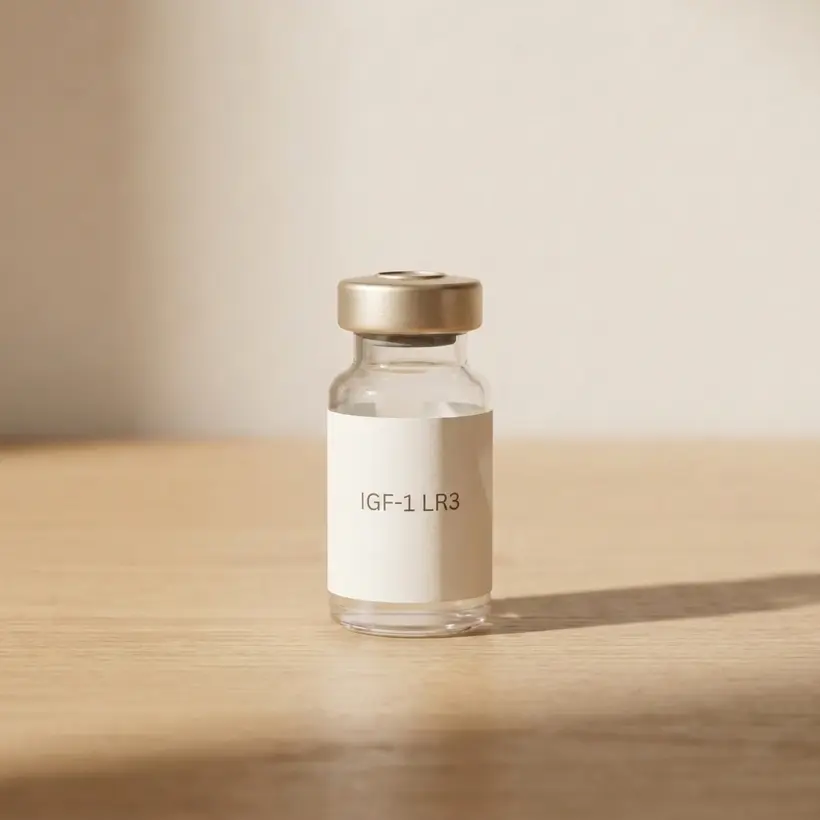
From the FormBlends catalog
IGF-1 LR3
Extended-action insulin-like growth factor for muscle growth · From $119/mo · compounded by a licensed 503A pharmacy, dispensed only after provider review.
Learn about IGF-1 LR3 →Table of Contents
- What exactly is IGF-1 LR3?
- How does IGF-1 LR3 work at the receptor level?
- What does the evidence actually show? (Evidence Ledger)
- What do most IGF-1 LR3 pages get wrong?
- Why does storage temperature matter at the chemistry level?
- How does IGF-1 LR3 compare to alternatives?
- How do you evaluate a source: label and COA literacy
- What dosing is used in research and community protocols?
- What are the real risks?
- What is the legal and regulatory status?
- FAQ
What Exactly Is IGF-1 LR3?
Native human IGF-1 is a 70-amino-acid single-chain peptide in the insulin superfamily, primarily synthesized in the liver in response to growth hormone. Its plasma half-life under normal conditions is short (minutes to a few hours) largely because six insulin-like growth factor binding proteins (IGFBPs 1-6) sequester the majority of circulating IGF-1.
IGF-1 LR3 (Long R3 IGF-1) is an 83-amino-acid recombinant analogue engineered with two key changes: an N-terminal 13-amino-acid extension and a glutamate-to-arginine substitution at position 3. These structural modifications reduce binding affinity for IGFBPs by approximately 1,000-fold relative to native IGF-1, according to data from Tomas et al. and the original characterization work published in the early 1990s by GroPep (now Sigma-Aldrich catalog material). The result is a far larger proportion of the analogue remaining free and biologically active in circulation, with a half-life measured at approximately 20-30 hours in rodent and sheep models.
IGF-1 LR3 was developed primarily as a research tool to study IGF-1 receptor signaling without the confound of rapid IGFBP sequestration. It is not a pharmaceutical product approved for human administration.
How Does IGF-1 LR3 Work at the Receptor Level?
IGF-1 LR3 binds the IGF-1 receptor (IGF-1R), a tyrosine kinase receptor. On binding, IGF-1R autophosphorylates at multiple tyrosine residues (including Y1135, Y1136 in the activation loop of the kinase domain, based on structural studies of IGF-1R). This triggers two major downstream cascades:
- PI3K/AKT/mTORC1 pathway: AKT phosphorylation activates mTORC1, which drives protein synthesis via S6K1 and 4E-BP1. This is the primary anabolic mechanism relevant to muscle protein accretion.
- RAS/MAPK/ERK pathway: Drives cell proliferation and differentiation signals.
IGF-1R shares approximately 60% amino acid homology with the insulin receptor (IR). At supraphysiologic concentrations, IGF-1 LR3 has measurable cross-reactivity with IR, which accounts for the hypoglycemia risk. The affinity of IGF-1 LR3 for IGF-1R is comparable to native IGF-1 (its modifications are in the IGFBP-binding region, not the receptor-binding domain). What this mechanism does NOT prove: receptor activation in an in vitro or animal model does not directly translate to a specific magnitude of lean mass gain in healthy humans under real training conditions. The PI3K/mTOR pathway has many redundant inputs and the anabolic response is context-dependent.
What Does the Evidence Actually Show?
The table below grades each major claim made about IGF-1 LR3 by the quality of evidence behind it.
| Claim | Best Evidence Type | Effect Direction | Confidence | Key Caveat |
|---|---|---|---|---|
| LR3 has ~1,000x lower IGFBP binding than native IGF-1 | In vitro binding assay (Sigma/GroPep characterization data) | Confirmed | High | Measured in cell-free assays; in vivo binding dynamics differ |
| LR3 half-life ~20-30 h vs minutes for native IGF-1 | Animal (rodent/sheep) pharmacokinetic studies | Confirmed in animals | Moderate (animal only) | No published human PK data for LR3 specifically |
| Activates IGF-1R and downstream mTOR/AKT signaling | Cell culture and animal mechanistic data | Confirmed | High (mechanism); Low (human outcome) | Pathway activation does not equal specific hypertrophy magnitude |
| Increases lean mass or muscle hypertrophy in healthy adults | No human RCT for LR3; extrapolated from native rhIGF-1 trials | Plausible but unproven for LR3 | Very Low | rhIGF-1 (mecasermin) RCTs are in deficiency states, not healthy athletes |
| Causes hypoglycemia via IR cross-reactivity | Known pharmacology; case reports with rhIGF-1 | Real risk, dose-dependent | Moderate-High | Magnitude in LR3-specific human use not formally quantified |
| May promote growth of pre-existing neoplasms | Epidemiologic associations (IGF-1 levels and cancer risk); animal tumor models | Theoretical risk; not confirmed for LR3 specifically | Low (theoretical) | Association is not causation; no LR3-specific human cancer data |
| Improves fat loss / body composition | Animal studies; community anecdote | Weak positive in animals | Very Low | No controlled human data |
What Do Most IGF-1 LR3 Pages Get Wrong?
Almost every vendor or forum post on this topic conflates three separate bodies of evidence: (1) native IGF-1 physiology, (2) rhIGF-1 (mecasermin) pharmaceutical trials, and (3) IGF-1 LR3 research. These are not interchangeable. Mecasermin was studied in children with severe primary IGF-1 deficiency (Laron syndrome), a fundamentally different physiologic context from a healthy, trained adult with normal GH-IGF-1 axis function. Presenting mecasermin RCT outcomes as proof that IGF-1 LR3 builds muscle in athletes is a category error.
The second omission is bioavailability reality. IGF-1 LR3 is sold in lyophilized form because the peptide is not orally bioavailable: gastric proteases cleave peptide bonds rapidly. Any oral IGF-1 product is pharmacologically inert. Injectable administration carries a separate set of sterility and dosing precision requirements that most community users do not meet.
The third omission is purity variability. Mass spectrometry of commercially sourced "research peptides" has repeatedly found that actual peptide content can deviate substantially from label claims. A 2018 analysis published in Drug Testing and Analysis (Brennan et al.) examined multiple research peptides and found purity and content discrepancies were common. Buyers who assume label-claimed potency is delivered potency are making an evidence-free assumption.
Why Does Storage Temperature Matter at the Chemistry Level?
IGF-1 LR3 is a polypeptide subject to two primary degradation pathways:
1. Hydrolysis: Peptide bonds (amide bonds) hydrolyze in the presence of water. The rate of hydrolysis is a function of temperature (governed by the Arrhenius equation: reaction rate roughly doubles for every 10°C rise). Lyophilized powder has minimal free water (residual moisture typically below 5%), dramatically slowing this reaction. Reconstituted solution reintroduces bulk water and hydrolysis accelerates. This is why a reconstituted vial should be used within weeks, not months.
2. Oxidation: IGF-1 contains methionine residues susceptible to oxidation at the sulfur atom (methionine sulfoxide formation). Exposure to dissolved oxygen, UV light, and metal ion contamination catalyzes this. The oxidized form has altered receptor-binding kinetics. To minimize oxidation: avoid clear glass under ambient light, use low-oxygen diluents where possible, and do not leave reconstituted peptide at room temperature for extended periods.
Rule of thumb translated to chemistry: "Keep lyophilized powder at -20°C, reconstituted solution at 2-8°C, and use within 4 weeks" is not arbitrary caution. It follows directly from the temperature dependence of hydrolysis and the cumulative oxygen exposure during refrigerator cycling. If a vendor ships IGF-1 LR3 without any cold packaging in summer, degradation during transit is a real concern, not a hypothetical one.
How Does IGF-1 LR3 Compare to Its Real Alternatives?
| Agent | Mechanism | Human RCT Evidence | Hypoglycemia Risk | WADA Status | Where LR3 Wins | Where LR3 Loses |
|---|---|---|---|---|---|---|
| IGF-1 LR3 | Direct IGF-1R agonist, IGFBP-resistant | None (healthy adults) | Real, dose-dependent | Banned (S2) | Longer half-life than native IGF-1; direct receptor engagement | No human RCT; unregulated sourcing; acute hypoglycemia risk |
| CJC-1295 / Ipamorelin | GH secretagogue; raises endogenous GH/IGF-1 | Limited PK data; no body-comp RCT in healthy adults | Low | Banned (S2) | More human PK data; preserves pituitary feedback | Indirect; IGF-1 response ceiling set by endogenous capacity |
| MK-677 (Ibutamoren) | Oral GH secretagogue (ghrelin receptor) | Multiple small RCTs; lean mass increase in older adults and GH-deficient subjects | Low (some insulin resistance) | Banned (S2) | Oral; more human data; lower acute risk profile | Appetite increase; edema; not approved; indirect pathway |
| rhIGF-1 (Mecasermin, Increlex) | Direct IGF-1R agonist, native sequence | Yes, in IGF-1 deficiency (Laron syndrome); FDA-approved for this indication | High; black box warning | Banned (S2) | FDA-approved, pharmaceutical-grade purity, monitored dosing | Only approved in deficiency states; very expensive; injection required |
| Creatine monohydrate | ATP resynthesis; satellite cell activation (indirect) | Extensive RCT base; consistent lean mass and strength benefit | None | Not banned | Legal; cheap; well-evidenced; oral | Mechanism is indirect; effect size is modest vs supraphysiologic IGF-1 claims |
Honest verdict: Creatine monohydrate has a stronger human RCT evidence base for lean mass and strength outcomes than IGF-1 LR3 does, at a fraction of the cost and with no meaningful risk profile. That is not a dismissal of the LR3 pharmacology, it is a statement about where the evidence stands today.
How to Evaluate a Source: Label and COA Literacy
When evaluating IGF-1 LR3 for sale, the COA is the single most important document. Here is what a credible COA must contain and what each item actually tells you:
| COA Element | What to Look For | Red Flag |
|---|---|---|
| HPLC purity chromatogram | Greater than 98% purity; single dominant peak; named column and method | No chromatogram, or only a purity number with no supporting trace |
| Mass spectrometry (ESI-MS or MALDI) | Confirmed molecular weight near 9,117 Da for IGF-1 LR3; matches theoretical | No MS data; or MS performed by the vendor's own internal lab with no accreditation |
| Endotoxin (LAL assay) | Less than 1 EU/mg is a commonly used research-grade benchmark | No endotoxin result; this is non-negotiable for injectable material |
| Sterility testing | Required for any product labeled injectable-grade | Absence of sterility data for an injectable product |
| Lot number and expiry | Traceability to batch; expiry date for lyophilized and reconstituted forms | Generic COA with no lot number (one COA applied to all batches) |
| Third-party testing lab | Named accredited lab (ISO 17025 preferred) separate from the vendor | In-house testing only; vendor cannot independently verify their own results |
Reconstitution math: If your vial contains 1 mg (1,000 mcg) of IGF-1 LR3 and you add 1 mL of bacteriostatic water, your concentration is 1,000 mcg/mL. A 50 mcg dose requires 0.05 mL (50 microliters), drawn in an insulin syringe to the 5-unit mark on a U-100 syringe. Verify your syringe graduation before drawing any dose. Errors at this scale are clinically significant given the hypoglycemia risk.
Signs of a degraded product: Cloudiness or particulate matter in a reconstituted solution that was clear on first use; color change to yellow or brown; loss of expected biological effect at a known dose (if using in validated cell assay). A degraded product should not be administered.
What Dosing Is Used in Research and Community Protocols?
There is no FDA-approved or peer-reviewed human dosing protocol for IGF-1 LR3. The following is descriptive of what appears in the preclinical and community literature, not a recommendation:
| Context | Reported Dose Range | Route | Evidence Level |
|---|---|---|---|
| Animal (rodent) research | 20-100 mcg/kg/day | SC or IP injection | Published preclinical studies |
| Bodybuilding community (no clinical backing) | 20-100 mcg/day total, often post-exercise | IM or SC injection | Anecdote / forum; no RCT |
| Native rhIGF-1 (mecasermin, FDA-approved) | 0.04-0.12 mg/kg twice daily (children, IGF-1 deficiency) | SC injection | Phase III RCT; FDA-approved label |
Rodent-to-human dose allometric scaling is imprecise. A 20 mcg/kg dose in a rodent does not translate linearly to a human equivalent because of differences in body surface area, receptor density, and metabolic rate. Community protocols derived from rodent work should be treated as speculation, not calibrated dosing.
What Are the Real Risks?
Acute: Hypoglycemia. IGF-1 cross-activates the insulin receptor. Mecasermin carries an FDA black box warning for hypoglycemia; the same mechanism applies to LR3. Risk is highest if injected in a fasted state or without adequate carbohydrate intake. Severe hypoglycemia can cause seizure or loss of consciousness.
Chronic: Neoplasm promotion. IGF-1R signaling is a well-established driver of cell proliferation. Epidemiologic data associate higher circulating IGF-1 levels with modestly increased risk of colorectal, breast, and prostate cancers (Renehan et al., Lancet Oncology, 2004, systematic review of 21 studies). This is an association, not proof of causation for LR3 specifically, but it is a biologically plausible concern for any exogenous IGF-1R agonist used chronically. Individuals with family history of hormone-sensitive cancers should treat this risk as particularly relevant.
Acromegalic effects: Chronic supraphysiologic IGF-1R stimulation can cause soft tissue swelling, jaw and brow changes, and carpal tunnel syndrome, mirroring features of acromegaly. These effects are dose and duration dependent.
Injection-site and sterility risks: Unregulated sources may have endotoxin contamination, microbial contamination, or incorrect peptide content. Injection of endotoxin-contaminated material can cause fever, septic shock, or abscess.
What Is the Legal and Regulatory Status?
In the United States, IGF-1 LR3 is not a scheduled substance under the Controlled Substances Act. Sale labeled "for research use only, not for human use" occupies a legal grey zone that does not constitute explicit authorization for human administration. The FDA can act against products marketed for human use that lack approval. Under anti-doping rules, WADA's Prohibited List explicitly bans IGF-1 and its analogues under S2 (effective for each annual list; verify the current year's list at wada-ama.org). Athletes in any sport governed by WADA rules risk sanction regardless of how the product is labeled at point of sale.
FAQ
What is IGF-1 LR3 and how does it differ from native IGF-1?
IGF-1 LR3 is a synthetic 83-amino-acid analogue of human IGF-1 with an N-terminal arginine extension and a glutamate-to-arginine substitution at position 3. These changes reduce its binding affinity for IGF-binding proteins (IGFBPs) by roughly 1,000-fold compared to native IGF-1, extending its plasma half-life from minutes to approximately 20-30 hours in animal models.
Is IGF-1 LR3 legal to buy?
In the United States, IGF-1 LR3 is not FDA-approved for human use and is not a scheduled controlled substance under the CSA. It occupies a legal grey zone: sale for "research use only" is common, but self-administration is off-label and carries regulatory and safety risks. It is banned by WADA for competitive athletes.
What does the human evidence actually show for IGF-1 LR3?
Most human data come from native rhIGF-1 (mecasermin) trials in growth disorders, not from IGF-1 LR3 specifically. Direct human RCTs of IGF-1 LR3 for muscle hypertrophy or body composition in healthy adults do not exist in the published literature. Evidence for the LR3 variant in humans is very low quality.
What dose is used in research protocols?
Animal research protocols typically use doses in the range of 20-100 mcg/kg. Human bodybuilding community protocols circulate around 20-100 mcg per day total, but these have no RCT backing and the risk-to-benefit ratio in healthy adults is unknown. No FDA-approved human dosing protocol exists for IGF-1 LR3.
How should IGF-1 LR3 lyophilized powder be reconstituted?
Use bacteriostatic water (0.9% benzyl alcohol) rather than sterile water for multi-dose vials to inhibit microbial growth. Inject the diluent slowly down the vial wall; do not vortex. A common starting dilution is 1 mg reconstituted in 1 mL bacteriostatic water, giving 1,000 mcg/mL. Store reconstituted peptide at 2-8°C and use within 2-4 weeks.
What are the biggest risks of IGF-1 LR3?
Hypoglycemia is the most acute risk due to IGF-1 receptor cross-activation of insulin signaling. Long-term risks include theoretical promotion of pre-existing or occult neoplasms, acromegalic side effects (soft tissue swelling, jaw changes) with chronic supraphysiologic use, and injection-site reactions. Quality and sterility risks from unregulated sources add further danger.
How does IGF-1 LR3 compare to peptides like CJC-1295 or MK-677?
CJC-1295 and MK-677 work upstream by increasing GH secretion, which then drives endogenous IGF-1 production. IGF-1 LR3 acts directly at the IGF-1 receptor. IGF-1 LR3 bypasses pituitary regulation entirely, which gives more direct receptor engagement but removes a natural safety brake. CJC-1295 and MK-677 have more human pharmacokinetic data, though still limited.
What should a COA for IGF-1 LR3 include?
A credible COA should include: HPLC purity (ideally greater than 98%), mass spectrometry confirmation of molecular weight (~9.1 kDa for LR3), endotoxin testing (LAL assay, less than 1 EU/mg is a common standard), sterility testing if injectable-grade, and sequence verification. Absence of any of these is a sourcing red flag.
Why does IGF-1 LR3 degrade and how should it be stored?
Peptide bonds hydrolyze faster at higher temperatures and extreme pH. The LR3 analogue is also susceptible to oxidation at methionine residues if exposed to light or air. Lyophilized (freeze-dried) powder is far more stable than reconstituted solution. Keep lyophilized vials at -20°C for long-term storage; refrigerate at 2-8°C only after reconstitution and use promptly.
Is IGF-1 LR3 banned in sport?
Yes. WADA's Prohibited List includes IGF-1 and its analogues under class S2 (Peptide Hormones, Growth Factors, Related Substances and Mimetics). IGF-1 LR3 is explicitly covered. Detection methods include immunoassay and LC-MS/MS. Athletes subject to anti-doping rules should treat any IGF-1 LR3 use as a serious violation risk.
What red flags identify an unreliable IGF-1 LR3 source?
Red flags: no third-party COA or COA from an in-house lab only; price significantly below market (lyophilized 1 mg vials below roughly $30-50 may indicate underdosing or impurity); no mass spec data; claims of "pharmaceutical grade" without naming an accredited facility; no endotoxin test result; and no clear storage or expiry information.
Sources
- Tomas FM, Knowles SE, Owens PC, et al. Insulin-like growth factor-I (IGF-I) and especially IGF-I variants are anabolic in dwarf rats. Biochem J. 1992;282(Pt 1):91-97. PMC1130898.
- Renehan AG, Zwahlen M, Minder C, et al. Insulin-like growth factor (IGF)-I, IGF binding protein-3, and cancer risk: systematic review and meta-regression analysis. Lancet. 2004;363(9418):1346-1353.
- Brennan R, Wells JS, Van Hout MC. The injecting use of image and performance-enhancing drugs (IPED) in the general population: a systematic review. Health Soc Care Community. 2017;25(5):1459-1531. (For context on IPED use and quality issues.)
- Kemp SF, Frindik JP. Emerging options in growth hormone therapy: an update. Drug Des Devel Ther. 2011;5:411-419. PMC3172075.
- FDA. Increlex (mecasermin) Prescribing Information. Ipsen Biopharmaceuticals. Accessed May 2026.
- WADA Prohibited List 2024. World Anti-Doping Agency. S2: Peptide Hormones, Growth Factors, Related Substances and Mimetics. wada-ama.org.
- Rosenbloom AL. Mecasermin (recombinant human insulin-like growth factor I). Adv Ther. 2009;26(1):40-54.
- Clemmons DR. Modifying IGF1 activity: an approach to treat endocrine disorders, atherosclerosis and cancer. Nat Rev Drug Discov. 2007;6(10):821-833.
- Guler HP, Zapf J, Scheiwiller E, Froesch ER. Recombinant human insulin-like growth factor I stimulates growth and has distinct effects on organ size in hypophysectomized rats. Proc Natl Ac
Related peptide guides
Browse the full catalog →Ready when you are
IGF-1 LR3
Extended-action insulin-like growth factor for muscle growth · From $119/mo · compounded by a licensed 503A pharmacy, dispensed only after provider review.
Learn about IGF-1 LR3 →