Key Takeaways
- DSIP is a nine-amino-acid neuropeptide with a plasma half-life of roughly 5 to 8 minutes, meaning most of the molecule is degraded before it can reach CNS targets via peripheral injection.
- The best human sleep studies on DSIP date from the 1980s and 1990s, with sample sizes typically under 20 subjects and no modern RCT replication, placing overall evidence confidence at Low to Very Low.
- Legitimate research-grade DSIP for sale should come with a lot-specific HPLC COA showing at least 98% purity and MS confirmation of the 850.9 g/mol molecular weight.
- DSIP is not FDA-approved, not controlled in the US, and sits in a research-chemical gray area; it cannot legally be marketed for human consumption.
- Compared to CBT-I and approved sleep medications, DSIP has far weaker clinical evidence; its theoretical advantage (physiological sleep architecture modulation without sedation) has not been confirmed by adequately powered trials.
What Is DSIP and Should You Buy It?
Buy DSIP peptide only if you understand what it is: a nine-amino-acid research compound with genuinely interesting early science, an extremely short half-life that limits peripheral bioavailability, and no modern controlled human trials. It is not an approved sleep drug. If your goal is better sleep tonight, CBT-I and approved agents have stronger evidence. If your goal is exploring emerging peptide science, DSIP is a legitimate area of interest with real but incomplete data.
Table of Contents
- What is DSIP peptide exactly?
- Evidence ledger: what the research actually shows
- How does DSIP work? Mechanism with real numbers
- What most DSIP pages get wrong (bioavailability reality)
- DSIP peptide cost: what you should expect to pay
- How to read a DSIP COA and spot low-quality product
- Honest head-to-head: DSIP vs real alternatives
- Why storage rules matter: the chemistry behind degradation
- Dosing and protocols found in research
- Safety and side effects: what is known and unknown
- FAQ
What Is DSIP Peptide Exactly?
Delta sleep-inducing peptide (DSIP) is a nonapeptide with the sequence Trp-Ala-Gly-Gly-Asp-Ala-Ser-Gly-Glu. It was first isolated and described by Monnier and colleagues in 1977 from the thalamic venous blood of rabbits during electrically induced slow-wave sleep. The molecular weight of the free base is 850.9 g/mol. It is natively produced in the hypothalamus and found in peripheral tissues including the pituitary gland, blood plasma, and breast milk.
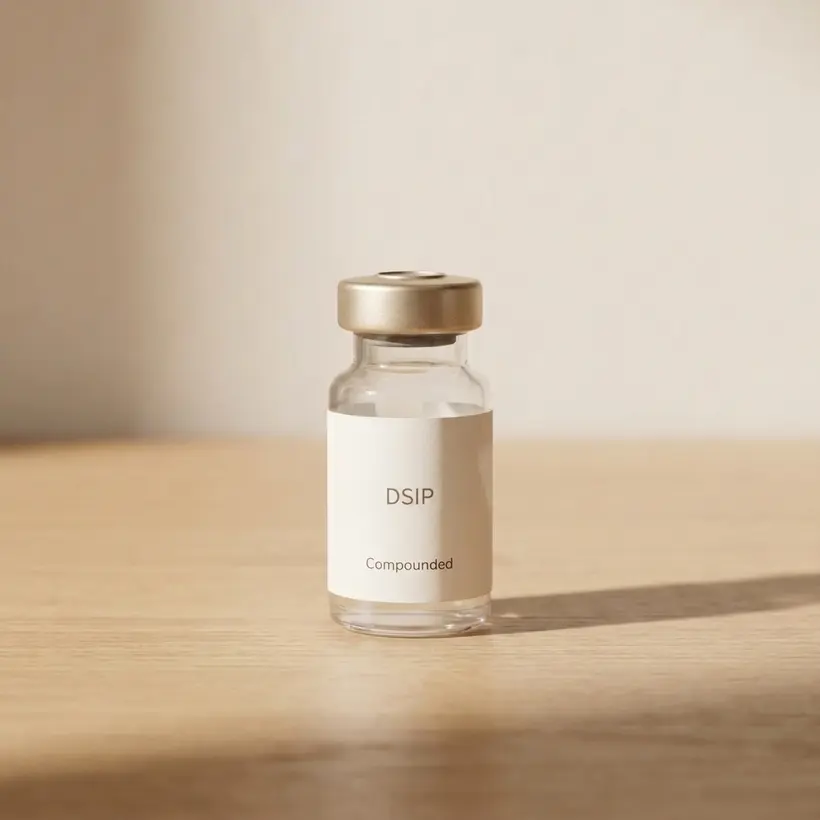
From the FormBlends catalog
DSIP (Delta Sleep-Inducing Peptide)
Restore deep, restorative delta wave sleep · From $179/mo · compounded by a licensed 503A pharmacy, dispensed only after provider review.
View DSIP (Delta Sleep-Inducing Peptide) →Despite the name, DSIP does not act like a classical sedative. Early characterization described it as a sleep-modulator, one that appeared to shift sleep architecture toward deeper stages rather than simply inducing unconsciousness. That distinction is part of why it attracted research interest, and part of why the story is more complicated than vendor pages suggest.
Evidence Ledger: What the Research Actually Shows
| Claim | Best Evidence Type | Effect Direction | Sample Sizes (if human) | Confidence |
|---|---|---|---|---|
| DSIP increases delta (slow-wave) sleep in animals | Animal (rabbit, rat) | Positive in founding studies | N/A (animal) | Moderate for animal models |
| DSIP improves subjective sleep quality in humans | Small uncontrolled/open-label human trials (1980s-1990s) | Generally positive but inconsistent | Typically 10 to 20 subjects | Low |
| DSIP reduces insomnia in psychosomatic patients | Small human open-label trial (Schneider-Helmert 1984-1988 series) | Positive trend | Under 30 subjects per study | Low |
| DSIP has antioxidant activity | In vitro and animal | Positive (scavenges reactive species) | N/A (lab) | Moderate for mechanism, Very Low for clinical relevance |
| DSIP modulates ACTH and cortisol rhythms | Animal + small human studies | Positive, normalizing effect on circadian cortisol | Under 20 subjects | Low |
| DSIP reduces chronic pain / opiate withdrawal symptoms | Very small human pilot studies | Inconclusive | Under 10 subjects | Very Low |
| DSIP has meaningful subcutaneous bioavailability in humans | Mechanism/inference only (no SC human PK study) | Likely limited given half-life | No adequate human PK study found | Very Low |
How Does DSIP Work? Mechanism With Real Numbers
DSIP does not bind to a single, well-characterized receptor the way melatonin binds MT1/MT2 receptors. Its mechanism is better described as pleiotropic and incompletely understood. Key proposed pathways include:
- Opioid system interaction: DSIP has been reported to interact with opioid receptors in animal studies, which may partly explain observations about pain modulation and sleep promotion. The precise receptor subtype and binding affinity have not been definitively established in human tissue.
- ACTH suppression and circadian normalization: Studies by Graf and colleagues (referenced in Ekman 1985 and subsequent reviews) reported that DSIP suppresses ACTH-stimulated cortisol release and appears to normalize disrupted circadian patterns. Cortisol normalization could plausibly improve sleep onset, but the effect size and consistency across subjects was modest.
- Antioxidant activity: In vitro studies demonstrated DSIP scavenging of reactive oxygen species. The tryptophan residue at position 1 is the proposed active site. This does not prove clinical antioxidant benefit.
- Plasma half-life of 5 to 8 minutes: This is the most important number in the whole DSIP story. Endopeptidases in peripheral plasma cleave DSIP rapidly. The cited half-life range comes from pharmacokinetic studies in animal models and is consistent with the general behavior of unmodified small peptides in blood. It means a subcutaneous injection delivers a very short exposure window before the peptide is fragmented. Whether fragments retain any activity is unknown. No validated BBB-penetration data for subcutaneously injected DSIP in humans exists.
What the mechanism does NOT prove: Even if all the proposed mechanisms are real, they have been demonstrated primarily in animals or in vitro. The extrapolation to "subcutaneous DSIP will improve your sleep by promoting delta wave activity" is multiple logical steps beyond what the evidence supports.
What Most DSIP Pages Get Wrong: The Bioavailability Problem
This is the section almost no vendor page or blog post includes. Here is what is routinely omitted when you see DSIP peptide for sale:
The half-life problem is severe. A 5 to 8 minute plasma half-life means that by the time subcutaneously injected DSIP is absorbed from the injection site, cleared through lymphatics into venous blood, and circulated, a very substantial fraction has already been enzymatically degraded. The founding DSIP sleep research used intravenous infusion directly into cerebral venous blood (in animals) or intravenous administration in humans, not subcutaneous injection. The route matters enormously for a peptide this fragile.
Blood-brain barrier crossing is unconfirmed for peripherally administered DSIP. Even if intact DSIP survives peripheral circulation, crossing the BBB requires either an active transporter or sufficient lipophilicity. DSIP is a hydrophilic nonapeptide. Some endogenous neuropeptides do cross via saturable transport systems, and there is speculation that DSIP may do so, but this has not been rigorously demonstrated for exogenously administered peripheral DSIP in humans.
Intranasal is promising but not validated commercially. Several researchers have proposed intranasal delivery to reduce first-pass degradation and allow direct olfactory-pathway CNS access. This is scientifically reasonable but no validated commercial intranasal DSIP preparation with confirmed human bioavailability data exists as of this writing.
DSIP Peptide Cost: What You Should Expect to Pay
For research-grade DSIP peptide for sale in the United States, typical pricing from established vendors runs approximately:
| Format | Typical Quantity | Typical Price Range | Notes |
|---|---|---|---|
| Lyophilized powder (research grade) | 5 mg vial | $25 to $60 | Should include lot-specific COA |
| Lyophilized powder (research grade) | 10 mg vial | $45 to $90 | Better value per mg if purity confirmed |
| Compounded injectable preparation | Varies by pharmacy | Substantially higher; pharmacy-dependent | Requires prescriber; formulation details vary |
Prices significantly below the lower end of these ranges are a red flag. DSIP synthesis requires solid-phase peptide synthesis with nine amino-acid couplings; legitimate synthesis, HPLC purification, and third-party testing carry real costs. An unusually cheap product is usually underdosed, impure, or both.
How to Read a DSIP COA and Spot Low-Quality Product
When you buy DSIP peptide, you should always request and review a certificate of analysis before use. Here is what to check:
- HPLC purity: Should be at least 98% for research-grade material. The HPLC chromatogram should show one dominant peak at the expected retention time with minimal secondary peaks. A purity below 95% is considered substandard for peptide research material.
- Mass spectrometry (MS) confirmation: The COA should confirm the observed mass matches the expected molecular weight of 850.9 g/mol (or the protonated [M+H]+ ion at 851.9 for electrospray ionization MS). This confirms you have the correct peptide and not a truncated or scrambled sequence.
- Lot number specificity: The COA lot number should match the lot number printed on your vial. Generic COAs showing no lot number are not meaningful quality documentation.
- Third-party lab: The issuing laboratory should be an independent analytical chemistry lab, not the vendor's own in-house testing. Look for a recognizable analytical lab name and contact information on the COA document.
- Appearance of the lyophilized powder: Legitimate lyophilized DSIP should appear as a white to off-white fluffy cake or powder. Yellow discoloration can indicate oxidation of the tryptophan residue, a marker of degradation.
- Water content: The best COAs also include Karl Fischer water content. High residual moisture (above roughly 5 to 7%) shortens shelf life of the lyophilized product.
Honest Head-to-Head: DSIP vs Real Alternatives for Sleep
| Intervention | Evidence Quality | Mechanism | Availability | Key Limitation | DSIP Wins? |
|---|---|---|---|---|---|
| CBT-I (Cognitive Behavioral Therapy for Insomnia) | High (multiple large RCTs, meta-analyses) | Behavioral: stimulus control, sleep restriction, cognitive restructuring | Therapist or digital app | Requires effort and time commitment | No. CBT-I is the first-line recommendation per major sleep societies. |
| Melatonin (low dose, 0.5 to 3 mg) | Moderate (decent RCT evidence for circadian phase disorders) | MT1/MT2 receptor agonism, circadian phase shifting | OTC, inexpensive | Effect size modest for sleep maintenance; jet lag strongest use case | No. Melatonin has far more and better human data. |
| Lemborexant / Suvorexant (orexin antagonists) | High (FDA-approved based on large phase III RCTs) | Dual orexin receptor antagonism | Prescription only | Cost, next-day sedation risk, regulatory restriction | No. Better evidence by a wide margin. |
| Low-dose doxepin (Silenor) | High (FDA-approved for sleep maintenance) | H1 histamine antagonism at very low doses | Prescription only | Not appropriate for all populations; dry mouth, residual sedation | No. |
| DSIP peptide | Low to Very Low (small, dated, unblinded human studies) | Proposed: delta-wave promotion, ACTH modulation, opioid interaction | Research peptide vendors, compounding pharmacies | Very short half-life, no modern RCT, unconfirmed SC bioavailability | Theoretical advantage (physiological architecture change without sedation) not confirmed in adequate trials. |
Why Storage Rules Matter: The Chemistry Behind Peptide Degradation
The instruction to keep DSIP refrigerated and protected from light is not arbitrary. Here is the specific chemistry driving it:
Tryptophan oxidation: The Trp residue at position 1 of DSIP is particularly vulnerable to oxidative degradation. Exposure to UV light and atmospheric oxygen generates reactive oxidative species that convert tryptophan's indole ring into oxidized products (kynurenine pathway derivatives and others). This is why yellowing of the powder is a degradation signal. Once the Trp residue is oxidized, the peptide no longer matches its intended sequence and loses biological activity.
Hydrolysis of peptide bonds: In aqueous solution, peptide bonds are subject to acid- and base-catalyzed hydrolysis. At room temperature and physiological pH, unmodified small peptides in solution degrade over days to weeks, not months. Refrigeration at 2 to 8 degrees Celsius substantially slows the hydrolysis rate. Freezing (below -20 degrees Celsius) for long-term storage stops it almost entirely.
Repeated freeze-thaw cycles damage the peptide by promoting aggregation and physical degradation of the peptide structure. If you have reconstituted DSIP and need to store it, single-use aliquots drawn with a sterile syringe and stored refrigerated are preferable to repeatedly puncturing the same vial over weeks.
Bacteriostatic vs sterile water: Reconstitute with bacteriostatic water (which contains benzyl alcohol as a preservative) rather than plain sterile water if the vial will be used over multiple days. Plain sterile water provides no antimicrobial protection once the septum is punctured.
Dosing and Protocols Found in Research
| Context | Route | Dose Range Used | Source Type | Confidence |
|---|---|---|---|---|
| Sleep induction (early human studies) | Intravenous | 25 to 50 mcg/kg body weight | Small human trials (Schneider-Helmert series) | Low (small N, dated) |
| Subcutaneous (extrapolated in community protocols) | Subcutaneous | 100 to 500 mcg per dose | Community/forum extrapolation; no validated SC human trial | Very Low; not validated |
| Intranasal (experimental) | Intranasal | Not standardized | Proposed in reviews; no validated commercial formulation | Very Low |
Given the 5 to 8 minute plasma half-life, protocols that use subcutaneous injection are working against basic pharmacokinetics. This does not mean zero drug reaches CNS targets, but it does mean the fraction is likely small and the pharmacokinetic profile is poorly characterized for that route.
Safety and Side Effects: What Is Known and What Is Not
The honest answer is that DSIP's safety profile in humans is incompletely characterized because no large, long-term controlled trial has been conducted.
Reported in small human studies: Headache, dizziness, and transient blood pressure changes were noted in some early studies. These were generally described as mild and transient.
Theoretical concerns: Because DSIP interacts with the opioid system and ACTH axis in animal models, chronic use could theoretically affect neuroendocrine regulation. This has not been rigorously studied in humans.
Injection-site risk: Any subcutaneous injection carries risk of local infection, bruising, and lipodystrophy with repeated use at the same site. These risks are not DSIP-specific but are relevant to all injectable peptides used outside a clinical setting.
Drug interactions: No formal drug interaction studies exist. Given proposed opioid and sedative mechanisms, combining DSIP with CNS depressants, opioid medications, or benzodiazepines should be avoided without direct medical supervision.
Populations to avoid: Pregnant and breastfeeding individuals, individuals with active neuroendocrine conditions, and those on ACTH-axis medications should not use DSIP without specialist guidance.
Frequently Asked Questions
What is DSIP peptide and what does it do?
DSIP (delta sleep-inducing peptide) is a nine-amino-acid neuropeptide first isolated from rabbit thalamic perfusate in 1977. It was named for its ability to increase slow-wave (delta) sleep in early animal studies. Its proposed mechanisms include modulation of ACTH release, antioxidant activity, and opioid system interaction, but most human evidence is weak or dated.
Is there human clinical evidence that DSIP improves sleep?
A small number of human studies from the 1980s and 1990s reported improvements in sleep architecture and reduced insomnia symptoms, but these trials had very small sample sizes (often under 20 subjects), lacked rigorous controls, and have not been replicated with modern methodology. Evidence confidence is Low to Very Low.
What does DSIP peptide cost?
Research-grade DSIP typically sells for roughly $25 to $60 per 5 mg vial from established US peptide suppliers. Compounded injectable preparations through licensed compounding pharmacies carry higher costs. Prices well below this range often indicate lower purity or underdosed product.
How do I know if DSIP peptide is high purity?
Request a certificate of analysis (COA) showing HPLC purity of at least 98% and mass spectrometry (MS) confirmation of the correct molecular weight (850.9 g/mol for the free base). COAs should be lot-specific and from a third-party laboratory, not self-generated by the vendor.
What is the half-life of DSIP?
DSIP has a very short plasma half-life of approximately 5 to 8 minutes in peripheral blood due to rapid enzymatic degradation by endopeptidases. This extremely short half-life is a major practical limitation and is rarely disclosed by vendors selling the peptide for sleep use.
What are the known side effects of DSIP?
Reported adverse effects in small human studies include headache, dizziness, and transient blood pressure changes. Because robust safety trials in humans are absent, the full side-effect profile is unknown. Injection-site reactions are possible with any subcutaneous peptide. DSIP should not be used in pregnancy or alongside sedative medications without medical supervision.
How is DSIP legally classified in the United States?
DSIP is not an FDA-approved drug and is not a scheduled controlled substance in the US. It occupies a gray-area status similar to many research peptides. It may be sold legally as a research chemical but cannot legally be marketed for human use. Regulations differ by country, so buyers should verify local law.
How should DSIP peptide be stored after reconstitution?
Lyophilized DSIP should be kept at 2 to 8 degrees Celsius (refrigerated) and protected from light. After reconstitution with bacteriostatic water, it should be stored refrigerated and used within 14 to 28 days. The peptide degrades faster at room temperature due to hydrolysis of peptide bonds, particularly at the Trp-Ala segment.
How does DSIP compare to other sleep interventions?
Cognitive behavioral therapy for insomnia (CBT-I) has the strongest evidence base for chronic insomnia, with multiple large RCTs showing durable benefit. Approved sleep medications (melatonin, doxepin, lemborexant) have larger and better-controlled trials than DSIP. DSIP's theoretical advantage (minimal next-day sedation and potential physiological sleep architecture improvement) has not been confirmed in modern trials.
What dose of DSIP is used in research protocols?
Human research used intravenous doses in the range of 25 to 50 micrograms per kilogram. Subcutaneous protocols sometimes reference 100 to 500 mcg per administration, but there is no validated subcutaneous dosing established by controlled trials. These numbers are extrapolations and should not be treated as clinical guidance.
Can DSIP be taken orally?
Oral bioavailability of DSIP is expected to be very low because stomach acid and gastrointestinal proteases rapidly cleave the nine-amino-acid chain before absorption. Some intranasal formulations have been explored in research settings, but no commercially validated oral or nasal product exists with confirmed bioavailability data.
Is DSIP banned in sport?
DSIP does not appear on the current WADA Prohibited List. However, WADA's catch-all clause prohibits any substance used to artificially manipulate physiology; athletes should confirm DSIP status with their sport's anti-doping authority before use, as the list is updated annually.
Sources
- Monnier M, Dudler L, Gachter R, Schoenenberger GA. "Delta sleep-inducing peptide (DSIP): EEG and motor activity in rabbits following intravenous administration." Neuroscience Letters. 1977;6(1):9-13.
- Schoenenberger GA, Maier PF, Tobler HJ, Monnier M. "A naturally occurring delta-EEG-enhancing nonapeptide in urine of sleep-deprived rats." Pflugers Archiv. 1978;376(2):119-29.
- Schneider-Helmert D. "DSIP in insomnia." European Neurology. 1984;23(5):358-363.
- Schneider-Helmert D. "Effects of DSIP in man." European Neurology. 1988;27 Suppl 1:86-93.
- Ekman R, Agren G, Heilig M, Widerlov E. "Delta sleep-inducing peptide: human cerebrospinal fluid and regional brain distribution." Peptides. 1985;6(5):873-8.
- Graf MV, Kastin AJ. "Delta-sleep-inducing peptide (DSIP): a review." Neuroscience and Biobehavioral Reviews. 1984;8(1):83-93.
- Graf MV, Kastin AJ. "Delta-sleep-inducing peptide: an update." Peptides. 1986;7(6):1165-87.
- Riou F, Cespuglio R, Jouvet M. "Endogenous peptides and sleep in the rat. II. Peptides without opiate activity." Neuropeptides. 1982;2(4):265-76.
- Havlicek V, Rezek M, Friesen H. "Somatostatin and thyrotropin releasing hormone: central effect on sleep and motor system." Pharmacology Biochemistry and Behavior. 1976;4(4):455-9.
- Yehuda S, Carasso RL. "DSIP: a novel fatigue-inducing factor." International Journal of Neuroscience. 1988;38(3-4):345-51.
- Khvatova EM, Rubanova NA, Prudchenko IA, Mikhailova II. "Effects of delta sleep-inducing peptide on free radical processes under stress." Bulletin of Experimental Biology and Medicine. 2003;135(3):241-4.
- American Academy of Sleep Medicine. "Clinical Practice Guideline for the Pharmacological Treatment of Chronic Insomnia in Adults." Journal of Clinical Sleep Medicine. 2017;13(2):307-349.
- WADA Prohibited List 2024. World Anti-Doping Agency. Available at: wada-ama.org.
Related peptide guides
Ready when you are
DSIP (Delta Sleep-Inducing Peptide)
Restore deep, restorative delta wave sleep · From $179/mo · compounded by a licensed 503A pharmacy, dispensed only after provider review.
View DSIP (Delta Sleep-Inducing Peptide) →