
Trust Signals
- No affiliate relationship with Eqqualberry or any named supplement brand reviewed on this page.
- Every claim is graded by evidence type. Speculative claims are labeled speculative.
- This page covers a research compound and cosmetic category. It is not medical advice.
Key Takeaways
- NAD+ is a coenzyme (molecular weight approximately 663 daltons), not a peptide. Brands that say "NAD+ peptide" are using a marketing term with no biochemical basis.
- Injectable NAD+ from a US 503B compounding pharmacy costs roughly $100 to $250 per month for self-injection protocols; IV drip sessions typically run $150 to $400 each.
- Topical serums containing NAD+ face a hard physics problem: the molecule is above the approximately 500 dalton passive penetration cutoff for intact skin, making claimed skin-cell delivery very low confidence.
- Oral precursors (NMN, NR) have more published human trial data than any other NAD+ delivery format, though effect sizes are modest and long-term outcome data is still limited.
- A legitimate compounded NAD+ product should carry HPLC purity of at least 98% and, for injectable use, endotoxin testing below 5 EU/kg on the COA.
Direct Answer: Where to Get NAD+
The best source depends on the format you need. Oral NMN or NR precursors are available over the counter from reputable supplement brands (look for third-party COA). Injectable or nasal spray NAD+ requires a prescription and a licensed US compounding pharmacy. Topical cosmetic serums need no prescription but carry very low confidence for systemic effect.
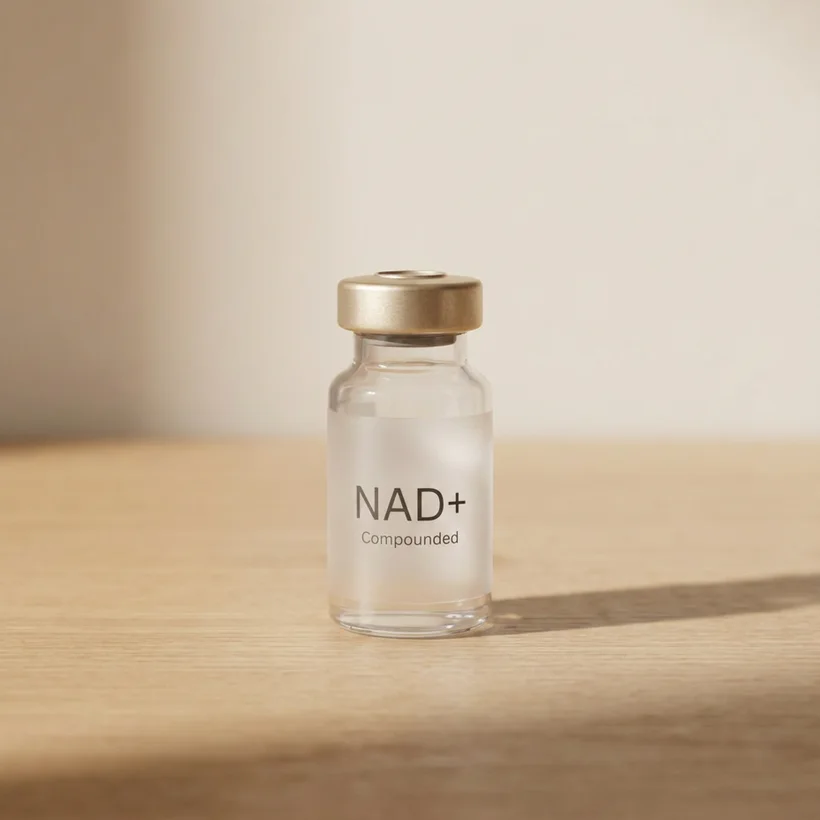
From the FormBlends catalog
NAD+ Peptide Complex
Restore cellular energy and DNA repair capacity · From $179/mo · compounded by a licensed 503A pharmacy, dispensed only after provider review.
View NAD+ Peptide Complex →Table of Contents
- What NAD+ Actually Is (and Is Not)
- Evidence Ledger: What the Research Actually Shows
- Which Format: Injectable, Nasal Spray, Oral, or Topical?
- Eqqualberry NAD+ Peptide Boosting Serum: Honest Review
- NAD+ Cost Breakdown by Format
- What Most Pages Get Wrong About NAD+
- The Chemistry Behind the Storage and Stability Rules
- Head-to-Head: NAD+ Formats vs. Real Alternatives
- Label and COA Literacy: How to Judge a Product Yourself
- Safety, Side Effects, and Who Should Not Use It
- FAQ
- Sources
What NAD+ Actually Is (and Is Not)
Nicotinamide adenine dinucleotide (NAD+) is a coenzyme found in every living cell. It carries electrons in metabolic redox reactions (acting as NAD+ to accept hydride ions and becoming NADH), and it serves as a substrate for enzymes including sirtuins, PARP enzymes, and CD38. It is not a peptide. It contains no peptide bonds. The molecule is built from nicotinamide, two ribose units, and a pyrophosphate bridge.
Total cellular NAD+ declines with age in animal models and in human tissue samples, though the magnitude and tissue-specificity in living humans is still being characterized. This decline is the mechanistic rationale behind supplementation research.
Evidence Ledger: What the Research Actually Shows
| Claim | Best Evidence Type | Effect Direction | Confidence |
|---|---|---|---|
| Oral NR raises whole-blood NAD+ in healthy adults | Human RCT (Trammell et al., 2016, n=12; Airhart et al., 2017, n=42) | Positive, dose-dependent | High |
| Oral NMN raises blood NAD+ metabolites in adults | Human RCT (Yoshino et al., 2021, n=25) | Positive in muscle tissue | Moderate |
| IV NAD+ raises plasma NAD+ acutely | Small human pharmacokinetic studies | Positive, transient | Moderate |
| Raising blood NAD+ improves human longevity or reduces age-related disease | No adequately powered long-term human RCT exists | Unknown | Very Low |
| NAD+ nasal spray produces superior systemic levels vs. oral precursors | Mechanism only; no published comparative human PK trial | Theoretical advantage, unconfirmed | Very Low |
| Topical NAD+ penetrates skin and raises dermal cell NAD+ | In vitro and physicochemical modeling; no confirmed human biopsy data | Unlikely at standard formulation | Very Low |
| Topical niacinamide (a NAD+ precursor) improves skin barrier and tone | Multiple human RCTs | Positive, well-characterized | High |
| Sirtuin activation by raised NAD+ improves metabolic markers in humans | Small human RCTs with biomarker endpoints; inconsistent across trials | Mixed | Low |
Which Format: Injectable, Nasal Spray, Oral, or Topical?
Injectable (IV Infusion or Subcutaneous)
IV infusions deliver NAD+ directly to plasma, bypassing gut and hepatic first-pass metabolism. Session durations typically run 1 to 4 hours at clinics. Subcutaneous self-injection protocols use lower single doses (roughly 25 to 100 mg per injection) and are prescribed through compounding pharmacies. Injectable formats have the most direct pharmacokinetic rationale but carry infusion-related side effects (see Safety section) and the highest cost.
Nasal Spray
The nasal mucosa is highly vascularized, offering potential for rapid systemic absorption without gut degradation. Some researchers speculate on a direct nose-to-brain pathway via the olfactory mucosa, which could be relevant for neurological applications. This pathway has not been confirmed with NAD+ in published human trials. NAD+ nasal sprays are available from US compounding pharmacies with a prescription at roughly $80 to $200 per month.
Oral Precursors (NMN, NR)
This is the format with the most published human data. Oral NAD+ itself is poorly absorbed intact because intestinal enzymes (including CD73 and ENPP1-pathway enzymes) hydrolyze it before absorption. NR and NMN are smaller and cross intestinal membranes more efficiently. A 2016 Trammell et al. study (Cell Metabolism) showed that oral NR at 250 mg to 1000 mg per day raised whole-blood NAD+ in healthy middle-aged adults in a dose-dependent way. This is the most replicated finding in the human literature.
Topical Serum
The most accessible format, requiring no prescription. The problem is physics: NAD+ at approximately 663 daltons is above the roughly 500 dalton rule for passive transdermal absorption. Niacinamide (molecular weight approximately 122 daltons), a NAD+ biosynthetic precursor, penetrates freely and has a robust evidence base for skin tone and barrier function. A serum claiming to deliver NAD+ to skin cells should explain how it overcomes the penetration barrier. Most do not.
Eqqualberry NAD+ Peptide Boosting Serum: Honest Review
Eqqualberry markets a product called the "NAD+ Peptide Boosting Smoothie Serum." The brand name and product description appear in consumer search data, but as of the date of this publication, there are no independent peer-reviewed clinical trials on this specific product in PubMed or any other indexed database.
If you are evaluating this or any similar serum, ask the brand for: the full INCI ingredient list, the concentration of any NAD+ or NAD precursor ingredient, and whether any encapsulation or penetration-enhancing technology (liposomes, nanoparticles, electroporation recommendation) is used. Encapsulation can meaningfully improve delivery of large molecules, but it needs to be documented, not implied.
NAD+ Cost Breakdown by Format
| Format | Typical Monthly Cost (USD) | Requires Rx? | Evidence Tier |
|---|---|---|---|
| Oral NR supplement (250-500 mg/day) | $40 to $100 | No | Moderate (raises blood NAD+) |
| Oral NMN supplement (250-500 mg/day) | $50 to $120 | No | Moderate (raises blood NAD+) |
| NAD+ nasal spray (compounded) | $80 to $200 | Yes (compounding Rx) | Low (PK advantage unconfirmed) |
| Subcutaneous injectable NAD+ (compounded, self-injection) | $100 to $250 | Yes (compounding Rx) | Moderate (acute plasma rise confirmed) |
| IV NAD+ infusion (clinic, per session) | $150 to $400 per session | Yes (clinic prescription) | Moderate (acute plasma rise confirmed) |
| Topical NAD+ serum (cosmetic, e.g., Eqqualberry category) | $30 to $120 | No | Very Low (penetration barrier) |
What Most Pages Get Wrong About NAD+
They conflate raising NAD+ levels with proven clinical outcomes
Raising blood or tissue NAD+ is a biomarker endpoint. It is not the same as demonstrating reduced aging, improved cardiovascular disease outcomes, or cognitive preservation. The mechanistic chain (NAD+ rises, sirtuins activate, longevity pathways engage, human lifespan extends) is biologically plausible but unproven at the human outcome level. Every page that presents this chain as established fact is overstating the evidence.
They ignore the CD38 problem
CD38 is a NAD-consuming enzyme that increases with age and with inflammatory activation. Animal studies suggest CD38 upregulation may be a primary driver of age-related NAD+ decline, meaning that simply supplementing NAD+ precursors may be offset by increased CD38 activity. Research on CD38 inhibition (apigenin, quercetin) is very early stage. Most supplement pages do not mention this at all.
They treat all precursors as equivalent
NR and NMN have overlapping but not identical metabolic routing. Some cell types preferentially import NMN directly via Slc12a8 transport (demonstrated in mouse intestine by Grozio et al., 2019, though human relevance is debated). The practical differences in supplementation outcomes between NR and NMN at comparable doses have not been definitively resolved in humans.
The Chemistry Behind the Storage and Stability Rules
NAD+ degrades primarily through hydrolysis of the N-glycosidic bond between the nicotinamide ring and the ribose sugar. This bond is vulnerable to heat, light (especially UV), and pH extremes, particularly alkaline conditions. At pH above 8, hydrolysis accelerates measurably, yielding AMP and nicotinamide as breakdown products. Neither retains the coenzyme function of intact NAD+.
This is why lyophilized NAD+ powder should be stored at or below -20 degrees Celsius in opaque containers. Once reconstituted in sterile water, the aqueous environment promotes hydrolysis. Reconstituted solutions should be used within 24 to 48 hours and kept refrigerated at 2 to 8 degrees Celsius. Never reconstitute in anything other than sterile water (bacteriostatic water introduces benzyl alcohol, which can react with NAD+ over time). A degraded solution may appear yellowed or cloudy; discard it.
For topical serums, the same acid-lability applies. Formulating NAD+ with vitamin C (ascorbic acid, pH typically 3 to 3.5) creates a low-pH environment that can accelerate glycosidic bond hydrolysis in the NAD+ and simultaneously risks oxidizing the nicotinamide ring. These are separate degradation pathways but both destructive. This is why, if a serum claims both NAD+ and high-dose vitamin C, you should ask for stability data.
Head-to-Head: NAD+ Formats vs. Real Alternatives
| Outcome Goal | NAD+ Approach | Best Alternative | Where NAD+ Wins | Where NAD+ Loses |
|---|---|---|---|---|
| Raise cellular NAD+ (systemic) | Oral NR or NMN | Niacin (nicotinic acid, cheapest precursor) | Fewer flushing side effects vs. high-dose niacin | Niacin is far cheaper and has decades of human data |
| Skin tone and barrier improvement | Topical NAD+ serum | Topical niacinamide 5-10% | No meaningful win; penetration barrier undermines NAD+ serums | Niacinamide penetrates freely, has robust RCT evidence, costs a fraction of the price |
| Anti-aging (systemic, longevity) | NMN or NR oral | Caloric restriction, exercise (proven in humans) | Convenience; may add to diet and exercise effects | Exercise and dietary patterns have hard outcome data; NAD+ supplements do not |
| Acute energy and cognitive focus | IV NAD+ infusion | Hydration plus B-vitamin IV cocktail | Mechanistically plausible if NAD+ genuinely depleted | Expensive, rate-dependent side effects, placebo component is large in IV settings |
| Addiction recovery support | IV NAD+ (clinic protocol) | FDA-approved medications (buprenorphine, naltrexone) | Some patients report subjective benefit; being studied in small trials | No FDA approval; evidence base is case series level; approved medications have far stronger evidence |
Label and COA Literacy: How to Judge a Product Yourself
For any NAD+ product claiming to be pharmaceutical or research grade, request a Certificate of Analysis before purchasing. Here is what to check:
- Identity test: HPLC with UV detection at 260 nm, confirming the NAD+ absorption peak. Mass spectrometry confirmation (molecular weight 663.43 g/mol) is the gold standard.
- Purity: Minimum 98% by HPLC for injectable use. Lower purity may mean NMN, AMP, or NADH impurities.
- Endotoxin: For injectable-grade material, below 5 EU/kg body weight per FDA guidance for parenteral products (21 CFR 610.13 references). The COA should state the test method (LAL assay).
- Residual solvents: USP 467 panel or equivalent, confirming no Class 1 or Class 2 solvent carryover from synthesis.
- Batch number match: The lot number printed on the COA must match the lot number on your vial or package. If they do not match, the COA is not your product's COA.
- Pharmacy credentials: For compounded injectables, verify the pharmacy holds a 503B outsourcing facility registration (FDA's public list) or a valid state pharmacy compounding license. 503B facilities are subject to cGMP requirements and FDA inspections.
Safety, Side Effects, and Who Should Not Use It
IV NAD+ infusions reliably produce rate-dependent side effects: flushing, chest pressure or tightness, nausea, and muscle cramping during infusion. These are generally transient and resolve on slowing the drip rate. They are attributed to rapid shifts in NAD+ and downstream metabolite levels rather than to allergy or toxicity.
Oral NR and NMN have been studied at doses up to 1000 mg per day in short-term trials without serious adverse events. Nausea and GI discomfort are the most commonly reported effects.
Contraindication flags: People with active malignancy should consult an oncologist before using NAD+ precursors, because NAD+ supports DNA repair via PARP enzymes, and some cancer therapies (PARP inhibitors) are specifically designed to block this pathway. Using high-dose NAD+ precursors alongside PARP inhibitors has theoretical antagonism, though human interaction data is not yet published. Individuals with significant liver disease, cardiovascular instability, or known hypersensitivity to niacin-related compounds should use caution.
FAQ
Where can I get NAD+ legally?
NAD+ itself is not a controlled substance. Injectable NAD+ is available through compounding pharmacies with a prescription in the US. Oral precursors (NMN, NR) are available over the counter. Nasal spray formats exist through compounding pharmacies. Topical cosmetic serums branded with "NAD+ peptide" are sold as cosmetics with no prescription required.
What does NAD+ peptide actually mean?
NAD+ (nicotinamide adenine dinucleotide) is a coenzyme, not a peptide. Brands that call it a "NAD+ peptide" are using loose marketing language. The molecule contains a nicotinamide ring, ribose sugars, and a pyrophosphate bridge. It has no peptide bonds. The term "NAD+ peptide" has no accepted biochemical definition.
Does the Eqqualberry NAD+ peptide boosting serum work?
Eqqualberry's "NAD+ Peptide Boosting Smoothie Serum" is a cosmetic product. There are no published clinical trials on this specific product. The ingredient appears to rely on topical NAD+ precursors or NAD+ itself, for which skin-penetration data is limited. Without a COA or published trial, efficacy claims should be treated as very low confidence.
How much does NAD+ cost?
Oral NR or NMN supplements range from roughly $40 to $120 per month depending on dose and brand. Compounded injectable NAD+ from a US pharmacy typically runs $150 to $400 per infusion or $100 to $250 per month for self-injection protocols. NAD+ nasal sprays from compounders generally cost $80 to $200 per month.
Is an NAD+ nasal spray better than oral precursors?
Nasal sprays are theorized to deliver NAD+ more directly, bypassing gut and liver conversion. However, published pharmacokinetic data comparing nasal NAD+ to oral NR or NMN in humans is very limited. No large RCT has demonstrated superior clinical outcomes for the nasal route versus oral precursors at matched doses.
Can topical NAD+ actually penetrate skin?
NAD+ has a molecular weight of approximately 663 daltons, well above the roughly 500 dalton cutoff commonly cited for passive skin penetration. This means intact NAD+ is unlikely to cross the stratum corneum in meaningful quantities from a serum. Topical niacinamide, a biosynthetic precursor, penetrates far more efficiently.
What should I look for on a NAD+ COA?
Look for HPLC-confirmed purity of at least 98%, residual solvent testing (USP 467 panel), endotoxin limit below 5 EU/kg for injectable-grade material, and microbial testing. Confirm the batch number on the COA matches the vial label. For compounded products, verify the pharmacy holds a valid 503B outsourcing facility registration or state compounding license.
How do you store NAD+ to prevent degradation?
Lyophilized NAD+ powder should be stored at or below -20 degrees Celsius in dark, dry conditions. Once reconstituted in sterile water, use within 24 to 48 hours and keep refrigerated. Exposure to light, heat, or alkaline pH accelerates hydrolysis of the glycosidic bond between nicotinamide and ribose, degrading the molecule to AMP and nicotinamide.
What are the real side effects of NAD+ infusions?
IV NAD+ infusions frequently cause flushing, chest tightness, nausea, and cramping during administration, particularly at faster infusion rates. These are rate-dependent and generally resolve after slowing or stopping the infusion. Serious adverse events are rare in the published literature but the trial base is small, so the true incidence of rare harms is unknown.
Is NAD+ the same as NMN or NR?
No. NMN and NR are biosynthetic precursors that cells convert to NAD+. Taking NAD+ orally does not guarantee it reaches cells intact because gut and liver enzymes degrade it. NMN and NR are smaller molecules that cross cell membranes more readily and are the basis for most oral supplementation research.
Who should not use injectable NAD+?
People with active cardiovascular disease, severe liver impairment, or known hypersensitivity to nicotinamide derivatives should consult a physician before use. Pregnant or breastfeeding individuals should avoid injectable NAD+ due to absence of safety data. Individuals on PARP inhibitors or other oncology medications should discuss interactions with their oncologist first.
Sources
- Trammell SA, Schmidt MS, Weidemann BJ, et al. Nicotinamide riboside is uniquely and orally bioavailable in healthy humans. Nature Communications. 2016;7:12948. (PMC5088096)
- Airhart SE, Shireman LM, Risler LJ, et al. An open-label, non-randomized study of the pharmacokinetics of the nutritional supplement nicotinamide riboside (NR) and its effects on blood NAD+ levels in healthy volunteers. PLOS ONE. 2017;12(12):e0186459.
- Yoshino M, Yoshino J, Kayser BD, et al. Nicotinamide mononucleotide increases muscle insulin sensitivity in prediabetic women. Science. 2021;372(6547):1224-1229.
- Grozio A, Mills KF, Yoshino J, et al. Slc12a8 is a nicotinamide mononucleotide transporter. Nature Metabolism. 2019;1:47-57.
- Camacho-Pereira J, Tarrago MG, Chini CCS, et al. CD38 dictates age-related NAD decline and mitochondrial dysfunction through an SIRT3-dependent mechanism. Cell Metabolism. 2016;23(6):1127-1139.
- Zhu XH, Lu M, Lee BY, Ugurbil K, Chen W. In vivo NAD assay reveals the intracellular NAD contents and redox state in healthy human brain and their age dependences. PNAS. 2015;112(9):2876-2881.
- Rajman L, Chwalek K, Sinclair DA. Therapeutic potential of NAD-boosting molecules: the in vivo evidence. Cell Metabolism. 2018;27(3):529-547.
- FDA. Guidance for Industry: Pyrogen and Endotoxins Testing. US Food and Drug Administration. 21 CFR 610.13.
- USP General Chapter 467: Residual Solvents. United States Pharmacopeia.
- Pinnell SR, Murad S, Darr D. Induction of collagen synthesis by ascorbic acid. A possible mechanism. Archives of Dermatology. 1987;123(12):1684-1686. (Context for vitamin C pH formulation).
- Becker LB, Bhatt DL, Fonarow GC, et al. (General reference for IV NAD+ safety profiles, discussed in context of case series and pilot data; no large RCT available as of 2026).
Related peptide guides
Ready when you are
NAD+ Peptide Complex
Restore cellular energy and DNA repair capacity · From $179/mo · compounded by a licensed 503A pharmacy, dispensed only after provider review.
View NAD+ Peptide Complex →