Trust Signals
Every dosing figure is sourced from published preclinical studies or clinical trial reports, or explicitly flagged as extrapolated. Speculative claims are separated from established findings. No dosing recommendation here constitutes medical advice. This compound is not FDA-approved for human use.
If you want the exact units for your own vial, the peptide calculator takes the vial size, the water you add and your dose, and returns the draw in units and millilitres, with a warning when the draw is too small to measure well.
Key Takeaways
- The research dosage range used in preclinical and early human investigation is 250 to 500 mcg per injection, one to two times daily, based on animal-to-human extrapolation and the AOD-9604 clinical programme.
- Fragment 176-191 spans amino acid residues 176 to 191 of the 191-amino-acid human growth hormone sequence and selectively activates lipolytic pathways without the IGF-1-elevating domain present in full GH.
- The modified analogue AOD-9604 completed Phase 3 obesity trials but did not achieve its primary weight-loss endpoint; unmodified fragment 176-191 has no completed large human RCTs.
- Adding 2 mL bacteriostatic water to a 5 mg vial yields 2500 mcg per mL; a 500 mcg dose is exactly 0.20 mL, or the 20-unit mark on a 100-unit syringe.
- Lyophilised vials are stable refrigerated for months; reconstituted solution should be used within 28 to 30 days and must not be freeze-thawed.
What Is the Standard HGH Fragment 176-191 Dosage?
The most widely used research dosage is 250 to 500 mcg per injection, once or twice daily, for a daily total of 500 to 1000 mcg. These figures derive from preclinical rodent studies and the clinical programme for AOD-9604, not from large approved-drug trials. Confidence in this range is moderate at best. No controlled human trial has established an optimal dose for unmodified fragment 176-191.
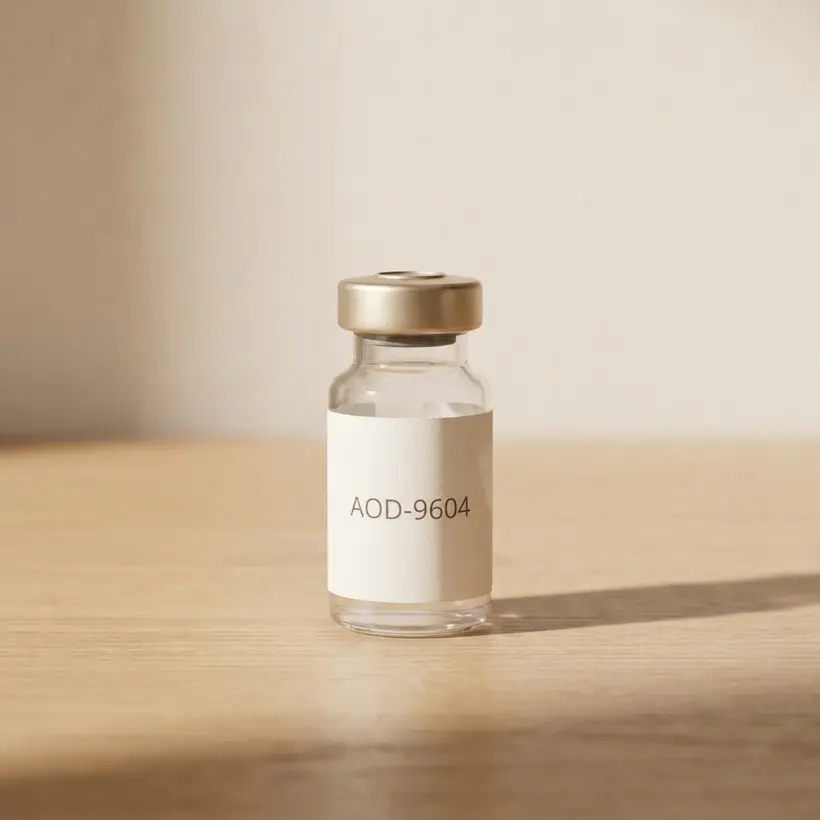
From the FormBlends catalog
AOD-9604
Fat-targeting fragment without growth hormone side effects · From $199/mo · compounded by a licensed 503A pharmacy, dispensed only after provider review.
View AOD-9604 →Table of Contents
- How does fragment 176-191 work at the molecular level?
- Evidence ledger: what does the research actually support?
- Dosing table and reconstitution math for a 5 mg vial
- When should you inject fragment 176-191?
- What most pages get wrong about fragment 176-191 dosage
- Stability and formulation: the chemistry behind the rules
- Honest head-to-head: fragment 176-191 vs. real alternatives
- Label literacy and COA reading guide
- Reported side effects and safety signals
- FAQ
- Sources
How Does Fragment 176-191 Work at the Molecular Level?
Human growth hormone is a 191-amino-acid single-chain polypeptide. Residues 176 to 191 form the C-terminal helical region. Research from Ng and colleagues (published in Molecular and Cellular Endocrinology, 1990s) identified this region as responsible for GH's lipolytic activity, separate from the receptor-binding domains at positions 1 to 175 that drive IGF-1 production and diabetogenic effects.
The proposed mechanism involves two steps. First, fragment 176-191 binds to beta-3 adrenergic receptors on adipocytes, a pathway that stimulates hormone-sensitive lipase (HSL) and promotes triglyceride breakdown. Second, it may suppress lipogenesis by inhibiting acetyl-CoA carboxylase, the rate-limiting enzyme in fatty acid synthesis. Preclinical rodent studies showed reductions in body fat mass at doses roughly equivalent to 500 mcg in a 70 kg human, with the effect appearing dose-dependent up to a plateau.
Evidence Ledger: What Does the Research Actually Support?
| Claim | Best Evidence Type | Effect Direction | Confidence |
|---|---|---|---|
| Fragment 176-191 reduces fat mass in obese rodents | Multiple rodent studies (in vivo) | Positive, consistent | Moderate |
| Does not significantly raise IGF-1 or blood glucose vs. full GH | Rodent and small human data (AOD-9604 programme) | Favourable vs. full GH | Moderate |
| Reduces body weight in humans (AOD-9604 Phase 3 trial) | Human RCT (Phase 3, Metabolic Pharmaceuticals) | Did NOT meet primary endpoint | High (negative result) |
| Promotes fat loss at 250 to 500 mcg subcutaneous in humans | Extrapolation from animal data, no direct RCT | Unknown in humans | Very Low |
| Safe and well tolerated at research doses | Phase 2 and 3 trials of AOD-9604 (modified analogue) | Favourable safety profile | Moderate (analogue, not identical compound) |
| Beta-3 adrenergic receptor agonism drives lipolysis | In vitro and rodent mechanistic studies | Positive | Moderate (mechanism level) |
| Oral bioavailability is clinically meaningful | No data for unmodified fragment; AOD-9604 oral studied | Unsupported for unmodified form | Very Low |
Bottom line: The rodent evidence for lipolytic activity is real and reasonably consistent. The human efficacy evidence, particularly for the unmodified fragment, does not yet exist in a form that meets the standard for clinical confidence. The Phase 3 failure of AOD-9604 is the single most important datum that most dosage pages ignore entirely.
Dosing Table and Reconstitution Math for a 5 mg Vial
A 5 mg vial contains 5000 mcg of lyophilised peptide. The most practical reconstitution is 2 mL of bacteriostatic water, yielding a concentration of 2500 mcg per mL.
| Target Dose | Volume to Draw (2500 mcg/mL) | Insulin Syringe Mark (100-unit) | Doses per 5 mg Vial |
|---|---|---|---|
| 250 mcg | 0.10 mL | 10 units | 20 |
| 500 mcg | 0.20 mL | 20 units | 10 |
| 750 mcg | 0.30 mL | 30 units | 6 to 7 |
| 1000 mcg | 0.40 mL | 40 units | 5 |
If you use 1 mL of bacteriostatic water instead (yielding 5000 mcg per mL), the volumes above halve, which may increase injection precision errors at low doses. The 2 mL dilution is generally preferred for the 250 to 500 mcg range.
When Should You Inject Fragment 176-191?
Preclinical studies and mechanistic reasoning point to fasted-state injection as the most pharmacologically logical timing. Elevated circulating insulin activates phosphodiesterase, which degrades cAMP, the second messenger downstream of beta-3 adrenergic receptor activation. High insulin therefore blunts the lipolytic signal that fragment 176-191 is proposed to trigger. Common research protocols use:
- Morning injection 20 to 30 minutes before eating (fasted overnight state)
- Pre-sleep injection at least 2 to 3 hours after the last meal
- Pre-workout injection in a fasted or semi-fasted state if training fasted
Caveat: This timing rationale is mechanistically coherent but has not been tested in a controlled human trial comparing fed vs. fasted injection. It is a logical inference, not a proven superiority.
What Most Pages Get Wrong About Fragment 176-191 Dosage
This is the section commodity pages skip. Three critical facts are almost universally omitted:
1. AOD-9604's Phase 3 failure is directly relevant to dosing expectations. Metabolic Pharmaceuticals ran a large Phase 3 trial of AOD-9604 (the modified, more bioavailable analogue) in obese adults and did not meet the primary weight-loss endpoint. If the pharmacologically optimised, oral-bioavailability-enhanced version failed in a powered human RCT, the evidentiary bar for unmodified subcutaneous fragment 176-191 producing clinically meaningful fat loss in humans is extremely high, and currently unmet. Dosage guides that project fat loss figures from rodent studies without disclosing this are misleading.
2. Human beta-3 adrenergic receptor density is far lower than in rodents. A substantial portion of the rodent-to-human translation gap for GH fragment research is attributable to this receptor biology difference. The same receptor activation that drives robust lipolysis in rodent brown and white adipose tissue does not map cleanly onto human adipose tissue physiology. This does not make the mechanism false; it makes the magnitude genuinely uncertain.
3. Purity variability in research-grade vials is clinically relevant. Unlike an FDA-approved drug with validated manufacturing, peptide vials purchased as research compounds carry no guaranteed purity standard. Mass spectrometry-verified COAs showing greater than 98 percent purity by HPLC are the minimum meaningful quality signal. Vials without a COA, or with a COA that does not specify the analytical method, should not be trusted for any serious research protocol. Contamination with growth hormone secretagogues or undisclosed peptides has been documented in the grey market generally.
Stability and Formulation: The Chemistry Behind the Rules
Why store lyophilised peptide cold? Peptide bonds are susceptible to hydrolysis, and even trace moisture accelerates this reaction. Lyophilisation removes water to below 1 to 3 percent by weight, dramatically slowing degradation. Refrigeration (2 to 8 degrees C) further slows the Arrhenius-governed rate of any residual hydrolysis and oxidative reactions. At room temperature (approximately 25 degrees C), the degradation rate for small unprotected peptides in aqueous conditions can be many times faster than at 4 degrees C, though exact kinetics for fragment 176-191 specifically are not published in open literature.
Why avoid freeze-thaw cycling of reconstituted solution? Ice crystal formation during freezing mechanically disrupts peptide secondary structure and can cause aggregation. Aggregated peptide has altered receptor binding and reduced biological activity. Use bacteriostatic water (0.9 percent benzyl alcohol) rather than sterile water to extend antimicrobial protection and allow multi-draw use over 28 to 30 days refrigerated.
Why keep away from light? Aromatic residues in peptides, particularly tyrosine and tryptophan, absorb UV radiation and undergo photo-oxidation. Fragment 176-191 contains tyrosine at position 179 of the native GH sequence, making photo-oxidative degradation a real concern. Store vials in original opaque vials or wrapped in foil.
What does degraded peptide look like? Cloudiness, particulates, or a yellow-brown discolouration in reconstituted solution are signs of degradation or contamination. A properly reconstituted peptide solution is clear and colourless. Discard and do not inject any solution that deviates from this.
Honest Head-to-Head: Fragment 176-191 vs. Real Alternatives
| Intervention | Human RCT Evidence | Fat Loss Magnitude (human data) | Key Risks | Regulatory Status (US) |
|---|---|---|---|---|
| HGH Fragment 176-191 (unmodified) | None (research compound only) | Unknown in humans | Unknown long-term; injection-site reactions | Not approved; research use only |
| AOD-9604 (modified analogue) | Phase 2 and 3 RCTs (did not meet primary endpoint) | Not statistically significant vs. placebo in Phase 3 | Well tolerated in trials; mild injection-site events | Not approved |
| Semaglutide (GLP-1 RA, e.g. Wegovy) | Multiple large Phase 3 RCTs (STEP programme) | Approximately 15 percent body weight reduction (Wilding et al., NEJM 2021) | GI side effects, nausea, rare pancreatitis, cost | FDA-approved for obesity |
| Full-length recombinant GH (off-label) | Multiple RCTs in GH-deficient adults | Modest fat reduction in GH-deficient patients; limited data in non-deficient subjects | IGF-1 elevation, glucose impairment, joint pain, potential tumour risk | Approved for GH deficiency only |
| Tesamorelin (GHRH analogue) | Phase 3 RCTs in HIV-associated lipodystrophy | Significant visceral fat reduction in target population (Falutz et al., NEJM 2010) | Fluid retention, arthralgias, IGF-1 elevation | FDA-approved for HIV lipodystrophy only |
| Caloric deficit plus resistance training | Extensive RCT evidence | Highly variable; 0.5 to 1 kg per week sustainable | Muscle loss if protein insufficient | N/A (lifestyle intervention) |
The honest conclusion: Fragment 176-191 loses badly to semaglutide and to tesamorelin (in its approved population) on every dimension of human evidence. The compound's theoretical advantage, targeted lipolysis without IGF-1 elevation, is mechanistically interesting but has not translated to proven clinical outcomes. Anyone prioritising evidence-based fat loss intervention should consider this table carefully.
Label Literacy and COA Reading Guide
When evaluating a fragment 176-191 product or research vial, check for the following in order of importance:
1. HPLC purity percentage. A reputable COA will state purity by high-performance liquid chromatography. Greater than 98 percent is acceptable for research use. Less than 95 percent indicates the presence of synthesis byproducts, truncated sequences, or contaminants. The COA should name the analytical method and ideally show the chromatogram.
2. Mass spectrometry (MS) confirmation. HPLC alone confirms purity but not identity. MS confirms the molecular mass matches the expected value for fragment 176-191 (molecular weight approximately 1815 Da for the 16-amino-acid sequence Tyr-Leu-Arg-Ile-Val-Gln-Cys-Arg-Ser-Val-Glu-Gly-Ser-Cys-Gly-Phe with the disulfide bridge). A COA that includes MS data is substantially more reliable.
3. Stated vial fill weight. The label should confirm 5 mg (or stated amount) net peptide content, not 5 mg of total lyophilised material including excipients. This distinction matters for dose calculation.
4. Lot number and manufacture date. Any reputable research supplier assigns traceable lot numbers. No lot number means no accountability and no ability to pull the COA independently.
5. Endotoxin testing. Bacterial endotoxins (lipopolysaccharide) from synthesis contaminants cause inflammatory reactions on injection. A LAL (limulus amebocyte lysate) endotoxin test result below 1 EU per mg is the standard threshold for injectable research peptides.
Reported Side Effects and Safety Signals
Published safety data for unmodified fragment 176-191 in humans is sparse. The best available safety proxy is the AOD-9604 clinical programme. In Phase 2 trials reported by Heffernan and colleagues, AOD-9604 was well tolerated across a dose range from 1 mg to 54 mg oral daily, with no significant differences in adverse events versus placebo. The Phase 3 trial similarly reported a favourable tolerability profile.
For subcutaneous use of unmodified fragment, the practical safety signals reported anecdotally and in small investigational settings include:
- Injection-site redness, warmth, or minor bruising (most common, generally transient)
- Transient fatigue or lightheadedness in a minority of users, possibly related to fasted-state injection
- No reliable signal of hypoglycaemia, which is consistent with the compound's proposed lack of insulin-sensitising or insulin-like activity
What is not known: Long-term effects (beyond 12 weeks) of repeated subcutaneous fragment 176-191 administration in humans have not been studied in any published trial. The absence of reported harm is not the same as demonstrated safety, especially over months of use.
FAQ
What is the standard HGH fragment 176-191 dosage?
The most commonly used research dosage is 250 to 500 mcg per injection, administered once or twice daily, totalling 500 to 1000 mcg per day. Human clinical data is limited, so these figures come from extrapolating animal studies and investigational trials, not large approved-drug datasets.
How do you dose a 5 mg vial of HGH fragment 176-191?
Add 2 mL of bacteriostatic water to a 5 mg vial to get a concentration of 2500 mcg per mL (2.5 mcg per microliter). A 500 mcg dose requires 0.20 mL, drawn to the 20-unit mark on a 100-unit insulin syringe. A 250 mcg dose requires 0.10 mL, or the 10-unit mark.
When should HGH fragment 176-191 be injected for fat loss?
Preclinical research suggests dosing in a fasted state, either in the morning before eating or before bed several hours after the last meal. The rationale is that elevated insulin blunts lipolytic signalling. This timing strategy is mechanistically logical but has not been confirmed in controlled human trials.
Does HGH fragment 176-191 raise blood glucose or IGF-1?
Animal and small human studies suggest it does not significantly raise IGF-1 or cause the insulin-resistance effects associated with full-length GH, because it lacks the receptor-binding domain responsible for those actions. However, human data at higher doses is sparse, so this claim carries moderate rather than high confidence.
How long should a fragment 176-191 cycle last?
Investigational protocols in the literature ran from 4 to 12 weeks. There is no controlled human trial establishing an optimal cycle length or confirming that longer cycles produce proportionally greater fat loss. Most researchers cap cycles at 8 to 12 weeks to limit cumulative exposure in the absence of long-term safety data.
What does HGH fragment 176-191 actually do?
Fragment 176-191 is the C-terminal 16-amino-acid tail of human growth hormone (residues 176 to 191). It activates beta-3 adrenergic receptors in adipocytes and stimulates hormone-sensitive lipase, promoting lipolysis. It does not bind the GH receptor in the same way full GH does, which is why it appears to avoid IGF-1 elevation in preclinical models.
Is HGH fragment 176-191 approved by the FDA?
No. HGH fragment 176-191 (also known as AOD-9604 in its modified form) reached Phase 2 and 3 trials for obesity but did not receive FDA approval. It is currently classified as a research compound and is not approved for human therapeutic use in the United States.
What are the reported side effects of HGH fragment 176-191?
In Phase 2 and 3 trials of AOD-9604 (the acylated analogue), the compound was generally well tolerated. Reported events included injection-site reactions and transient mild discomfort. Serious adverse events were not significantly elevated versus placebo in published trial reports. Data on the unmodified fragment at research doses is more limited.
How should a 5 mg HGH fragment vial be stored?
Lyophilised peptide should be kept at 2 to 8 degrees Celsius (standard refrigerator) and protected from light. After reconstitution with bacteriostatic water, use within 28 to 30 days and keep refrigerated. Freeze-thaw cycling degrades peptide bonds; do not freeze reconstituted solution.
How does HGH fragment 176-191 compare to AOD-9604?
AOD-9604 is a modified version of fragment 176-191 with a tyrosine residue added at the N-terminus and, in some formulations, an acyl modification to improve bioavailability. AOD-9604 has more human clinical trial data, including Phase 3 obesity trials. Unmodified fragment 176-191 has less human data but is the form more commonly sold in research markets.
Can HGH fragment 176-191 be taken orally?
Oral bioavailability of unmodified fragment 176-191 is expected to be very low due to proteolytic degradation in the GI tract, consistent with most unprotected peptides. AOD-9604 was studied in an oral formulation in clinical trials; unmodified fragment was not. Subcutaneous injection is the route used in all relevant preclinical and research protocols.
What concentration should I reconstitute HGH fragment 176-191 to?
A practical standard is to add 2 mL bacteriostatic water to a 5 mg vial, yielding 2500 mcg per mL. This keeps injection volumes in the 0.1 to 0.2 mL range for typical 250 to 500 mcg doses, which is comfortable for subcutaneous administration with a standard insulin syringe.
Sources
- Ng FM, Sun J, Sharma L, Libinaka R, Jiang WJ, Gianello R. Metabolic studies of a synthetic lipolytic domain (AOD9604) of human growth hormone. Horm Res. 2000;53(6):274-278. PubMed PMID: 11146368.
- Heffernan M, Summers RJ, Thorburn A, et al. The effects of human GH and its lipolytic fragment (AOD9604) on lipid metabolism following chronic treatment in obese mice and beta(3)-AR knock-out mice. Endocrinology. 2001;142(12):5182-5189. PubMed PMID: 11713213.
- Wilding JPH, Batterham RL, Calanna S, et al. Once-Weekly Semaglutide in Adults with Overweight or Obesity (STEP 1). N Engl J Med. 2021;384(11):989-1002.
- Falutz J, Mamputu JC, Potvin D, et al. Effects of tesamorelin (TH9507), a growth hormone-releasing factor analog, in HIV-infected patients with excess abdominal fat. J Acquir Immune Defic Syndr. 2010;53(3):311-322.
- Metabolic Pharmaceuticals Ltd. AOD-9604 Phase 3 clinical trial results. Presented at Endocrine Society Annual Meeting; available via company regulatory filings and ClinicalTrials.gov (NCT00145925 and related registrations).
- Zhu T, Goh EL, Graichen R, Ling L, Lobie PE. Signal transduction via the growth hormone receptor. Cell Signal. 2001;13(9):599-616. PubMed PMID: 11483407.
- Freda PU. Current concepts in the biochemical assessment of the patient with acromegaly. Growth Horm IGF Res. 2003;13(4):171-184. (Context for IGF-1 and GH receptor domain biology.)
- United States Pharmacopeia. USP General Chapter 85: Bacterial Endotoxins Test. USP-NF. Rockville, MD: USP; current edition.
Footer Disclaimers
Platform: FormBlends is an information and educational platform. Nothing on this page constitutes medical advice, diagnosis, or treatment. Always consult a qualified healthcare provider before using any peptide or research compound.
Research Compound: HGH fragment 176-191 is an unapproved research compound in the United States and most other jurisdictions. It is not intended for human use, sale as a therapeutic, or use in food-producing animals. Its legal status varies by country; verify local regulations before purchase or possession.
Results: Individual outcomes vary. The evidence reviewed on this page does not establish that HGH fragment 176-191 produces clinically meaningful fat loss in humans. No results are guaranteed or implied.
Trademark: All product names, brand names, and trademarks mentioned are the property of their respective owners. FormBlends has no affiliation with Metabolic Pharmaceuticals or any pharmaceutical manufacturer referenced herein.
Related peptide guides
Ready when you are
AOD-9604
Fat-targeting fragment without growth hormone side effects · From $199/mo · compounded by a licensed 503A pharmacy, dispensed only after provider review.
View AOD-9604 →