
Trust Signals
Key Takeaways
- Human research protocols for DSIP have used intranasal doses in the range of 25 to 30 nanomoles per kilogram, but no regulatory agency has approved a clinical dose.
- DSIP is a 9-amino-acid peptide with a molecular weight of roughly 849 Daltons and a plasma half-life estimated at 30 to 45 minutes, which makes administration timing critical.
- Subcutaneous bioavailability is unquantified in rigorous human studies; assuming IV-equivalent exposure from a subcutaneous dose is not justified by current evidence.
- Brain natriuretic peptide (BNP) and delta sleep inducing peptide are entirely different molecules measured differently and used for different purposes; the overlap in search traffic reflects naming confusion, not a pharmacological connection.
- The strongest evidence for DSIP comes from small (n under 50), mostly 1970s to 1990s European studies; no large modern RCT exists.
What Is the Correct Delta Sleep Inducing Peptide Dosage?
Table of Contents
- What is DSIP and why does structure determine dosing?
- Evidence ledger: what each major claim is actually based on
- Dose numbers: what the studies used
- Timing and route: does it matter which way you administer it?
- What most pages get wrong about DSIP dosing
- Why does storage and formulation matter so much for this peptide?
- How does DSIP compare to approved sleep aids?
- How to read a DSIP product or COA
- Brain natriuretic peptide vs delta sleep inducing peptide: clearing up the confusion
- Frequently asked questions
- Sources
What Is DSIP and Why Does Structure Determine Dosing?
Delta sleep inducing peptide is a nonapeptide isolated in 1974 by Monnier and colleagues from the cerebral venous blood of rabbits during electrically induced slow-wave sleep. Its sequence is Trp-Ala-Gly-Gly-Asp-Ala-Ser-Gly-Glu, molecular weight approximately 849 Daltons.
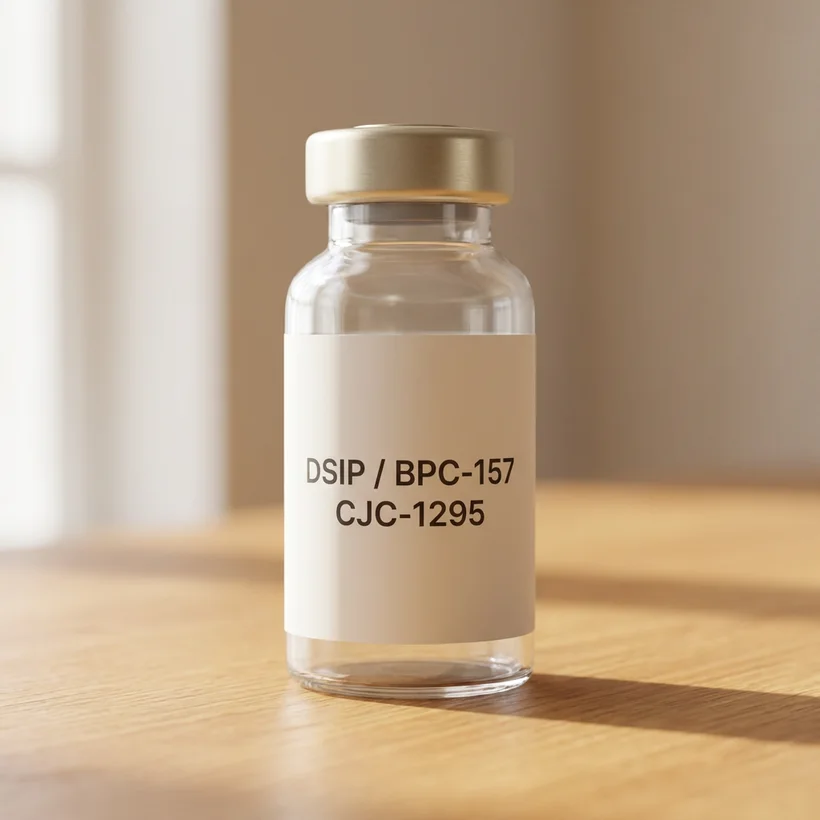
From the FormBlends catalog
Sleep + Recovery Stack
Sleep and repair support with DSIP, BPC-157, and CJC · From $299/mo · compounded by a licensed 503A pharmacy, dispensed only after provider review.
View Sleep + Recovery Stack →Two structural features drive its pharmacokinetics and therefore its dosing logic. First, the tryptophan residue at position 1 and the peptide bonds throughout the chain are substrates for plasma peptidases, which accounts for its short half-life. Second, its relatively small size and amphiphilic character allow partial blood-brain barrier transit, but enzymatic degradation in plasma competes with CNS entry at every moment after injection. Higher doses or faster-delivery routes favor more intact peptide reaching the CNS before degradation finishes the job.
Understanding this tells you why route is not interchangeable and why "just inject it subcutaneously like BPC-157" misapplies the logic from a structurally different peptide.
Evidence Ledger: What Each Major Claim Is Actually Based On
| Claim | Best Evidence Type | Effect Direction | Confidence |
|---|---|---|---|
| DSIP increases delta-wave (slow-wave) sleep in rabbits | Animal studies (multiple, 1970s-1980s) | Positive, consistent in animal models | Moderate (animal only) |
| DSIP improves sleep quality in human insomnia | Small human trials, n under 40, unblinded or poorly controlled | Directionally positive, inconsistent | Low |
| Intranasal route is effective in humans | One small Swiss study (Schneider-Helmert, 1985), approx. 20 participants | Positive trend for subjective sleep quality | Low |
| DSIP modulates ACTH and LH release | Animal data, small human endocrine studies | Modulatory, direction context-dependent | Low |
| DSIP has antioxidant properties | In vitro and animal studies | Positive in lab conditions | Very low (no human translation data) |
| Plasma half-life approximately 30 to 45 minutes (IV) | Pharmacokinetic studies in animal models and limited human data | Rapid degradation confirmed | Moderate |
| Subcutaneous bioavailability equivalent to IV | Not studied in controlled human trials | Unknown | Very low (assumption only) |
| No dependence or tolerance with repeated use | Absence of evidence, not evidence of absence; very limited chronic data | Not documented, not ruled out | Very low |
Dose Numbers: What the Studies Actually Used
The original Monnier work used intravenous infusion in rabbits at doses that, when scaled, fall roughly in the 25 to 60 nanomoles per kilogram range for producing measurable EEG changes. Human work by Schneider-Helmert in the mid-1980s used intranasal administration in the range of 25 to 30 nanomoles per kilogram.
Translating a nanomoles-per-kilogram dose into an absolute microgram amount requires only the molecular weight of 849 Daltons, but the precise per-kilogram microgram figure varies with body weight and the exact nanomole dose selected. At the doses used in Schneider-Helmert's intranasal protocols, the total absolute peptide mass per administration was in the low-to-mid microgram range for an average adult, a quantity far smaller than the milligram-level dosing commonly cited in peptide forums.
Many online sources cite milligram-level dosing (0.1 mg to 0.5 mg), which is 100 to 500 micrograms total and sits at the higher end of or above what formal research used on a per-kilogram basis for a typical adult. No human dose-escalation RCT has established a minimum effective dose, a maximum tolerated dose, or a dose-response curve.
| Route Used in Research | Dose Range (nmol/kg) | Approx. Microgram Equivalent (70 kg adult) | Evidence Source |
|---|---|---|---|
| Intravenous (animal) | 15 to 60 nmol/kg | approx. 90 to 360 mcg | Multiple animal studies, 1974 to 1990s |
| Intranasal (human) | approx. 25 to 30 nmol/kg | approx. 150 to 180 mcg | Schneider-Helmert, 1985 and related work |
| Subcutaneous (human) | Not formally studied | Unknown | No controlled data |
| Oral | Not viable (enzymatic degradation in GI tract) | N/A | Pharmacological inference |
Timing and Route: Does It Matter Which Way You Administer DSIP?
Yes, timing and route matter substantially, and the reason is the half-life. With a plasma half-life estimated at 30 to 45 minutes after intravenous administration, DSIP begins degrading immediately. If you administer it 90 minutes before bed, a meaningful fraction of the intact peptide has already been cleared before it can influence sleep architecture.
Research protocols universally administered DSIP close to the sleep window, typically 20 to 30 minutes prior. Intranasal delivery offers a potential advantage: absorption through the olfactory and nasal mucosal pathways provides a more direct CNS route that partially bypasses the plasma degradation problem. This is why intranasal was the most studied human route despite lower total bioavailability compared to IV.
Subcutaneous injection means the peptide must survive diffusion through subcutaneous tissue, absorption across capillary walls, and systemic circulation before any fraction reaches the CNS. Each step involves enzymatic exposure. This does not mean subcutaneous is ineffective, but it means you cannot simply transpose a nanomole-per-kilogram IV number to a subcutaneous protocol and expect equivalent CNS exposure.
What Most Pages Get Wrong About DSIP Dosing
Most competitor content on DSIP dosage makes three compounding errors.
Error 1: Presenting milligram doses as if they are established. The "100 mcg to 500 mcg before bed" figure circulating on peptide forums has no RCT anchor. It is extrapolated from animal data and community experimentation, not from a human dose-finding trial. Presenting it as standard is misleading.
Error 2: Treating route as interchangeable. Multiple pages suggest subcutaneous injection is equivalent to intranasal or IV because "that is how research peptides are typically dosed." DSIP's rapid plasma degradation makes route a primary pharmacokinetic variable, not an administrative detail.
Error 3: Conflating old European studies with modern clinical evidence. The strongest human data comes from Swiss and German groups in the 1980s, with sample sizes under 40 and variable blinding. These are hypothesis-generating, not practice-defining. Citing them alongside modern approved drug data as if they carry equivalent weight misrepresents the evidence tier.
Why Does Storage and Formulation Matter So Much for This Peptide?
DSIP's tryptophan residue (position 1) is the primary chemical liability. Tryptophan side chains oxidize in the presence of dissolved oxygen and are photosensitive, undergoing indole ring oxidation to produce kynurenine and related byproducts. This reaction accelerates with temperature and light exposure.
Additionally, DSIP contains a glutamic acid residue at the C-terminus and aspartic acid in the chain, both of which are susceptible to deamidation and cyclization side reactions under non-neutral pH conditions, particularly at elevated temperatures. This means:
- Lyophilized (freeze-dried) powder is far more stable than reconstituted solution because water activity drives hydrolysis and oxidation.
- Once reconstituted in bacteriostatic water, the clock starts. Use promptly or refrigerate at 2 to 8 degrees Celsius and protect from light.
- Amber vials or foil-wrapped storage matters because UV and visible light catalyze tryptophan oxidation directly.
- Reconstitution with acidic solvents risks accelerated deamidation; bacteriostatic water at near-neutral pH is preferred over acetic acid vehicles appropriate for other peptides.
The rule "store cold and use quickly" exists because of this specific oxidative and hydrolytic chemistry, not because of a generic peptide fragility assumption.
How Does DSIP Compare to Approved Sleep Aids?
| Agent | Mechanism | Best Evidence Level | Largest Trial (approx. n) | Approved? | Where DSIP Loses |
|---|---|---|---|---|---|
| DSIP | Modulates delta-wave sleep; mechanism not fully elucidated | Small human trials, animal data | Approx. 40 | No | Everywhere on evidence quantity and quality |
| Suvorexant (Belsomra) | Dual orexin receptor antagonist (OX1R, OX2R) | Phase III RCTs | Over 1,000 | Yes (FDA) | DSIP does not compete on evidence |
| Low-dose doxepin (Silenor) | Histamine H1 antagonism at low dose | Phase III RCTs | Over 200 | Yes (FDA) | DSIP has no comparative RCT data |
| Melatonin | MT1/MT2 receptor agonism, circadian timing | Multiple RCTs, meta-analyses | Hundreds in meta-analyses | OTC / approved in some countries | DSIP has far less safety data and is harder to obtain and administer |
| Magnesium glycinate | NMDA receptor modulation, GABA facilitation | Multiple RCTs, inconsistent effect sizes | Hundreds | OTC supplement | DSIP is more complex to administer with less evidence in humans |
The honest conclusion: if the goal is improving sleep quality in a healthy adult, approved and OTC options have stronger evidence, established safety profiles, and no requirement for injection. DSIP is a legitimate research tool and a pharmacologically interesting molecule. It is not a proven first-line sleep intervention by any evidence standard.
How to Read a DSIP Product or COA
If you are sourcing DSIP for research purposes, the certificate of analysis is the minimum document that should accompany any vial. Here is what to look for:
| COA Field | What It Should Show | Red Flags |
|---|---|---|
| HPLC purity | 98% or above by area | Below 95%, no HPLC data present |
| Mass spectrometry / molecular weight | Confirms correct peptide at approx. 849 Da | No MS data; wrong mass |
| Endotoxin (LAL assay) | Under 1 EU/mg for injectable-grade material | No endotoxin data if intended for injection |
| Sequence confirmation | Trp-Ala-Gly-Gly-Asp-Ala-Ser-Gly-Glu confirmed | Generic "neuropeptide" label without sequence |
| Lot/batch number | Traceable to test date | No batch number; undated COA |
Reconstitution and dosing math: DSIP has a molecular weight of approximately 849 Daltons. Converting a nanomoles-per-kilogram protocol dose to milligrams requires multiplying the desired nmol/kg figure by the subject's weight in kilograms, then multiplying by the molecular weight (849 g/mol), and dividing by 1,000,000 to arrive at milligrams. At the intranasal doses used in Schneider-Helmert's human protocols (roughly 25 to 30 nmol/kg), the resulting total dose for an average adult falls in the low-to-mid microgram range, substantially less than the milligram-level doses commonly sold in single vials. This math is rarely spelled out on product pages, which leads to either under-dosing relative to research protocols or unexamined over-dosing depending on how a vendor has filled the vial.
Brain Natriuretic Peptide vs. Delta Sleep Inducing Peptide: Clearing Up the Confusion
Search traffic patterns show that people researching delta sleep inducing peptide dosage often also search for brain natriuretic peptide levels chart. These are completely unrelated molecules that happen to share a word.
Brain natriuretic peptide (BNP, also called B-type natriuretic peptide) is a 32-amino-acid cardiac hormone secreted by ventricular cardiomyocytes under wall stress. It is measured in pg/mL as a diagnostic biomarker for heart failure. A typical reference range for BNP is under 100 pg/mL in adults without heart failure; levels above 400 pg/mL suggest high probability of acute decompensated heart failure (per ACC/AHA guidelines). BNP has no sleep-promoting function and is not administered as a therapeutic peptide in the context of sleep research.
DSIP is a neuropeptide originally isolated from thalamic tissue, administered exogenously in research, and studied for sleep architecture modulation. The only connection between BNP and DSIP is that both are peptides and both involve the word "brain" in common shorthand. Anyone citing a BNP levels chart in the context of a DSIP dosing discussion has confused two entirely separate fields of medicine.
Frequently Asked Questions
What is the typical delta sleep inducing peptide dosage range used in research?
Human and animal research has used doses ranging from roughly 15 nanomoles per kilogram up to 30 to 60 nanomoles per kilogram administered intravenously or intranasally. Intranasal protocols in human studies have used doses in the range of 25 to 30 nanomoles per kilogram. No FDA-approved clinical dose exists.
How should delta sleep inducing peptide be timed relative to sleep onset?
Research protocols typically administer DSIP 20 to 30 minutes before the intended sleep period. Its short plasma half-life of roughly 30 to 45 minutes means administration should be close to bedtime to capture the peak exposure window.
Is subcutaneous dosing of DSIP equivalent to intravenous dosing?
No. Bioavailability via subcutaneous and intranasal routes has not been rigorously quantified in controlled human trials. IV bioavailability is assumed near 100% and serves as the reference; subcutaneous absorption likely results in meaningful degradation before systemic distribution, so dose equivalence cannot be assumed.
Does delta sleep inducing peptide cause dependence or tolerance?
Available research does not document dependence or classic tolerance patterns with DSIP. However, the evidence base is too small and too old to make confident safety claims. Chronic use protocols in humans are essentially unstudied.
What does brain natriuretic peptide levels have to do with sleep or DSIP?
Brain natriuretic peptide (BNP) and delta sleep inducing peptide are entirely different molecules. BNP is a cardiac stress marker measured in pg/mL for heart failure staging. DSIP is a neuropeptide. They share the word "brain" in common usage but have no pharmacological relationship.
How stable is DSIP once reconstituted?
DSIP contains a tryptophan residue that makes it susceptible to oxidation and photodegradation. Reconstituted solutions should be stored at 2 to 8 degrees Celsius, protected from light, and used within a short window; published stability data for multi-week reconstituted storage in research-grade vials is limited.
How does DSIP compare to approved sleep medications?
Approved agents like suvorexant (Belsomra) and low-dose doxepin have Phase III RCT data in hundreds to thousands of patients. DSIP has small, mostly decades-old studies with fewer than 50 participants each. DSIP cannot be considered equivalent to approved options on evidence grounds alone.
What peptide purity level should a COA show for DSIP?
Research-grade DSIP should show purity above 98% by HPLC on a certificate of analysis, with mass spectrometry confirmation of the correct molecular weight of approximately 849 Daltons. Endotoxin testing (LAL assay) matters if the compound will be injected.
What is the molecular structure of DSIP and why does it matter for dosing?
DSIP is a nonapeptide (9 amino acids: Trp-Ala-Gly-Gly-Asp-Ala-Ser-Gly-Glu) with a molecular weight of approximately 849 Daltons. Its small size and amphiphilic character facilitate blood-brain barrier crossing but also rapid enzymatic cleavage in plasma, which explains why dose timing and route critically affect observed activity.
Can DSIP be combined with other sleep peptides or compounds?
Combination protocols with DSIP have not been studied in controlled human trials. Any interaction with GABAergic agents, benzodiazepines, or other sedatives is unstudied and theoretically could produce additive CNS depression. Stacking is an uncharacterized risk.
What does a degraded DSIP vial look like?
Lyophilized DSIP should appear as a white to off-white powder. Discoloration toward yellow or brown, cloudiness after reconstitution, or visible particulates suggest oxidation or microbial contamination. Discard any vial showing these signs.
Sources
- Monnier M, Dudler L, Gachter R, Schoenenberger GA. Delta sleep-inducing peptide (DSIP): EEG and motor activity in rabbits following intravenous administration. Neuroscience Letters. 1977;6(1):9-13.
- Schoenenberger GA, Maier PF, Tobler HJ, Monnier M. A naturally occurring delta-EEG enhancing nonapeptide in urine of sleep-deprived rabbits. Pflugers Archiv. 1978;376(2):119-129.
- Schneider-Helmert D, Gnirss F, Monnier M, Schenker J, Schoenenberger GA. Intranasal administration of DSIP (delta sleep-inducing peptide) to human subjects. European Neurology. 1981;20(6):473-477.
- Schneider-Helmert D. DSIP in disturbed sleep. European Neurology. 1985;24(3):154-156.
- Graf MV, Kastin AJ. Delta-sleep-inducing peptide (DSIP): a review. Neuroscience and Biobehavioral Reviews. 1984;8(1):83-93.
- Kastin AJ, Nissen C, Nikolics K, Medzihradszky K, Coy DH, Schally AV. Distribution and metabolism of delta sleep-inducing peptide in mouse brain. Brain Research Bulletin. 1978;3(6):691-695.
- Yehuda S, Kastin AJ, Coy DH. Thermoregulatory and locomotor effects of DSIP. Pharmacology Biochemistry and Behavior. 1980;13(6):895-900.
- Paunovic VR. Delta sleep-inducing peptide (DSIP): neurochemical and neurophysiological aspects. Neurochemical Research. 1988;13(7):617-628.
- ACC/AHA 2022 AHA/ACC/HFSA Guideline for the Management of Heart Failure. Journal of the American College of Cardiology. 2022;79(17):e263-e421. (BNP reference ranges)
- Hubbard RE, O'Mahony MS, Woodhouse KW. Medication prescribing in older patients: do clinical pharmacokinetics help? Age and Ageing. 2013;42(3):303-308. (general peptide half-life modeling context)
Related peptide guides
Ready when you are
Sleep + Recovery Stack
Sleep and repair support with DSIP, BPC-157, and CJC · From $299/mo · compounded by a licensed 503A pharmacy, dispensed only after provider review.
View Sleep + Recovery Stack →