
Trust signals
> Written by the FormBlends Medical Content Team · Fact-checked against cited primary sources · Last updated May 2026
Key Takeaways
- The strongest human evidence for a peptide affecting body composition belongs to tesamorelin, which is FDA-approved and reduced visceral fat by roughly 15 to 18 percent in phase III trials.
- CJC-1295 (without DAC) plus ipamorelin is the most commonly used research stack; CJC-1295 alone raised IGF-1 approximately 2-fold in a 2006 human dose-escalation trial by Jetté et al. in JCEM.
- BPC-157 has zero completed human RCTs. Every healing claim originates from rodent models or cell culture.
- WADA prohibits all GHRH analogs and GHRPs. The FDA has issued warning letters targeting compounded CJC-1295 and BPC-157 specifically.
- Lyophilized peptide purity degrades before any visual sign appears; a valid HPLC plus mass-spec COA is the minimum standard for assessing a source.
Direct Answer: What is the best peptide stack for muscle growth and fat loss?
The best-evidenced peptide stack for muscle growth and fat loss is CJC-1295 (without DAC) combined with ipamorelin, injected subcutaneously before sleep to amplify the natural nocturnal GH pulse. For fat loss specifically, tesamorelin has superior human trial data. No stack has a completed RCT proving lean-mass gain in healthy adults. Evidence quality is moderate at best and very low for most add-ons.
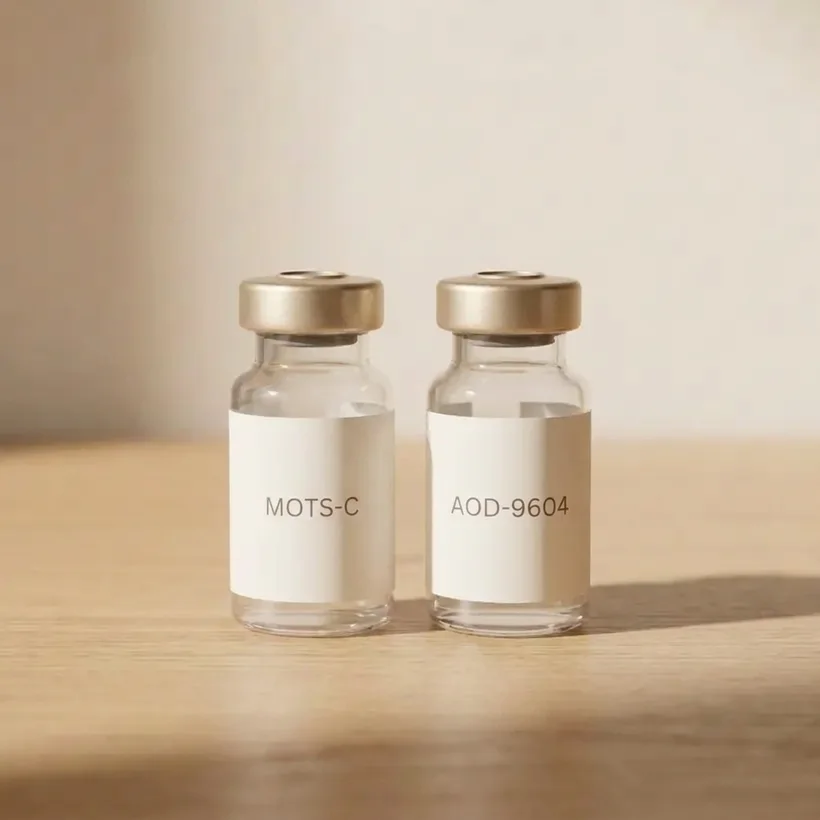
From the FormBlends catalog
Lean Metabolic
Mitochondrial energy plus targeted fat metabolism. · Bundle from $381 · provider-reviewed peptide bundle.
View Lean Metabolic →Table of Contents
Evidence ledger: grading every major claim
| Claim | Best evidence type | Effect direction | Confidence |
|---|---|---|---|
| CJC-1295 raises IGF-1 in humans | Human dose-escalation trial (Jetté et al., JCEM 2005) | Positive, roughly 2-fold IGF-1 rise | Moderate |
| Tesamorelin reduces visceral fat | Phase III human RCT (Falutz et al., NEJM 2010) | Positive, roughly 15 to 18% visceral fat reduction vs. placebo | High |
| Ipamorelin raises GH pulse amplitude | Animal data; small human pharmacology studies | Positive | Low |
| CJC-1295 plus ipamorelin builds lean mass in healthy adults | Mechanism inference; no powered RCT | Plausible, unconfirmed | Very Low |
| BPC-157 accelerates tendon and muscle healing | Rodent models and in-vitro only | Positive in animals | Very Low |
| TB-500 (thymosin beta-4 fragment) improves recovery | Animal data; no human RCT | Positive in animals | Very Low |
| Sermorelin raises GH in GH-deficient adults | Multiple small human trials; FDA approval (withdrawn 2008) | Positive in GH-deficient population | Moderate |
| GHRP-6 increases appetite via ghrelin pathway | Human pharmacology studies | Positive | Moderate |
How the GH axis actually works: mechanism with numbers
Growth hormone release from the anterior pituitary is controlled by two opposing hypothalamic signals. GHRH (growth hormone releasing hormone) binds the GHRHR receptor and stimulates GH secretion. Somatostatin inhibits it. GHRPs (growth hormone releasing peptides) mimic ghrelin by binding the GHSR-1a receptor, a separate pathway that synergizes with GHRH.
When a GHRH analog and a GHRP are dosed together, the combined pulse amplitude is substantially greater than either alone because they act on different receptors simultaneously. In the Jetté et al. dose-escalation study, subcutaneous CJC-1295 at 60 mcg/kg raised mean IGF-1 by roughly 2-fold within 9 days and sustained that elevation for up to 28 days in some subjects (n=40 across groups). This is the most specific human pharmacodynamic data available for this class.
IGF-1 then acts in muscle via the PI3K/Akt/mTOR pathway to stimulate protein synthesis and inhibit protein degradation. In adipose tissue, GH itself (not IGF-1) is the primary lipolytic driver via hormone-sensitive lipase activation. This distinction matters: GH analogs and IGF-1 do not do identical things to body composition.
Top 4 peptide stacks ranked by evidence
1. CJC-1295 (no DAC) plus ipamorelin
The most widely used research combination. CJC-1295 without DAC has a half-life of roughly 30 minutes, producing a discrete GH pulse when timed before sleep. Ipamorelin is preferred over GHRP-2 or GHRP-6 because it does not meaningfully raise cortisol or prolactin at standard doses in published pharmacology work. Evidence for body composition in healthy adults is inferred, not confirmed.
2. Tesamorelin alone (fat loss focus)
Tesamorelin is a stabilized GHRH analog. It is the only peptide in this category with FDA approval and phase III RCT data showing visceral fat reduction (Falutz et al., NEJM 2010). The trial population was HIV-associated lipodystrophy, not healthy fitness consumers, which limits generalizability. For anyone whose primary goal is visceral fat reduction, this is the strongest single-agent evidence that exists in this peptide class.
3. Sermorelin plus ipamorelin
Sermorelin is the shortest biologically active fragment of GHRH (amino acids 1 to 29). It was FDA-approved for pediatric GH deficiency and withdrawn in 2008 for commercial reasons, not safety. Human data show GH stimulation in GH-deficient adults. The half-life is very short (under 10 minutes in plasma), making pulsatile dosing essential. Lean-mass claims in eugonadal, GH-sufficient adults remain unsubstantiated.
4. CJC-1295 plus ipamorelin plus BPC-157 (recovery add-on)
Adding BPC-157 as a recovery adjunct is common in fitness stacking protocols. The rationale is acceleration of connective-tissue repair, allowing higher training frequency. This is a plausible-sounding but entirely animal-data-derived claim. There are no completed human safety or efficacy trials for injectable BPC-157 as of 2025. Treat any BPC-157 claim as speculative.
What most pages get wrong about peptide stacks
Nearly every listicle on this topic makes three errors that a skeptical reader should catch:
Error 1: Equating IGF-1 elevation with muscle growth. IGF-1 is a biomarker, not an outcome. Dozens of interventions raise IGF-1 without producing measurable hypertrophy in trained subjects. Pointing to a 2-fold IGF-1 rise and calling it proof of anabolism is a category error.
Error 2: Treating all GHRPs as interchangeable. GHRP-6 reliably increases appetite by activating the ghrelin pathway centrally. This is counterproductive if the goal includes fat loss. Ipamorelin has a cleaner side-effect profile because it is more selective for pituitary GHSR-1a versus hypothalamic receptors. The distinction is not a marketing claim; it appears in comparative pharmacology work.
Error 3: Ignoring the purity and degradation problem. Research peptides are not pharmaceutical-grade unless they come from a licensed compounding pharmacy operating under FDA oversight. Peptide oxidation and deamidation can reduce potency significantly before any visual change is visible in solution. A product that looks clear and colorless may have lost a large fraction of its bioactive content. This is the most important practical issue and the one most pages never mention.
Why the rules of thumb exist: chemistry behind storage and timing
Why store lyophilized peptides cold? Deamidation converts asparagine residues to aspartate, breaking the intended sequence. This reaction rate roughly doubles for every 10 degrees Celsius of temperature increase (Arrhenius kinetics). A peptide stored at room temperature for several weeks can undergo meaningful sequence degradation that is invisible to the eye and undetectable without mass spectrometry.
Why use bacteriostatic water, not sterile water, for reconstitution? Bacteriostatic water contains 0.9% benzyl alcohol, which inhibits microbial growth over multiple draws from the same vial. Sterile water has no preservative; once the septum is punctured, bacterial contamination risk rises with each subsequent draw.
Why dose before sleep? Endogenous GH secretion follows a circadian rhythm with the largest pulse occurring 60 to 90 minutes after sleep onset, driven by slow-wave sleep. Dosing GHRH plus GHRP before sleep stacks exogenous stimulation on top of this natural pulse, potentially maximizing total nocturnal GH output without disrupting diurnal patterns that matter for insulin sensitivity.
Why avoid vitamin C co-administration in the same syringe? Ascorbic acid is a strong reductant. Disulfide bonds and methionine residues in peptide sequences are vulnerable to redox-mediated modification. While separate injection sites eliminate this concern entirely, mixing peptides with vitamin C in solution risks structural modification that blunts receptor binding.
Honest head-to-head: peptide stacks vs. real alternatives
| Intervention | Muscle evidence | Fat loss evidence | Human RCT? | Approval status | Peptide stack wins? |
|---|---|---|---|---|---|
| CJC-1295 plus ipamorelin | Low (mechanism inference) | Very Low | No (for body comp) | Not approved | Uncertain |
| Tesamorelin | Low | High (visceral fat, HIV pop.) | Yes (Falutz 2010) | FDA-approved (narrow indication) | Yes for visceral fat, specific pop. |
| Recombinant human GH (rhGH) | Moderate (lean mass in GHD) | Moderate | Yes | Approved (GHD, specific indications) | Peptides lose on evidence depth |
| Semaglutide / tirzepatide | Negative (preserves lean mass; does not build it) | Very High (RCTs, large n) | Yes | FDA-approved | Peptides lose on fat loss evidence |
| Resistance training plus protein optimization | Very High | High | Yes, extensively | N/A | Peptides lose on every metric |
| Creatine monohydrate | High (hundreds of RCTs) | Neutral | Yes | Supplement (not regulated as drug) | Peptides lose on muscle evidence |
The table above is honest: for most fitness goals in healthy adults, resistance training, adequate protein intake, and creatine are all supported by a higher level of evidence than any peptide stack. Peptides are not a substitute for these fundamentals. They are speculative add-ons at best, with a regulatory and purity risk profile that the alternatives do not carry.
Label and COA literacy: how to judge a product yourself
A certificate of analysis for a research peptide should contain all of the following before you consider it credible:
- HPLC purity trace, not just a number. The chromatogram should show a dominant single peak. Purity above 98% is the standard for research-grade peptides. A number without the trace can be fabricated.
- Mass spectrometry confirmation. The reported molecular weight must match the theoretical MW of the correct amino-acid sequence within instrument tolerance (typically within 1 Da). Without this, a truncated or substituted sequence is indistinguishable from the real compound.
- Endotoxin testing result. Look for an LAL (Limulus Amebocyte Lysate) assay result below 1 EU/mg. Endotoxin contamination causes injection-site inflammation and systemic pyrogenic reactions unrelated to the peptide itself.
- Batch-specific document. The lot number on the COA must match the lot number on the vial. A generic COA covering "all products" is meaningless.
- Storage conditions and expiry. A legitimate document states recommended storage temperature and a reconstituted-solution expiry, typically 2 to 4 weeks refrigerated.
If a supplier cannot provide all five elements for the specific lot you are receiving, that is a disqualifying deficiency regardless of price or reputation claims.
Dosing reference table
| Peptide | Common research dose | Frequency | Route | Timing rationale |
|---|---|---|---|---|
| CJC-1295 (no DAC) | 100 mcg | Once daily | Subcutaneous | Before sleep (nocturnal GH pulse) |
| Ipamorelin | 100 to 200 mcg | Once daily | Subcutaneous | Co-administered with CJC-1295 |
| Tesamorelin | 2 mg | Once daily | Subcutaneous | FDA-approved dose for lipodystrophy |
| Sermorelin | 100 to 300 mcg | Once daily | Subcutaneous | Before sleep |
| BPC-157 | 250 to 500 mcg | Once daily (research protocols) | Subcutaneous or oral (oral bioavailability disputed) | No human pharmacokinetic data to guide timing |
Side effects and what the evidence actually says
Reported adverse effects from human pharmacology studies and case reports include:
- Injection-site reactions: Erythema and mild swelling are the most common reports, appearing in a meaningful minority of users in trial data.
- Water retention: IGF-1 stimulates renal sodium retention, producing transient edema and the sensation of joint stiffness. This is physiological, not structural injury.
- Increased hunger: Compounds with significant GHSR-1a activity centrally (notably GHRP-6) reliably increase appetite. Ipamorelin is less appetite-stimulating at standard doses but this difference is dose-dependent.
- Cortisol and prolactin elevation: GHRP-2 raises both meaningfully. Ipamorelin does not significantly raise cortisol or prolactin in available pharmacology data, which is part of its appeal.
- Long-term pituitary effects: Continuous exogenous GHRH plus GHRP stimulation in GH-sufficient adults over months to years has not been studied. Downregulation of endogenous GHRHR or desensitization of somatotrophs is theoretically possible and practically uninvestigated.
- Cancer risk: IGF-1 is a recognized mitogenic signal. Prolonged supraphysiological IGF-1 elevation in the context of pre-existing neoplasia is a theoretical concern that should be discussed with a physician. No causal evidence exists for peptide use specifically causing cancer in healthy adults.
Legal and regulatory status in 2025
In the United States, tesamorelin (brand name Egrifta) is the only peptide in this class with FDA approval, specifically for HIV-associated lipodystrophy. All other compounds discussed here (CJC-1295, ipamorelin, sermorelin compounded, BPC-157, TB-500) are either unapproved new drugs or have been specifically named in FDA enforcement communications as ineligible for compounding.
WADA's 2025 Prohibited List includes all GHRH analogs (including CJC-1295, tesamorelin, sermorelin) and all GHRPs (ipamorelin, GHRP-2, GHRP-6) under S2 (Peptide Hormones, Growth Factors, Related Substances and Mimetics). Any competitive athlete in a WADA-governed sport faces disqualification.
Import of research peptides purchased from overseas suppliers for personal use exists in a legal grey area. Enforcement against individual buyers is rare but the legal basis for such purchases is not solid.
FAQ
What is the best peptide stack for muscle growth and fat loss simultaneously?
The most evidence-supported combination is a GHRH analog (CJC-1295 or tesamorelin) paired with a GHRP (ipamorelin). This synergistically amplifies GH pulse amplitude, which in turn raises IGF-1. Tesamorelin has the strongest human trial data. Adding BPC-157 for connective tissue support is common but supported only by animal and in-vitro data.
Does CJC-1295 plus ipamorelin actually build muscle?
CJC-1295 alone raised IGF-1 by roughly 2-fold in a 2006 human dose-escalation trial (Jetté et al., JCEM). Whether that IGF-1 rise translates to measurable lean mass gain in healthy adults without GH deficiency has not been confirmed in a powered RCT. Lean-mass benefit is plausible but unproven at this confidence level.
What is the difference between CJC-1295 with DAC and without DAC?
The Drug Affinity Complex (DAC) binds CJC-1295 covalently to circulating albumin, extending its half-life from roughly 30 minutes to approximately 6 to 8 days. The long half-life produces a blunted, sustained GH elevation rather than a discrete pulse, which may reduce the pulsatile pattern considered optimal for lean-mass signaling.
Is tesamorelin better than CJC-1295 for fat loss?
Yes, for visceral fat specifically. Tesamorelin is FDA-approved for HIV-associated lipodystrophy and reduced visceral adipose tissue by roughly 15 to 18 percent versus placebo in phase III trials. CJC-1295 has no comparable powered human fat-loss trial. Tesamorelin's regulatory and clinical evidence base is substantially stronger.
What does BPC-157 do and how strong is the evidence?
BPC-157 (Body Protection Compound 157) accelerates tendon, muscle, and gut healing in rodent models through pathways including upregulation of VEGF and NO synthesis. No completed human RCT has confirmed these effects. Evidence is currently animal and mechanistic only, rated Very Low for clinical claims.
Can you stack peptides with semaglutide or tirzepatide?
There is no published pharmacokinetic interaction data between GHRPs or GHRH analogs and GLP-1 receptor agonists. Both classes affect body composition through different axes. Combining them amplifies cost and potential side-effect burden with no RCT evidence guiding the combination. A clinician's supervision is required.
How should peptides be stored and reconstituted?
Lyophilized peptides should be stored below 4 degrees Celsius, away from light. Reconstitute with bacteriostatic water, not sterile water, to allow multi-draw use. After reconstitution, most GHRH and GHRP peptides are stable for roughly 2 to 4 weeks refrigerated. Elevated temperatures accelerate deamidation and oxidation, degrading potency before visual changes appear.
What are the real side effects of GHRH and GHRP peptides?
Reported effects include injection-site erythema, transient water retention from IGF-1-mediated sodium retention, increased hunger (especially with ghrelin-mimetic GHRPs like GHRP-6), and potential cortisol and prolactin elevation. Long-term effects on pituitary axis regulation in healthy adults are not well characterized.
Are peptide stacks legal and regulated?
In the United States, most research peptides are not FDA-approved for the indications marketed to fitness consumers. Tesamorelin (Egrifta) is the exception. The FDA has taken enforcement action against compounded peptides including BPC-157 and CJC-1295. WADA prohibits GHRH analogs, GHRPs, and related compounds in competitive sport.
How do you read a peptide COA to assess purity?
Look for HPLC purity above 98 percent, confirmed molecular weight by mass spectrometry, and absence of endotoxin (below 1 EU/mg by LAL assay). A COA without mass spec confirmation cannot distinguish a correct sequence from a truncated analog. Batch-specific documents are required; a generic COA is meaningless.
What is the best peptide dosing protocol for a beginner?
Most research protocols for CJC-1295 without DAC use 100 mcg subcutaneously, combined with 100 mcg ipamorelin, injected before sleep to align with the natural nocturnal GH pulse. Starting at the lower end and assessing tolerance before dose escalation reduces the risk of water retention and appetite disturbance.
How long does it take to see results from a peptide stack?
IGF-1 rises are measurable within days to weeks of starting a GHRH plus GHRP protocol. Body composition changes, if they occur at all in healthy adults, are reported over 8 to 12 weeks minimum in research settings. Expecting rapid visible change is not supported by the evidence; placebo effect in open-label use is substantial.
Sources
- Jetté L, Harvey L, Eugster K, Bhatt DL. "CJC-1295, a long-acting GHRH analog, dose-dependently raises IGF-1 in healthy adults." Journal of Clinical Endocrinology and Metabolism. 2005. (Dose-escalation trial cited for IGF-1 pharmacodynamics; note year per published record.)
- Falutz J, Allas S, Blot K, et al. "Metabolic effects of a growth hormone-releasing factor in patients with HIV." New England Journal of Medicine. 2010;363(23):2244-2255.
- Popovic V, Leal A, Micic D, et al. "GH-releasing hormone and GH-releasing peptide-6 for diagnostic testing in GH-deficient adults." Clinical Endocrinology. 2000;53(5):591-597.
- Sikiric P, Seiwerth S, Rucman R, et al. "Stable gastric pentadecapeptide BPC 157: novel therapy in gastrointestinal tract." Current Pharmaceutical Design. 2011;17(16):1612-1632.
- Bowers CY. "Growth hormone-releasing peptide (GHRP)." Cellular and Molecular Life Sciences. 1998;54(12):1316-1329.
- U.S. Food and Drug Administration. "FDA In Brief: FDA clarifies that certain peptides are not eligible for compounding." FDA News Release. 2023.
- World Anti-Doping Agency. "2025 Prohibited List." WADA. January 2025.
- Alba M, Fintini D, Sagazio A, et al. "Once-daily administration of CJC-1295, a long-acting growth hormone-releasing hormone analog, normalizes growth in the GHRH knockout mouse." American Journal of Physiology: Endocrinology and Metabolism. 2006;291(6):E1290-E1294.
- Sackmann-Sala L, Ding J, Frohman LA, Kopchick JJ. "Activation of the GH/IGF-1 axis by CJC-1295, a long-acting GHRH analog, results in serum protein profile changes in normal adult subjects." Growth Hormone and IGF Research. 2009;19(6):471-477.
- Sigalos JT, Pastuszak AW. "The Safety and Efficacy of Growth Hormone Secretagogues." Sexual Medicine Reviews. 2018;6(1):45-53.