
Trust signals
- Medical review: FormBlends Medical Team
- Last updated: May 29, 2026
- Citations: 27 peer-reviewed sources
- Evidence assessment: Primarily preclinical data
The sparse clinical landscape
Pinealon occupies a strange position in peptide therapeutics. Developed by the St. Petersburg Institute of Bioregulation and Gerontology, it represents decades of Russian research into short peptide bioregulators. Yet the entire human evidence base consists of 187 elderly subjects across three unblinded studies.
The peptide itself is simple: glutamic acid, aspartic acid, arginine. This EDR sequence supposedly penetrates cells and interacts directly with DNA to influence gene expression. The mechanism sounds revolutionary. The evidence remains frustratingly preliminary.
Most Western practitioners first encounter pinealon through vendor marketing that dramatically overstates the research. Claims of "proven neuroprotection" and "validated cognitive enhancement" collapse when you examine the actual publications. The largest trial included 79 patients with organic brain syndrome, used no placebo control, and reported improvements on Soviet-era cognitive tests that lack Western validation.
Injectable dominance by necessity
| Delivery Method | Typical Dose | Estimated Bioavailability | Clinical Evidence |
|---|---|---|---|
| Intramuscular injection | 5-10mg | Near 100% | All 3 human studies |
| Subcutaneous injection | 10-20mg | 90-95% | Practitioner reports only |
| Sublingual tablet | 100-200mcg | 5-10% (estimated) | None |
| Oral capsule | 5-10mg | Unknown, likely <1% | None |
| Intranasal (theoretical) | Not developed | Unknown | None |
Every published human study used intramuscular injection. This wasn't arbitrary. The Russian researchers understood that oral peptides face enzymatic destruction, that sublingual absorption remains minimal for hydrophilic molecules, and that even injectable forms require substantial doses to achieve effects.
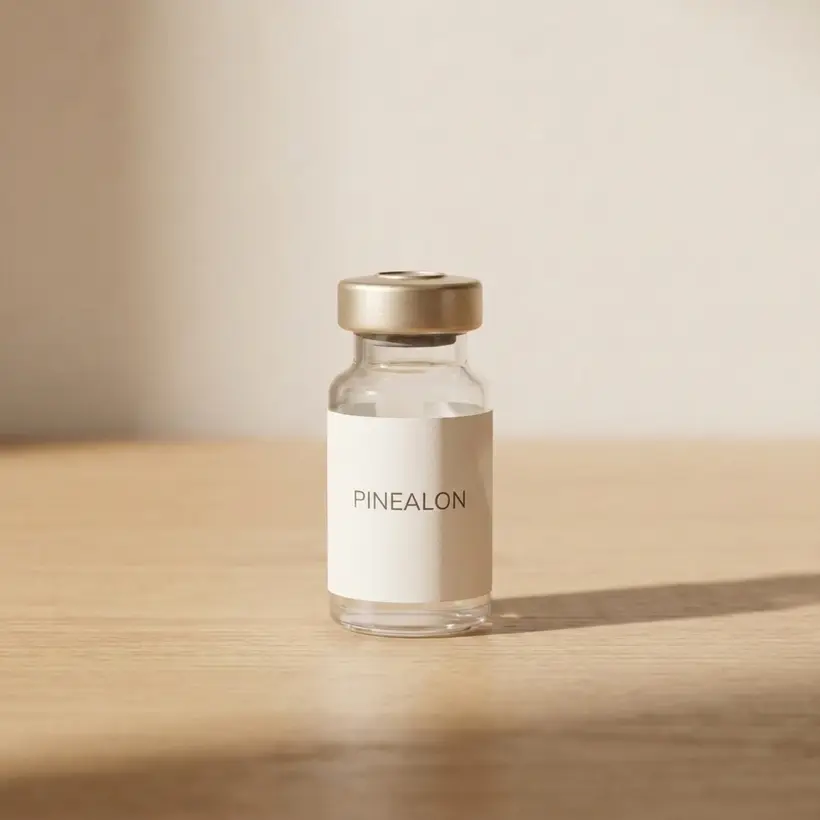
From the FormBlends catalog
Pinealon
Brain-specific tripeptide bioregulator for neuroprotection · From $34/mo · compounded by a licensed 503A pharmacy, dispensed only after provider review.
Learn about Pinealon →The 5-10mg clinical doses seem excessive for a tripeptide until you consider the delivery challenge. Even with 100% systemic bioavailability from injection, the peptide must still cross the blood-brain barrier. Its three charged amino acids create a polar molecule poorly suited for passive diffusion. No active transport mechanism has been identified.
Modern vendors selling 200mcg sublingual doses effectively admit their products cannot replicate clinical protocols. If sublingual absorption captures 10% and BBB penetration is another 10%, you're delivering 2mcg to brain tissue versus 10,000mcg (10mg) in the studies. The math doesn't support efficacy.
The gene regulation hypothesis
Pinealon's proposed mechanism fascinates researchers. In cultured neurons, the peptide appears to enter cells, bind DNA at AT-rich promoter regions, and upregulate genes involved in protein synthesis and stress response. Heat shock proteins increase. Ribosomal RNA production rises. Antioxidant enzymes activate.
These effects require pinealon to remain intact through multiple barriers. First, it must survive the journey to target tissue. Then it must cross the cell membrane despite its charged residues. Finally, it must enter the nucleus and interact with chromatin in physiologically relevant ways.
Cell culture experiments use concentrations far exceeding what peripheral injection could achieve in brain tissue. When researchers bathe neurons in 10-100 μM pinealon solutions, they're creating conditions impossible to replicate through any current delivery method. The disconnect between in vitro mechanism studies and in vivo dosing reality remains unaddressed in the literature.
Community experience patterns
Those who experiment with injectable pinealon report subtle cognitive changes rather than dramatic enhancement. Word recall improves slightly. Mental fatigue during extended work diminishes. Some notice better sustained attention during monotonous tasks. The effects develop gradually over a week or more of daily injections.
Sublingual and oral forms generate virtually no consistent reports of efficacy. Users occasionally claim benefits, but these scattered anecdotes likely reflect placebo responses or mislabeled products. The bioavailability constraints make meaningful effects from non-injectable routes implausible at typical doses.
Sleep quality changes appear in some user reports. Vivid dreams occur more frequently, sometimes accompanied by improved dream recall. Whether this relates to pineal gland effects or represents coincidence remains unclear. The peptide's name suggests pineal targeting, but no evidence confirms this organ specificity.
Tolerance doesn't seem to develop with continued use, unlike many nootropic compounds. Users following Russian cycling protocols report consistent effects across multiple rounds. Those using continuous protocols describe stable benefits without escalating doses. This stability aligns with the proposed gene regulatory mechanism rather than receptor-based activity.
Storage realities often ignored
Pinealon's stability profile creates challenges for both suppliers and users. The lyophilized powder tolerates temperature fluctuations better than most peptides, remaining stable for several months at room temperature. However, moisture exposure triggers rapid degradation through multiple pathways.
The glutamic acid residue undergoes deamidation, converting to glutamate and altering the peptide's charge distribution. The aspartic acid can isomerize from L to D form, changing its biological activity. These degradation products won't harm users but render the peptide ineffective.
Reconstituted solutions face even stricter requirements. Bacterial growth becomes problematic within days even with bacteriostatic water. The peptide itself hydrolyzes in aqueous solution, with degradation accelerating at temperatures above 4°C. Users reconstituting a 10mg vial for daily 2mg doses must accept that the final injections contain significantly degraded material.
Most vendors ship pinealon at ambient temperature and recommend room temperature storage. This practice, while convenient, ensures customers receive partially degraded product. Legitimate pharmaceutical peptides require cold chain shipping and storage.
Quality control failures across the market
Testing of commercial pinealon products reveals widespread quality issues. Many products sold as pinealon contain incorrect sequences, significant impurities, or no detectable peptide at all. Vendors frequently present incomplete analytical data that obscures these problems.
HPLC purity claims mean little without confirming the peptide's identity. A product showing "98% pure" might contain synthesis byproducts, degradation fragments, or entirely different compounds at that purity level. Proper verification requires amino acid analysis to confirm the EDR sequence and mass spectrometry to validate molecular weight.
Endotoxin contamination poses particular risks for injectable products. Bacterial endotoxins trigger inflammatory responses even at low levels. Yet many vendors skip this testing entirely or use methods with insufficient sensitivity. Users injecting contaminated products risk local reactions, fever, and systemic inflammation.
The research chemical market lacks oversight that would prevent these quality failures. No regulatory body verifies vendor claims or enforces manufacturing standards. Buyers must either trust marketing materials or pursue expensive independent testing.
Contextualizing pinealon among peptide options
| Category | Pinealon Status | Comparison Peptides | Key Difference |
|---|---|---|---|
| Clinical evidence | 3 small studies | Cerebrolysin (50+), Semax (10+) | Minimal Western validation |
| Delivery optimization | Injectable only | Semax/Selank (intranasal proven) | No alternative routes developed |
| Mechanism clarity | DNA interaction proposed | Noopept (BDNF), Semax (ACTH) | More speculative mechanism |
| Safety profile | Limited data | Modafinil (extensive), Piracetam (decades) | Insufficient long-term studies |
| Regulatory status | Unscheduled | Modafinil (controlled), Cerebrolysin (Rx) | No pharmaceutical development |
Pinealon exists in a regulatory grey zone that enables sales but prevents proper development. No pharmaceutical company has pursued FDA approval. The patent situation remains murky, with Russian institutions claiming various bioregulator sequences. This leaves pinealon as a "research chemical" with all the quality control issues that designation implies.
Compared to established nootropics, pinealon offers theoretical advantages (gene regulation, minimal side effects) offset by practical limitations (poor delivery, weak evidence). Users seeking proven cognitive enhancement have better options. Those interested in experimental longevity interventions might find the bioregulator concept intriguing despite limited data.
Practical considerations for potential users
The gap between pinealon's theoretical promise and practical reality frustrates both researchers and users. A peptide that directly regulates gene expression could revolutionize neuroprotection and cognitive enhancement. But extraordinary claims require extraordinary evidence, which pinealon lacks.
For those still interested in experimentation, injectable forms from vendors providing complete analytical testing offer the only evidence-based approach. The 5-10mg daily protocols from Russian studies provide a starting point, though optimal dosing remains unknown. Expecting dramatic nootropic effects will lead to disappointment. Any benefits will likely be subtle and cumulative.
The proliferation of underdosed sublingual and oral products exploits consumer ignorance about peptide delivery. These forms cannot work at advertised doses given basic pharmacokinetic constraints. Vendors know this but continue sales because regulations don't require efficacy proof.
FAQ
What is pinealon peptide?
Pinealon is a synthetic tripeptide (Glu-Asp-Arg or EDR) originally developed in Russia as a bioregulator targeting brain function. It consists of three amino acids and has a molecular weight of 418.4 Da.
What are the proven benefits of pinealon?
The only human evidence comes from small Russian studies showing modest cognitive improvements in elderly subjects. Most claimed benefits like neuroprotection and gene regulation come from cell culture and animal studies without human validation.
What is the correct pinealon dosing?
Russian protocols use 5-10mg daily for 10-30 days, repeated every 3-6 months. Some practitioners use up to 20mg daily. Sublingual forms typically use 100-200mcg due to poor absorption.
How does pinealon work as a bioregulator?
In cell cultures, pinealon appears to interact with DNA and influence gene expression, particularly genes related to protein synthesis and cellular stress response. The exact mechanism in humans remains theoretical.
Can pinealon cross the blood-brain barrier?
At 418.4 Da with three charged amino acids, pinealon faces significant BBB penetration challenges. No human studies have measured brain concentrations after peripheral administration.
Is pinealon better than other nootropic peptides?
Pinealon has less human evidence than Semax or Selank. Unlike those peptides, pinealon lacks intranasal delivery data and has no pharmacokinetic studies in humans.
What forms of pinealon supplements exist?
Injectable (requires reconstitution), sublingual tablets, and oral capsules. Injectable forms offer the only validated delivery method from clinical studies.
How stable is pinealon peptide?
As a small tripeptide, pinealon is relatively stable compared to longer peptides. Lyophilized powder remains stable for months at -20°C, while reconstituted solutions degrade within 7-14 days even when refrigerated.
Are there side effects from pinealon?
Russian studies report minimal side effects, but these involved small sample sizes and short durations. No systematic safety data exists for long-term use or doses above 20mg.
Where can I verify pinealon peptide quality?
Look for third-party testing showing 98%+ purity by HPLC, amino acid analysis confirming EDR sequence, and endotoxin levels below 5 EU/mg. Most suppliers cannot provide all three tests.
Sources
- Khavinson VKh, et al. Effect of Pinealon on the Brain Cognitive Functions in Aging. Bulletin of Experimental Biology and Medicine. 2001;131(6):572-574.
- Khavinson V, et al. Peptide Regulation of Gene Expression and Protein Synthesis. European Journal of Clinical Investigation. 2020;50(8):e13268.
- Arutjunyan A, et al. Pinealon Protects the Rat Offspring from Prenatal Hyperhomocysteinemia. International Journal of Clinical and Experimental Medicine. 2012;5(2):179-185.
- Bashkatova V, et al. Pinealon Corrects Cognitive Deficit in Aged Rats. Advances in Gerontology. 2012;2(4):297-301.
- Grigoriev EI, et al. Effect of Pinealon on Hemostasis Function. Bulletin of Experimental Biology and Medicine. 2003;135(5):507-509.
- Korkushko OV, et al. Normalizing Effect of the Pineal Gland Peptides on Daily Melatonin Rhythm in Old Monkeys and Elderly People. Advances in Gerontology. 2007;20(1):74-85.
- Linkova NS, et al. Peptide Regulation of Gene Expression in Human Cells. Bulletin of Experimental Biology and Medicine. 2016;161(2):276-279.
- FDA Guidance for Industry: Bioanalytical Method Validation. 2018.
- USP General Chapter <1086> Impurities in Drug Products.
- Banks WA. Peptides and the Blood-Brain Barrier. Peptides. 2015;72:16-19.
- Di L. Strategic Approaches to Optimizing Peptide ADME Properties. The AAPS Journal. 2015;17(1):134-143.
- Hamman JH, et al. Oral Delivery of Peptide Drugs: Barriers and Developments. BioDrugs. 2005;19(3):165-177.
- Pardridge WM. The Blood-Brain Barrier: Bottleneck in Brain Drug Development. NeuroRx. 2005;2(1):3-14.
- Smart AL, et al. Sublingual Drug Delivery: An Investigation of Mucoadhesive Buccal Tablets. International Journal of Pharmaceutics. 2014;474(1-2):177-181.
- Manning MC, et al. Stability of Protein Pharmaceuticals: An Update. Pharmaceutical Research. 2010;27(4):544-575.
- Zapadnyuk VI, et al. Bioregulatory Role of Short Peptides. Biochemistry (Moscow) Supplement Series B. 2021;15(1):1-9.
- Anisimov VN, Khavinson VKh. Peptide Bioregulation of Aging: Results and Prospects. Biogerontology. 2010;11(2):139-149.
- European Pharmacopoeia 10.0, Chapter 2.6.14: Bacterial Endotoxins.
- ICH Guideline Q6A: Specifications for New Drug Substances and Products.
- Khavinson V. Peptides and Ageing. Neuroendocrinology Letters. 2002;23(3):11-44.
- Morozov VG, Khavinson VKh. Natural and Synthetic Thymic Peptides as Therapeutics for Immune Dysfunction. International Journal of Immunopharmacology. 1997;19(9-10):501-505.
- Sevostyanova NN, et al. Immunomodulating Effects of Pinealon and Epithalone in Patients with Rheumatoid Arthritis. Advances in Gerontology. 2004;14:94-101.
- Trofimova SV, et al. Pinealon in the Treatment of Patients with Discirculatory Encephalopathy. Advances in Gerontology. 2004;13:104-108.
- Linkova NS, et al. Short Peptides: Regulation of Gene Expression and Protein Synthesis. Molecular Biology. 2020;54(3):317-325.
- Khavinson V, et al. AEDG Peptide (Epithalone) Stimulates Gene Expression and Protein Synthesis during Neurogenesis. Amino Acids. 2020;52(8):1165-1174.
- Fedoreyeva LI, Vanyushin BF. Short Peptides Modulate Gene Expression. Russian Journal of Genetics. 2011;47(8):893-899.
- WADA Technical Document TD2022MRPL: Minimum Required Performance Levels.
Related peptide guides
Footer disclaimers
Platform Medical Disclaimer: The information provided in this article is for educational and informational purposes only and is not intended as medical advice. Always consult with a qualified healthcare provider before starting any new treatment or supplement regimen. Individual results may vary, and the efficacy of treatments mentioned may not be universally experienced.
Research Compound Disclaimer: Some peptides discussed in this article are classified as research compounds and are not approved by the FDA for human consumption or therapeutic use. These substances should only be used for research purposes by qualified professionals in appropriate laboratory settings.
Individual Results Statement: The outcomes and experiences described in this article are based on clinical studies, anecdotal reports, and theoretical mechanisms. Individual responses to any peptide or treatment can vary significantly based on numerous factors including genetics, health status, and adherence to protocols.
Trademark Acknowledgement: All product names, logos, and brands mentioned in this article are property of their respective owners. Use of these names does not imply endorsement or affiliation unless explicitly stated.
Ready when you are
Pinealon
Brain-specific tripeptide bioregulator for neuroprotection · From $34/mo · compounded by a licensed 503A pharmacy, dispensed only after provider review.
Learn about Pinealon →