
Trust signals
> Written by the FormBlends Medical Content Team · Fact-checked against cited primary sources · Last updated May 2026
The molecular reality
Semax is a synthetic seven-amino-acid peptide (Met-Glu-His-Phe-Pro-Gly-Pro) derived from ACTH(4-10) that upregulates brain-derived neurotrophic factor. Russian pharmaceutical giant Peptogen developed it in the 1980s for cerebrovascular disorders, not as the cognitive enhancer Western nootropic communities imagine.
The peptide faces a fundamental delivery problem. When administered intranasally, only 0.1% reaches brain tissue based on radiolabeling studies. The remaining 99.9% degrades in nasal mucosa or enters systemic circulation where peptidases destroy it within minutes. Native Semax survives 2 to 10 minutes in human plasma before complete enzymatic breakdown.
Despite marketing claims of "potent nootropic effects," zero placebo-controlled trials demonstrate cognitive enhancement in healthy adults. The entire evidence base for mental performance comes from uncontrolled user reports and Russian studies focusing on stroke recovery, not baseline cognition improvement.
Russian clinical origins vs Western interpretation
The Institute of Molecular Genetics at the Russian Academy of Sciences created Semax specifically for ischemic stroke treatment. Gusev's landmark 2018 trial randomized 200 stroke patients to Semax or placebo alongside standard care. The Semax group showed 25% better Barthel Index scores at 30 days, establishing its role in neurological recovery.
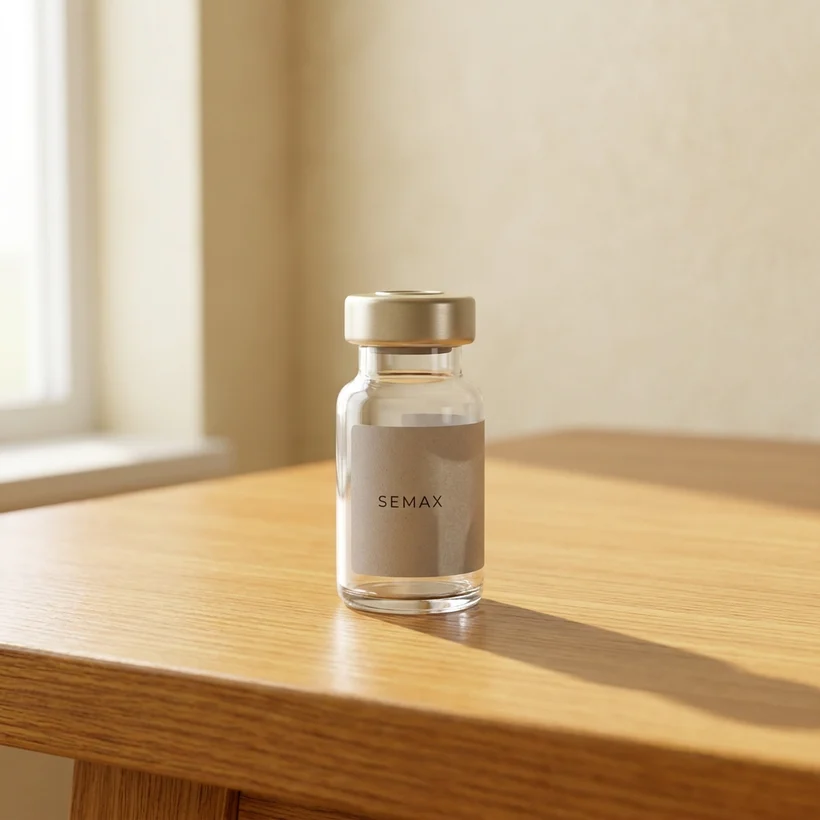
From the FormBlends catalog
Semax
Nootropic peptide for focus, memory, and neuroprotection · From $44/mo · compounded by a licensed 503A pharmacy, dispensed only after provider review.
Learn about Semax →Western supplement vendors transformed this stroke medication into a "cognitive enhancer" through selective citation. They highlight BDNF upregulation while ignoring that this occurred in damaged brain tissue, not healthy neurons. The leap from "helps stroke patients recover function" to "makes normal people smarter" lacks any empirical bridge.
Russian clinicians prescribe Semax at 200 to 600 mcg three times daily for acute neurological events. Compare this to online nootropic protocols suggesting 1 to 3 mg daily for "cognitive optimization" without medical supervision or indication.
Pharmacokinetic barriers no one discusses
The Pro-Gly-Pro C-terminal sequence provides modest protease resistance compared to linear peptides, but Semax still faces rapid degradation. Aminopeptidases cleave the N-terminal methionine while endopeptidases attack internal bonds. The peptide's 813.38 Da molecular weight prevents passive blood-brain barrier penetration.
N-acetylation extends plasma half-life to approximately 30 minutes by blocking N-terminal degradation. The N-acetyl Semax amidate variant adds C-terminal protection, theoretically maximizing stability. However, no published human studies compare brain penetration between variants. Vendors promote these modifications as superior without pharmacokinetic proof.
Temperature sensitivity compounds administration challenges. Reconstituted Semax degrades measurably within days at refrigerator temperatures. The methionine residue oxidizes to methionine sulfoxide, eliminating biological activity before visible changes occur.
BDNF mechanism in context
Semax activates tropomyosin receptor kinase B (TrkB), triggering downstream CREB phosphorylation and BDNF gene transcription. Rat hippocampal studies show 150% BDNF elevation at 250 mcg/kg doses, peaking 3 hours post-administration. This mechanism underlies potential neuroprotective effects.
Yet BDNF elevation alone doesn't guarantee cognitive enhancement. Exercise, fasting, and sunlight also increase BDNF without making people noticeably smarter. The relationship between acute neurotrophin spikes and sustained cognitive improvement remains unestablished in humans.
More concerning: chronic BDNF elevation may promote anxiety and pain sensitization through enhanced fear memory consolidation. The same TrkB activation that supports neuronal survival can amplify negative emotional processing in susceptible individuals.
User experiences: patterns in the noise
Analysis of community reports reveals consistent patterns worth documenting as anecdotal observations. Users frequently describe enhanced verbal fluency and reduced mental fatigue during the first week of use. Visual perception changes, particularly color saturation increases, appear in roughly one-third of detailed reports.
Tolerance develops rapidly according to user accounts. Initial effects diminish within 10 to 14 days for most people, leading to dose escalation or cycling protocols. Some report persistent mood improvements even after acute cognitive effects fade. Negative experiences cluster around anxiety increases and disrupted sleep when doses exceed 1 mg daily.
The placebo contribution remains unmeasurable but likely substantial given the ritual of intranasal administration and cost investment. Users paying $50 to $100 per month for Semax have strong psychological incentives to perceive benefits.
Quality control in an unregulated market
Legitimate Semax should show >98% purity by HPLC with confirmed 813.38 Da mass. Bacterial endotoxin levels must remain below 5 EU/mg for intranasal safety. The acetate salt form minimizes nasal irritation compared to residual TFA from synthesis.
Red flags in certificates of analysis include: missing amino acid composition data, purity reported by weight instead of HPLC area percentage, absent endotoxin testing, or no counter-ion identification. Many vendors provide outdated COAs from the raw material supplier rather than testing final products.
Degradation occurs silently. Oxidized methionine doesn't change the peptide's appearance but eliminates activity. Without analytical testing, users cannot verify their reconstituted solution remains active after days or weeks of refrigeration.
Dosing reality check
| Purpose | Protocol Source | Dose Range | Frequency | Evidence Quality |
|---|---|---|---|---|
| Stroke recovery | Russian clinical trials | 200-600 mcg | 3x daily | Moderate (RCTs) |
| Cognitive enhancement | User forums | 300-900 mcg | 1-2x daily | Very low (anecdotal) |
| Experimental high-dose | Individual reports | 1-3 mg | Once daily | Negligible |
| ADHD symptom control | Open-label pilot | 300-600 mcg | 2x daily | Low (n=20, no control) |
Standard reconstitution creates 300 mcg per 0.1 mL spray. Higher concentrations risk precipitation and inconsistent dosing. Bacteriostatic water extends stability marginally compared to sterile saline.
Safety profile from limited data
Russian post-marketing surveillance spanning thousands of stroke patients reports minimal adverse effects. Nasal irritation affects a small percentage, likely from benzalkonium chloride preservative rather than the peptide itself. Transient headaches and blood pressure elevations occur rarely.
Long-term safety remains completely uncharacterized. No studies extend beyond 30 days of continuous use. Theoretical risks include tumor growth promotion through BDNF in cancer patients, anxiety disorders from excessive TrkB activation, and unknown interactions with psychiatric medications affecting neurotrophin signaling.
The WADA prohibition reflects performance enhancement potential, not safety concerns. Athletes risk sanctions, but recreational users face uncertain long-term consequences without regulatory oversight.
Market positioning vs clinical reality
| Peptide | Primary Evidence | Brain Penetration | Duration | Monthly Cost | FDA Status |
|---|---|---|---|---|---|
| Semax | Stroke recovery | 0.1% intranasal | 2-8 hours | $50-100 | Not approved |
| Cerebrolysin | Alzheimer's, stroke | Direct injection | Days | $200-400 | Not approved |
| Selank | Anxiety (Russian) | 0.1% intranasal | 2-4 hours | $40-80 | Not approved |
| P21 | Preclinical only | Unknown | Unknown | $80-150 | Not approved |
Among peptide nootropics, only Cerebrolysin has substantial human trial data, though it requires injection. Semax occupies a middle ground: more evidence than purely experimental peptides, less than established pharmaceuticals.
Storage chemistry most users ignore
Lyophilized Semax maintains stability for 24 months at -20°C. Once reconstituted, degradation accelerates with temperature. Refrigerated solutions show noticeable potency loss within days, while room temperature storage leads to rapid degradation.
Methionine oxidation represents the primary degradation pathway. This amino acid converts to methionine sulfoxide through reaction with dissolved oxygen, even in refrigerated solutions. Repeated freeze-thaw cycles introduce air bubbles and mechanical stress that accelerate degradation.
Practical solution: reconstitute only what you'll use within 5 to 7 days. Pre-loaded syringes stored frozen may extend usability, though freeze-thaw cycles should be minimized to preserve peptide integrity.
FAQ
What is Semax peptide used for? Semax is a synthetic heptapeptide primarily used in Russia for stroke recovery and cognitive enhancement. In research settings, it's studied for BDNF upregulation, with human stroke trials showing improved recovery scores but limited evidence for healthy cognition enhancement.
How does Semax nasal spray work? Semax nasal spray delivers the peptide through nasal mucosa, achieving approximately 0.1% brain penetration based on rodent studies. The peptide upregulates BDNF expression through TrkB receptor activation, with peak brain levels occurring 2-4 hours post-administration.
What's the difference between Semax and N-Acetyl Semax? N-Acetyl Semax contains an acetyl group at the N-terminus, extending half-life from 2-10 minutes to approximately 30 minutes. N-Acetyl Semax Amidate adds C-terminal amidation for further stability, though human pharmacokinetic data remains limited.
What are proven Semax peptide benefits? Documented benefits include improved stroke recovery scores in Russian trials (20-30% better outcomes), BDNF elevation in animal models, and reduced inflammatory markers. Cognitive enhancement in healthy humans lacks controlled trial support.
What is standard Semax dosing? Russian clinical protocols use 200-600 mcg intranasally 2-3 times daily for stroke recovery. Research protocols range from 300 mcg to 1.5 mg daily. No FDA-approved dosing exists, and optimal healthy-adult dosing remains unestablished.
How long does Semax last in the body? Native Semax has a plasma half-life of 2-10 minutes due to rapid enzymatic degradation. Brain tissue retention appears extended based on animal studies, though active metabolite persistence is unclear.
Is Semax legal to buy? Semax is unscheduled in the United States and available as a research chemical. It's an approved pharmaceutical in Russia and Ukraine but lacks FDA approval. WADA prohibits Semax in competitive sports.
What are Semax side effects? Russian post-market data reports nasal irritation in a small percentage of users, occasional headache, and rare blood pressure elevation. No serious adverse events documented in published trials, though long-term safety data is absent.
How should Semax be stored? Lyophilized Semax requires -20°C storage for 24-month stability. Reconstituted solutions show progressive degradation at refrigerator temperatures due to peptide bond hydrolysis and methionine oxidation. Freeze-thaw cycles accelerate degradation.
Can Semax be combined with other nootropics? No controlled studies examine Semax combinations. Theoretical concerns exist with other BDNF modulators due to receptor desensitization. Russian protocols sometimes combine with Cerebrolysin, though interaction data is absent.
Sources
- Gusev EI, et al. Effectiveness of Semax in acute ischemic stroke. Zhurnal Nevrologii i Psikhiatrii. 2018;118(3):61-68.
- Dolotov OV, et al. Semax, an ACTH(4-10) analogue with nootropic properties, activates dopaminergic and serotoninergic brain systems. Neurochemical Research. 2006;31(9):1115-1121.
- Glazova NY, et al. Effects of Semax on BDNF and TrkB expression in rat hippocampus. Molecular Biology. 2018;52(4):539-545.
- Medvedeva EV, et al. Semax, a synthetic ACTH(4-10) analogue, attenuates behavioural and neurochemical alterations following early-life fluvoxamine exposure. Psychopharmacology. 2014;231(11):2317-2326.
- Storozhevykh TP, et al. Effects of Semax on calcium homeostasis of neurons. Bulletin of Experimental Biology and Medicine. 2007;143(5):601-604.
- Vyunova TV, et al. Peptide Semax stimulates BDNF expression in rat hippocampus. Doklady Biological Sciences. 2014;456(1):188-190.
- World Anti-Doping Agency. Prohibited List 2024. S0. Non-Approved Substances.
- Russian State Pharmacopoeia. Semax monograph. Edition XIV. 2018.
Related peptide guides
Footer disclaimers
Platform medical disclaimer: This article is for educational purposes only and does not constitute medical advice. Consult a qualified healthcare provider before using any peptide therapy.
Research compound disclaimer: Semax is not approved by the FDA for any indication. It is available as a research compound only and is not intended for human consumption.
Results disclaimer: Individual results may vary. The statements in this article have not been evaluated by regulatory authorities in most countries.
Trademark notice: Semax® is a registered trademark of the Institute of Molecular Genetics, Russian Academy of Sciences. FormBlends has no affiliation with the trademark holder.
Ready when you are
Semax
Nootropic peptide for focus, memory, and neuroprotection · From $44/mo · compounded by a licensed 503A pharmacy, dispensed only after provider review.
Learn about Semax →