
Trust signals
> Written by the FormBlends Medical Content Team · Fact-checked against cited primary sources · Last updated May 2026
The TB500 identity crisis
You're probably not taking what you think you're taking. Most vendors selling "TB500" actually ship full-length Thymosin Beta-4, a completely different molecule that's ten times larger and behaves differently in the body. The real TB500 fragment (Ac-SDKP) comprises just four amino acids, while Thymosin Beta-4 contains 43.
This matters beyond semantics. The tetrapeptide fragment clears your system in hours. Full-length TB-4 lingers for days. One costs pennies per milligram to synthesize, the other demands sophisticated production. Yet vendors charge premium TB-4 prices while shipping whichever version their supplier provided that month.
What the human evidence actually demonstrates
TB500's reputation rests on three small trials treating corneal wounds. Total human subjects across all controlled studies: 72 people. All used topical drops, not injections.
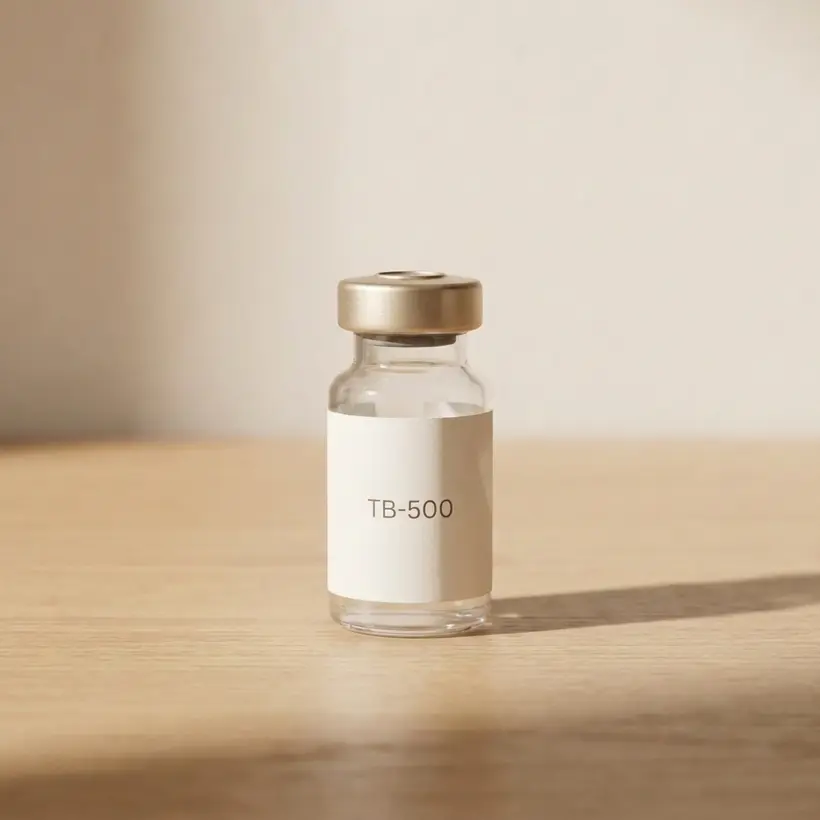
From the FormBlends catalog
TB-500 (Thymosin Beta-4)
Universal repair peptide for tissue regeneration · From $49/mo · compounded by a licensed 503A pharmacy, dispensed only after provider review.
Learn about TB-500 (Thymosin Beta-4) →The results were genuinely impressive for eye injuries. Patients with non-healing corneal defects saw complete closure in 7-14 days after months of failed treatments. But corneal epithelium differs fundamentally from tendons, muscles, or joint capsules. The eye has no blood-tissue barrier. Drops achieve millimolar concentrations directly at the wound site.
For musculoskeletal injuries, we have rat studies. Surgically severed rat Achilles tendons showed improved collagen organization after TB-4 treatment. Mouse hearts recovered better after induced heart attacks. These studies used doses of 6mg per kilogram, which would translate to 420mg for a 70kg human. Current protocols use 2-5mg total.
No controlled human trial has ever tested systemic TB500 for sports injuries, despite fifteen years of underground use.
The mechanism makes sense, but distribution remains a mystery
TB500 works through elegant molecular choreography. The peptide binds G-actin monomers, preventing them from polymerizing into rigid filaments. This keeps cells mobile, able to migrate into wound sites. At 100 nanograms per milliliter, endothelial cells move 2-3 times faster in laboratory dishes.
VEGF expression increases within hours. New blood vessels form. Inflammatory cytokines decrease. In culture dishes and corneal surfaces, the healing cascade accelerates measurably.
But subcutaneous injection presents different challenges. The peptide must survive enzymatic degradation, achieve systemic distribution, penetrate into avascular tendon tissue, and maintain therapeutic concentrations despite a 2-4 hour half-life. No published study has measured TB500 levels in human tendons after injection. We're dosing blind.
Practical protocols and their shaky foundations
The standard protocol emerged from bodybuilding forums circa 2010: 2-5mg twice weekly for 4-6 weeks, then weekly maintenance. This bears no relationship to the animal studies it supposedly derives from.
Animal studies using 6mg/kg doses cannot be directly translated to human protocols through simple scaling. The community settled on 5mg twice weekly, total 10mg, because that's what people could afford and seemed to work without obvious side effects.
| Protocol Component | Common Practice | Scientific Basis |
|---|---|---|
| Loading dose | 5mg twice weekly | None, extrapolated from cost tolerance |
| Maintenance dose | 2-5mg weekly | Pure speculation |
| Injection site | Subcutaneous, anywhere | No comparative studies |
| Duration | 4-12 weeks | Arbitrary, based on anecdote |
The twice-weekly schedule assumes tissue accumulation, but the fragment's short half-life suggests daily dosing might work better. Nobody has tested this because it would cost $1000+ monthly.
Cancer biology creates uncomfortable questions
Thymosin Beta-4 appears throughout cancer biology literature, always in unflattering roles. Breast tumors overexpress it 5-10 fold. Knockdown experiments reduce metastasis. The peptide helps tumors build blood supplies and invade surrounding tissue.
This doesn't mean TB500 causes cancer. Wound healing and tumor growth share molecular machinery: cell migration, angiogenesis, tissue remodeling. The same VEGF upregulation that helps healing could theoretically feed existing tumors.
Young athletes probably face minimal risk. But anyone over 40 has likely developed microscopic tumors that remain harmless precisely because they lack blood supply. Pro-angiogenic compounds could theoretically change that calculus. We have no data either way.
Quality control remains anarchic
Testing from independent laboratories shows remarkable inconsistency in "TB500" products. Some contain the actual tetrapeptide. Most contain full-length Thymosin Beta-4. A few contain neither, just random peptide fragments or nothing at all.
Identifying real TB500 requires understanding basic peptide chemistry:
- Molecular weight differences: The fragment is significantly smaller than full TB-4
- Solubility: The fragment dissolves instantly, TB-4 takes longer
- Price logic: Fragment synthesis costs substantially less than full-length
- HPLC profile: Completely different retention times
If your certificate of analysis shows approximately 5000 daltons, you have Thymosin Beta-4. If the vendor uses "TB500/TB-4" interchangeably, they don't understand their own product. If the price matches full TB-4, you're probably getting it regardless of labeling.
What people actually experience
Aggregating reports from peptide communities reveals consistent patterns, keeping in mind these represent uncontrolled anecdotes, not evidence:
Recovery acceleration appears most commonly for soft tissue injuries. Users report tendinitis improving in 3-4 weeks instead of 8-12 weeks. Muscle strains allegedly heal faster. Joint injuries show mixed results. Bone injuries show no apparent benefit.
The loading phase often produces systemic effects: mild fatigue, head pressure, occasional flushing. These typically resolve after the first week. Some users report a subtle sense of increased healing "systemically," with old injuries feeling better and minor cuts healing unusually fast.
Non-responders comprise maybe 30-40% of users, similar to most peptides. Whether this reflects fake products, inappropriate dosing, or individual variation remains unknown. The placebo effect runs strong when people spend $300 on healing acceleration.
Athletes in tested sports should note that detection methods have improved significantly. Early TB500 users escaped detection because tests looked for full-length TB-4. Current LC-MS/MS methods catch both the fragment and full peptide for several weeks post-injection.
The regulatory maze
TB500 occupies a peculiar regulatory space. Not illegal to possess, not approved for human use, banned in sport, available as "research chemical," sometimes compounded by pharmacies.
RegeneRx spent millions developing thymosin beta-4 (branded Tβ4) through proper channels. Their Phase III trial for dry eye failed in 2013, ending commercial development. The patent situation remains complex, with composition of matter expired but specific uses potentially protected.
Research chemical suppliers operate in gray zones, selling "not for human consumption" while knowing their entire market consists of human consumers. Quality varies wildly. Sterility isn't guaranteed. Heavy metals occasionally appear in testing.
Compounding pharmacies offer a legitimate option where available. They source from FDA-registered facilities, test for sterility and potency, and require prescriptions. Prices run 2-3x higher than research chemicals but include medical oversight.
Storage chemistry and practical handling
Peptide stability depends more on handling than most users realize. TB500's small size provides some protection, but poor storage destroys activity quickly.
Lyophilized powder remains stable for months at room temperature, years in freezers. Once reconstituted, degradation accelerates. The acetyl group protects against some enzymatic breakdown but can't prevent hydrolysis or oxidation.
Reconstitution math stays simple: 5mg peptide + 2mL bacteriostatic water = 2.5mg/mL. For a 2mg dose, draw 0.8mL. Use bacteriostatic water, not sterile water, as benzyl alcohol prevents bacterial growth over weeks of storage.
Never shake vials. Add water slowly down the side. Swirl gently if needed. Store reconstituted peptide refrigerated, never frozen. Use within 4 weeks maximum, sooner if cloudiness develops.
Future directions and honest assessment
TB500 represents both the promise and problems of peptide therapeutics. Clear mechanism, compelling animal data, minimal human evidence, widespread use based on extrapolation and hope.
Proper trials would cost millions and face patent complications. No pharmaceutical company will fund studies for a generic peptide. Academic researchers focus on mechanisms, not athletic applications. The evidence gap will likely persist.
For those considering use: you're running an experiment on yourself. The mechanism suggests potential benefit. The risks appear modest for healthy individuals. The cost runs high for a speculative intervention. Most importantly, you might not even receive the compound you're paying for.
FAQ
What is TB500 peptide?
TB500 is the synthetic version of Thymosin Beta-4 fragment (amino acids 1-4), containing the active sequence Ac-SDKP. Many products labeled TB500 actually contain full-length Thymosin Beta-4 (43 amino acids) instead of the true fragment.
How does TB 500 work for healing?
TB 500 works through actin sequestration, promoting cell migration at concentrations of 10-100 ng/mL. It upregulates VEGF and increases angiogenesis markers by 2-3 fold in endothelial cells, though human tissue penetration remains unproven.
What is the difference between TB 500 and BPC-157?
TB 500 primarily promotes cell migration through actin binding, while BPC-157 works through growth hormone receptor upregulation. TB 500 has human wound healing trials; BPC-157 has only animal data. Neither has proven systemic bioavailability from subcutaneous injection.
How long does TB500 take to work?
In human corneal wound studies, TB 500 showed effects within 7-14 days. Animal tendon studies show collagen changes at 2-4 weeks. Anecdotal reports claim benefits in 2-6 weeks, but no controlled human studies exist for musculoskeletal applications.
What is the proper TB 500 dosage?
Common protocols use 2-5mg twice weekly for 4-6 weeks, then 2-5mg weekly maintenance. Human studies used topical 0.1% solutions. No human trials establish optimal subcutaneous dosing. The 2-5mg range comes from extrapolating animal studies.
Is TB500 legal?
TB500 is not FDA-approved for any indication. It's banned by WADA for competitive athletes. Available legally as a research chemical in most jurisdictions, but human use violates most supplier terms. Compounding pharmacies can prepare it with prescription.
Can TB 500 cause cancer?
Thymosin Beta-4 is overexpressed in several cancers and promotes tumor angiogenesis. No direct evidence shows TB 500 causes cancer, but its pro-angiogenic effects theoretically could accelerate existing tumor growth. Long-term safety data doesn't exist.
How do you reconstitute TB500?
Add bacteriostatic water slowly down the vial wall. For 5mg vial: 2mL water = 2.5mg/mL concentration. For 2mg dose, draw 0.8mL. Store reconstituted peptide at 2-8°C for up to 4 weeks. Never shake, only gentle swirl.
Does TB 500 need to be injected near injury?
No evidence supports site-specific injection for TB 500. Thymosin Beta-4 works systemically through bloodstream distribution. Subcutaneous injection anywhere should theoretically provide same effect, though human pharmacokinetic studies are lacking.
What are TB500 side effects?
Human studies report mild injection site reactions in a minority of patients. Anecdotal reports include fatigue, head pressure, and flushing. No systematic safety studies exist. Theoretical risks include promoting unwanted angiogenesis.
Sources
- Dunn SP, et al. Treatment of chronic nonhealing neurotrophic corneal epithelial defects with thymosin beta4. Arch Ophthalmol. 2010;128(5):636-638.
- Sosne G, et al. Thymosin beta 4 promotes corneal wound healing and decreases inflammation in vivo following alkali injury. Exp Eye Res. 2002;74(2):293-299.
- Malinda KM, et al. Thymosin beta4 accelerates wound healing. J Invest Dermatol. 1999;113(3):364-368.
- Goldstein AL, et al. Thymosin β4: a multi-functional regenerative peptide. Basic properties and clinical applications. Expert Opin Biol Ther. 2012;12(1):37-51.
- WADA Prohibited List 2026. World Anti-Doping Agency. Section S2: Peptide Hormones.
- Crockford D. Development of thymosin beta4 for treatment of patients with ischemic heart disease. Ann N Y Acad Sci. 2007;1112:385-395.
- RegeneRx Biopharmaceuticals. Phase 3 ARISE-2 Trial Results. Press Release, 2013.
- Smart N, et al. Thymosin β4 induces adult epicardial progenitor mobilization and neovascularization. Nature. 2007;445(7124):177-182.
- Philp D, et al. The actin binding site on thymosin beta4 promotes angiogenesis. FASEB J. 2003;17(14):2103-2105.
Related peptide guides
Footer disclaimers
Platform: This content is for educational purposes only and is not medical advice.
Research Compound: TB 500 is not approved by the FDA for human use and is available only as a research compound.
Results: Individual results may vary. Reported benefits are based on limited studies and anecdotal evidence.
Trademark: FormBlends is a trademark of FormBlends Inc. Not affiliated with any pharmaceutical manufacturer.
Ready when you are
TB-500 (Thymosin Beta-4)
Universal repair peptide for tissue regeneration · From $49/mo · compounded by a licensed 503A pharmacy, dispensed only after provider review.
Learn about TB-500 (Thymosin Beta-4) →