
Trust Signals
- Evidence graded by study type: human RCT, observational, animal, or mechanistic only.
- Limitations and failure modes are stated explicitly, not buried in disclaimers.
- No undisclosed affiliate relationships to specific compounding pharmacies or clinics.
- Regulatory status reflects FDA position as of that date.
Key Takeaways
- Sermorelin is a synthetic 29-amino-acid fragment of endogenous GHRH that stimulates pituitary GH release; it does not deliver GH directly.
- The only randomized, double-blind, placebo-controlled trial in adults (Vittone et al., 1997, n=20 elderly men) showed measurable IGF-1 increases but modest body composition changes over 6 months.
- Sleep improvement tends to be the first reported benefit, typically within 2-4 weeks; meaningful body composition shifts require at least 3-6 months.
- Sermorelin acetate (Geref) lost FDA approval in 2008 when its manufacturer withdrew it from the market; compounded versions operate under different regulatory rules.
- The "glycine" in sermorelin glycine formulations is an inert lyophilization stabilizer, not an active ingredient, and does not change clinical outcomes.
What Is Sermorelin and What Can You Realistically Expect Before and After?
Sermorelin peptide before and after results are gradual, modest, and highly dependent on your baseline GH axis function. Most users see improved sleep quality within weeks, with body composition changes requiring 3 to 6 months of consistent subcutaneous dosing. It is not a substitute for recombinant HGH, and the photographic transformations circulating on social media frequently involve confounding lifestyle interventions.
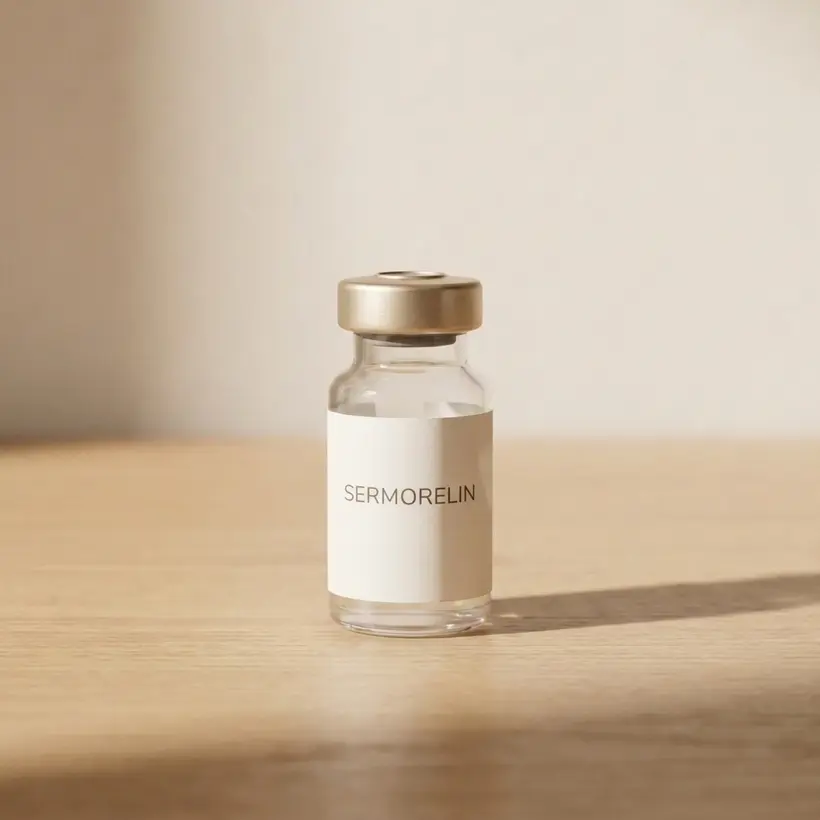
From the FormBlends catalog
Sermorelin
Bioidentical GHRH analog for natural growth hormone pulsatility · From $175/mo · compounded by a licensed 503A pharmacy, dispensed only after provider review.
View Sermorelin →Table of Contents
- How long does sermorelin take to show results?
- What does the clinical evidence actually show?
- How does sermorelin work, with real numbers?
- What do before and after results look like in men specifically?
- What is sermorelin glycine and does it change results?
- What happens with a sermorelin and testosterone stack?
- What most pages get wrong about sermorelin results
- Honest head-to-head: sermorelin vs alternatives
- Operational and label literacy: reading a COA and vial
- FAQ
- Sources
How Long Does Sermorelin Take to Show Results?
Results develop in phases that roughly track the biology of the GH-IGF-1 axis:
| Phase | Approximate Timing | What Is Typically Reported | Evidence Quality |
|---|---|---|---|
| Early | 1-4 weeks | Improved sleep depth and quality, vivid dreams, slight improvement in morning energy | Low (observational, no controlled data for this window) |
| Intermediate | 6-12 weeks | Measurable IGF-1 rise on labwork, possible early reduction in visceral fat, improved recovery from exercise | Moderate (based on Vittone 1997 and GHRH-class trials) |
| Consolidation | 3-6 months | Modest lean mass increase, continued fat reduction, improved skin texture reported anecdotally | Low to moderate; body composition endpoints from small or indirect trials |
| Long-term | 6+ months | Stabilization; IGF-1 should be monitored to avoid supraphysiologic elevation | Very low; no long-term RCTs in healthy adults exist |
What Does the Clinical Evidence Actually Show? (Evidence Ledger)
| Claim | Best Evidence | Source/Detail | Effect Direction | Confidence |
|---|---|---|---|---|
| Sermorelin raises GH pulse amplitude in elderly adults | Human RCT | Vittone et al., 1997; n=20 elderly men, 6-month placebo-controlled | Positive | Moderate |
| IGF-1 levels increase with nightly sermorelin dosing | Human RCT | Vittone et al., 1997 | Positive | Moderate |
| Lean body mass increases with sermorelin | Small RCT / extrapolation from GHRH class | Vittone 1997; modest signal; larger GHRH trials show modest LBM gains | Weakly positive | Low |
| Fat mass decreases with sermorelin | Extrapolation from GHRH class and observational | No large adult-specific RCT; consistent directional signal across GHRH studies | Weakly positive | Low |
| Sleep quality improves | Mechanistic + observational | GH secretion is sleep-entrained; slow-wave sleep association well-established; controlled sermorelin sleep data limited | Positive (mechanism strong) | Low for sermorelin-specific claim |
| Sermorelin safe for multi-month use in adults | Historical prescribing data (Geref) + observational | Original Geref prescribing information; no long-term RCT | Acceptable short-term safety profile | Moderate for short term; Very low for >12 months |
| Synergistic body composition benefit with testosterone stack | Mechanistic reasoning only | No RCT evaluating the combination specifically | Plausible but unproven | Very low |
| Tumor promotion risk with prolonged GH elevation | Epidemiological signal for supraphysiologic HGH; not established for sermorelin doses | Multiple HGH safety reviews; indirect applicability to sermorelin | Theoretical risk; not quantified for sermorelin | Very low (concern noted, not quantified) |
How Does Sermorelin Work, With Real Numbers?
Sermorelin is a synthetic analogue corresponding to the first 29 amino acids of endogenous growth hormone-releasing hormone (GHRH 1-29 NH2). Endogenous GHRH is 44 amino acids; the 29-residue N-terminal fragment retains full receptor-binding activity at the pituitary GHRH receptor (GHRHR).
Key pharmacological facts:
- Half-life: Sermorelin has a short plasma half-life, estimated under 12 minutes in humans based on pharmacokinetic data from the original Geref development program. This is why nightly subcutaneous injection timing matters: dosing close to sleep onset exploits the natural nocturnal GH pulse window.
- Receptor: Binds GHRHR on somatotroph cells in the anterior pituitary. The receptor is a G-protein-coupled receptor (Gs) that increases intracellular cAMP and calcium, triggering GH vesicle release.
- Downstream: Released GH binds hepatic GH receptors to stimulate IGF-1 synthesis. IGF-1 then acts at muscle, bone, and adipose tissue via IGF-1R.
- Feedback intact: Unlike exogenous recombinant HGH, sermorelin preserves somatostatin-mediated negative feedback. This means pituitary output remains physiologically regulated, which is the primary claimed safety advantage.
What Do Sermorelin Peptide Before and After Results Look Like in Men?
Men are the most common users of compounded sermorelin in anti-aging and TRT clinic settings. The pattern of results reported across observational data and the Vittone 1997 cohort (exclusively men) follows a consistent but unspectacular arc:
- Sleep depth: Usually the first subjective improvement, driven by GH's relationship to slow-wave sleep architecture. Reported within weeks.
- Visceral fat: GH-axis stimulation preferentially affects visceral adipose, where GH-sensitive lipolysis is active. Directional fat reduction signal is consistent across GHRH-class literature but the effect size in middle-aged men is modest relative to caloric deficit or exercise intervention.
- Lean mass: Modest accretion over months. The Vittone trial showed a trend; the clinical significance relative to resistance training alone is not established.
- Libido and energy: Frequently reported but impossible to attribute to sermorelin specifically when subjects are also receiving lifestyle coaching, nutritional guidance, or concurrent testosterone therapy.
- Skin and hair: Anecdotally mentioned; evidence grade is very low. GH does affect collagen synthesis pathways, but sermorelin-specific skin outcome data do not exist.
What Is Sermorelin Glycine, and Does the Glycine Change Before and After Results?
This question reflects a formulation detail that causes genuine confusion. Glycine appears in some compounded sermorelin product labels because it is used as a lyophilization excipient: a bulking and stabilizing agent that protects the peptide structure during freeze-drying.
The chemistry: Sermorelin is a peptide that must be lyophilized (freeze-dried) for stable storage. During lyophilization, the rapid removal of water can cause structural stress (denaturation, aggregation). Small amino acids like glycine act as cryoprotectants by forming a glassy matrix that minimizes ice crystal damage to the peptide backbone. Glycine itself is pharmacologically inactive at the doses present as an excipient.
The bottom line: "Sermorelin glycine" and "sermorelin acetate" refer to the same active ingredient with different labeling conventions for the excipient or counterion used. Glycine in this context does not add any independent anabolic, sleep, or body composition effect, and before-and-after expectations should be identical.
Sermorelin and Testosterone Stack: What the Evidence Supports
Co-prescribing sermorelin with testosterone replacement therapy (TRT) is common in men's health clinics. The pharmacological rationale has two components:
- Testosterone and GH/IGF-1 act on partially overlapping but distinct anabolic pathways. Testosterone primarily drives androgen-receptor-mediated gene expression in muscle; IGF-1 drives PI3K/Akt/mTOR signaling. The combination is theoretically additive.
- Hypogonadal men often have blunted GH pulsatility. Restoring testosterone may partially improve GH secretion, so the two interventions may complement each other.
What the evidence does not show: There are no randomized controlled trials evaluating the sermorelin-plus-testosterone combination versus either agent alone for body composition outcomes in adults. Claims of synergistic transformation visible in before-and-after photos rest on mechanistic reasoning plus the well-established body composition effects of testosterone replacement in isolation.
What Most Pages Get Wrong About Sermorelin Results
This is the section commodity pages skip.
1. Pituitary reserve is the real limiting variable. Sermorelin only works if your pituitary still has functional somatotroph capacity to respond to GHRH stimulation. Obesity strongly suppresses GH secretion; a BMI above roughly 30 blunts GHRH-stimulated GH release substantially. Heavy users expecting the best results are often the worst biological candidates.
2. Antibody formation was a documented issue with prolonged sermorelin use. The original Geref prescribing information noted that some patients developed antibodies to sermorelin acetate with extended use. While these antibodies were generally not neutralizing in the sense of blocking GH secretion completely, their clinical significance over multi-year courses is unknown and rarely mentioned in promotional content.
3. Injection timing is mechanistically significant, not just a dosing preference. Endogenous GH secretion is strongly sleep-entrained, peaking during the first slow-wave sleep episode. Sermorelin administered 30-60 minutes before sleep can amplify this natural pulse. Injecting in the morning or randomly through the day wastes the pharmacological window. Most patients are not told why the timing rule exists.
4. Compounded purity is not guaranteed and is rarely tested by the patient. Compounded sermorelin is not manufactured under the same process controls as an NDA-approved product. The FDA has issued warning letters to compounding pharmacies for sterility failures, mislabeling, and subpotency in peptide products. Requesting a certificate of analysis (COA) that includes HPLC purity and endotoxin testing is the minimum due diligence step, but surveys suggest a minority of patients do this.
5. IGF-1 normalization is the correct target, not maximum IGF-1 elevation. Clinic marketing often implies more IGF-1 is better. Supraphysiologic IGF-1 is associated with increased cancer risk in epidemiological literature. The correct therapeutic goal is raising IGF-1 into age-appropriate normal range, not maximizing it.
Honest Head-to-Head: Sermorelin vs Real Alternatives
| Agent | Mechanism | Evidence Quality (Adults) | GH Elevation Pattern | Regulatory Status (US) | Where Sermorelin Loses |
|---|---|---|---|---|---|
| Sermorelin | GHRHR agonist; indirect GH stimulation | Low-Moderate (small RCTs, observational) | Pulsatile, feedback-preserved | Compounded only (Geref withdrawn 2008) | Lower GH elevation magnitude vs HGH; shorter evidence base vs ipamorelin combos |
| Recombinant HGH (somatropin) | Direct GH receptor agonist | High for GHD; Moderate for adult body composition | Sustained, feedback bypassed | FDA-approved for GHD, short bowel, HIV wasting | Sermorelin loses on magnitude and speed of effect; loses on off-label evidence base |
| CJC-1295 with DAC | GHRHR agonist; long-acting DAC modification | Very low (minimal human RCTs) | Sustained "bleed," non-pulsatile | Not FDA-approved; compounded | Sermorelin wins on pulsatile physiologic mimicry; loses on dosing convenience |
| Ipamorelin | GHSR (ghrelin receptor) agonist; different pathway | Very low (human data extremely limited) | Pulsatile; low cortisol/prolactin spillover | Not FDA-approved; compounded | Sermorelin has more published human data; loses on selectivity profile in theory |
| Tesamorelin | GHRH analogue (stabilized) | High for HIV-associated lipodystrophy (multiple Phase III RCTs) | Pulsatile, feedback-preserved | FDA-approved (Egrifta) for HIV lipodystrophy only | Sermorelin loses decisively on evidence quality; tesamorelin is the only GHRH-class peptide with robust adult RCT data |
Operational and Label Literacy: Reading a Sermorelin COA and Vial
What to request from your compounding pharmacy:
- HPLC purity: Should be stated as a percentage (ideally >98% purity by area). If the COA does not include HPLC, the purity is unverified.
- Endotoxin (LAL) test: Must pass USP <85> limits for parenteral products. Endotoxin failures cause injection-site reactions and systemic inflammatory responses.
- Sterility: Compounded sterile preparations require a sterility test certificate per USP <71>.
- Labeled concentration: Most sermorelin compounded vials are labeled at 3 mg or 6 mg per vial. Verify the stated mg matches your dose calculations.
Reconstitution: Sermorelin lyophilized powder is reconstituted with bacteriostatic water for injection. Add water slowly down the inside wall of the vial; do not shake (rolling gently is acceptable). Shaking can denature the peptide.
Dose math example: A 3 mg vial reconstituted with 3 mL bacteriostatic water yields 1 mg/mL. A 0.2 mg dose = 0.2 mL drawn in an insulin syringe. Verify your pharmacy's labeled concentration before calculating.
Storage: Lyophilized powder should be refrigerated at 2-8 degrees Celsius and protected from light. Once reconstituted, use within the timeframe specified by the compounding pharmacy (commonly 30 days refrigerated). Do not freeze reconstituted solution.
Signs of degraded product:
- Reconstituted solution that is cloudy, contains visible particulates, or has a yellowish color: discard.
- Loss of efficacy over a course (documented by falling IGF-1 on repeat labs despite consistent dosing) may indicate subpotent compounding or degraded stock.
- Lyophilized cake that has collapsed or appears wet before reconstitution suggests cold-chain failure.
FAQ
How long does sermorelin take to show results?
Most users report improved sleep quality within 2-4 weeks. Fat loss and lean mass changes typically require 3-6 months of consistent dosing because IGF-1 elevation must be sustained long enough to shift body composition. Expecting dramatic before-and-after changes inside 8 weeks is unrealistic based on available evidence.
What do sermorelin peptide before and after results look like in men?
Men in clinical trials and registry studies most commonly report improved sleep quality, modest reductions in visceral fat, modest lean mass increases, and improved energy. These are gradual changes measured over months, not dramatic physical transformations visible in short-timeline before-and-after photos.
What is sermorelin glycine and does the glycine change results?
Sermorelin acetate lyophilized powder is reconstituted with bacteriostatic water containing benzyl alcohol. Some compounded vials are labeled "sermorelin glycine" because glycine is used as a lyophilization stabilizer excipient, not as an active ingredient. The glycine does not alter the pharmacological effect of sermorelin.
Can sermorelin and testosterone be stacked together?
They are sometimes co-prescribed in TRT clinics. Testosterone and GH axis hormones have complementary but distinct anabolic pathways. There are no large RCTs evaluating the sermorelin-plus-testosterone combination specifically. Any synergistic effect is supported only by mechanistic reasoning and small observational data, not high-quality controlled trials.
Is sermorelin FDA-approved?
Sermorelin acetate (Geref) was FDA-approved for pediatric growth hormone deficiency diagnosis and treatment. The FDA withdrew approval for Geref in 2008 when the manufacturer discontinued the product. Compounded sermorelin is currently available through 503A pharmacies under certain conditions, but it is not an FDA-approved finished drug product.
What does the clinical evidence actually show for sermorelin in adults?
The strongest adult evidence comes from a randomized, double-blind, placebo-controlled trial by Vittone et al. (1997) in elderly men showing increased GH pulse amplitude and some body composition signals. Larger outcome trials in healthy adults do not exist. Most body composition data comes from extrapolation of GHRH-class studies or small observational cohorts.
How does sermorelin compare to ipamorelin or CJC-1295?
Sermorelin is a 29-amino-acid GHRH analogue with a shorter half-life than CJC-1295 with DAC. Ipamorelin works via the ghrelin receptor (GHSR), a different pathway. CJC-1295 with DAC produces a sustained GH bleed rather than pulsatile release, which may carry different safety implications. None of these comparisons are settled by head-to-head RCTs in adults.
What are the most common side effects of sermorelin?
The most commonly reported side effects are injection-site reactions (redness, swelling, pain), flushing, headache, and transient dizziness. These were documented in the original Geref prescribing information. Rare concerns include fluid retention and potential effects on insulin sensitivity with prolonged GH elevation, though these are better characterized with recombinant HGH.
What does a degraded sermorelin vial look like and how do I avoid it?
Properly reconstituted sermorelin is a clear, colorless solution. Cloudiness, visible particulates, or a yellowish tint indicate degradation or contamination and the vial should be discarded. Lyophilized powder should be stored refrigerated; once reconstituted, it should be kept at 2-8 degrees Celsius and used within the period specified by the compounding pharmacy, typically 30 days.
Does sermorelin raise IGF-1 levels measurably?
Yes. Sermorelin stimulates pituitary GH release, which drives hepatic IGF-1 production. The Vittone 1997 trial showed meaningful IGF-1 increases versus placebo. However, the magnitude of IGF-1 rise depends heavily on baseline pituitary reserve, dosing frequency, and injection timing relative to sleep.
Why do before-and-after photos for sermorelin often look unconvincing?
Because sermorelin works indirectly and gradually. It stimulates endogenous GH pulses rather than delivering pharmacological HGH doses directly. Body composition changes are modest relative to supraphysiologic HGH or anabolic steroids and develop over months. Marketing photos often mix confounding lifestyle changes or use misleading lighting and timing.
Who is the best candidate for sermorelin therapy?
Adults with documented low IGF-1 and blunted GH secretion, often confirmed by GHRH stimulation testing, represent the population most likely to respond. Individuals with normal GH axis function, obesity-related GH suppression, or pituitary pathology are poorer candidates. A baseline IGF-1 lab, not just symptom lists, should guide prescribing decisions.
Sources
- Vittone J, Blackman MR, Busby-Whitehead J, et al. Effects of single nightly injections of growth hormone-releasing hormone (GHRH 1-29) in healthy elderly men. Metabolism. 1997;46(1):89-96.
- FDA. Geref (sermorelin acetate) original prescribing information. Serono Laboratories. (Referenced via FDA historical drug database; product withdrawn 2008.)
- Corpas E, Harman SM, Piazza L, Blackman MR. Growth hormone (GH)-releasing hormone-(1-29) twice daily reverses the decreased GH and insulin-like growth factor-I levels in old men. J Clin Endocrinol Metab. 1992;75(2):530-535.
- Sigalos JT, Pastuszak AW. The safety and efficacy of growth hormone secretagogues. Sex Med Rev. 2018;6(1):45-53.
- Ionescu M, Frohman LA. Pulsatile secretion of growth hormone (GH) persists during continuous stimulation by CJC-1295, a long-acting GH-releasing hormone analog. J Clin Endocrinol Metab. 2006;91(12):4792-4797.
- Stanley TL, Falutz J, Mamputu JC, et al. Effects of tesamorelin on non-alcoholic fatty liver disease in HIV: a randomised, double-blind, multicentre trial. Lancet HIV. 2019;6(12):e821-e830. (Cited as the strongest GHRH-class adult RCT comparator.)
- Vance ML. Can growth hormone prevent aging? N Engl J Med. 2003;348(9):779-780.
- FDA. Guidance for Industry: Mixing, Diluting, or Repackaging Biological Products Outside the Scope of an Approved Biologics License Application. 2018. (Relevant to compounding regulatory context.)
- USP General Chapter <85> Bacterial Endotoxins Test. United States Pharmacopeia. (Standard for parenteral injectable preparations.)
- USP General Chapter <71> Sterility Tests. United States Pharmacopeia.
Related peptide guides
Ready when you are
Sermorelin
Bioidentical GHRH analog for natural growth hormone pulsatility · From $175/mo · compounded by a licensed 503A pharmacy, dispensed only after provider review.
View Sermorelin →