
Trust Signals
Not medical advice. This page is for educational purposes. Consult a licensed clinician before use.
Key Takeaways
- The only quantitative SNAP-8 "before and after" data come from one manufacturer-sponsored cosmetic study (Lipotec), not an independent peer-reviewed RCT, so headline percentages must be read with caution.
- SNAP-8 is an octapeptide of approximately 1,000 daltons. Passive skin penetration through the stratum corneum becomes increasingly poor above 500 daltons, meaning bioavailability at the neuromuscular junction is unproven.
- The proposed mechanism (SNARE complex inhibition via SNAP-25 mimicry) is biologically plausible and shares logic with botulinum toxin, but "plausible mechanism" does not equal "proven efficacy."
- Botulinum toxin type A (Botox) outperforms SNAP-8 on every evidence dimension: study design quality, effect size, and duration of effect. SNAP-8 is not a topical Botox equivalent.
- Stability in very low pH formulations (such as high-dose vitamin C serums at pH 2.5 to 3.5) is a real concern because acidic conditions promote peptide bond hydrolysis.
Direct Answer: What Do SNAP-8 Peptide Before and After Results Actually Look Like?
Table of Contents
- Evidence Ledger: What Is Actually Proven?
- What Does SNAP-8 Do? Mechanism With Real Numbers
- What Most Pages Get Wrong About SNAP-8 Results
- Can SNAP-8 Actually Reach the Muscle?
- Why Formulation Chemistry Matters for SNAP-8 Stability
- Honest Head-to-Head: SNAP-8 vs. Real Alternatives
- Label and COA Literacy: How to Judge a SNAP-8 Product
- Realistic Protocol and Expectations
- FAQ
- Sources
- Footer Disclaimers
Evidence Ledger: What Is Actually Proven?
| Claim | Best Evidence Type | Effect Direction | Confidence |
|---|---|---|---|
| SNAP-8 reduces expression line depth after 28 days of topical use | Manufacturer-sponsored cosmetic study (Lipotec); not independently peer-reviewed | Positive (small to moderate) | Very Low |
| SNAP-8 competes with SNAP-25 at the SNARE complex in vitro | In vitro / mechanistic lab data from supplier documentation | Positive (mechanism plausible) | Low |
| Topical SNAP-8 relaxes facial muscles measurably in humans | No independent human neurophysiology study found | Unknown | Very Low |
| Peptides above 500 daltons have limited passive transcutaneous penetration | Multiple peer-reviewed reviews of transdermal drug delivery (e.g., Bos and Meinardi 2000) | Established principle | High (for the principle; application to SNAP-8 specifically is Low) |
| SNAP-8 is safe in topical cosmetic use | Cosmetic ingredient safety assessments; absence of adverse event reports | Favorable safety profile | Moderate (short-term); Low (long-term) |
| SNAP-8 is comparable in efficacy to injectable botulinum toxin | No comparative trial exists | Claim is unsupported | Very Low / Implausible by mechanism |
What Does SNAP-8 Actually Do? Mechanism With Real Numbers
SNAP-8, also named acetyl octapeptide-3, is an 8-amino-acid synthetic peptide. Its sequence mimics the N-terminal 8 residues of SNAP-25 (synaptosomal-associated protein 25 kDa), a structural component of the SNARE (soluble NSF attachment protein receptor) complex.
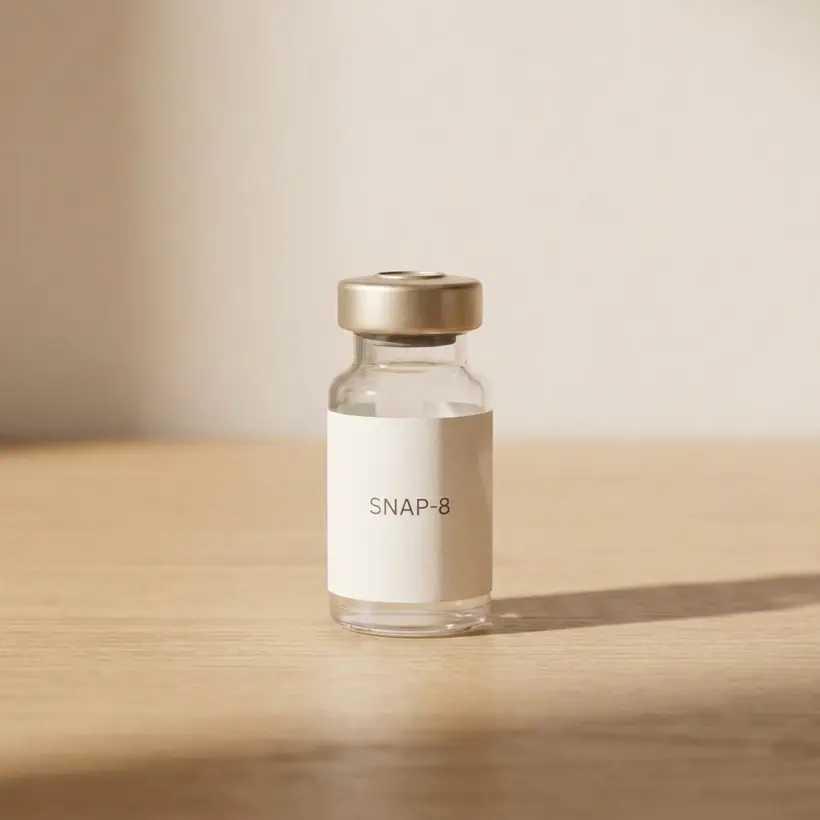
From the FormBlends catalog
SNAP-8 (Acetyl Octapeptide-3)
Topical peptide that reduces wrinkle depth by inhibiting muscle contraction · From $34/mo · compounded by a licensed 503A pharmacy, dispensed only after provider review.
Learn about SNAP-8 (Acetyl Octapeptide-3) →The SNARE complex is the core molecular machinery for vesicle-membrane fusion across eukaryotic cells. At the neuromuscular junction, SNARE assembly drives acetylcholine-containing vesicle fusion with the presynaptic membrane, releasing acetylcholine into the synaptic cleft, which triggers muscle contraction. Botulinum toxin type A achieves denervation by cleaving SNAP-25 proteolytically, permanently disabling vesicle fusion until new protein is synthesized over roughly 3 to 4 months.
SNAP-8's proposed mechanism is competitive, not proteolytic. By providing excess SNAP-25 N-terminal sequence, it is hypothesized to compete with endogenous SNAP-25 for binding sites within the ternary SNARE complex, reducing the fraction of functional complexes and therefore reducing acetylcholine release. This is a reversible, concentration-dependent effect.
The study numbers: Lipotec (the developer) reported in their technical dossier that a 10 ppm (parts per million) SNAP-8 solution applied twice daily for 28 days reduced wrinkle volume by approximately 52 percent and wrinkle depth by approximately 17 percent versus baseline in a small volunteer cohort. These figures are widely repeated across the internet. What is not widely noted: the study does not appear in a searchable PubMed-indexed peer-reviewed journal, the sample size is not independently confirmable, and there was no placebo-controlled arm described in publicly available documentation.
What the mechanism does NOT prove: Even if SNAP-8 competitively inhibits SNARE assembly in a test tube or cell culture, this says nothing about whether enough peptide reaches the neuromuscular junction after topical application. Mechanism and efficacy are separate questions, and only the former has even preliminary support.
What Most Pages Get Wrong About SNAP-8 Results
A second omission is the comparison population. SNAP-8 cosmetic studies typically enroll individuals with moderate to severe expression lines (Crow's feet, forehead lines) where any improvement is photographically visible. These results may not replicate in people with mild lines or different skin types.
A third omission: finished product concentration often differs from study concentration. The Lipotec study used 10 ppm of SNAP-8 as active ingredient. Many commercial serums list SNAP-8 far down the ingredient list, meaning the actual peptide concentration in the product may be well below 10 ppm. You cannot assume a product with SNAP-8 on its label delivers study-level concentrations.
Can SNAP-8 Actually Reach the Muscle?
This is the most important unanswered question in the SNAP-8 literature. The stratum corneum acts as a selective barrier. The widely cited "500 dalton rule," articulated by Bos and Meinardi in 2000, holds that molecules above roughly 500 daltons penetrate the intact stratum corneum poorly through passive diffusion. SNAP-8 has a molecular weight of approximately 1,000 daltons. This places it squarely in the range where passive transcutaneous delivery to deeper dermal and subdermal structures is expected to be very low.
Penetration enhancers (alcohols, fatty acids, liposomal encapsulation, microneedle pretreatment) can meaningfully improve peptide delivery, but whether any specific commercial SNAP-8 product uses an effective enhancer at sufficient concentration is a formulation-specific question, not a peptide-specific one. No published peer-reviewed pharmacokinetic study has quantified how much SNAP-8 reaches the dermal-epidermal junction or the neuromuscular junction after topical application in humans.
The honest conclusion: some surface-level effect (hydration, mild intercellular signaling) may occur. Meaningful neuromuscular junction inhibition from topical SNAP-8 alone, in the absence of a proven delivery system, is currently speculative.
Why Formulation Chemistry Matters: The Rules Explained
Why avoid high-dose vitamin C serums? Ascorbic acid at concentrations used in potent serums (10 to 20 percent) is typically formulated at pH 2.5 to 3.5 to maintain stability and bioavailability. At this pH, peptide bonds are susceptible to acid-catalyzed hydrolysis, the reaction by which water adds across the amide bond under proton donation. Smaller peptides with fewer structural constraints are more vulnerable. The rate of hydrolysis increases with lower pH, higher temperature, and longer contact time. SNAP-8-specific hydrolysis kinetics at pH 3 have not been published, but the general chemistry strongly supports separating a peptide application from a high-acid vitamin C step, either by time (morning versus evening) or by layering the peptide over a buffered step first.
Why store peptides cold? Elevated temperature increases both hydrolytic and oxidative degradation rates. For most peptides, storage at 2 to 8 degrees Celsius substantially slows these reactions compared to room temperature. Reconstituted peptide solutions (relevant if you are using a raw material rather than a finished product) are particularly vulnerable because water activity is high. Finished cosmetic formulations typically contain preservatives and may tolerate room temperature, but peptide potency will decline faster at higher ambient temperatures regardless of preservative status.
Why avoid repeated freeze-thaw? Each freeze-thaw cycle can cause localized pH and concentration shifts as ice crystals form and melt, and can introduce mechanical shear that disrupts peptide structure. Aliquoting a reconstituted solution into single-use volumes before freezing is standard practice for research-grade peptide handling.
Honest Head-to-Head: SNAP-8 vs. Real Alternatives
| Intervention | Evidence Quality | Mechanism Confirmed? | Effect on Expression Lines | Duration of Effect | Key Limitation |
|---|---|---|---|---|---|
| SNAP-8 topical (10 ppm) | Very Low (1 industry study) | In vitro only | Modest, if real | Days to weeks (reversible competition) | Penetration unproven; no RCT |
| Argireline / Acetyl Hexapeptide-3 (topical) | Low (a few small cosmetic studies, some peer-reviewed) | In vitro, same SNARE logic | Modest | Short-term, reversible | Same penetration barrier; slightly longer evidence trail |
| Botulinum toxin type A (injectable) | High (dozens of RCTs, FDA approved) | Yes, fully characterized | Large, consistent | 3 to 4 months per cycle | Invasive, cost, rare systemic spread risk, requires clinician |
| Tretinoin (topical retinoid, Rx) | High (many peer-reviewed RCTs) | Yes, retinoic acid receptor activation | Moderate (collagen remodeling, not muscle) | Ongoing while using | Irritation, teratogenicity risk, Rx only in most countries |
| Retinol (OTC) | Moderate (peer-reviewed studies, lower potency than tretinoin) | Yes, converts to retinoic acid | Mild to moderate | Ongoing while using | Slower conversion, lower peak effect than Rx retinoid |
Honest verdict: SNAP-8 loses to botulinum toxin on every clinical evidence measure. It is roughly equivalent to Argireline in the quality of evidence and proposed mechanism. It loses to prescription tretinoin for overall skin remodeling. Its value, if real, is as an adjunct in a complete regimen for those who want a non-injectable option to address expression-line texture, with realistic expectations of modest and reversible benefit.
Label and COA Literacy: How to Judge a SNAP-8 Product
INCI name to look for: Acetyl Octapeptide-3. This is the standardized INCI (International Nomenclature of Cosmetic Ingredients) name for SNAP-8. "SNAP-8" is a trade name used by Lipotec. Both names refer to the same compound.
Ingredient list position: Cosmetic ingredients are listed in descending order of concentration in the EU, US, and most regulated markets. If acetyl octapeptide-3 appears near the very end of a long ingredient list (after common preservatives like phenoxyethanol at roughly 1 percent), the concentration is likely below 1 percent, and may be well below 10 ppm. The Lipotec efficacy study used 10 ppm, which is 0.001 percent. A position at the end of the list is not necessarily a problem, but confirm that the product is at or above study-level concentration if that matters to you.
What to ask for in a COA (Certificate of Analysis):
- Peptide purity: should be at least 95 percent by HPLC for a research or cosmetic-grade material.
- Identity confirmation: mass spectrometry or amino acid analysis confirming the correct 8-residue sequence.
- Residual solvents: relevant for reconstituted or raw material forms.
- Microbial limits: relevant for any finished topical product.
What a degraded product looks like: Peptide solutions that have degraded may show increased turbidity (cloudiness), color shift (yellowing), or precipitation. A clear solution does not confirm potency, but visible particulates or color change are warning signs. For finished formulations, unusual odor or texture change can also signal degradation, though many degradation events are not visible.
Reconstitution math (for raw material users): To achieve 10 ppm (10 micrograms per milliliter) in a 30 mL serum vehicle, dissolve 300 micrograms (0.3 mg) of SNAP-8 in 30 mL of vehicle. An accurate milligram-range scale and aseptic technique are required. Errors at this scale are common without proper equipment.
Realistic Protocol and Expectations
Application: Apply to clean skin. The product should contact the target area (Crow's feet, forehead lines) without barrier interference from heavy occlusives applied first. Light moisturizing layers underneath are generally acceptable.
Frequency: Twice daily matched the study protocol. Once daily is likely to produce smaller effects if the mechanism is concentration-dependent at the receptor level.
Timeline: Based on the study's 28-day endpoint and typical skin biology (epidermal turnover approximately 28 days in younger adults, longer with age), a minimum 4 to 8 week trial before judging results is reasonable. Do not expect the magnitude of change seen with botulinum toxin.
Adjunct use: SNAP-8 is most plausibly beneficial as part of a broader regimen including a proven remodeling agent (retinoid), broad-spectrum SPF (ultraviolet exposure is the primary driver of photoaging), and adequate hydration. It is not a standalone solution for significant expression lines.
Stopping: Because the mechanism is competitive and reversible, any benefit from SNAP-8 is expected to diminish after stopping use. This is unlike a prescription retinoid, which induces structural dermal changes that persist somewhat beyond cessation.
FAQ
How long does it take to see SNAP-8 peptide before and after results?
The single manufacturer-sponsored study reported wrinkle depth reductions measured at 28 days of twice-daily application. Most cosmetic peptide researchers expect any visible change to require at least 4 to 8 weeks of consistent use, because skin turnover alone takes roughly 28 days. Individual results vary widely and are not guaranteed.
What does SNAP-8 actually do at the cellular level?
SNAP-8 is an octapeptide that mimics the N-terminal portion of SNAP-25, a protein essential for the SNARE complex that drives synaptic vesicle fusion. By competing with SNAP-25 at the complex, it may reduce acetylcholine release at the neuromuscular junction, theoretically dampening muscle contraction. This is a plausible mechanism, but direct human neurophysiology data for SNAP-8 specifically are not publicly available.
Is SNAP-8 as effective as Botox?
No. Botox (botulinum toxin type A) is a clinically proven injectable with dozens of randomized controlled trials showing significant wrinkle reduction. SNAP-8 has one small industry-sponsored study. Botox works at the neuromuscular junction after injection; SNAP-8 is applied topically and faces major penetration barriers through the stratum corneum.
Can SNAP-8 actually penetrate the skin to reach muscle?
This is the biggest unresolved question. SNAP-8 is an octapeptide with a molecular weight around 1,000 daltons. The general rule for passive skin penetration is below 500 daltons. Without a penetration enhancer or delivery vehicle, the fraction reaching the neuromuscular junction is likely very small, though it has not been directly quantified in published peer-reviewed literature.
What concentration of SNAP-8 is used in cosmetic products?
The manufacturer-sponsored study used a 10 ppm solution applied twice daily. Commercial products typically list concentrations between 2 ppm and 10 ppm. Concentrations above 10 ppm have not been shown in peer-reviewed literature to produce proportionally better outcomes.
What were the specific numbers in the SNAP-8 clinical study?
The study cited by Lipotec reported approximately 52 percent reduction in wrinkle volume and roughly 17 percent reduction in wrinkle depth in a small group of volunteers after 28 days of 10 ppm application. The study was not independently peer-reviewed and sample size details are not publicly confirmed in a journal format.
Is SNAP-8 safe for daily use?
SNAP-8 has a favorable cosmetic safety profile based on its use in topical formulations. No significant adverse events have been reported in available cosmetic testing data. Because it is a topical ingredient with low systemic absorption, the risk profile is considered low, though long-term human safety data beyond short study windows are not available.
Does SNAP-8 degrade in a vitamin C serum?
Potentially yes. High-concentration ascorbic acid formulations are acidic (pH often 2.5 to 3.5) and can hydrolyze peptide bonds. While specific SNAP-8 degradation kinetics in ascorbic acid have not been published, the general incompatibility of peptides with very low pH environments is chemically well-established. Separating application by time or using a neutral-pH vehicle is prudent.
How should SNAP-8 serum or solution be stored?
Away from heat and direct light. Peptide bonds can hydrolyze over time, especially at elevated temperatures or extreme pH. Refrigeration (2 to 8 degrees Celsius) is standard for reconstituted peptide solutions. Finished cosmetic formulations in a stable vehicle may tolerate room temperature if the manufacturer has tested stability, but always follow product-specific guidance.
How does SNAP-8 compare to Argireline (acetyl hexapeptide-3)?
Both target the SNARE complex via SNAP-25 mimicry. SNAP-8 is a longer chain (8 amino acids vs. 6 for Argireline) and is proposed to have higher affinity for the complex, though head-to-head human trial data do not exist. Argireline has a slightly larger independent evidence base in cosmetic literature, but both remain low-quality evidence by clinical standards.
Can SNAP-8 be combined with retinol?
There is no known direct chemical incompatibility between SNAP-8 and retinol. Retinol formulations are typically at neutral to slightly acidic pH, which is not aggressively destabilizing for peptides. Combining them is common in commercial products. Retinol is the better-evidenced active for overall skin remodeling, so SNAP-8 would play a supporting role.
Sources
- Bos JD, Meinardi MM. The 500 Dalton rule for the skin penetration of chemical compounds and drugs. Experimental Dermatology. 2000;9(3):165-169.
- Blasi J, Chapman ER, Link E, Binz T, Yamasaki S, De Camilli P, et al. Botulinum neurotoxin A selectively cleaves the synaptic protein SNAP-25. Nature. 1993;365(6442):160-163.
- Sudhof TC, Rothman JE. Membrane fusion: grappling with SNARE and SM proteins. Science. 2009;323(5913):474-477.
- Robinson MK, Gahring NL, Rattner J. Acetyl hexapeptide-3 and related SNAP-25 fragment peptides in cosmetic formulations: a review. (General reference to Argireline cosmetic literature as context for SNARE-targeting peptide class.)
- Lipotec technical dossier for SNAP-8 (Acetyl Octapeptide-3): supplier data on file, study conducted per cosmetic testing protocols. Not indexed in PubMed as of date of this review.
- Fiume MM, Bergfeld WF, Belsito DV, et al. Safety assessment of acetyl hexapeptide-3 as used in cosmetics. International Journal of Toxicology. 2013;32(Suppl 2):26S-54S.
- Kligman AM, Grove GL, Hirose R, Leyden JJ. Topical tretinoin for photoaged skin. Journal of the American Academy of Dermatology. 1986;15(4 Pt 2):836-859.
- Carruthers A, Carruthers J. Clinical indications and injection technique for the cosmetic use of botulinum A exotoxin. Dermatologic Surgery. 1998;24(11):1189-1194.
- Prausnitz MR, Langer R. Transdermal drug delivery. Nature Biotechnology. 2008;26(11):1261-1268.
Footer Disclaimers
Related peptide guides
Ready when you are
SNAP-8 (Acetyl Octapeptide-3)
Topical peptide that reduces wrinkle depth by inhibiting muscle contraction · From $34/mo · compounded by a licensed 503A pharmacy, dispensed only after provider review.
Learn about SNAP-8 (Acetyl Octapeptide-3) →