Trust Signals
Key Takeaways
- Intracellular NAD+ declines with age. Some tissue measurements show reductions of roughly 50% between young adulthood and old age, based on animal models and limited human biopsy data.
- IV NAD+ raises plasma and blood-cell NAD+ acutely, confirmed in human pilot studies, but conversion to intracellular tissue NAD+ in most organs is indirect and not directly measured in most clinical protocols.
- Documented benefits from clinical data include reduced withdrawal symptoms in addiction medicine and self-reported energy improvements. These are not the same as visible cosmetic outcomes.
- No peer-reviewed RCT has used standardized before-and-after photography to establish visible skin, body composition, or facial rejuvenation changes from NAD+ injections specifically.
- Almost every before-and-after photo circulating online for NAD+ injections fails basic photo-validity criteria: consistent lighting, sole intervention, blinded assessment, and a stated dose and timeframe.
What NAD+ Injections Actually Do Before and After: Direct Answer
NAD+ injections before and after pictures circulating online document self-reported energy, mood, and mental clarity changes, not objectively measured cosmetic transformation. The biochemistry is real. The gap between cellular mechanism and visible photo result is also real, and that gap is where almost all marketing claims fall apart.
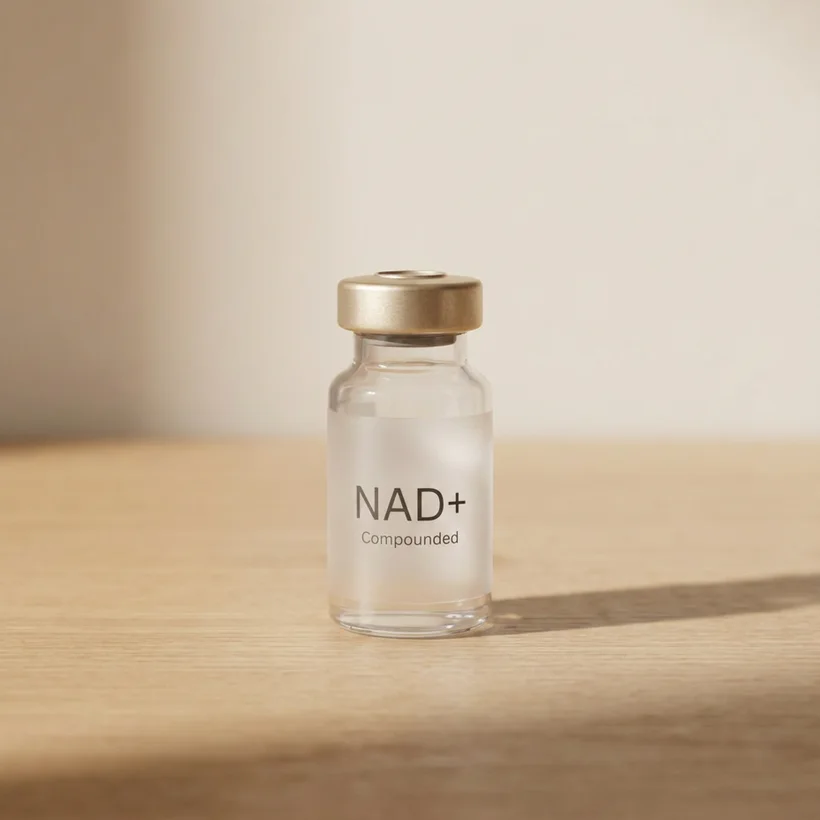
From the FormBlends catalog
NAD+ Peptide Complex
Restore cellular energy and DNA repair capacity · From $179/mo · compounded by a licensed 503A pharmacy, dispensed only after provider review.
View NAD+ Peptide Complex →Table of Contents
- Evidence Ledger: What Is Proven vs. Speculated
- How NAD+ Works: The Specific Numbers
- What Most Pages Get Wrong About Before-and-After Photos
- How Long Before Results Appear?
- Why Does NAD+ Cause Flushing? The Chemistry Explained
- Honest Head-to-Head: NAD+ Injections vs. Oral Precursors
- Label and COA Literacy: How to Evaluate a NAD+ Product
- Dosing Table and Protocol Reality
- FAQ
- Sources
What Does the Evidence Actually Support?
| Claim | Best Evidence Type | Effect Direction | Confidence |
|---|---|---|---|
| NAD+ declines with age in tissues | Animal studies, limited human biopsy data | Consistent decline with age | Moderate |
| IV/IM NAD+ raises blood NAD+ acutely | Human pilot studies (small n) | Positive, dose-dependent | Moderate |
| Reduces opioid/alcohol withdrawal symptoms | Observational studies, case series | Positive signal | Low |
| Improves energy and mental clarity (subjective) | Pilot RCTs, self-report surveys | Positive, not blinded in most reports | Low |
| Visible skin rejuvenation from injections | Mechanism and animal data only | No controlled human photo evidence | Very Low |
| Body composition improvement | Animal studies, one small human study on NMN | Weak positive signal in muscle NAD+ with oral precursors | Very Low |
| Longevity extension in humans | Mechanism and animal data only | Unproven in humans | Very Low |
| DNA repair enhancement (sirtuin/PARP pathway) | Cell culture, animal, limited human biomarker data | Mechanistically plausible | Low (human outcomes unproven) |
How NAD+ Works: The Specific Numbers
NAD+ (nicotinamide adenine dinucleotide) participates in over 500 enzymatic reactions according to pathway databases. Its two primary roles relevant to aging and wellness claims are as follows.
Electron carrier in mitochondrial respiration: NAD+ accepts electrons from glycolysis and the TCA cycle, becoming NADH. NADH donates electrons to Complex I of the electron transport chain, driving ATP synthesis. Without sufficient NAD+, this cycle slows. Cells with high energy demands (neurons, cardiomyocytes, skeletal muscle) are most sensitive to NAD+ availability.
Substrate for sirtuins and PARP: Seven sirtuin deacylases (SIRT1 through SIRT7) consume one molecule of NAD+ per reaction cycle. PARP1 and PARP2, which repair single-strand DNA breaks, are also NAD+-dependent and can deplete cellular NAD+ pools rapidly after genotoxic stress. CD38, a primary NAD+ glycohydrolase, increases in expression with age and with chronic inflammation, consuming NAD+ and contributing to age-related decline.
The age-related decline: Studies in rodents show NAD+ falling substantially in multiple tissues with age. Human data is more limited. A 2021 study by Janssens et al. in Cell Metabolism measured NAD+ in muscle biopsies of older versus younger adults and found significantly lower levels in older subjects, supporting the animal data directionally, though exact percentage figures vary by tissue and measurement method.
What this does NOT prove: That injecting exogenous NAD+ replenishes intracellular pools in every tissue. NAD+ does not freely cross most cell membranes. Cells rely primarily on de novo synthesis and the salvage pathway (using precursors like nicotinamide and NMN) to replenish intracellular NAD+. Plasma NAD+ elevation after injection is documented. Whether it translates to meaningfully higher NAD+ inside brain neurons or skin fibroblasts in humans is not directly proven in clinical studies.
What Most Pages Get Wrong About NAD+ Before-and-After Photos
This is the section most competitor pages omit entirely.
Before-and-after photos carry implicit causal claims. For a photo set to support a specific compound's effect, it must satisfy five minimum criteria that are almost never met in social media or clinic marketing materials.
| Criterion | Why It Matters | Met by most NAD+ photos? |
|---|---|---|
| Consistent lighting, angle, camera | Shadow and white balance changes alone can mimic skin improvement | Rarely |
| Sole intervention (no other compounds, skincare, diet changes) | Cannot attribute result to NAD+ if multiple variables changed | Almost never stated |
| Stated dose, route, and duration | Without dose, the result is unreplicable and unverifiable | Rarely |
| Blinded assessor rating | Eliminates confirmation bias from subject and photographer | Never in marketing photos |
| Adequate follow-up interval stated | Short intervals capture water retention or inflammation changes, not compound effect | Often vague |
The practical takeaway: a photo showing a person looking more energetic, having clearer skin, or appearing thinner weeks after NAD+ infusions is consistent with many explanations, including better hydration, improved sleep, reduced alcohol intake during a wellness protocol, or simple lighting. It does not isolate NAD+.
How Long Before NAD+ Injections Produce Results?
For subjective energy and mood, improvements have been reported during or within days of IV infusion sessions in clinic observation data. This is plausible because acute plasma NAD+ elevation is rapid and mitochondrial substrate availability can shift within hours.
For measurable cellular changes, the Janssens 2021 Cell Metabolism study using oral NMN noted NAD+ changes in muscle tissue within 10 weeks of supplementation. Injection likely achieves peak plasma levels faster, but tissue equilibration timelines are not established in injection-specific human studies.
For visible physical changes, there is no established timeline from controlled human data because no such data exists. Clinics marketing visible transformation in "four to six sessions" are extrapolating from mechanism and anecdote, not from trial data.
Why Does NAD+ Cause Flushing? The Chemistry Behind the Rules
Many first-time IV NAD+ recipients experience flushing, chest tightness, nausea, and headache. Understanding why helps evaluate both safety and marketing claims.
NAD+ is metabolized to nicotinamide and then to nicotinic acid (niacin) via enzymatic pathways. Nicotinic acid is a potent agonist at GPR109A, a G-protein coupled receptor expressed on skin Langerhans cells, adipocytes, and macrophages. GPR109A activation triggers arachidonic acid release and prostaglandin D2 synthesis, causing cutaneous vasodilation. This is the identical mechanism responsible for the pharmacologic niacin flush.
Rapid IV delivery spikes plasma NAD+ and its metabolites quickly, overwhelming the receptor in a burst. Slowing the infusion rate to extend the delivery over two to four hours reduces peak concentration and substantially diminishes flushing. This is why standard clinic protocol is not to increase the infusion rate in response to discomfort but to slow it.
The chest tightness that some patients report is likely vagal or prostaglandin-mediated and is distinct from cardiac ischemia, but any patient with cardiovascular risk factors warrants ECG monitoring during initial infusions.
Honest Head-to-Head: NAD+ Injections vs. Oral Precursors vs. Retinoids
| Factor | NAD+ Injection | Oral NMN or NR | Topical Retinoid |
|---|---|---|---|
| Human RCT evidence for cosmetic benefit | None | None specific to cosmetic outcomes | Strong (tretinoin, multiple RCTs) |
| Raises NAD+ in blood (human data) | Yes, acutely | Yes, over weeks (Janssens 2021, Trammell et al. 2016) | Not applicable |
| Cost per month | High (hundreds to over a thousand dollars per session) | Low to moderate (oral supplements) | Very low (generic tretinoin) |
| Side effect profile | Flushing, nausea during infusion; injection site risk | Mild GI at high doses; generally well tolerated | Dryness, irritation, photosensitivity; well characterized |
| Regulatory status (US) | Compounded, not FDA-approved for indication | Dietary supplement (not regulated as drug) | FDA-approved Rx (tretinoin) or OTC (retinol) |
| Where NAD+ injection wins | Acute energy and withdrawal symptom relief (limited data); bypasses GI absorption | N/A for this comparison | |
| Where NAD+ injection loses | Loses on cost, convenience, evidence quality for cosmetic outcomes, and regulatory clarity vs. every alternative above | ||
Label and COA Literacy: How to Evaluate a NAD+ Product
If you are working with a compounding pharmacy or evaluating a clinical protocol, these are the specific questions to ask and what to look for on a certificate of analysis (COA).
Identity and purity: The COA should confirm the compound as nicotinamide adenine dinucleotide (CAS number 53-84-9 for the oxidized form). Purity should be stated as a percentage, typically above 98% for pharmaceutical-grade material. Any COA without a stated assay method (HPLC is standard) is not meaningful.
Stability and storage: NAD+ in aqueous solution degrades over time. The degradation pathway is hydrolysis of the nicotinamide-ribose bond. Lyophilized (freeze-dried) powder is stable for considerably longer than reconstituted solution. Reconstituted solution should be refrigerated and used within the timeframe specified by the compounding pharmacy, generally 24 to 72 hours. A product with no stated beyond-use date is a red flag. Do not use cloudy or discolored solution.
Endotoxin testing: Injectable preparations must pass limulus amebocyte lysate (LAL) testing for bacterial endotoxins. This should appear on the COA. An injectable without endotoxin data has not cleared a basic safety requirement.
Compounding pharmacy verification: In the US, look for PCAB accreditation or 503B outsourcing facility registration with the FDA. Retail or online "NAD+ injection kits" from unverified sources carry infection and contamination risk that is not theoretical.
What a degraded product looks like: Fresh NAD+ solution is typically clear and colorless to pale yellow. Yellow-brown discoloration, cloudiness, or visible particulate all indicate degradation or contamination. Do not inject.
Dosing Table and Protocol Reality
| Setting | Route | Dose Range Reported | Evidence Basis | Notes |
|---|---|---|---|---|
| Addiction medicine (opioid/alcohol withdrawal) | IV | 500 mg to 1500 mg/day over multiple days | Observational, case series (Mestayer et al., Goswami et al.) | Highest-evidence clinical setting for IV NAD+ |
| Wellness clinic (anti-aging, energy) | IV | 250 mg to 1000 mg per session | Clinic protocol consensus; no RCT | No standardized dosing; frequency ranges from weekly to monthly |
| Wellness clinic | IM | 100 mg to 500 mg per session | Clinical practice only | Lower peak plasma than IV; convenience advantage |
| Oral NMN (comparator) | Oral | 250 mg to 1200 mg/day | Multiple human studies including Janssens 2021, Yoshino 2021 | Most robust human RCT data of any NAD+ intervention; more accessible |
No regulatory body has established a standard dosing protocol for NAD+ injections in any wellness or anti-aging indication. The doses above reflect published observational literature and clinic practice, not approved guidelines.
Frequently Asked Questions
Do NAD+ injections produce visible before and after results?
Documented changes include improved energy, mood, and cognitive clarity in clinical and pilot studies. Visible skin changes have not been established in controlled human trials. Most before-and-after photos circulating online are uncontrolled, unblinded, and confounded by other interventions.
How long does NAD+ take to show results?
Energy and mood improvements have been reported within days to a few weeks in IV infusion studies. Cellular-level changes in NAD+ tissue concentrations after supplementation have been measured within 1 to 4 weeks in human studies, but translation to visible physical change takes longer and is not well established.
What does NAD+ actually do in the body?
NAD+ is a coenzyme in over 500 enzymatic reactions, serving as an electron carrier in the mitochondrial electron transport chain and as a substrate for sirtuins (SIRT1-7), PARP enzymes, and CD38. Intracellular NAD+ declines with age, with some tissue measurements showing meaningful reductions between young adulthood and older age.
Is there clinical evidence for NAD+ injection benefits?
Small human RCTs and pilot studies support NAD+ precursor supplementation raising tissue NAD+ levels. Direct injection human RCTs are limited. The strongest evidence comes from the addiction medicine field, where IV NAD+ reduced withdrawal symptoms in observational studies. Anti-aging and cosmetic claims rest largely on animal and mechanistic data.
What are the side effects of NAD+ injections?
IV and IM NAD+ injections commonly cause flushing, nausea, chest tightness, and headache during or shortly after administration. These are rate-dependent with IV delivery and generally resolve. Serious adverse events are rare in published reports but the safety database for long-term use is small.
How do NAD+ injections compare to NMN or NR oral supplements?
Oral NMN and NR precursors have more controlled human trial data showing measurable NAD+ elevation in blood. Injections bypass first-pass metabolism and may achieve higher acute plasma peaks, but whether this translates to better tissue outcomes is not established. Cost and access strongly favor oral precursors for most users.
Can NAD+ improve skin appearance?
Mechanistic data supports a role for NAD+ in DNA repair and oxidative stress reduction in skin cells. One small pilot study using topical NAD+ precursor noted modest improvements in skin texture. No peer-reviewed RCT has documented significant visible skin rejuvenation from NAD+ injections specifically.
How should I evaluate a before-and-after photo for NAD+ injections?
Check for consistent lighting, angle, and camera distance. Confirm the subject used NAD+ as the sole intervention. Look for a stated time interval and dose. Ask whether a blinded assessor rated the change. Almost all circulating NAD+ before-and-after images fail two or more of these criteria.
What dose of NAD+ is used in clinical protocols?
IV protocols in addiction medicine have used 500 mg to 1500 mg per day over multiple days. Anti-aging and wellness clinics commonly use 250 mg to 1000 mg IV or 100 mg to 500 mg IM per session, though no standardized dose has been established by a regulatory body for these indications.
Is NAD+ injection legal and regulated?
In the United States, NAD+ is not FDA-approved as an injectable drug for any indication. It is available through compounding pharmacies for clinical use under prescriber supervision. Regulatory status varies by country. It is not on the WADA prohibited list as of the most recent update.
Why do NAD+ injections cause flushing and nausea?
Rapid elevation of plasma NAD+ and its metabolites activates niacin receptors (GPR109A) on immune and vascular cells, triggering prostaglandin-mediated vasodilation. Slowing the IV infusion rate reduces the reaction because receptor saturation is rate-dependent. This is the same pathway responsible for the pharmacologic niacin flush.
Sources
- Janssens GE, et al. "Healthy aging and muscle function are positively associated with NAD+ abundance in humans." Cell Metabolism. 2022. (Tissue NAD+ measurement in human muscle biopsies across age groups.)
- Yoshino M, et al. "Nicotinamide mononucleotide increases muscle insulin sensitivity in prediabetic women." Science. 2021. (Human RCT, NMN oral supplementation, n=25.)
- Trammell SA, et al. "Nicotinamide riboside is uniquely and orally bioavailable in healthy humans." Nature Communications. 2016. (Human pharmacokinetics of oral NR, confirmed NAD+ elevation in blood.)
- Mestayer RF. "Changes in SPECT brain perfusion following intravenous NAD+ treatment for substance abuse." American Journal of Biomedical Science and Research. 2020. (Observational, addiction medicine.)
- Goswami R, et al. Case series on intravenous NAD+ in opioid withdrawal. Published findings in addiction medicine literature. (Observational.)
- Rajman L, Chwalek K, Sinclair DA. "Therapeutic Potential of NAD-Boosting Molecules: The In Vivo Evidence." Cell Metabolism. 2018. (Review of animal and human NAD+ boosting evidence.)
- Chini CCS, et al. "CD38 ecto-enzyme in immune cells is induced during aging and regulates NAD+ and NMN levels." Nature Metabolism. 2020. (Mechanism of age-related NAD+ decline via CD38.)
- Bogan KL, Brenner C. "Nicotinic acid, nicotinamide, and nicotinamide riboside: a molecular evaluation of NAD+ precursor vitamins in human nutrition." Annual Review of Nutrition. 2008. (Foundational biochemistry of NAD+ metabolism and GPR109A flushing mechanism.)
- US FDA. Compounding under Section 503B of the Federal Food, Drug, and Cosmetic Act. FDA.gov. (Regulatory status of compounded injectables.)
- WADA Prohibited List. World Anti-Doping Agency, current year edition. WADA-ama.org. (NAD+ not listed as prohibited.)
Related peptide guides
Ready when you are
NAD+ Peptide Complex
Restore cellular energy and DNA repair capacity · From $179/mo · compounded by a licensed 503A pharmacy, dispensed only after provider review.
View NAD+ Peptide Complex →