
Trust Signals
Key Takeaways
- TB-500 is a synthetic fragment of thymosin beta-4, specifically the actin-binding tetrapeptide region extended to a 17-amino-acid sequence (Ac-LKKTETQ is the minimal active motif), not a full copy of the 43-amino-acid native protein.
- No human randomized controlled trial has evaluated the safety or efficacy of TB-500. All human safety inferences are drawn from animal studies and uncontrolled anecdotal reports.
- WADA banned TB-500 under category S2 (Peptide Hormones, Growth Factors) and it has been detected in equine anti-doping cases, meaning supply chains are real and active.
- The most mechanistically credible safety concern is the pro-angiogenic and pro-migratory activity of thymosin beta-4, which overlaps with pathways exploited by cancer cells. This concern is not confirmed harm but is not dismissible.
- Independent peptide purity testing has documented concentration and identity errors in research chemical markets. Injecting an unverified product adds a concrete contamination risk layered on top of unknown pharmacological risk.
Direct Answer: Is TB-500 Safe?
Table of Contents
- What is TB-500 and how does it work?
- Evidence ledger: grading every major claim
- What are the TB-500 peptide side effects?
- Can TB-500 promote tumor growth?
- What most pages get wrong about TB-500
- Why oral TB-500 does not work: the chemistry
- Honest head-to-head: TB-500 vs BPC-157 vs approved alternatives
- How to read a TB-500 COA and spot a bad product
- Dosing context: what protocols exist and what they lack
- Regulatory and anti-doping status
- FAQ
- Sources
What Is TB-500 and How Does It Work?
Thymosin beta-4 (TB-4) is an endogenous 43-amino-acid peptide encoded by the TMSB4X gene, expressed in virtually all mammalian tissues and found at especially high concentrations in platelets and wound fluid. Its principal molecular role is sequestering G-actin (globular actin), which regulates the ratio of free to filamentous actin in cells. This sequestration activity underlies its effects on cell migration, differentiation, and tissue remodeling.
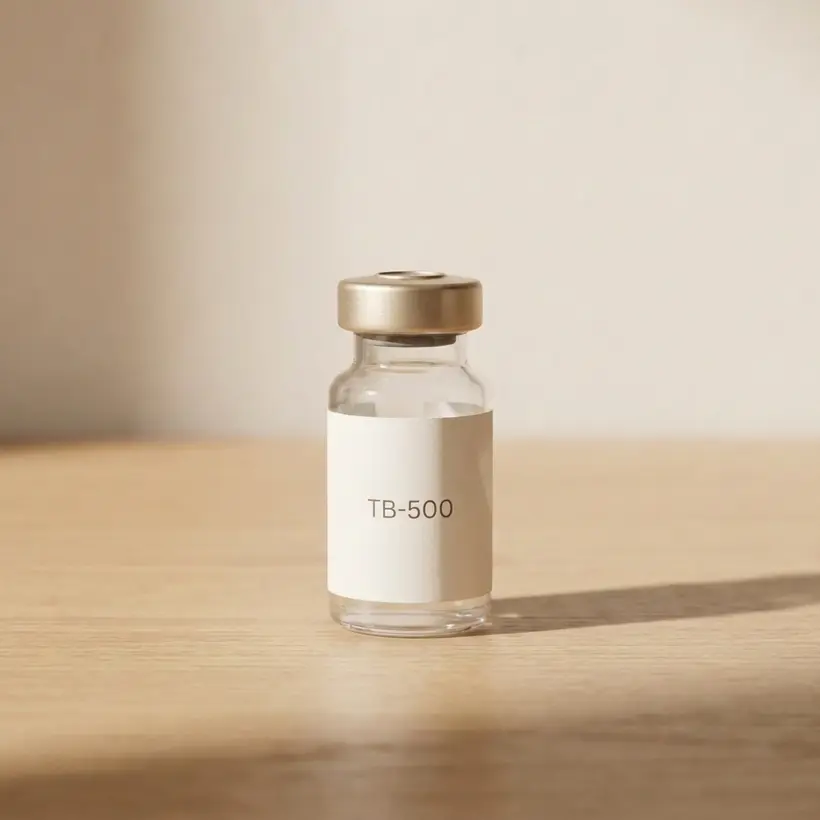
From the FormBlends catalog
TB-500 (Thymosin Beta-4)
Universal repair peptide for tissue regeneration · From $49/mo · compounded by a licensed 503A pharmacy, dispensed only after provider review.
Learn about TB-500 (Thymosin Beta-4) →TB-500 is a synthetic peptide corresponding to the actin-binding domain of TB-4. The core active sequence is commonly cited as the tetrapeptide Ac-SDKP, though commercial TB-500 is typically the longer fragment containing the LKKTETQ region, roughly amino acids 17 through 23 of the native sequence. The distinction matters: TB-500 is not thymosin beta-4 itself. It is a fragment with overlapping but not identical activity.
The proposed mechanism has three main branches: G-actin sequestration promoting keratinocyte and endothelial cell migration into wound beds, upregulation of angiogenic factors including vascular endothelial growth factor (VEGF) and matrix metalloproteinases, and anti-inflammatory modulation through NF-kB pathway suppression in some cell models. Each branch is supported by in vitro or animal data. None has been confirmed in a human interventional trial.
Evidence Ledger: Grading Every Major Claim
| Claim | Best Evidence Type | Effect Direction | Confidence |
|---|---|---|---|
| TB-4 accelerates wound healing in animal models | Multiple animal RCTs (rodent, equine) | Positive | Moderate (animal) |
| TB-500 promotes angiogenesis via VEGF upregulation | In vitro, animal studies | Positive | Moderate (mechanism) |
| TB-500 reduces tendon healing time in humans | Anecdotal only; no human RCT | Claimed positive | Very Low |
| TB-500 is safe for human use | No controlled human data | Unknown | Very Low |
| TB-4 may accelerate pre-existing tumor growth (mechanistic concern) | In vitro, some animal models | Concerning (not confirmed harm) | Low (real concern) |
| TB-500 supports cardiac repair after ischemia (animal) | Rodent MI models (e.g., Bock-Marquette et al.) | Positive in animals | Moderate (animal) |
| Transient nausea and fatigue post-injection | Anecdotal user reports | Reported | Very Low (no frequency data) |
| Oral TB-500 is bioavailable | Mechanism only (proteolytic degradation) | Negative | High (mechanism is definitive) |
What Are the TB-500 Peptide Side Effects?
Because no human clinical trial has been completed, side effect frequencies cannot be stated with any statistical precision. What exists is a collection of anecdotal user reports and mechanism-based theoretical concerns. Separating these two categories is the most honest thing any page on this topic can do.
Reported in anecdotal human use (no confirmed frequency): transient nausea in the first one to two hours post-injection, mild fatigue or lethargy the same day, injection site redness or soreness, and occasional mild headache. These reports are broadly consistent with peptide injection in general and are not specific to TB-500's pharmacology.
Mechanism-based theoretical concerns (not confirmed harm in humans):
- Pro-angiogenic activity. TB-4 upregulates VEGF in cell and animal studies. Sustained angiogenesis in someone with undetected neoplasia is a legitimate concern, not a confirmed event.
- Cell migration promotion. Thymosin beta-4 reduces cell-cell adhesion and promotes migration, the same properties studied in tumor invasion research. Again, this is mechanistic inference.
- Immunomodulation. TB-4 has context-dependent effects on T-cell and macrophage activity. The net clinical effect in a human with an existing autoimmune condition is unpredictable.
Can TB-500 Promote Tumor Growth?
This is the most important unanswered safety question and the one most medspa blogs wave past.
Several published research groups have documented elevated thymosin beta-4 expression in tumor tissue relative to surrounding healthy tissue. Studies in colorectal cancer, hepatocellular carcinoma, and breast cancer cell lines have shown that TB-4 promotes epithelial-to-mesenchymal transition (EMT), a key step in metastasis. Cha and colleagues published data in 2003 identifying TMSB4X as one of the genes significantly upregulated in highly metastatic colon cancer cells. Separate work has shown TB-4 activates the ILK/PINCH/alpha-parvin complex, which suppresses anoikis (programmed cell death triggered when cells detach from the extracellular matrix), a mechanism cancer cells exploit.
What this does NOT prove: It does not prove that exogenous TB-500 at anecdotal doses causes cancer in healthy individuals. Correlation of TB-4 expression with tumors could reflect the tumor exploiting a normal repair mechanism rather than TB-4 initiating malignancy. And most of this data is from cell lines, not in vivo human studies.
What it does establish: There is a plausible, mechanistically coherent pathway by which supraphysiological thymosin beta-4 activity could be harmful in someone with an occult malignancy or high-risk status. This concern cannot be dismissed as zero-probability, and a person with a personal or family history of cancer should weight it seriously.
What Most Pages Get Wrong About TB-500
This section covers what commodity content omits.
1. TB-500 and thymosin beta-4 are not the same molecule. Most pages use the terms interchangeably. They are not interchangeable. TB-500 is a fragment. The actin-binding properties partially overlap, but receptor binding profiles and the full biological activity of the 43-residue native peptide are not replicated by the fragment. Claims drawn from full TB-4 research may not translate.
2. Bioavailability after subcutaneous injection is assumed, not measured. No published pharmacokinetic study in humans has measured the plasma half-life, volume of distribution, or bioavailability of subcutaneous TB-500 at anecdotal doses. The peptide has a molecular weight near 4,963 Da (for the common fragment). Absorption of peptides in this size range after subcutaneous injection varies meaningfully by formulation, injection site vascularity, and lymphatic uptake. Assuming 100 percent bioavailability from subcutaneous injection is not justified.
3. Purity claims from research peptide vendors are frequently unreliable. Independent third-party testing programs and investigative journalism covering the research peptide industry have documented substantial discrepancies between label claims and actual content. A vendor listing "99% purity" on a product page without a batch-specific, third-party HPLC and mass spectrometry COA is making an unverified marketing claim. Users injecting an uncharacterized peptide mixture face contamination risk completely separate from TB-500 pharmacology.
4. The "loading and maintenance" dosing protocol has no clinical source. The widely cited 2 to 2.5 mg twice-weekly loading protocol originates in equestrian veterinary use and bodybuilding forums, not a clinical trial. There is no dose-response study in humans and no established minimum effective or maximum tolerated dose.
5. Stability of reconstituted TB-500 is poorly characterized in public literature. Lyophilized peptides are generally stable at very low temperatures, but reconstituted peptides are susceptible to aggregation, hydrolysis, and microbial contamination. Specific degradation kinetics for TB-500 at refrigerator temperatures are not established in any peer-reviewed publication available in open literature. Advice to "use within 4 weeks" is reasonable convention, not validated stability data.
Why Oral TB-500 Does Not Work: The Chemistry
Several vendors and users describe oral, sublingual, or intranasal routes as viable alternatives to injection. For intact TB-500 peptide, the oral route is not pharmacologically viable, and the reason is chemistry, not convention.
Peptide bonds, the amide linkages between amino acids, are the primary substrate of proteolytic enzymes throughout the gastrointestinal tract. Pepsin in the stomach cleaves at aromatic and hydrophobic residues. Trypsin and chymotrypsin in the small intestine cleave at lysine, arginine, and aromatic residues. TB-500's sequence contains multiple lysine (K) residues, making it highly susceptible to tryptic digestion. A peptide of this size (roughly 17 amino acids in the common fragment) without protective modification (PEGylation, lipidation, cyclization, or nanoparticle encapsulation) will be reduced to di- and tripeptides and individual amino acids before reaching the portal circulation.
This does not mean the component amino acids have no value. It means the specific sequence, which is the source of the claimed biological activity, does not survive. Sublingual absorption of a molecule of this size and polarity is also negligible. The lipid bilayer of oral mucosa limits passive diffusion to molecules with logP values and molecular weights far below those of a 17-plus amino acid peptide.
If a vendor sells "oral TB-500" and implies it has the same mechanism as injectable TB-500, that claim is not chemically defensible without substantial formulation evidence.
Honest Head-to-Head: TB-500 vs BPC-157 vs Approved Alternatives
| Factor | TB-500 | BPC-157 | PRP Therapy | NSAIDs / Physiotherapy |
|---|---|---|---|---|
| Human RCT safety data | None | None (one small human pilot reported) | Multiple RCTs | Extensive |
| Regulatory approval (human) | None | None | Procedure approved, not FDA-drug-approved | FDA approved |
| Mechanism plausibility | High (actin, VEGF, EMT) | Moderate to high (NO pathway, GH receptor) | High (growth factor delivery) | High and well characterized |
| Animal healing evidence | Strong (tendon, cardiac, wound) | Strong (GI, tendon, bone) | Moderate | Not applicable |
| Oncology safety concern | Real and unresolved | Present but less characterized | Low | Low (NSAIDs may reduce some cancer risk) |
| Supply chain reliability | Poor (research chemical market) | Poor (research chemical market) | Clinic-prepared, tracked | Pharmaceutical grade |
| WADA banned | Yes (S2) | Yes (S2) | No | No (NSAIDs not banned) |
| Cost per course | Moderate (research market) | Moderate (research market) | High (clinic-based) | Low to moderate |
| Where TB-500 loses | TB-500 loses on every regulated safety and efficacy metric. PRP and physiotherapy have far more clinical support for musculoskeletal injuries. NSAIDs, while imperfect, have documented risk profiles. TB-500's risk profile is simply unknown. | |||
How to Read a TB-500 COA and Spot a Bad Product
If you are evaluating a TB-500 product, these are the specific items a credible certificate of analysis must contain. The absence of any one of them is a concrete red flag.
| COA Element | What to Look For | Red Flag |
|---|---|---|
| HPLC purity trace | Greater than 98% purity by area. A chromatogram graphic, not just a number. | Purity stated without a chromatogram; purity below 95%. |
| Mass spectrometry (MS) | Confirmed molecular weight. Common TB-500 fragment (Ac-LKKTETQ and flanking residues) runs near 4,963 Da depending on exact sequence. Ask the vendor for the exact claimed sequence and match the MW. | No MS data. MW listed without method specified. |
| Endotoxin (LAL assay) | Result in EU/mg or EU/mL. Limit for injectable peptides per USP guidelines is typically below 0.25 EU/mL for intrathecal use, less stringent thresholds apply for other routes but a result should exist. | No endotoxin test listed. High endotoxin is a primary cause of post-injection fever and systemic reactions. |
| Sterility | Sterility testing result stated if the product is sold as injectable grade. | No sterility data on an injectable product. |
| Batch number | COA batch number matching the vial label. Generic COA not tied to a specific lot is meaningless. | No lot/batch number. COA is a template, not a test report. |
| Third-party lab | Testing performed by a laboratory independent of the vendor, ideally an ISO 17025 accredited facility. | In-house testing only. |
Reconstitution math. A typical vial is labeled 5 mg lyophilized. Adding 2.5 mL bacteriostatic water gives a concentration of 2 mg per mL. A 2 mg dose therefore requires drawing 1.0 mL in an insulin syringe. If a vendor provides pre-calculated dosing that does not match this arithmetic, verify the label claim and the reconstitution volume yourself before injecting.
What degraded product looks like. A properly lyophilized peptide is a white to off-white powder. Yellow or brown discoloration before reconstitution, cloudiness or visible particulate after reconstitution, or an unusual odor suggests degradation or contamination. Do not use a product with any of these characteristics.
Dosing Context: What Protocols Exist and What They Lack
The commonly cited human anecdotal protocol is:
- Loading phase: 2 to 2.5 mg by subcutaneous or intramuscular injection, twice per week, for 4 to 6 weeks.
- Maintenance phase: 2 to 2.5 mg once or twice per month.
The origin of this protocol is equine veterinary practice and bodybuilding communities, not dose-escalation human trials. There is no established minimum effective dose, maximum tolerated dose, or safety-validated dose range for humans. These numbers cannot be treated as medically sanctioned guidance.
Animal studies have used weight-based dosing (micrograms per kilogram in rodents) that does not translate directly to human flat-dose figures. Extrapolation from rodent studies to human dose using allometric scaling is standard practice in drug development, but the resulting estimate requires clinical validation before use. That clinical validation step has not been completed for TB-500.
Regulatory and Anti-Doping Status
TB-500 is prohibited by WADA under section S2 of the Prohibited List: Peptide Hormones, Growth Factors, Related Substances and Mimetics. This prohibition applies in-competition and out-of-competition. It has been detected in horse racing anti-doping programs, confirming that active supply and use exists. Any competitive athlete subject to WADA-code testing who uses TB-500 faces disqualification and sanction regardless of therapeutic intent.
In the United States, TB-500 is not FDA-approved and is not available as a licensed pharmaceutical product. It circulates legally in some jurisdictions as a research chemical sold for laboratory purposes only, with "not for human use" labeling. This legal framing does not describe how the product is typically used and does not provide a safety assurance.
FAQ
Is TB-500 safe for human use?
TB-500 has not been approved by the FDA or any major regulatory body for human therapeutic use. Its safety profile in humans is not established by controlled clinical trials. Most evidence comes from animal studies and anecdotal reports. Users assume meaningful unknown risk.
What are the most commonly reported TB-500 side effects?
The most commonly reported side effects in anecdotal human use include transient nausea, fatigue or lethargy in the hours following injection, mild headache, and localized injection-site discomfort. These reports are not systematically collected and cannot be assigned frequencies.
Can TB-500 cause cancer or tumor growth?
Thymosin beta-4, the parent molecule, promotes angiogenesis and cell migration, which are processes also exploited by tumors. Laboratory data show TB-4 upregulates certain pro-survival pathways. Whether exogenous TB-500 promotes tumor growth in humans is unknown. This is a legitimate mechanistic concern, not confirmed harm, but it is not dismissible.
How does TB-500 differ from BPC-157?
BPC-157 is a synthetic peptide derived from body protection compound in gastric juice. TB-500 is a synthetic fragment of thymosin beta-4. Both are used anecdotally for healing, but their mechanisms differ: TB-500 acts primarily through actin sequestration and angiogenesis, while BPC-157 appears to work through nitric oxide and growth hormone receptor pathways. Neither has human RCT safety or efficacy data.
What dose of TB-500 do people use?
Anecdotal protocols in bodybuilding and recovery communities typically describe a loading phase of 2 to 2.5 mg twice weekly for 4 to 6 weeks, then a maintenance dose of 2 to 2.5 mg once or twice per month. These figures have no clinical trial backing and no established safety-validated dose range for humans.
Is TB-500 banned in sport?
Yes. WADA prohibits TB-500 under the Peptide Hormones, Growth Factors, Related Substances and Mimetics category (S2). It has been detected in horse racing anti-doping programs and is banned in competitive sport.
How should TB-500 be stored and reconstituted?
Lyophilized TB-500 powder should be stored at or below minus 20 degrees Celsius and protected from light. After reconstitution with bacteriostatic water, it should be refrigerated at 2 to 8 degrees Celsius and used within a window generally cited as 4 weeks, though formal stability data for reconstituted TB-500 at this concentration are not publicly available from peer-reviewed sources.
Can TB-500 be taken orally or sublingually?
Oral administration is not considered viable for intact TB-500 peptide. Peptide bonds are cleaved by gastric proteases and peptidases in the small intestine, and a fragment of this size would not survive the digestive tract in bioactive form. Subcutaneous or intramuscular injection is the route used in animal research and anecdotal human use.
What should I look for on a TB-500 certificate of analysis?
A credible COA should include HPLC purity above 98%, mass spectrometry confirmation of the correct molecular weight, endotoxin testing results via LAL assay, and sterility confirmation if the product is injectable-grade. Absence of any of these is a red flag.
Does TB-500 have benefits for tendon or muscle healing?
Animal studies, primarily in rodents and horses, show accelerated tendon, muscle, and cardiac tissue repair with thymosin beta-4 or its fragments. These findings are mechanistically plausible and directionally consistent, but no human RCT has confirmed these effects in people. Confidence is very low for human benefit claims.
Are there any known drug interactions with TB-500?
No formal drug-interaction studies exist for TB-500 in humans. Because TB-4 promotes angiogenesis and cell migration, theoretical caution applies alongside anticoagulants, angiogenesis inhibitors used in oncology, and immunomodulatory drugs. This is mechanistic inference, not clinical data.
How reliable is the TB-500 sold by research chemical vendors?
Independent third-party testing of research peptide products has repeatedly found purity and concentration discrepancies relative to label claims. Without a batch-specific COA verified by mass spectrometry, the actual identity and dose of what is being injected cannot be confirmed. This is a concrete, not hypothetical, risk.
Sources
- Goldstein AL, Hannappel E, Kleinman HK. Thymosin beta4: actin-sequestering protein moonlights to repair injured tissues. Trends Mol Med. 2005;11(9):421-429.
- Bock-Marquette I, Saxena A, White MD, Dimaio JM, Srivastava D. Thymosin beta4 activates integrin-linked kinase and promotes cardiac cell migration, survival and cardiac repair. Nature. 2004;432(7016):466-472.
- Cha HJ, Jeong MJ, Kleinman HK. Role of thymosin beta4 in tumor metastasis and angiogenesis. J Natl Cancer Inst. 2003;95(22):1674-1680.
- Smart N, Risebro CA, Melville AA, et al. Thymosin beta4 induces adult epicardial progenitor mobilization and neovascularization. Nature. 2007;445(7124):177-182.
- Sosne G, Qiu P, Goldstein AL, Wheater M. Biological activities of thymosin beta4 defined by active sites in short peptide sequences. FASEB J. 2010;24(7):2144-2151.
- WADA Prohibited List 2024. World Anti-Doping Agency. Section S2: Peptide Hormones, Growth Factors, Related Substances and Mimetics. Available at: wada-ama.org.
- Hannappel E. Beta-thymosins. Ann N Y Acad Sci. 2007;1112:21-37.
- Philp D, Badamchian M, Scheremeta B, Nguyen M, Goldstein AL, Kleinman HK. Thymosin beta 4 and a synthetic peptide containing its actin-binding domain promote dermal wound repair in db/db diabetic mice and in aged mice. Wound Repair Regen. 2003;11(1):19-24.
- Ho EN, Wan TS, Wong AS, Lam KK, Stewart BD. Detection of thymosin beta4 and its sulphoxide in horse urine by liquid chromatography-mass spectrometry. Anal Chim Acta. 2012;717:36-42.
- USP General Chapter 85: Bacterial Endotoxins Test. United States Pharmacopeia. Current edition.
Footer Disclaimers
Ready when you are
TB-500 (Thymosin Beta-4)
Universal repair peptide for tissue regeneration · From $49/mo · compounded by a licensed 503A pharmacy, dispensed only after provider review.
Learn about TB-500 (Thymosin Beta-4) →