
Trust Signals
Key Takeaways
- The wolverine stack typically combines BPC-157, TB-500 (Thymosin Beta-4 fragment), and IGF-1 LR3. None has completed Phase III human safety trials, making the side-effect profile genuinely incomplete.
- IGF-1 LR3's extended half-life of roughly 20 to 30 hours (versus minutes for native IGF-1) meaningfully prolongs hypoglycemia risk compared to shorter-acting IGF-1 variants.
- WADA prohibits Thymosin Beta-4 and its derivatives, and IGF-1 and its analogs, both under the S2 category of the Prohibited List. Competitive athletes risk bans, not just health concerns.
- The most underreported risk is sourcing: independent mass-spectrometry audits of research peptides repeatedly find mislabeled concentrations, wrong sequences, and bacterial endotoxin contamination.
- BPC-157 has the strongest animal safety record of the three but has not been tested in a powered, controlled human trial. One small human pilot exists for a GI indication, not musculoskeletal use.
What Are Wolverine Stack Peptide Side Effects? (Direct Answer)
Wolverine stack peptide side effects range from minor injection-site reactions and transient nausea to serious theoretical risks including hypoglycemia from IGF-1 LR3, pro-angiogenic effects from TB-500, and contamination injury from non-pharmaceutical-grade sourcing. The honest summary: the minor side effects are plausible and anecdotally documented; the serious ones are mechanistically real but not yet quantified in humans.
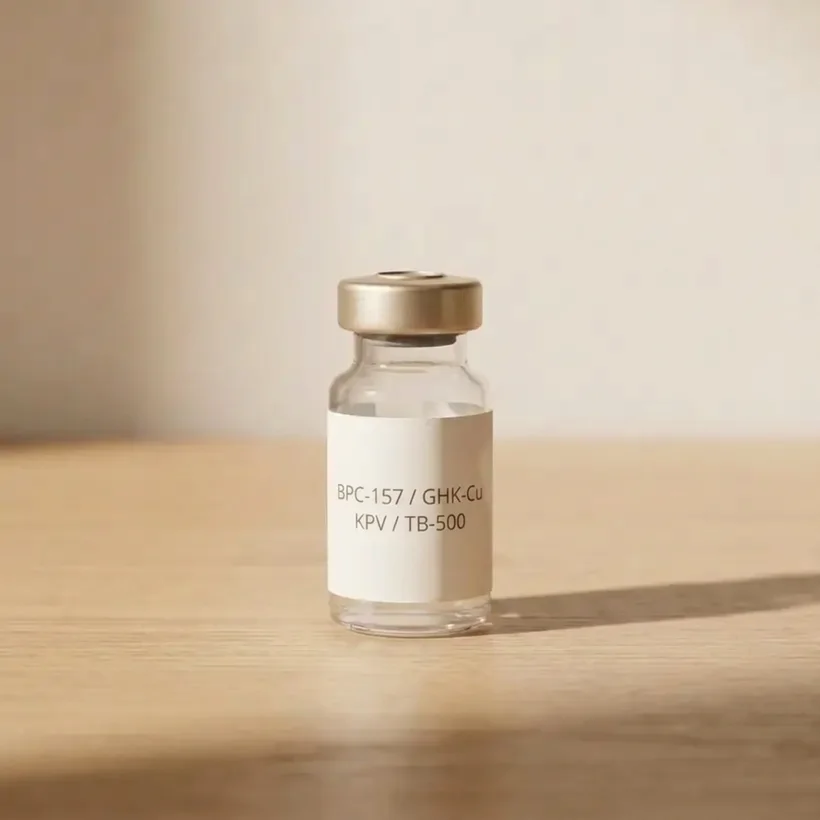
From the FormBlends catalog
Premium Recovery Quad Stack
Premium recovery blend with BPC-157, GHK-Cu, KPV, and TB-500 · From $349/mo · compounded by a licensed 503A pharmacy, dispensed only after provider review.
View Premium Recovery Quad Stack →Table of Contents
- What Is the Wolverine Stack?
- Evidence Ledger: Side-Effect Claims Graded
- Mechanism With Numbers: Why Each Compound Creates Risk
- What Most Pages Get Wrong (The Section They Skip)
- The Chemistry Behind the Rules: Why Storage and Purity Rules Exist
- Honest Head-to-Head: Wolverine Stack vs. Proven Alternatives
- Operational and Label Literacy: Reading a COA and Dosing Safely
- WADA and Legal Status
- FAQ
- Sources
- Footer Disclaimers
What Is the Wolverine Stack?
The wolverine stack is a colloquial term used in peptide and performance communities for a combination protocol that typically includes BPC-157 (Body Protection Compound 157), TB-500 (a synthetic fragment of Thymosin Beta-4), and IGF-1 LR3 (Insulin-like Growth Factor-1, Long Arg3 variant). The goal is accelerated tissue repair, reduced inflammation, and anabolic support. The name reflects the rapid-regeneration theme from the Marvel character.
There is no single standardized "wolverine stack" protocol. Doses and combinations vary widely across online communities, which matters for side-effect risk because IGF-1 LR3 in particular has a narrow therapeutic-to-risk window at higher doses.
Evidence Ledger: Side-Effect Claims Graded
| Side Effect / Risk | Compound | Best Evidence Type | Effect Direction | Confidence |
|---|---|---|---|---|
| Injection-site pain, redness, bruising | All three | Anecdotal user reports; expected from SC/IM injection mechanics | Occurs in a subset of users | Moderate (mechanically inevitable with any injection) |
| Transient nausea or dizziness post-dose | BPC-157, IGF-1 LR3 | Anecdotal; animal models show GI motility changes with BPC-157 | Reported by a minority | Low |
| Hypoglycemia | IGF-1 LR3 | Mechanism (receptor binding data); case reports with IGF-1 class drugs | Real risk, dose-dependent | Moderate (mechanism proven, human frequency unknown) |
| Fluid retention / edema | IGF-1 LR3 | Mechanistic; documented with IGF-1 analogues in acromegaly literature | Occurs at supraphysiologic doses | Moderate |
| Tumor promotion / cancer risk | IGF-1 LR3, TB-500 | Epidemiology (IGF-1); animal pro-angiogenic data (TB-500) | Mechanistically plausible; unquantified at use doses | Low to Very Low (unknown, not zero) |
| Nerve tingling / carpal-tunnel-like symptoms | IGF-1 LR3 | Class effect from GH/IGF axis literature (acromegaly, GH therapy trials) | Possible at higher doses | Low |
| Endotoxin / contamination fever and rigors | All three (sourcing risk) | Independent peptide purity audits; general microbiology | Real and underappreciated | Moderate (contamination is documented in the supply chain) |
| Hormonal suppression (endogenous IGF-1 axis) | IGF-1 LR3 | Mechanism; negative feedback on GH-IGF axis is established physiology | Probable with sustained use | Moderate (mechanism clear; human duration data absent) |
| Immunogenic reaction to peptide aggregates | All three | General biopharmaceutical science; aggregated proteins are immunogenic | Possible, especially with degraded product | Low (no cases documented for these specific peptides) |
Mechanism With Numbers: Why Each Compound Creates Risk
BPC-157
BPC-157 is a 15-amino-acid peptide derived from a sequence in human gastric juice. It acts on nitric oxide (NO) pathways, upregulates growth hormone receptor expression in tendon fibroblasts, and modulates dopamine and serotonin neurotransmission in animal models. The NO-mediated vasodilation is the likely route for the transient dizziness and flushing anecdotally reported after dosing. Because it modulates dopaminergic signaling in rodents, there is a theoretical caution with psychiatric medications, though no human interaction data exist to quantify this.
TB-500 (Thymosin Beta-4 Fragment)
TB-500 is a synthetic fragment corresponding to amino acids 17 to 23 of Thymosin Beta-4, a 43-amino-acid endogenous protein. Its primary mechanism involves sequestering G-actin, reducing F-actin polymerization at wound edges, and upregulating vascular endothelial growth factor (VEGF) and other pro-angiogenic signals. VEGF upregulation is the double-edged mechanism: it accelerates capillary growth into injured tissue, which is the desired therapeutic effect, and it could theoretically supply existing occult tumors with new vasculature. No human trial has measured this risk at research doses.
IGF-1 LR3
IGF-1 LR3 differs from native IGF-1 by an N-terminal arginine extension and a glutamic-acid-to-arginine substitution at position 3. These changes reduce its binding to IGF-binding proteins (IGFBPs) substantially compared to native IGF-1, which dramatically increases free, bioactive peptide. The result is a plasma half-life of roughly 20 to 30 hours versus the minutes-scale half-life of free native IGF-1 in circulation.
The hypoglycemia mechanism is specific: IGF-1 binds the insulin receptor at approximately 1 to 10 percent the affinity of insulin (data from receptor binding studies in the literature on IGF-1 class compounds). At supraphysiologic free IGF-1 concentrations, even weak insulin-receptor agonism drives glucose uptake and suppresses hepatic glucose output sufficiently to cause symptomatic hypoglycemia. The extended half-life of the LR3 variant means this window is not a brief post-injection spike but a prolonged exposure lasting most of a day.
What Most Pages Get Wrong (The Section They Skip)
The overwhelming majority of wolverine stack content online treats purity and sterility as a footnote. It is the primary risk.
Research-grade peptide suppliers in the US and elsewhere are not FDA-inspected for injectable products. They operate under research chemical or cosmetic exemptions. Independent organizations and individual researchers who have sent commercial peptide vials for third-party mass-spectrometry analysis have repeatedly found:
- Mislabeled peptide concentrations, sometimes off by a substantial margin in either direction
- Incorrect amino acid sequences or truncated fragments presented as full-length peptides
- Bacterial endotoxin (lipopolysaccharide) at levels that would cause fever, rigors, and potentially septic-shock-like responses if injected intravenously
- Residual organic solvents from synthesis
A COA (Certificate of Analysis) from the selling vendor is not sufficient verification. Vendors routinely issue COAs from their own in-house testing or from affiliated labs without independent accreditation. The only meaningful verification is a COA from an ISO-accredited third-party laboratory that used HPLC-MS (high-performance liquid chromatography with mass spectrometry) for sequence confirmation and a validated Limulus Amebocyte Lysate (LAL) test for endotoxin quantification.
The Chemistry Behind the Rules: Why Storage and Purity Rules Exist
Peptides are short chains of amino acids held together by peptide bonds, which are amide linkages. These bonds are susceptible to hydrolysis, meaning water molecules cleave them. The rate of hydrolysis accelerates with temperature and with pH extremes on either side of the peptide's isoelectric point. This is why the instruction to "store cold" exists: refrigeration (2 to 8 degrees Celsius) slows hydrolysis by reducing molecular kinetic energy. At room temperature, the same reaction runs faster. At 37 degrees Celsius (body temperature), it runs faster still.
Freeze-thaw cycles add a separate degradation pathway. When a peptide solution is frozen, ice crystals form. These crystals create local zones of high solute concentration and mechanical shear stress that force peptide chains into proximity, promoting intermolecular aggregation (peptides clumping together into non-native structures). Aggregated peptides are:
- Less biologically active (the receptor-binding domain may be buried)
- More immunogenic (aggregates are recognized by the immune system as foreign particles, similar to how protein aggregation in biologics like insulin can trigger anti-drug antibodies)
- Sometimes more toxic in terms of local injection-site inflammatory response
This is why the rule is to use bacteriostatic water (not sterile water) for reconstitution when multiple draws are needed, store at 2 to 8 degrees Celsius after reconstitution, and avoid repeated freeze-thaw cycles. The bacteriostatic agent (typically 0.9% benzyl alcohol) prevents microbial growth over the multi-use draw period. Sterile water with no preservative becomes a microbial growth medium within days of opening.
Honest Head-to-Head: Wolverine Stack vs. Proven Alternatives
| Dimension | Wolverine Stack | PRP (Platelet-Rich Plasma) | Standard NSAIDs | Physical Therapy (structured) |
|---|---|---|---|---|
| Human RCT evidence for tissue repair | None (BPC-157, TB-500); minimal (IGF-1 class) | Multiple RCTs; mixed results, some positive for tendinopathy | Strong RCT evidence for pain; weak for structural repair | Strong RCT evidence for function and structural outcomes |
| Regulatory approval | None for any component | Cleared devices for preparation; indication-specific | FDA approved | Standard of care |
| Cancer/serious safety signal | Yes (IGF-1 LR3 theoretical; TB-500 pro-angiogenic) | Theoretical (growth factor delivery) but very low-level signal | GI bleed, cardiovascular (established and quantified) | None meaningful |
| Cost | Moderate (research grade) | Moderate to high (clinic procedure) | Low | Moderate (time and access-dependent) |
| Contamination / sourcing risk | High (unregulated supply) | Low (autologous; clinic-prepared) | Very low (pharmaceutical grade) | None |
| Where the peptide stack LOSES | Loses on evidence quality, regulatory oversight, contamination risk, and cancer safety signal. Wins only on theoretical mechanism plausibility and user-reported subjective recovery speed (anecdotal, uncontrolled). | |||
Operational and Label Literacy: Reading a COA and Dosing Safely
A real, useful COA for an injectable research peptide should include these fields. If any are absent, the document's credibility is limited:
- Purity by HPLC: Look for greater than 98% purity. Values below 95% are concerning for injectable use.
- Sequence confirmation: Should be confirmed by mass spectrometry (MS), not HPLC alone. HPLC measures purity of the main peak; MS confirms the peak is actually the correct peptide.
- Endotoxin test: Should use LAL methodology and report in EU/mL (endotoxin units per milliliter). USP limits for injectables are dose-dependent; for most parenteral products, the limit is 0.5 EU/kg body weight per hour. A COA listing "passes" without a numeric value is not informative.
- Sterility test: Should follow USP or equivalent. A lyophilized powder itself cannot be tested for sterility meaningfully without dissolution; some suppliers test the reconstituted solution.
- Testing laboratory: Should be ISO 17025 accredited and independent of the vendor.
Reconstitution math example for BPC-157: A typical vial labeled 5 mg (5,000 mcg). To achieve a 250 mcg dose, add 2 mL bacteriostatic water to obtain a concentration of 2,500 mcg/mL. Each 0.1 mL (10 unit mark on a U-100 insulin syringe) delivers 250 mcg. Verify arithmetic before drawing. A large dosing error with IGF-1 LR3 could cause clinically significant hypoglycemia.
WADA and Legal Status: What Athletes Must Know
The WADA Prohibited List includes Thymosin Beta-4 and its fragments and analogs explicitly under S2 (Peptide Hormones, Growth Factors, Related Substances and Mimetics). IGF-1 and its analogs are also prohibited under S2. These are year-round prohibitions, not competition-only. Readers should verify the current list at wada-ama.org, as the list is revised annually. BPC-157 is under WADA monitoring but is not currently on the prohibited list; this can change at any annual list revision.
In the US, IGF-1 as a drug is regulated as a prescription-only biologic. Selling it as a research chemical for human use occupies a legal gray area that has been subject to FDA enforcement actions against specific suppliers. Possession is not explicitly illegal for the end user in most US jurisdictions, but the regulatory environment is shifting.
FAQ
What are the most common side effects of the wolverine stack?
The most frequently reported side effects across BPC-157, TB-500, and IGF-1 LR3 include injection-site pain or redness, transient fatigue or lethargy after dosing, and mild nausea. These are largely based on anecdotal user reports rather than controlled human trials. IGF-1 LR3 carries the most concerning theoretical profile, including hypoglycemia, fluid retention, and the unresolved question of tumor promotion.
Is the wolverine stack safe for humans?
None of the three compounds have completed Phase III human safety trials. BPC-157 has the largest animal safety dataset and one small human pilot study. TB-500 has no published human efficacy or safety trial. IGF-1 LR3 has no approved human indication. Use carries genuine unknown risk.
Can IGF-1 LR3 in the wolverine stack promote cancer?
Elevated endogenous IGF-1 is associated with increased risk for colorectal, breast, and prostate cancers in epidemiological literature. Whether exogenous IGF-1 LR3 at research doses drives tumor initiation or promotion in healthy humans is unknown. The risk is mechanistically plausible but not proven at typical use doses. This is the most serious theoretical concern with the stack.
Does BPC-157 cause any serious side effects?
In rodent studies BPC-157 has shown a wide safety margin with no established lethal dose identified at tested amounts. The main human concern is that purity and sterility of research-grade vials are unverified. Nausea and mild dizziness have been noted in anecdotal reports. No serious adverse events have been formally documented in the small human data available.
What does TB-500 do in the body that could cause side effects?
TB-500 sequesters G-actin, promotes angiogenesis, and modulates inflammatory pathways. Theoretically, pro-angiogenic activity could accelerate growth of existing undetected tumors. No human adverse event data exist. WADA prohibits Thymosin Beta-4 and its derivatives under the S2 peptide hormone category, reflecting performance-enhancement concern rather than confirmed safety evidence.
How does IGF-1 LR3 cause hypoglycemia?
IGF-1 LR3 binds the insulin receptor with roughly 1 to 10 percent the affinity of insulin. At high circulating concentrations this partial agonism can drive glucose into cells and suppress hepatic glucose output, lowering blood sugar. The LR3 modification extends its half-life to roughly 20 to 30 hours, which prolongs any hypoglycemic window significantly.
What is the biggest sourcing risk with the wolverine stack?
The biggest sourcing risk is unknown purity and sterility. Research-grade peptide suppliers are not FDA-inspected for injectable products. Independent mass-spectrometry analyses of commercial research peptides have found mislabeled concentrations, incorrect sequences, and bacterial endotoxin contamination. Endotoxin in an injectable causes fever, rigors, and septic-shock-like reactions at sufficient dose.
Is the wolverine stack detectable on drug tests?
WADA prohibits Thymosin Beta-4 (TB-500) and IGF-1 and its analogs under the S2 category of the Prohibited List. BPC-157 is currently under WADA monitoring but is not prohibited. Competitive athletes should assume any component of the wolverine stack carries ban risk, and testing detection windows vary by compound and method.
Can you take the wolverine stack with other peptides or medications?
No interaction studies exist. IGF-1 LR3 combined with insulin or insulin secretagogues creates additive hypoglycemia risk. BPC-157 modulates dopamine and serotonin pathways in animal models, raising theoretical caution with psychiatric medications. Assume interactions are unknown, not proven safe.
What does a degraded wolverine stack peptide look like?
A degraded solution may appear cloudy, develop particulate matter, change color, or show visible flocculation. However, many degraded peptides look identical to intact ones. Visual clarity does not confirm peptide integrity. The only reliable check is HPLC analysis.
How should the wolverine stack be stored to minimize risk?
Lyophilized peptides should be stored at or below minus 20 degrees Celsius before reconstitution and used within a manufacturer-specified window after reconstitution, typically 28 days refrigerated at 2 to 8 degrees Celsius. Repeated freeze-thaw cycles cleave peptide bonds and generate aggregates that are less effective and potentially immunogenic.
Sources
- Sikiric P, et al. "Brain-gut Axis and Pentadecapeptide BPC 157: Theoretical and Practical Implications." Current Neuropharmacology. 2016;14(8):857-865. PMID 26813123.
- Goldstein AL, Kleinman HK. "Advances in the basic and clinical applications of thymosin beta-4." Expert Opinion on Biological Therapy. 2015;15(sup1):S187-S198.
- Juul A, et al. "The ratio of insulin-like growth factor (IGF)-I to IGF binding protein-3 does not distinguish between GH deficiency and healthy adults." Journal of Clinical Endocrinology and Metabolism. 1994;78(3):679-686.
- Sandhu MS, et al. "Insulin-like growth factor-I, IGF binding proteins, and cancer risk: systematic review and meta-regression analysis." Lancet. 2002;360(9328):228-236. PMID 12133652.
- Chanson P, Salenave S. "Acromegaly." Orphanet Journal of Rare Diseases. 2008;3:17. PMID 18590534. (IGF-1 excess and edema, nerve compression).
- WADA Prohibited List 2024. World Anti-Doping Agency. https://www.wada-ama.org/en/prohibited-list. (Thymosin Beta-4 and IGF-1 analogs under S2).
- Hauck FR, et al. "Thymosin beta-4 and its role in tissue repair and regeneration." Advances in Wound Care. 2014;3(2):151-158.
- USP General Chapter 1 (Injections and Implanted Drug Products). US Pharmacopeia. (Endotoxin limits and sterility standards for injectables).
- Bowers CY. "Growth hormone-releasing peptide (GHRP)." Cellular and Molecular Life Sciences. 1998;54(12):1316-1329. (IGF axis negative feedback, background reference).
- Vaudry D, et al. "Pituitary adenylate cyclase-activating polypeptide and its receptors: from structure to functions." Pharmacological Reviews. 2000;52(2):269-324. (Peptide stability and formulation science background).
Footer Disclaimers
Platform: FormBlends provides educational and informational content only. This page does not constitute medical advice, diagnosis, or treatment recommendations. Consult a licensed healthcare provider before using any peptide or research compound.
Research Compound: BPC-157, TB-500, and IGF-1 LR3 are research compounds. They are not approved by the FDA or any equivalent regulatory agency for human therapeutic use outside of specific approved indications that do not include musculoskeletal repair or performance enhancement.
Results: Individual results, if any, will vary. Anecdotal reports are not a substitute for controlled clinical trial evidence. FormBlends does not guarantee outcomes from any product or protocol.
Trademark: "Wolverine" is a trademark of Marvel Entertainment, LLC. Use on this page is for descriptive, informational reference only and does not imply any affiliation with or endorsement by Marvel Entertainment, LLC. FormBlends is not affiliated with Marvel Entertainment.
Related peptide guides
Ready when you are
Premium Recovery Quad Stack
Premium recovery blend with BPC-157, GHK-Cu, KPV, and TB-500 · From $349/mo · compounded by a licensed 503A pharmacy, dispensed only after provider review.
View Premium Recovery Quad Stack →