
Trust Signals
Conflicts: FormBlends sells research-grade peptides. This page grades the evidence honestly regardless of commercial interest. Claims that lack human RCT support are labeled as such.
Last updated: 2026-05-29
Key Takeaways
- The wolverine stack peptide combines BPC-157 (a 15-amino-acid sequence derived from gastric juice protein) and TB-500 (synthetic Thymosin Beta-4 fragment), two mechanistically distinct peptides proposed to work synergistically on tissue repair.
- BPC-157 has at least one Phase II human trial for gastrointestinal use; TB-500 has zero published human trial data for any indication, musculoskeletal or otherwise.
- WADA explicitly prohibits Thymosin Beta-4 and its fragments (including TB-500) under Section S2 of the Prohibited List; any athlete subject to drug testing faces a real detection risk.
- Wolverine stack peptide capsules face an unresolved oral bioavailability problem: no published data confirms that commercially dosed oral BPC-157 or TB-500 reaches therapeutic tissue concentrations in humans.
- Third-party COA verification (HPLC purity, mass spec, LAL endotoxin) is the only meaningful quality filter available to buyers because no FDA oversight exists for these compounds as sold.
What Is the Wolverine Stack Peptide? (Direct Answer)
The wolverine stack peptide is the informal name for a BPC-157 plus TB-500 combination protocol, named for the fictional X-Men character's rapid tissue regeneration. It targets tendon, muscle, and joint repair. All supporting evidence is preclinical or mechanistic. No human RCT has tested this specific combination. It is not FDA-approved for any use.
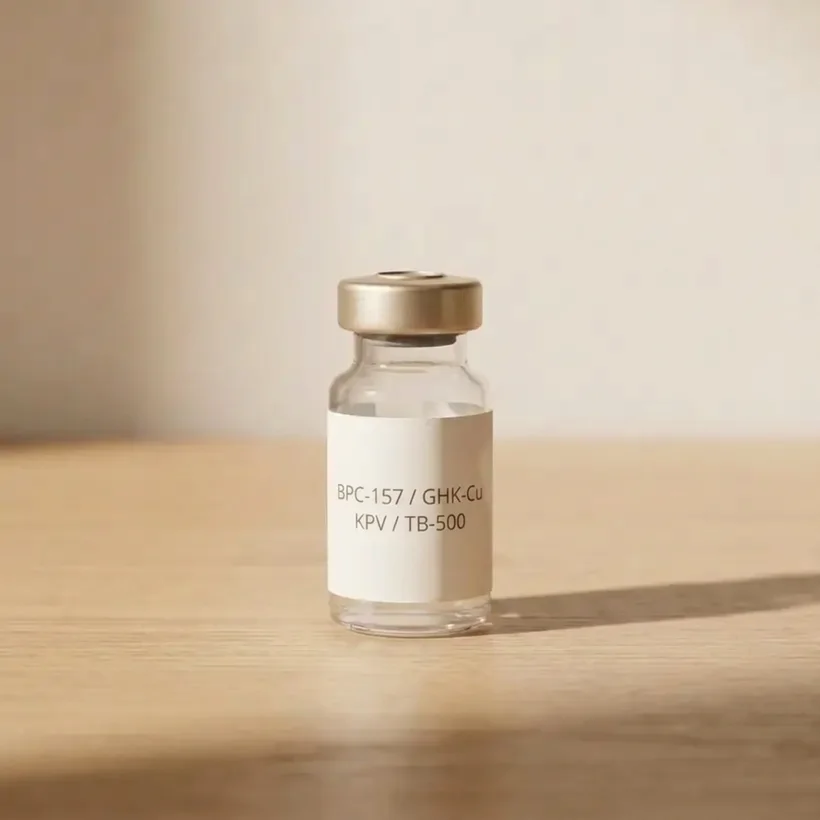
From the FormBlends catalog
Premium Recovery Quad Stack
Premium recovery blend with BPC-157, GHK-Cu, KPV, and TB-500 · From $349/mo · compounded by a licensed 503A pharmacy, dispensed only after provider review.
View Premium Recovery Quad Stack →Table of Contents
- What Peptides Are in the Wolverine Stack?
- How Does the Wolverine Stack Work? Mechanism With Specific Numbers
- Evidence Ledger: Every Major Claim Graded
- What Most Pages Get Wrong About the Wolverine Stack Peptides
- Dosing, Protocols, and the Math Behind Common Figures
- Honest Head-to-Head: Wolverine Stack vs. Real Alternatives
- WADA Status, Safety Signals, and What Is Not Known
- Operational Guide: Reading a COA and Judging a Product
- Wolverine Stack Peptide Capsules: The Bioavailability Problem Explained
- FAQ
- Sources
- Disclaimers
What Peptides Are in the Wolverine Stack?
The canonical wolverine stack peptides are two compounds:
- BPC-157 (Body Protection Compound 157): A 15-amino-acid pentadecapeptide with the sequence Gly-Glu-Pro-Pro-Pro-Gly-Lys-Pro-Ala-Asp-Asp-Ala-Gly-Leu-Val. It was isolated from a protein found in human gastric juice. Molecular weight approximately 1,419 Da. Research has explored it primarily for gastrointestinal protection and tendon/ligament healing in rodent models.
- TB-500 (Thymosin Beta-4 fragment, sometimes called TB4-Frag): A synthetic peptide corresponding to the 17-23 amino acid actin-binding region of the naturally occurring protein Thymosin Beta-4. Full Thymosin Beta-4 is a 43-amino-acid protein; TB-500 is a shorter fragment marketed for its proposed tissue-repair activity at lower cost than full TB-4.
Some vendors selling under names like "Pro Peptide Solutions Wolverine Stack" add a third compound such as GHK-Cu (a copper peptide with wound-healing preclinical data) or a growth hormone secretagogue like Ipamorelin. This page covers the core two-compound stack because that is what most search queries and protocols reference. Any stack expansion changes the risk and evidence profile.
How Does the Wolverine Stack Work? Mechanism With Specific Numbers
BPC-157: Vascular and Fibroblast Pathways
In rodent tendon transection models, BPC-157 administration has been associated with upregulation of VEGF (vascular endothelial growth factor) expression and accelerated tendon fibroblast migration and proliferation. A frequently cited study by Pevec and colleagues (published in the Journal of Orthopaedic Research, 2010) examined Achilles tendon healing in rats and reported histologically improved tendon organization in BPC-157-treated animals compared to controls, with dosing in the range of 10 mcg/kg body weight.
BPC-157 also interacts with the nitric oxide (NO) system. Preclinical data suggest it can modulate NO synthase activity, which influences vascular tone and local blood flow. Importantly: demonstrating VEGF upregulation in a rat tendon model does NOT prove that subcutaneous injection of BPC-157 in a human produces a clinically meaningful healing benefit. The mechanistic chain has multiple unconfirmed steps.
TB-500: Actin Sequestration and Cell Migration
Thymosin Beta-4 is an endogenous protein present in most human cells. Its best-characterized function is binding G-actin (globular actin), preventing its polymerization into F-actin (filamentous actin), which regulates cytoskeletal dynamics and enables cell migration. TB-500 targets this same actin-binding region.
In cardiac injury models in rodents, Thymosin Beta-4 administration promoted cardiomyocyte survival and reduced infarct size. In corneal wound healing models it accelerated re-epithelialization. The specific fragment in TB-500 retains partial actin-binding activity relative to the full protein, but the quantitative reduction in activity compared to full TB-4 has not been rigorously published for the commercial fragment sold as TB-500.
The Synergy Rationale (Speculative)
The theoretical basis for combining them: BPC-157 promotes angiogenesis and fibroblast activity at the injury site; TB-500 promotes the earlier cell-migration phase that precedes fibroblast deposition. The two peptides theoretically address sequential stages of healing. This rationale is biologically coherent but is constructed from individual preclinical findings, not from any study that measured synergy directly.
Evidence Ledger: Every Major Claim Graded
| Claim | Best Evidence Type | Effect Direction | Confidence |
|---|---|---|---|
| BPC-157 accelerates tendon healing (animal models) | Multiple rodent RCT-analog studies | Positive in most models | Moderate (animal) |
| BPC-157 promotes VEGF upregulation in tendon tissue | Rodent mechanistic studies | Positive signal | Moderate (preclinical) |
| BPC-157 is safe and effective for GI use in humans | Phase II trial (GI indication, not musculoskeletal) | Preliminary positive | Low (small, single indication) |
| TB-500 promotes tissue repair in humans | No human trial data published | Unknown in humans | Very Low |
| TB-4 / TB-500 promotes cardiac repair (animal) | Multiple rodent cardiac injury models | Positive in most models | Moderate (animal) |
| BPC-157 + TB-500 combination is superior to either alone | No published study of the combination | Unknown | Very Low |
| Subcutaneous injection reaches therapeutic tissue concentrations | Pharmacokinetic assumption, no published human PK data for TB-500 | Plausible for SC route vs. oral | Low |
| Oral/capsule wolverine stack delivers bioavailable peptide | Mechanism only (GI proteolysis concern); no human bioavailability data | Likely attenuated vs. injection | Very Low |
| Long-term safety in humans is established | No long-term human safety data | Unknown | Very Low |
What Most Pages Get Wrong About the Wolverine Stack Peptides
The second common error is treating individual animal-model findings as additive proof of a synergistic human stack. Compound A works in rats. Compound B works in different rats. That does not prove that A plus B works better than either alone in humans. No published study has measured the combination.
Third: vendor COA theater. Many sites display a QR code or a PDF labeled as a COA. A legitimate COA names the independent third-party laboratory, includes the date of testing, the HPLC chromatogram, and the mass spectrometry result confirming the correct molecular ion. A COA that only shows a single purity percentage with no lab name is not a COA. It is a label.
Fourth: the WADA status of TB-500 is understated. Most wolverine stack pages mention it in a footnote. TB-500 is prohibited in-competition and out-of-competition under the current WADA Prohibited List as a fragment of Thymosin Beta-4, which falls under S2 (Peptide Hormones, Growth Factors, Related Substances and Mimetics). This is not a grey area for tested athletes.
Dosing, Protocols, and the Math Behind Common Figures
| Compound | Common Community Dose | Route | Frequency | Reconstitution (typical vial) |
|---|---|---|---|---|
| BPC-157 | 250-500 mcg per injection | Subcutaneous or IM | Once daily | 5 mg vial + 2 mL bacteriostatic water = 2.5 mcg/mcL; 100-200 mcL per 250-500 mcg dose |
| TB-500 | 2-5 mg per injection | Subcutaneous | Twice weekly (loading), once weekly (maintenance) | 5 mg vial + 1 mL bacteriostatic water = 5 mcg/mcL; 400-1,000 mcL per 2-5 mg dose |
Reconstitution math check: Add bacteriostatic water slowly along the vial wall, not directly onto the lyophilized powder (to avoid shear degradation of the peptide structure). Swirl gently; do not vortex. Reconstituted peptides should be stored at 2-8 degrees C and used within a period of weeks rather than months; exact stability data for these specific compounds in bacteriostatic water is not formally published, but general peptide stability guidance recommends minimizing freeze-thaw cycles and light exposure.
Honest Head-to-Head: Wolverine Stack vs. Real Alternatives
| Intervention | Best Evidence Level | Human RCT for Tendon/Muscle Repair? | Route | Regulatory Status | Where It Wins | Where It Loses |
|---|---|---|---|---|---|---|
| Wolverine Stack (BPC-157 + TB-500) | Preclinical (animal + in vitro) | No | Injectable (typically) | Not FDA-approved; TB-500 WADA-banned | Systemic delivery; lower procedural cost than PRP; theoretical multi-pathway coverage | No human efficacy data; regulatory risk; purity risk from unregulated supply |
| Platelet-Rich Plasma (PRP) | Human RCTs (mixed results) | Yes (multiple, including Cochrane reviews) | Injectable (clinical procedure) | FDA-cleared devices; autologous use | Human data; autologous (no purity risk); clinician-supervised | Inconsistent RCT results; costly procedure; local only |
| Eccentric Loading (physical therapy) | Human RCTs | Yes | Exercise-based | Standard of care | Proven, low-risk, free, guideline-supported | Slower; requires adherence; not appropriate for acute tears |
| Corticosteroid Injection | Human RCTs | Yes | Injectable (clinical) | FDA-approved drugs | Fast pain relief; well-studied; low cost | Impairs long-term tendon structure with repeated use; symptom relief, not healing |
| GHK-Cu (add-on to stack) | In vitro and cosmetic RCTs; preclinical wound healing | No for musculoskeletal | Topical or injectable | Cosmetic ingredient (topical); research compound (injectable) | Strong wound-healing in vitro data; good topical safety record | Musculoskeletal injectable use is speculative |
WADA Status, Safety Signals, and What Is Not Known
WADA Prohibition
The 2024 and 2025 WADA Prohibited Lists classify Thymosin Beta-4 and "other similar substances" under S2.5. TB-500, as a synthetic fragment of Thymosin Beta-4 with the defining actin-binding sequence, falls within this prohibition. WADA explicitly states that the list applies to both in-competition and out-of-competition use for prohibited substances in S2. BPC-157 is not currently named explicitly on the WADA list but is classified by WADA as a substance of concern. Athletes in any sport governed by WADA-compliant anti-doping rules face real risk.
Safety Signals That Deserve Attention
- Angiogenesis and tumor growth: VEGF upregulation, which is a proposed mechanism of BPC-157, is a recognized pathway in tumor angiogenesis. This does not prove BPC-157 causes cancer, but it is a theoretical concern in individuals with undiagnosed or existing neoplastic disease. No clinical data currently confirms or refutes this risk in humans using BPC-157.
- Blood pressure effects: Nitric oxide pathway modulation by BPC-157 could theoretically affect vascular tone. No systematic human data characterizes this effect at typical self-administered doses.
- Injection site reactions: Reported by users; expected with any subcutaneous injection. Risk is amplified by non-sterile technique or contaminated product.
- Purity of research chemical supply: This is the most immediately quantifiable risk. Independent testing of research peptides by third parties has found concentration inaccuracies and contamination in a meaningful fraction of products. Without testing the specific batch, purity is unknown.
Operational Guide: Reading a COA and Judging a Product
What a Legitimate COA Contains
| Element | What to Look For | Red Flag |
|---|---|---|
| HPLC purity | At least 98% for injectable-grade material | No chromatogram shown; purity below 95% |
| Mass spectrometry | Correct molecular ion for BPC-157 (~1,419 Da) or TB-500 | Missing entirely; only mentions "HPLC" |
| Endotoxin test | LAL test result below 1 EU/mg for injectable use | Not mentioned; critical for injection products |
| Third-party lab | Named, independently verifiable laboratory (not the vendor's own) | No lab name; lab name not searchable; same lab as vendor address |
| Lot number and date | Matches the product label; recent date | Generic date; lot number does not match product |
Product Appearance and Degradation Signs
Lyophilized (freeze-dried) BPC-157 and TB-500 should appear as a white to off-white powder or cake in the vial. Yellowing, visible particulates after reconstitution, or cloudiness after proper reconstitution with bacteriostatic water may indicate degradation or contamination. Reconstituted peptide should be clear. Cloudiness is not always visible even with degraded product, which is why COA verification matters more than visual inspection.
Wolverine Stack Peptide Capsules: The Bioavailability Problem Explained Chemically
The core chemistry: BPC-157 and TB-500 are peptide chains. When ingested orally, the gastrointestinal tract treats them as dietary protein. Pepsin (active at gastric pH roughly 1.5-3.5) cleaves peptide bonds at aromatic and hydrophobic residues. Pancreatic proteases in the small intestine (trypsin, chymotrypsin, elastase) continue degradation. The resulting short peptides and amino acids are absorbed as nutrition, not as intact bioactive compounds.
For a peptide to survive this and reach systemic circulation intact, one of the following must apply: (1) it has structural resistance to proteolysis (some cyclic or D-amino-acid-modified peptides do; standard BPC-157 and TB-500 do not), (2) it uses an enteric-coated delivery system that bypasses gastric acid and releases in the duodenum, or (3) it is taken up by specific intestinal transporters. BPC-157 has rodent evidence of some oral activity at doses far higher than capsule formats, possibly involving gastrointestinal mucosal uptake before full systemic degradation. Whether this translates to the doses in commercial capsules is not established.
The practical conclusion: if oral activity of BPC-157 exists, it may be most relevant to gastrointestinal conditions (the target tissue is the same tissue that absorbs it), not to remote tendon or muscle repair. TB-500 oral bioavailability has no published data whatsoever. Capsule formats of the wolverine stack are a lower-evidence variant of an already low-evidence stack.
FAQ
Sources
- Pevec D, Novinscak T, Brcic L, et al. Impact of pentadecapeptide BPC 157 on healing of musculoskeletal soft tissue injuries. Journal of Orthopaedic Research. 2010.
- Sikiric P, Seiwerth S, Rucman R, et al. Stable gastric pentadecapeptide BPC 157: novel therapy in gastrointestinal tract. Current Pharmaceutical Design. 2011;17(16):1612-1632.
- Goldstein AL, Hannappel E, Kleinman HK. Thymosin beta4: actin-sequestering protein moonlights to repair injured tissues. Trends in Molecular Medicine. 2005;11(9):421-429.
- Bock-Marquette I, Saxena A, White MD, Dimaio JM, Srivastava D. Thymosin beta4 activates integrin-linked kinase and promotes cardiac cell migration, survival and cardiac repair. Nature. 2004;432(7016):466-472.
- Smart N, Risebro CA, Melville AA, et al. Thymosin beta4 induces adult epicardial progenitor mobilization and neovascularization. Nature. 2007;445(7124):177-182.
- World Anti-Doping Agency. Prohibited List 2024: Section S2 Peptide Hormones, Growth Factors, Related Substances and Mimetics. WADA, 2023. Available at: wada-ama.org
- Sikiric P, Seiwerth S, Rucman R, et al. Focus on ulcerative colitis: stable gastric pentadecapept
Related peptide guides
Ready when you are
Premium Recovery Quad Stack
Premium recovery blend with BPC-157, GHK-Cu, KPV, and TB-500 · From $349/mo · compounded by a licensed 503A pharmacy, dispensed only after provider review.
View Premium Recovery Quad Stack →