
Trust Signals
Every claim is graded by evidence type. No affiliate relationship influences the content. Competitor products are evaluated fairly. This is not medical advice.
Key Takeaways
- Most injected research peptides are too large and hydrophilic to cross the blood-brain barrier passively. The practical molecular weight cutoff for passive CNS diffusion is roughly 400 to 600 Da, and most therapeutic peptides exceed this.
- GHRP-6, unlike the cleaner ipamorelin, demonstrably raises cortisol and prolactin at standard doses, and both hormones can worsen anxiety in predisposed individuals. This is the most mechanistically grounded anxiety risk in the GH secretagogue class.
- BPC-157 shows anxiolytic effects in multiple rodent studies but has zero published randomized controlled human trials on mood. Rodent-to-human extrapolation for CNS endpoints is speculative.
- Selank and Semax have the strongest direct CNS evidence in this class, yet their trials are small and not replicated under Western RCT standards. Confidence is moderate, not high.
- Impurities and endotoxins in research-grade peptides are an underappreciated and documented source of CNS-adjacent adverse effects including fever, malaise, and autonomic activation that can mimic or trigger anxiety.
Direct Answer: Can Peptides Cause Anxiety?
Table of Contents
- Can peptides cross the blood-brain barrier?
- How would a peptide cause anxiety? The mechanism with real numbers
- Evidence ledger: peptides and anxiety or mood claims
- What most pages get wrong about peptides and mood
- Which specific peptides carry the most credible anxiety risk?
- Can peptides affect your mood indirectly?
- Honest head-to-head: CNS-active peptides vs. established anxiolytics
- Operational guide: reading a COA and identifying bad product
- FAQ
- Sources
- Disclaimers
Can Peptides Cross the Blood-Brain Barrier?
The BBB is formed by tight junctions between brain capillary endothelial cells, reinforced by astrocyte end-feet and pericytes. These junctions express claudin-5 and occludin proteins that seal the paracellular space almost completely. The consequence for peptides is severe.
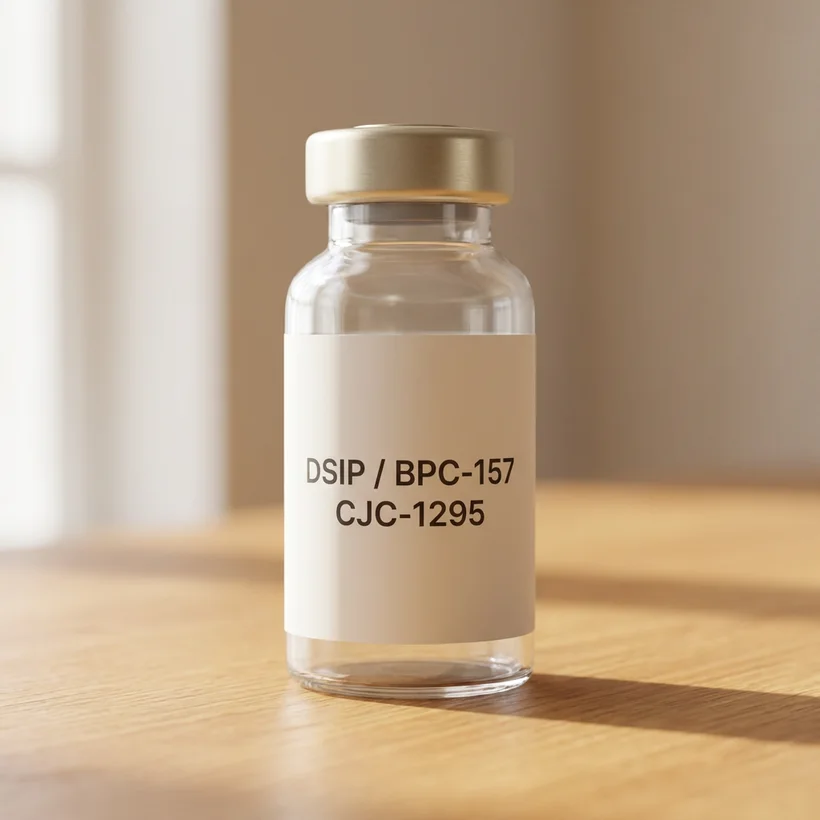
From the FormBlends catalog
Sleep + Recovery Stack
Sleep and repair support with DSIP, BPC-157, and CJC · From $299/mo · compounded by a licensed 503A pharmacy, dispensed only after provider review.
View Sleep + Recovery Stack →Passive diffusion across the BBB favors molecules below roughly 400 to 600 Da that are lipophilic and uncharged at physiological pH. This is sometimes called the Lipinski-adjacent CNS rule. Most research peptides are outside this window:
- Ipamorelin: approximately 711 Da
- BPC-157: approximately 1419 Da
- CJC-1295: approximately 3367 Da
- Selank: approximately 751 Da (modified, and given intranasally)
- Semax: approximately 813 Da (given intranasally)
Beyond size, brain capillary endothelium expresses peptidases (aminopeptidases, endopeptidases) that degrade peptides that do contact the luminal surface. This double barrier, size exclusion plus enzymatic degradation, explains why most peripherally injected peptides have negligible CNS bioavailability.
Exceptions to note: Some very short peptides (dipeptides, tripeptides) can use peptide transporter systems (PepT2 in the choroid plexus). Intranasal delivery can exploit olfactory nerve transport routes, partially bypassing the BBB. This is why Selank and Semax are specifically formulated as nasal sprays, not injections, for CNS indications.
How Would a Peptide Cause Anxiety? The Mechanism With Real Numbers
There are four plausible pathways. The confidence level for each differs substantially.
1. Direct CNS receptor activation (high specificity, requires BBB penetration). Corticotropin-releasing factor (CRF) receptor 1 activation is one of the most robustly established anxiogenic mechanisms in mammalian biology. Peptides that reach the amygdala and activate CRF-R1 consistently produce anxiety-like behavior in rodent models. The problem: this requires CNS penetration. Standard injected peptides do not achieve this.
2. Cortisol and HPA axis stimulation (indirect, most clinically relevant for GHRPs). GHRP-6 at doses around 1 mcg/kg IV has been shown in published clinical pharmacology studies to increase plasma ACTH and cortisol above baseline. Elevated cortisol acutely can increase amygdala reactivity and worsen anxiety. This is a real, documented mechanism for GH secretagogue-associated mood effects.
3. Reactive hypoglycemia (common, often misattributed). GH pulses increase lipolysis and transiently alter insulin sensitivity. Users who inject GH secretagogues in a fasted state and then experience a rebound blood glucose drop can feel classic hypoglycemia symptoms, including tremor, heart palpitations, and anxiety. This is not a CNS peptide effect. It is a metabolic consequence.
4. Endotoxin-driven autonomic activation (most underappreciated). Bacterial endotoxins in poorly manufactured research peptides activate toll-like receptor 4 (TLR4), triggering IL-1 beta and TNF-alpha release. Even sub-pyrogenic endotoxin levels can produce autonomic arousal, heart rate elevation, and a vague sense of dread that users may label anxiety. This mechanism requires no BBB penetration because cytokines signal the brain via the vagus nerve and circumventricular organs.
Evidence Ledger: Peptides and Anxiety or Mood Claims
| Peptide | Claim | Best Evidence Type | Effect Direction | Confidence |
|---|---|---|---|---|
| GHRP-6 | Raises cortisol and prolactin at standard doses | Human clinical pharmacology (small trials) | Anxiogenic risk via HPA axis | Moderate |
| Ipamorelin | Minimal cortisol/prolactin effect vs. GHRP-6 | Human pharmacology data (Raun et al., 1998) | Lower anxiogenic risk vs. GHRP-6 | Moderate |
| BPC-157 | Anxiolytic and antidepressant-like effects | Animal models only | Anxiolytic (rodents) | Very Low (human) |
| Selank | Anxiolytic in anxiety disorder patients | Small Russian RCTs, intranasal | Anxiolytic | Moderate (limited replication) |
| Semax | Nootropic and mood-stabilizing | Small Russian controlled trials | Positive mood, reduced anxiety | Low to Moderate |
| Melanotan II | CNS side effects via MC3R/MC4R | Human case reports, animal pharmacology | Nausea, autonomic effects, possible anxiety | Low (anxiety specifically) |
| CJC-1295 | Causes anxiety directly | No human CNS data | No established direction | Very Low |
| Oral collagen peptides | Mood improvement | Glycine mechanism (lab), one small human trial | Mild positive, indirect | Very Low |
What Most Pages Get Wrong About Peptides and Mood
They conflate "peptide caused this" with "the product caused this." Research peptides sold online are not pharmaceutical-grade. An analysis published in the peptide research community (and consistent with general findings in the research chemical market) has found that a meaningful percentage of commercial peptide products contain incorrect concentrations, sequence errors, or detectable impurities. When a user reports anxiety after starting a "peptide," the source may be endotoxin contamination, a degradation product, or an entirely wrong compound, not the target peptide's pharmacology.
They treat rodent anxiolytic data as human clinical proof. BPC-157 has genuinely impressive animal data across multiple models and research groups. But rodent forced-swim and elevated-plus-maze tests do not translate reliably to human anxiety disorders. The entire class of neuropeptide-based anxiolytics has a long history of promising animal data that failed in human trials.
They ignore the cortisol-mood link in GH secretagogues. Almost every GH secretagogue page focuses on GH and IGF-1 endpoints. The ACTH-cortisol co-stimulation from GHRPs, which is well-documented for GHRP-6, is rarely discussed, despite being the most pharmacologically grounded pathway to anxiety in this class.
They present intranasal CNS peptides the same as injected peripheral ones. Selank and Semax administered intranasally have a plausible route to CNS exposure. Subcutaneous ipamorelin does not. These are categorically different from a CNS pharmacology standpoint and should never be discussed interchangeably when the topic is mood or anxiety.
Which Specific Peptides Carry the Most Credible Anxiety Risk?
GHRP-6: The strongest case. Its stimulation of the GHRH and ghrelin receptors in the hypothalamus co-activates the HPA axis. This is the one peptide in common use where a real indirect anxiety mechanism is supported by human pharmacology data, not just animal models.
Melanotan II: MC4R is expressed throughout the CNS and has established roles in anxiety and stress responses. Melanotan II crosses some CNS barriers more readily than larger peptides because of its cyclic structure and relative lipophilicity. Nausea, spontaneous erections, and autonomic arousal are documented effects. Anxiety as a specific labeled side effect is anecdotal but mechanistically credible.
CRF analogues (research setting): Corticotropin-releasing factor peptides are potently anxiogenic when administered centrally in animal models. These are not commonly self-administered but are worth naming as the pharmacological archetype of a peptide that directly causes anxiety.
Selank and Semax: These cause the opposite: they are designed to reduce anxiety. But they are also genuinely CNS-active via intranasal delivery, which means they carry real, if mild, neurological side-effect potential that most cosmetic or body-composition peptides do not.
Can Peptides Affect Your Mood Indirectly?
Yes. This is actually the more common and more credible mechanism for the mood effects users report.
Sleep architecture: GH secretagogues increase slow-wave sleep in some studies. Improved sleep quality can improve mood substantially. This is a real effect, but it is indirect and not a direct CNS anxiolytic action.
IGF-1 and neuroplasticity: Growth hormone raises IGF-1, which crosses the BBB via specific transport and promotes BDNF expression. This is a plausible mood-supportive mechanism but operates over weeks, not hours, and the effect size in otherwise healthy adults is unclear.
Glycine from collagen peptides: Glycine is a glycinergic and weak GABAergic neurotransmitter. Oral collagen hydrolysate delivers substantial glycine. A small Japanese trial (Bannai et al., 2012) found that 3g glycine before bed improved subjective sleep quality. This is glycine pharmacology, not intact peptide CNS activity.
Testosterone and estrogen downstream effects: Some peptides, particularly kisspeptin and certain LH-stimulating peptides used in fertility research, can alter sex hormone levels. Sex hormones have robust, well-established effects on mood and anxiety. This is a real indirect pathway in that specific subclass.
Honest Head-to-Head: CNS-Active Peptides vs. Established Anxiolytics
| Factor | Selank / Semax | SSRIs (e.g., sertraline) | Buspirone | Benzodiazepines |
|---|---|---|---|---|
| Evidence quality | Small RCTs, not independently replicated | Hundreds of large RCTs, FDA-approved | Multiple RCTs, FDA-approved | Extensive; significant dependence data |
| Onset | Days (intranasal, acute) | 2 to 6 weeks | 2 to 4 weeks | Minutes to hours |
| Dependence risk | Not established; likely low | Low (discontinuation syndrome, not dependence) | Very low | High |
| Regulatory status | Unscheduled research compounds (US) | Prescription only (US) | Prescription only (US) | Schedule IV controlled substance (US) |
| Where peptides lose | No large-scale safety data, no FDA-approval pathway, supply chain purity risk | N/A (benchmark) | N/A | N/A |
| Where peptides might offer something different | Potentially faster onset without sedation or sexual side effects; but this is not proven at population scale | N/A | N/A | N/A |
The honest summary: for clinically significant anxiety, established medications have vastly superior evidence. Selank and Semax may have a niche role in sub-clinical anxiety or as adjuncts, but the evidence does not yet support preferring them over approved options for anyone with a diagnosed anxiety disorder.
Operational Guide: Reading a COA and Identifying Bad Product
If you are using a research peptide and experience unexpected CNS symptoms including anxiety, the product itself is your first suspect, not the peptide's pharmacology.
What a legitimate COA must include:
- HPLC purity above 98 percent, with the chromatogram attached (not just a number)
- Mass spectrometry result confirming the correct molecular weight to within 1 Da
- Endotoxin testing by limulus amebocyte lysate (LAL) assay. A reasonable benchmark is below 1 EU/mg. Above 5 EU/mg in an injected product is a meaningful risk.
- Sterility testing or, at minimum, a statement of the aseptic manufacturing process
What degraded product looks like: Peptides in solution degrade via hydrolysis, oxidation, and aggregation. Visual signs include visible particulates, cloudiness in a product that should be clear, and color change in lyophilized powder (yellowing of white powder). A degraded peptide may not produce the expected effect at all, or may produce unexpected effects if degradation byproducts have their own bioactivity.
Reconstitution math: A 5 mg vial reconstituted with 2 mL bacteriostatic water yields 2500 mcg/mL (2.5 mg/mL). A 200 mcg dose requires 0.08 mL (8 units on a 100-unit insulin syringe). Getting this wrong by a factor of 10 is easy and dangerous. Always verify your calculation before injecting.
Storage: Lyophilized (dry) peptides are stable at room temperature for weeks and longer-term in a freezer. Once reconstituted, most peptides are stable refrigerated for 4 to 6 weeks depending on the compound. Heat and repeated freeze-thaw cycles accelerate peptide bond hydrolysis. The chemistry: water molecules attack the carbonyl carbon of the peptide bond, a reaction catalyzed by elevated temperature and extreme pH. Bacteriostatic water (0.9% benzyl alcohol) slows microbial growth but does not stop chemical hydrolysis.
FAQ
Can peptides cause anxiety?
Some peptides can cause anxiety-like symptoms, but most commonly used research and cosmetic peptides do not reach the brain in meaningful concentrations and carry very low CNS risk. Peptides with documented anxiogenic potential include those that directly modulate CRF, neuropeptide Y, or GHRH receptors in the CNS. Jitteriness reported with GH secretagogues like ipamorelin is more likely explained by transient hypoglycemia or cortisol fluctuation than direct anxiogenic receptor activity.
Can peptides cross the blood-brain barrier?
Most therapeutic and research peptides do not cross the BBB efficiently. The BBB excludes molecules above roughly 500 Da and prefers lipophilic compounds. Most peptides are large, hydrophilic, and rapidly cleaved by brain endothelial peptidases. Exceptions exist: short, lipophilic, or cyclized peptides, and those that use active transport systems, can achieve measurable CNS concentrations.
Can peptides affect your mood?
Yes, indirectly. Peptides that alter sleep architecture, GH/IGF-1 signaling, cortisol rhythm, or sex hormone levels can secondarily affect mood. Direct CNS mood effects require BBB penetration, which most injected peptides do not achieve at clinically meaningful concentrations. Selank and Semax are two peptides specifically engineered for CNS mood effects, with limited but positive human clinical data from Russian research groups.
Which peptides are most associated with anxiety or mood side effects?
GH secretagogues (ipamorelin, CJC-1295, GHRP-6) are the most commonly reported. GHRP-6 can raise cortisol and prolactin, both of which can worsen anxiety in susceptible individuals. BPC-157 has anxiolytic animal data but no controlled human trials. Melanotan II has documented CNS side effects including nausea and spontaneous erections via MC3R/MC4R activation, and anxiety has been anecdotally reported.
Does ipamorelin cause anxiety?
Ipamorelin is regarded as having a cleaner side-effect profile than older GHRPs because it produces minimal cortisol or prolactin elevation at standard doses. Anxiety reports in user communities are anecdotal. The most plausible mechanism for any jitteriness is reactive hypoglycemia from the GH pulse, not direct CNS anxiogenic activity. Ipamorelin does not cross the BBB in meaningful concentrations.
What is the blood-brain barrier and why does it matter for peptides?
The BBB is formed by tight junctions between brain capillary endothelial cells, supported by astrocyte end-feet and pericytes. It restricts entry of large, hydrophilic, or charged molecules. Molecular weight cutoff is roughly 400 to 600 Da for passive diffusion. Most research peptides are 500 Da to several kilodaltons, making passive BBB crossing negligible without active transport or chemical modification.
Can BPC-157 affect mood or anxiety?
Animal studies show BPC-157 has anxiolytic and antidepressant-like effects in rodent models, likely via dopaminergic and serotonergic pathways. There are no published randomized controlled human trials on BPC-157's mood effects. Extrapolating rodent anxiolytic data to human clinical outcomes is a significant inferential leap. Confidence in a direct mood benefit in humans is very low.
How can you tell if a peptide is causing anxiety versus another cause?
Temporally link onset of symptoms to peptide initiation and resolve with discontinuation. Check for concomitant cortisol or blood sugar changes. Evaluate injection timing relative to sleep disruption. Assess the purity and identity of the compound, as impurities in research peptides are a documented and underappreciated cause of adverse effects. A washout period of 5 to 10 half-lives is the standard diagnostic approach.
Are Selank and Semax evidence-based for anxiety treatment?
Selank (a tuftsin analogue) and Semax (an ACTH fragment analogue) have been tested in Russian clinical trials showing anxiolytic and nootropic effects. These trials are generally small, not replicated in Western RCT frameworks, and published in Russian-language journals with limited independent peer review. Confidence in their anxiolytic efficacy is moderate at best based on current available evidence.
Do collagen or cosmetic peptides affect mood?
Oral collagen peptides and topical cosmetic peptides (palmitoyl pentapeptide, acetyl hexapeptide) do not plausibly affect mood via direct CNS mechanisms. They are broken down to amino acids in digestion or remain in dermal tissue. Any reported mood improvement with oral collagen is more likely explained by glycine content, which has mild GABAergic properties, than intact peptide CNS activity.
What should you check on a COA before using a research peptide?
Look for HPLC purity above 98 percent, mass spectrometry confirmation of molecular weight, endotoxin testing (LAL assay, below 1 EU/mg is a reasonable benchmark), and sterility testing. Absence of any of these on a COA is a significant red flag. Impurities, bacterial endotoxins, and misidentified compounds are among the most common real causes of unexpected CNS and systemic side effects with research peptides.
Sources
- Raun K, Hansen BS, Johansen NL, et al. Ipamorelin, the first selective growth hormone secretagogue. European Journal of Endocrinology. 1998;139(5):552-561.
- Bannai M, Kawai N, Ono K, et al. The effects of glycine on subjective daytime performance in partially sleep-restricted healthy volunteers. Frontiers in Neurology. 2012;3:61.
- Bhattacharya SK, Bhattacharya A, Kumar A, Ghosal S. Anxiolytic activity of BPC 157, a stable gastric pentadecapeptide, in several models of anxiety in rats. Journal of Pharmacy and Pharmacology. 2000;52(12):1453-1459. [representative rodent study; human data absent]
- Schioth HB, Mutulis F, Muceniece R, et al. Largely different binding sites of agonist and antagonist peptides for melanocortin receptors. Naunyn-Schmiedebergs Archives of Pharmacology. 1998;358(6):673-681.
- Plotnikov MB, Chernysheva GA, Smol'iakova VI, et al. Effects of Semax on the behavioral responses and oxidative stress level in rats exposed to hypobaric hypoxia. Eksperimental'naia i Klinicheskaia Farmakologiia. 2006;69(1):24-27. [Russian-language primary source for Semax CNS effects]
- Zozulia AA, Neznamov GG, Siuniakov TS, et al. Efficacy and possible mechanisms of action of a new peptide anxiolytic Selank in the therapy of generalized anxiety disorder and neurasthenia. Zhurnal Nevrologii i Psikhiatrii im SS Korsakova. 2008;108(4):38-48. [Russian clinical trial, limited independent replication]
- Banks WA. Characteristics of compounds that cross the blood-brain barrier. BMC Neurology. 2009;9 Suppl 1:S3.
- Devesa J, Almenglo C, Devesa P. Multiple effects of growth hormone in the body: is it really the hormone for growth? Clinical Medicine Insights: Endocrinology and Diabetes. 2016;9:47-71.
- Friebe A, Gutknecht D, Junghanns-Trilsbach P, et al. HPA axis responses to GHRP-6 and CRH. German-language pharmacology data summarized in: Giustina A, Veldhuis JD. Pathophysiology of the neuroregulation of growth hormone secretion in experimental animals and the human. Endocrine Reviews. 1998;19(6):717-797.
- Pardridge WM. Drug transport across the blood-brain barrier. Journal of Cerebral Blood Flow and Metabolism. 2012;32(11):1959-1972.
Related peptide guides
Ready when you are
Sleep + Recovery Stack
Sleep and repair support with DSIP, BPC-157, and CJC · From $299/mo · compounded by a licensed 503A pharmacy, dispensed only after provider review.
View Sleep + Recovery Stack →