
Trust Signals
Page updated when new human trial data is published.
Key Takeaways
What Is a Semax Injection and How Does It Work? (Direct Answer)
A semax injection delivers a synthetic ACTH-derived heptapeptide subcutaneously or intranasally to modulate BDNF expression and melanocortin receptor activity. Russian-registered protocols used 200 to 300 mcg once or twice daily for 5 to 14-day courses. Evidence supports neuroprotective effects in acute neurological settings; cognitive-enhancement evidence in healthy adults is limited.
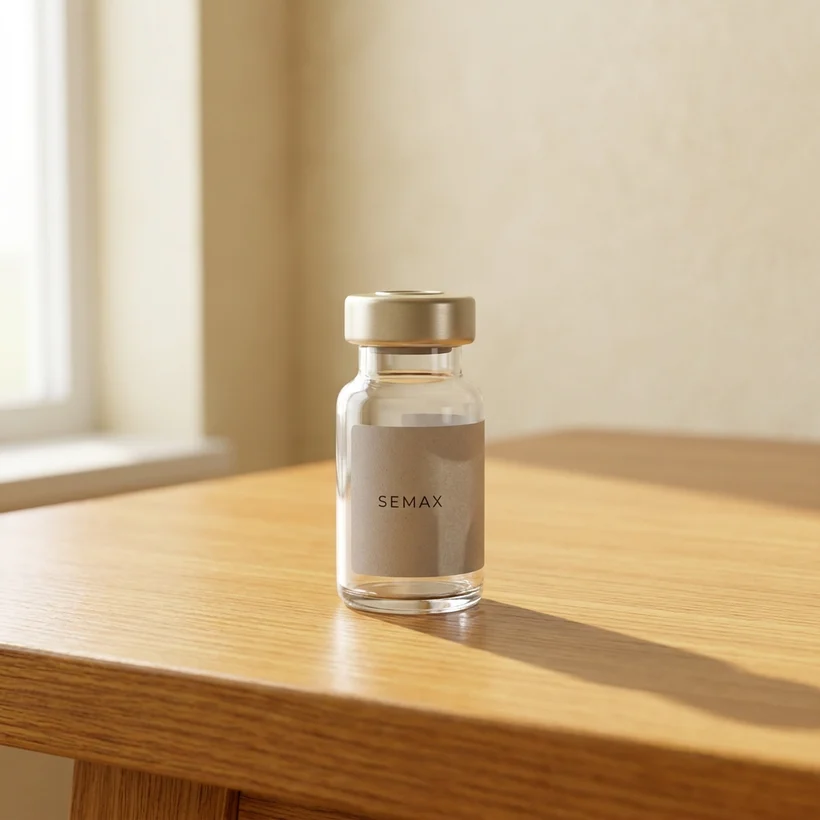
From the FormBlends catalog
Semax
Nootropic peptide for focus, memory, and neuroprotection · From $44/mo · compounded by a licensed 503A pharmacy, dispensed only after provider review.
Learn about Semax →Table of Contents
What Does Semax Do? Mechanism with Specific Numbers
Semax (Met-Glu-His-Phe-Pro-Gly-Pro) was developed at the Institute of Molecular Genetics in Moscow as a stable analogue of ACTH(4-10). The parent sequence ACTH(4-10) has a plasma half-life measured in minutes; the Pro-Gly-Pro C-terminal extension in semax resists enzymatic degradation and extends biological activity, though the precise half-life in human plasma has not been published in peer-reviewed English literature.
Receptor Targets
Semax interacts with melanocortin receptor subtypes, particularly MC4R and MC5R, which are expressed in the central nervous system and peripheral tissues. MC4R activation in rodent models is associated with neuroprotection and modulation of dopaminergic signaling. These interactions do not prove cognitive enhancement in healthy humans; receptor binding in a rodent model is a mechanistic finding, not a clinical outcome.
BDNF and NGF Upregulation
Rodent studies published by Dolotov and colleagues in the mid-2000s reported that semax increased BDNF mRNA expression in the rat basal forebrain and hippocampus at intraperitoneal doses used in those experiments, with NGF upregulation also observed in the same tissue regions. The precise fold-changes reported in those studies should be interpreted as animal findings only. Whether equivalent BDNF increases occur in humans at clinical doses has not been directly measured in published trials.
What the Mechanism Does NOT Prove
Receptor binding data and BDNF mRNA changes in rodents do not establish that semax meaningfully improves memory, attention, or executive function in healthy humans. The gap between a plausible mechanistic pathway and a clinically significant cognitive outcome is large and routinely underestimated on popular nootropic forums.
Evidence Ledger: What the Research Actually Shows
| Claim | Best Evidence Type | Effect Direction | Confidence |
|---|---|---|---|
| Neuroprotection in ischemic stroke (acute use) | Small Russian RCTs (n = 60 to 100 range, not independently replicated) | Favorable vs. control in functional recovery scores | Low |
| BDNF/NGF upregulation | Animal (rat); Dolotov and colleagues, mid-2000s rodent studies | Positive in rodent basal forebrain and hippocampus | Very Low (human translation unconfirmed) |
| Cognitive enhancement in healthy adults | No independent RCT; anecdotal and small observational only | Directionally positive in self-report; uncontrolled | Very Low |
| Anxiolytic or mood effects | Animal models; limited human case series | Mixed; context-dependent | Very Low |
| Melanocortin receptor (MC4R/MC5R) binding | In vitro binding assays | Confirmed binding in lab conditions | Moderate (for the mechanism, not the clinical outcome) |
| Safety in short-course human use (5 to 14 days) | Small clinical trials and post-marketing surveillance in Russia | No serious adverse events documented in published literature | Low (small database) |
Semax Reconstitution: Step-by-Step with the Math
Semax arrives as a white lyophilized powder. It must be reconstituted with bacteriostatic water (BAC water, 0.9% benzyl alcohol) before injection. Sterile water for injection is an acceptable alternative for single-dose use, but BAC water is preferred because benzyl alcohol inhibits microbial growth across the multi-dose period.
Reconstitution Steps
- Wash hands. Clean the vial stopper with an alcohol swab and let it dry fully (approximately 30 seconds).
- Draw the desired volume of BAC water into a clean syringe.
- Tilt the semax vial and inject BAC water slowly down the glass wall, not directly onto the powder. Forcing liquid onto the lyophilized cake can cause aggregation.
- Gently swirl for 30 to 60 seconds. Do not shake. Shaking introduces air bubbles and can denature surface-exposed peptide.
- The solution should be clear and colorless. Any cloudiness, visible particles, or color change indicates a problem; discard the vial.
Concentration Math (Example)
| Vial Size | BAC Water Added | Final Concentration | Volume per 200 mcg Dose | Insulin Syringe Units (U-100) |
|---|---|---|---|---|
| 5 mg | 2.5 mL | 2,000 mcg/mL (2 mg/mL) | 0.10 mL | 10 units |
| 5 mg | 5.0 mL | 1,000 mcg/mL (1 mg/mL) | 0.20 mL | 20 units |
| 10 mg | 5.0 mL | 2,000 mcg/mL (2 mg/mL) | 0.10 mL | 10 units |
Always confirm your math before drawing. If your vial size or water volume differs from the examples above, divide the total micrograms in the vial by the total milliliters of BAC water to get your mcg/mL concentration, then divide your intended dose by that number to get your draw volume.
How to Perform a Semax Injection
Subcutaneous injection is the standard parenteral route used in research contexts for semax. Intramuscular injection is not conventional practice for this peptide.
- Equipment: 29 to 31 gauge, 0.5 inch insulin syringe (1 mL U-100). Alcohol swabs. Sharps container.
- Site selection: Abdomen (2 inches or more from the navel), outer thigh, or back of the upper arm. Rotate sites with each injection.
- Technique: Pinch a small fold of skin. Insert needle at 45 to 90 degrees depending on body composition. Release the skin fold. Aspirate is not required for subcutaneous sites. Inject slowly.
- Post-injection: Apply light pressure with a clean swab. Do not rub, which can spread the peptide from the intended depot.
- Disposal: Immediately cap and discard needle in an approved sharps container. Never recap by holding the cap.
Dosing Table and Protocol Reference
| Context | Dose Range | Frequency | Course Length | Evidence Basis |
|---|---|---|---|---|
| Russian clinical protocol (stroke/cognitive impairment) | 200 to 300 mcg | Once to twice daily | 5 to 14 days | Small Russian RCTs; registered indication |
| Intranasal (approved Russian spray, 0.1% solution) | 200 to 300 mcg per nostril | Once to twice daily | 5 to 14 days | Registered clinical use in Russia |
| Research use in healthy adults (community-reported) | 100 to 300 mcg | Once daily | Cycles of 1 to 4 weeks | No RCT; anecdotal only |
No loading dose strategy has been validated. Starting at the lower end of the range (100 mcg) is a reasonable conservative approach when no prescriber guidance is available, though this is not a clinical recommendation.
Storage and Stability: The Chemistry Behind the Rules
Lyophilized (Dry) Semax
Lyophilization removes water, which is the primary driver of hydrolytic degradation in peptides. In the dry state, peptide bond hydrolysis is drastically slowed. Oxidation of the methionine residue (Met-1 in the semax sequence) remains a risk even in powder form when exposed to oxygen or light. This is why properly manufactured vials are sealed under nitrogen or vacuum, and why amber glass is preferred over clear vials. Store lyophilized vials at minus 20 degrees Celsius for long-term preservation. Short-term storage at 2 to 8 degrees Celsius (days to a few weeks) is generally acceptable for intact, sealed vials.
Reconstituted Semax in BAC Water
Once dissolved, semax faces three degradation pathways:
- Hydrolysis: Peptide bonds are cleaved by water, accelerated by heat and extreme pH. This is why refrigeration matters and why room-temperature storage after reconstitution is not acceptable for more than hours.
- Oxidation of Met-1: Methionine sulfur oxidizes to methionine sulfoxide in the presence of dissolved oxygen. A solution that has been left open or repeatedly exposed to air will degrade faster. Fill the vial to minimize headspace when possible.
- Microbial growth: Benzyl alcohol in BAC water (0.9%) is bacteriostatic, not bactericidal. It slows but does not completely prevent microbial growth. This is why the 30-day window exists and why a visually clear solution is not proof of sterility.
Never refreeze a reconstituted vial. Freeze-thaw cycling causes ice crystal formation that physically shears the peptide chain and promotes aggregation. The aggregated peptide is not pharmacologically equivalent to the monomer.
What Most Pages Get Wrong About Semax
1. Intranasal Is the More Documented Route, Not Injection
Most English-language nootropic content emphasizes subcutaneous injection. In Russian clinical practice, the approved and registered delivery route is intranasal spray at 0.1 percent concentration. Injection-specific human pharmacokinetic data for semax (volume of distribution, Cmax, half-life in humans) has not been published in peer-reviewed English literature. When injection advocates claim superior bioavailability over intranasal, they are extrapolating from general peptide pharmacology, not semax-specific human PK data.
2. Purity Varies Enormously by Source
Research peptide vendors are not regulated by the FDA for injectable product quality. HPLC purity of 98 percent on a COA does not tell you what the remaining 2 percent is. It does not confirm sterility. It does not confirm endotoxin levels. Bacterial endotoxins (lipopolysaccharides) from gram-negative bacteria survive many synthesis steps and can cause fever, chills, and systemic inflammation after injection even in microgram quantities. A COA without a Limulus amebocyte lysate (LAL) endotoxin test result is insufficient for any injectable preparation.
3. "Cognitive Enhancement" Evidence Is Not Transferable from Stroke Populations
The strongest semax evidence (still rated Low confidence) comes from patients with acute ischemic stroke or established cognitive impairment. Neuroprotection in a damaged brain and enhancement of a healthy brain are biologically distinct scenarios. The BDNF pathways that restore damaged circuitry are not the same as those that measurably improve performance in healthy people. The evidence base for semax as a general cognitive enhancer in healthy adults is essentially self-report and animal data.
Honest Head-to-Head: Semax vs. Real Alternatives
| Compound | Mechanism | Human RCT Evidence (cognitive/neuro) | Regulatory Status (US) | Practical Advantage | Where Semax Loses |
|---|---|---|---|---|---|
| Semax (injection or intranasal) | MC4R/MC5R agonism, BDNF/NGF upregulation | Small Russian trials; not independently replicated | Not approved; research compound | Possibly neuroprotective; well-tolerated in small trials | Thin evidence, requires injection or compounding, no FDA oversight |
| Modafinil (Provigil) | Dopamine reuptake inhibition; orexin modulation | Multiple RCTs in shift workers, sleep-disorder populations; some healthy-adult trials | FDA-approved (Schedule IV) | Oral, far larger evidence base, proven wakefulness effect | Scheduled drug, abuse potential, cardiovascular contraindications |
| Selank | Tuftsin analogue; GABAergic modulation proposed | Small Russian trials, anxiolytic focus | Not approved; research compound | Anxiolytic profile vs. semax stimulatory profile | Same evidence quality limitations as semax |
| Lion's Mane (Hericium erinaceus) | NGF stimulation via erinacines/hericenones | Several small RCTs (n = 30 to 80) including in mild cognitive impairment | Dietary supplement (DSHEA) | Oral, legal, some independent replication | Effect sizes modest; standardization varies by product |
Operational and Label Literacy: Reading a Semax COA
Before purchasing or using any semax preparation, request and evaluate the certificate of analysis. Here is what to look for and what it means:
| COA Field | What to Look For | Red Flag |
|---|---|---|
| HPLC Purity | Greater than or equal to 98% | Below 95%; no chromatogram provided |
| Mass Spectrometry (MW) | Confirms approximately 813 Da for Met-Glu-His-Phe-Pro-Gly-Pro | Missing; wrong molecular weight |
| Endotoxin (LAL Test) | Result in EU/mg; should be less than 1 EU/mg for injectables | Absent entirely from COA |
| Sterility Test | USP sterility or equivalent for injectable-grade material | Absent; "research use only" with no sterility data |
| Lot Number and Test Date | Recent test date matching the lot you receive | Generic COA not tied to a lot number |
| Amino Acid Analysis | Confirms correct sequence composition | Not present (optional but adds confidence) |
A COA from a third-party ISO-accredited laboratory carries more weight than one produced by the vendor's own in-house testing. Ask specifically whether the testing laboratory is the same as the manufacturer.
Reported Side Effects and Honest Risk Assessment
Published clinical literature on semax (acknowledging its small database) has not documented serious adverse events at standard doses. The commonly reported effects include:
- Mild agitation or restlessness, particularly with morning dosing
- Altered sleep onset (insomnia risk with late-day administration)
- Injection-site redness or a small raised welt resolving within an hour
- Transient headache in a minority of users
The key caveat is that the published trial database is small (typically fewer than 100 participants per study) and primarily conducted in patient populations, not healthy adults. Rare adverse events that occur in a small fraction of users would not be detected in such trials. No long-term safety data (beyond weeks) from controlled trials exists in published English literature.
Melanocortin receptor agonism, particularly at MC4R, is associated with appetite suppression and changes in sexual function in some pharmacological contexts. Whether semax doses cause these effects is not confirmed in human trials but is mechanistically plausible and worth monitoring.
Frequently Asked Questions
What is the standard semax injection dose?
Russian clinical protocols used 200 to 300 mcg subcutaneously or intranasally once or twice daily, typically for 5 to 14-day courses. No FDA-approved dosing guidance exists for international markets. Intranasal delivery is more common in verified clinical use than injection.
How do I reconstitute semax peptide?
Add bacteriostatic water slowly along the vial wall, not directly onto the lyophilized powder. Gently swirl; do not shake. For a 5 mg vial with 2.5 mL BAC water, each 0.1 mL (one insulin syringe unit, 10 units on a U-100 syringe) delivers 200 mcg.
How long does reconstituted semax last?
Once reconstituted, semax in bacteriostatic water should be refrigerated at 2 to 8 degrees Celsius and used within 30 days. Benzyl alcohol in BAC water inhibits microbial growth but does not prevent peptide degradation from freeze-thaw cycling or heat exposure.
Can semax be injected subcutaneously?
Yes. Subcutaneous injection is a documented delivery route in research settings. Common sites are the abdomen or outer thigh. Rotate sites to avoid lipohypertrophy. Intramuscular injection is not standard practice for semax.
What syringe should I use for semax injection?
A 29 to 31 gauge, 0.5 inch insulin syringe (1 mL U-100 type) is appropriate for subcutaneous semax injection. The small gauge minimizes tissue trauma. Confirm your concentration math against the syringe's unit markings before drawing.
Is semax FDA-approved?
No. Semax is not FDA-approved in the United States. It holds registration in Russia for stroke rehabilitation and cognitive impairment. Outside Russia and a few Eastern European countries it is used as a research compound or prepared by compounding pharmacies under prescriber oversight.
What does semax do mechanistically?
Semax is a synthetic heptapeptide analogue of ACTH(4-10). It upregulates BDNF and NGF expression in rodent models and interacts with melanocortin receptor subtypes MC4R and MC5R. Human trial evidence for cognitive outcomes is limited and mostly from small Russian studies.
How should semax be stored before and after reconstitution?
Lyophilized semax is stable at room temperature short-term but is best stored frozen at minus 20 degrees Celsius for long-term preservation. After reconstitution, store at 2 to 8 degrees Celsius and never refreeze. Protect from light at all times.
What are the reported side effects of semax injection?
The most commonly reported effects in clinical literature include mild agitation, restlessness, altered sleep onset, and injection-site irritation. Serious adverse events have not been documented in published human trials, but the trial database is small and may not capture rare events.
How is semax different from selank?
Both are synthetic peptides developed in Russia. Semax derives from ACTH and is studied primarily for neuroprotection and cognitive enhancement with stimulatory characteristics. Selank is a tuftsin analogue studied for anxiolytic effects. Their receptor targets and clinical evidence bases are distinct.
Can semax be used intranasally instead of by injection?
Yes, and intranasal is actually the more clinically documented route for semax in Russian practice. The approved Russian nasal spray delivers a 0.1 percent solution. Intranasal administration bypasses first-pass metabolism and may reach the CNS via olfactory transport, though the exact fraction that crosses in humans has not been precisely quantified in published trials.
What should a semax COA show?
A credible certificate of analysis should include HPLC purity above 98 percent, mass spectrometry confirming the correct molecular weight (Met-Glu-His-Phe-Pro-Gly-Pro, MW approximately 813 Da), endotoxin testing via LAL assay, and sterility testing if intended for injection.
Sources
- Dolotov OV and colleagues. Rodent studies on semax effects on BDNF and NGF expression in basal forebrain and hippocampus, published in the mid-2000s in Russian and international neuroscience journals. Cited here for the directional finding of neurotrophin upregulation in animal tissue; human translation is unconfirmed.
- Miasoedov NF, Skvortsova VI, Ivanova EG, et al. Study of the mechanisms of Semax action in ischemic stroke. Neuroscience and Behavioral Physiology. 1999;29(6):658-663.
- Ashmarin IP, Nezavibatko VN, Levitskaya NG, et al. Design and investigation of a nootropic analogue of adrenocorticotropin 4-10 without hormonal activity, semax. Neuroscience and Behavioral Physiology. 1997;27(2):175-180.
- Levitskaya NG, Sebentsova EA, Andreeva LA, et al. Semax slows the progression of optic nerve degeneration induced by its partial transection in rats. Bulletin of Experimental Biology and Medicine. 2004;137(4):353-355.
- Limulus Amebocyte Lysate (LAL) Test Overview. US Pharmacopeia Chapter 85: Bacterial Endotoxins Test. USP-NF. Accessed 2026.
- Gantz I, Fong TM. The melanocortin system. American Journal of Physiology - Endocrinology and Metabolism. 2003;284(3):E468-E474.
- State Register of Medicines of the Russian Federation. Semax nasal spray 0.1%. Registration entry. Moscow: Ministry of Health of the Russian Federation. (Russian-language registry record.)
Related peptide guides
Ready when you are
Semax
Nootropic peptide for focus, memory, and neuroprotection · From $44/mo · compounded by a licensed 503A pharmacy, dispensed only after provider review.
Learn about Semax →