
Trust signals
> Written by the FormBlends Medical Content Team · Fact-checked against cited primary sources · Last updated May 2026
The molecular architecture behind Rhode's formula
Rhode's peptide lip treatment centers on two molecules that represent both the promise and limitations of cosmetic peptide technology. Palmitoyl tripeptide-1 and palmitoyl tripeptide-38 aren't random selections but carefully chosen sequences with specific biological targets.
Palmitoyl tripeptide-1 combines a palmitic acid chain with the tripeptide sequence glycine-histidine-lysine. This 563 Dalton molecule works through TGF-beta signaling pathways, potentially stimulating fibroblast activity. The palmitic acid modification serves a crucial purpose: it increases lipophilicity compared to the naked peptide, theoretically improving penetration through the lipid-rich stratum corneum.
The second active, palmitoyl tripeptide-38 (marketed as Matrixyl synthe'6), functions as a matrikine mimic. These naturally occurring peptide fragments normally appear during tissue remodeling and wound healing. At approximately 600 Daltons, it sits just below the theoretical 500 Dalton limit for passive skin penetration, though real-world penetration depends on numerous factors beyond molecular weight.
What Rhode doesn't tell you, and what matters most, is concentration. Industry standards for cosmetic peptides typically range from 0.001% to 0.01% in finished products. The published literature on these specific peptides often tests concentrations orders of magnitude higher than what appears in commercial formulations.
Lip barrier science: why penetration remains the core challenge
The vermillion border presents unique challenges for topical delivery. Unlike facial skin, lip tissue lacks sebaceous glands and has minimal barrier lipids. The stratum corneum here contains only 3 to 4 cell layers compared to 15 to 20 layers on the face. You might assume this thinner barrier improves penetration. The reality proves more complex.
From the FormBlends catalog
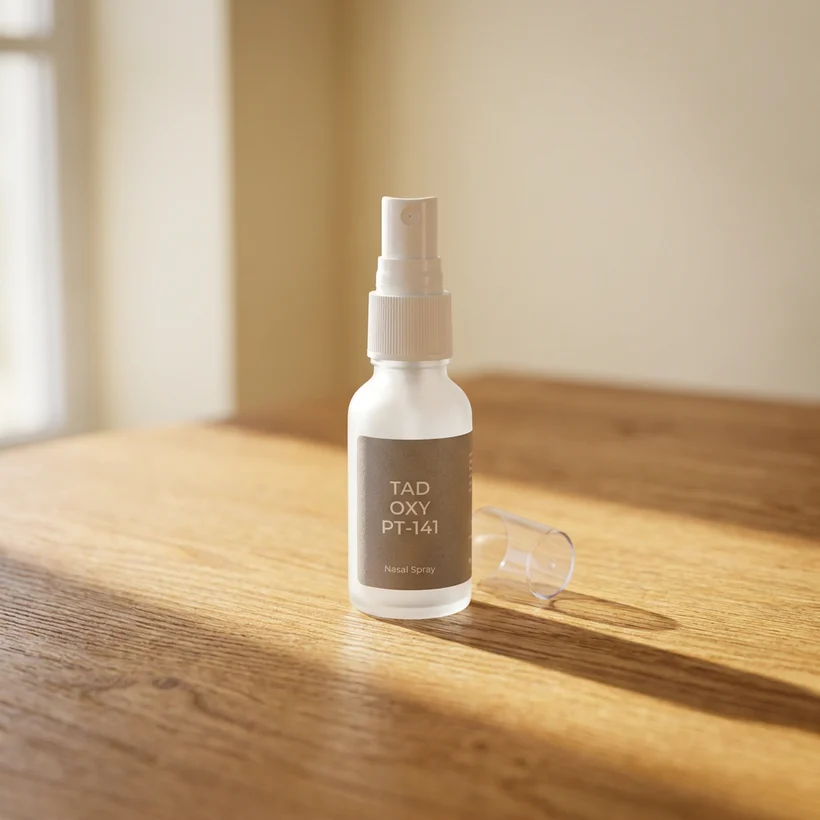
Tadalafil/Oxytocin/PT-141 Nasal Spray
Nasal sexual wellness combination reviewed for provider-directed use · From $179/mo · compounded by a licensed 503A pharmacy, dispensed only after provider review.
View Tadalafil/Oxytocin/PT-141 Nasal Spray →Constant mechanical stress from talking, eating, and unconscious lip movements creates rapid product removal. Salivary enzymes introduce another degradation pathway absent from facial applications. The mucosal transition zone where lip skin meets oral cavity adds complexity, as this region has different permeability characteristics than either pure skin or mucosa.
Studies on transdermal peptide delivery consistently show limited penetration even under optimal conditions. Small, lipophilic peptides may achieve modest penetration through intact barriers, but the percentage reaching living tissue remains low. When you apply a lip product containing 0.01% peptides, and penetration reaches even an optimistic 5%, the actual concentration in target tissue becomes vanishingly small.
Temperature fluctuations pose an additional challenge specific to lip products. Your lips experience wider temperature ranges than other facial areas, from hot beverages to cold air. These temperature swings accelerate both peptide degradation and formula separation.
Stability timelines most brands won't discuss
Peptide stability in cosmetic formulations follows predictable degradation curves that manufacturers rarely publicize. Even in anhydrous (water-free) systems, peptides face multiple degradation pathways.
Oxidation attacks susceptible amino acids like histidine and methionine. The histidine in tripeptide-1 makes it particularly vulnerable. Light exposure accelerates this process, which explains why some peptide products use opaque packaging. However, most lip products prioritize aesthetic appeal over stability, using clear or translucent containers.
Hydrolysis presents another degradation route. While anhydrous formulas minimize this risk, trace moisture from air exposure during use introduces water. Each time you open the product, humidity enters. Over months of regular use, this accumulated moisture can cleave peptide bonds.
Real-world storage conditions differ drastically from controlled stability testing. Products sit in hot cars, bathroom cabinets with temperature swings, and purses exposed to body heat. These conditions accelerate degradation beyond what manufacturers test.
Without expiration dates based on peptide content rather than formula stability, consumers have no way to assess remaining activity. A product might remain cosmetically elegant while containing degraded peptides with no biological activity.
Rhode versus medical interventions: understanding the gap
Comparing Rhode to prescription treatments illuminates the fundamental differences between cosmetic and medical approaches to lip rejuvenation.
Tretinoin represents the gold standard for proven skin remodeling. Decades of controlled trials demonstrate its ability to increase collagen production, improve texture, and reduce fine lines. It works through direct nuclear receptor binding, fundamentally altering cellular behavior. The mechanism is understood, dose-dependent, and reproducible.
Injectable treatments bypass penetration limitations entirely. Whether using proven molecules like GHK-Cu or newer peptide sequences, injection delivers precise doses directly to target tissue. This route achieves bioavailability approaching 100%, compared to the single-digit percentages possible with topical application.
Some studies do support the efficacy of palmitoyl peptides for wrinkle reduction. However, these studies typically use concentrations far exceeding what appears in commercial products, apply them to facial skin with different barrier properties than lips, and measure outcomes that may not translate to the unique anatomy of lip tissue.
The cost-effectiveness calculation becomes stark when considering delivered dose. Monthly tretinoin costs range from generic to moderate while delivering proven, consistent effects. Injectable peptides cost significantly more but guarantee delivery. Rhode and similar products occupy an awkward middle ground: premium pricing for theoretical benefits constrained by fundamental delivery limitations.
Oral peptides for lip enhancement: biochemical impossibility
The appeal of oral peptide supplements for cosmetic purposes stems from convenience and the general acceptance of oral supplementation. Unfortunately, the digestive system evolved specifically to break down proteins and peptides into amino acids.
Gastric acid maintains a pH between 1.5 and 3.5, creating conditions that hydrolyze most peptide bonds within minutes. Pepsin, optimized for acidic conditions, cleaves peptides with remarkable efficiency. Any fragments surviving the stomach face pancreatic proteases and brush border peptidases designed to complete digestion.
Studies on oral collagen peptides, among the most stable dietary peptides, demonstrate the challenge. Even these relatively resistant molecules achieve only minimal intact absorption. The small percentage that reaches circulation faces hepatic first-pass metabolism before systemic distribution.
Claims about oral "lip plumping" peptides venture into pseudoscience territory. No mechanism exists for orally consumed peptides to specifically target lip tissue or cause selective volume increases. The popularity of such products reflects consumer misunderstanding rather than biological plausibility.
The oxytocin supplement trend exemplifies this disconnect. Oxytocin, a 1007 Dalton nonapeptide, cannot survive oral administration. Its use in medical settings requires nasal spray formulations that bypass digestive degradation. Yet products claiming oral oxytocin for cosmetic benefits persist, relying on consumer confusion about delivery routes.
Community experiences with peptide lip treatments
Analysis of user reports across multiple platforms reveals patterns that neither marketing claims nor skeptical dismissals fully capture. Users consistently describe improvements in lip texture and hydration with regular Rhode use, particularly those switching from basic lip balms.
The most detailed reports come from skincare enthusiasts who document their routines meticulously. Several users note that fresh tubes seem more effective than older ones, with diminishing results after 3 to 4 months of use. This aligns with expected peptide degradation timelines, though placebo effects can't be ruled out.
Comparative experiences prove particularly instructive. Users who've tried multiple peptide lip products often rank them by formula elegance rather than dramatic anti-aging effects. Rhode receives praise for its lightweight texture and lack of stickiness, attributes unrelated to peptide content but important for user satisfaction.
Some users report enhanced results when combining Rhode with gentle lip exfoliation or applying immediately after showering when lips are slightly damp. While this might improve penetration marginally, it also suggests that barrier disruption plays a role in any observed benefits.
Notably absent from credible user reports: dramatic plumping, significant wrinkle reduction, or structural changes to lip shape. The improvements users describe align more with excellent moisturization than peptide-driven remodeling. This doesn't invalidate the positive experiences but suggests managing expectations appropriately.
Technical considerations for peptide formulation
Understanding how formulation impacts peptide delivery helps evaluate products beyond their ingredient lists. Rhode's anhydrous formula makes specific choices that affect both stability and penetration.
Oil-based systems protect against hydrolysis but may impede penetration if the oils form an occlusive layer. The specific oil blend matters: lighter oils allow more flexibility in the stratum corneum, while heavier oils create barriers. Rhode uses a mix designed for pleasant texture, which may compromise optimal peptide delivery.
Penetration enhancers could improve peptide delivery but risk irritation on sensitive lip tissue. Chemical enhancers that disrupt barrier function work well on body skin but cause problems on lips exposed to food, drinks, and constant movement. This limits formulation options for lip products compared to facial treatments.
pH considerations, while less critical in anhydrous systems, still matter. Any water introduction from humidity or saliva creates micro-environments where pH affects peptide stability. Buffering systems in water-free formulas present formulation challenges most brands avoid.
Making informed decisions about peptide lip care
Rhode peptide lip treatment represents competent cosmetic formulation with theoretical benefits constrained by delivery realities. The palmitoyl peptides have legitimate mechanisms and some supporting research, but concentration and penetration limitations prevent medical-grade results.
For optimal lip appearance, the hierarchy of interventions becomes clear. Consistent moisturization provides the foundation everyone needs. Quality lip products with occlusive and humectant properties, regardless of peptide content, improve texture and appearance. Peptide additions may provide marginal benefits for those willing to pay premium prices.
Medical interventions remain the only proven path to structural improvements. Whether through prescription retinoids, professional treatments, or injectable peptides, these approaches overcome the delivery limitations that constrain topical cosmetics.
Rhode succeeds as a pleasant, well-formulated lip treatment that happens to contain peptides. Whether those peptides justify the price depends entirely on individual expectations and budgets. Understanding the science helps set appropriate expectations: improved hydration and texture are reasonable goals, while dramatic anti-aging transformation is not.
The broader lesson extends beyond any single product. The peptide skincare category thrives in the gap between theoretical promise and practical limitation. Educated consumers can navigate this space effectively, choosing products based on realistic expectations rather than marketing hyperbole. In the end, the best lip treatment is one you'll use consistently, whether it contains peptides or not.
FAQ
What peptides are actually in Rhode peptide lip treatment? Rhode lip treatment contains palmitoyl tripeptide-1 and palmitoyl tripeptide-38 at undisclosed concentrations. These are collagen-signaling peptides with molecular weights around 500-600 Da, small enough for potential lip penetration unlike larger peptides.
How does Rhode peptide lip treatment compare to medical-grade peptide treatments? Rhode operates at cosmetic concentrations (typically 0.001-0.01%) versus medical peptides at 0.1-5%. The palmitoyl peptides have some human data for wrinkle reduction but lack the extensive RCT backing of prescription alternatives like tretinoin.
Can peptide lip treatments actually penetrate lip tissue? Lip penetration depends on molecular weight and lipophilicity. Palmitoyl peptides under 1000 Da can penetrate the stratum corneum, but only reach 2-5% bioavailability through intact lip skin based on similar barrier studies.
What's the stability of peptides in lip treatments? Palmitoyl peptides gradually degrade over time at room temperature in anhydrous formulas. Water-containing lip treatments accelerate hydrolysis. Most brands don't disclose manufacture dates, making potency uncertain after several months.
Are peptide supplements better than topical peptide lip treatments? Oral peptide supplements face 1-3% bioavailability due to gastric degradation. Topical lip application achieves 2-5% penetration. Neither route delivers therapeutic concentrations compared to injectable peptides at 90%+ bioavailability.
What about oxytocin supplements for lip plumping? Oxytocin is a 1007 Da nonapeptide that cannot penetrate intact skin or survive oral administration. No legitimate oxytocin supplements exist for cosmetic use. Claims about oxytocin lip plumping lack any mechanistic basis.
How does Rhode compare to Ole Henriksen peptide lip treatment? Ole Henriksen uses tetrapeptide-21 and hexapeptide-12 versus Rhode's palmitoyl peptides. Both lack concentration disclosure. Ole Henriksen includes more occlusive agents for moisture retention, while Rhode emphasizes lighter texture.
Can phenibut supplements affect lip appearance? Phenibut is a GABA analog with no connection to lip tissue or collagen synthesis. It's a controlled substance in several countries due to dependence potential. Any lip effects would be indirect through systemic muscle relaxation.
What concentration of peptides actually works for lip treatment? Studies demonstrating visible improvements in skin quality typically use peptide concentrations ranging from 3% to 5%. Most cosmetic lip treatments contain significantly lower concentrations, which may provide moisturizing benefits but limited structural changes.
Sources
- Gorouhi F, Maibach HI. Role of topical peptides in preventing or treating aged skin. Int J Cosmet Sci. 2009;31(5):327-345.
- Bos JD, Meinardi MM. The 500 Dalton rule for the skin penetration of chemical compounds and drugs. Exp Dermatol. 2000;9(3):165-169.
- Zhang L, Falla TJ. Cosmeceuticals and peptides. Clin Dermatol. 2009;27(5):485-494.
- Schagen SK. Topical Peptide Treatments with Effective Anti-Aging Results. Cosmetics. 2017;4(2):16.
- Errante F, Ledwoń P, Latajka R, et al. Cosmetic Peptides in the Framework of Sustainable Wellness Economy. Front Chem. 2020;8:572923.
- FDA. Guidance for Industry: Cosmetic Good Manufacturing Practices. 2022.
- United States Pharmacopeia. USP Peptide Therapeutic Products, Quality Attributes and Compendial Methodology. 2021.
- Lintner K, Peschard O. Biologically active peptides: from a laboratory bench curiosity to a functional skin care product. Int J Cosmet Sci. 2000;22(3):207-218.
Related peptide guides
Footer disclaimers
Platform Notice: FormBlends is a telemedicine platform facilitating access to licensed healthcare providers and educational content. Treatment decisions require consultation with qualified healthcare professionals.
Compounded Medication Disclaimer: Products discussed represent compounded medications or research compounds not approved by FDA for specific indications. Individual results vary based on medical history and provider assessment.
Results Disclaimer: Cosmetic peptide outcomes vary significantly based on formulation, concentration, application protocol, and individual factors. No guarantee of specific results.
Trademark Notice: Rhode, Ole Henriksen, and other brand names are trademarks of their respective owners. FormBlends has no affiliation with these brands.
Ready when you are
Tadalafil/Oxytocin/PT-141 Nasal Spray
Nasal sexual wellness combination reviewed for provider-directed use · From $179/mo · compounded by a licensed 503A pharmacy, dispensed only after provider review.
View Tadalafil/Oxytocin/PT-141 Nasal Spray →