Key Takeaway
Ligament and tendon injuries heal slowly. This TB-500 ligament tendon repair resource covers the important information you need to make informed decisions. These tissues receive limited blood flow compared to muscles, which means fewer repair cells and nutrients reach the damage site.
Ligament and tendon injuries heal slowly. This TB-500 ligament tendon repair resource covers the important information you need to make informed decisions. These tissues receive limited blood flow compared to muscles, which means fewer repair cells and nutrients reach the damage site. TB-500 for ligament and tendon repair has drawn attention precisely because it addresses this bottleneck.
Key Takeaways: - Discover why tendons and ligaments heal slowly - Common Soft Tissue Injuries and TB-500 Approaches - Protocol Considerations for Soft Tissue - Setting Realistic Timelines
By promoting new blood vessel formation and cell migration, TB-500 may help your body deliver more healing resources to stubborn soft tissue injuries. Here is what the evidence shows and how providers typically approach these protocols.
Why Tendons and Ligaments Heal Slowly
Knowing why soft tissue injuries are so frustrating helps explain where TB-500 fits in.
Tendons connect muscle to bone. Ligaments connect bone to bone. Both are made primarily of collagen fibers arranged in parallel bundles. This structure makes them strong but limits their blood supply.
Limited vascularity. Tendons and ligaments have far fewer blood vessels than muscle tissue. Blood delivers the oxygen, nutrients, and repair cells needed for healing. Less blood flow means slower healing.
High mechanical demand. Even during recovery, tendons and ligaments are under constant stress from daily movement. This repeated loading can disrupt healing before it completes.
Scar tissue formation. When tendons and ligaments heal, they often form disorganized scar tissue instead of the parallel collagen fibers found in healthy tissue. This scar tissue is weaker and more prone to re-injury.
Poor cellularity. These tissues have fewer cells per unit area compared to muscles or organs. Fewer cells means slower production of new tissue.
TB-500 targets several of these limitations directly. It promotes angiogenesis (new blood vessels), cell migration (more repair cells reaching the site), and tissue remodeling (better organization of new fibers). This makes it a logical candidate for soft tissue support.
"What makes tirzepatide particularly interesting is the dual GIP/GLP-1 mechanism. We're seeing that GIP receptor activation appears to amplify the metabolic effects in ways we didn't fully anticipate from the preclinical data.") Dr. Ania Jastreboff, MD, PhD, Yale School of Medicine, lead author of SURMOUNT-1[1]
Learn about for different types of soft tissue injuries.
Common Soft Tissue Injuries and TB-500 Approaches
Different injuries may benefit from different protocol emphases. Here is how providers typically approach common conditions.
View data table
| Category | Clinical Interest Score | Detail |
|---|---|---|
| BPC-157 | 88 | Tissue repair and gut healing |
| TB-500 | 82 | Injury recovery |
| Sermorelin | 78 | Growth hormone support |
| Ipamorelin | 75 | Anti-aging and recovery |
| GHK-Cu | 70 | Skin and tissue repair |
Free Download: Protocol Planner Plan your soft tissue recovery protocol with injury-specific timelines, rehab milestones, and TB-500 dosing schedules. Get yours free (we'll email it to you instantly. [Download Your Free Protocol Planner]
Rotator cuff injuries: The shoulder's rotator cuff is a group of four tendons that stabilize the joint. Partial tears and tendinitis are extremely common. TB-500's systemic delivery reaches the shoulder effectively without requiring local injection. Standard loading and maintenance protocol. Combine with physical therapy for rotator cuff-specific exercises.
Achilles tendinopathy: The Achilles tendon is the most common site of tendon degeneration in active adults. Its blood supply is particularly poor in the mid-portion. TB-500 may help by improving vascularization in this region. Eccentric loading exercises alongside TB-500 therapy is the standard rehabilitation approach.
ACL injuries: Anterior cruciate ligament tears often require surgical reconstruction. TB-500 may support the healing of the reconstructed graft during rehabilitation. Most providers start TB-500 1-2 weeks post-surgery with surgeon approval.
Tennis elbow (lateral epicondylitis): The extensor tendons at the outside of the elbow become damaged from repetitive use. TB-500 combined with activity modification and progressive strengthening may support recovery.
Plantar fasciitis: The plantar fascia is a thick band of tissue on the bottom of the foot. TB-500's tissue remodeling properties may help restore healthy tissue organization. Many providers combine TB-500 with BPC-157 for plantar fascia issues.
IT band syndrome: The iliotibial band connects the hip to the knee. Inflammation and tightness cause lateral knee pain. TB-500's anti-inflammatory and tissue support properties may complement stretching and foam rolling.
Your can evaluate your specific injury and design an appropriate protocol.
Protocol Considerations for Soft Tissue
Soft tissue injuries often require longer protocols than muscle injuries due to the slower healing rate of tendons and ligaments.
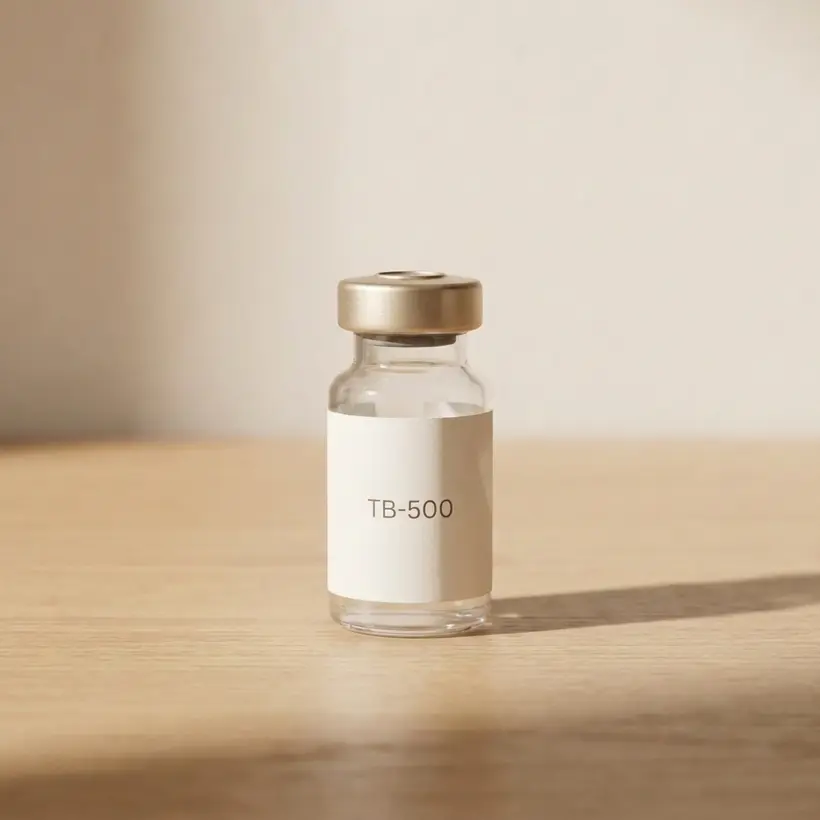
From the FormBlends catalog
TB-500 (Thymosin Beta-4)
Universal repair peptide for tissue regeneration · From $49/mo · compounded by a licensed 503A pharmacy, dispensed only after provider review.
Learn about TB-500 (Thymosin Beta-4) →Extended loading phase: - 2.5mg twice weekly for 6 weeks (instead of the standard 4 weeks) - Soft tissue heals slower, so longer loading may be beneficial - Monitor progress at week 4 to determine if extension is needed
Extended maintenance: - 2.5mg once weekly for 8-12 weeks - Some chronic tendinopathies benefit from 16-week total protocols - Gradual step-down to every-other-week injections as healing progresses
Combining with BPC-157: The is particularly popular for soft tissue injuries. BPC-157 can be injected near the injury site for localized healing while TB-500 provides systemic support. This dual approach targets soft tissue healing from two angles.
Rehabilitation is important: - TB-500 creates a more favorable healing environment - Mechanical loading through rehabilitation tells the body what type of tissue to build - Eccentric exercises are particularly important for tendon healing - Progressive loading prevents deconditioning while respecting healing timelines
Use the to prepare your TB-500 accurately.
Setting Realistic Timelines
Soft tissue healing takes time even with peptide support. Here is what to expect.
Mild tendinitis or strain (Grade 1): - Improvement noticeable within 2-4 weeks - Functional recovery in 4-8 weeks - Full tissue remodeling may take 3-6 months
Moderate tendon or ligament injury (Grade 2): - Initial improvement within 4-6 weeks - Functional recovery in 8-16 weeks - Full tissue remodeling may take 6-12 months
Severe or chronic injuries: - Initial improvement may take 6-8 weeks - Functional recovery is highly variable - Some chronic conditions require multiple TB-500 cycles with breaks between them
Signs of positive progress: - Reduced pain during daily activities - Improved range of motion - Ability to tolerate progressive loading in rehab - Reduced swelling or tenderness at the injury site - Better function during sport-specific movements
Track your progress in the and share data with your provider at regular check-ins.
Frequently Asked Questions
Can TB-500 heal a completely torn ligament without surgery?
Complete ligament tears (Grade 3) typically require surgical reconstruction, especially for critical ligaments like the ACL. TB-500 can't replace a severed ligament. But it may support healing of partial tears and may support surgical graft healing during post-operative rehabilitation.
Should I inject TB-500 near my injured tendon?
TB-500 works systemically and doesn't need to be injected near the injury. Standard subcutaneous abdominal injection is appropriate. Unlike BPC-157, which some providers inject locally, TB-500 distributes throughout the body regardless of injection site.
How long does it take for TB-500 to help tendinitis?
Most users report improvement in tendinitis symptoms within 3-6 weeks of starting a loading protocol. Chronic tendinopathy that has been present for months or years may take 8-12 weeks for meaningful improvement. Patience and compliance with the full protocol are important.
Can I exercise the injured area while on TB-500?
Controlled, progressive exercise is actually important for optimal soft tissue healing. Complete rest leads to tissue weakening. Work with a physical therapist to determine appropriate exercises for your specific injury. TB-500 supports healing but doesn't replace the mechanical stimulus of rehabilitation.
Let's Make This Happen
The research is clear. The options are available. The only question is whether it's right for you. A FormBlends provider can help you decide) no pressure, no commitment.
Medical References
- Jastreboff AM, Aronne LJ, Ahmad NN, et al. Tirzepatide Once Weekly for the Treatment of Obesity. N Engl J Med. 2022;387(3):205-216. [PubMed | ClinicalTrials.gov | DOI]
Sources &. References
- Bock-Marquette I, Saxena A, White MD, et al. Thymosin beta4 activates integrin-linked kinase and promotes cardiac cell migration, survival and cardiac repair. Nature. 2004;432(7016):466-472. Doi:10.1038/nature03000
- Malinda KM, Sidhu GS, Mani H, et al. Thymosin beta4 accelerates wound healing. J Invest Dermatol. 1999;113(3):364-368. Doi:10.1046/j.1523-1747.1999.00708.x
This article is for educational purposes only and doesn't constitute medical advice. Always consult with a licensed healthcare provider before starting, changing, or stopping any medication or supplement. FormBlends connects you with licensed providers who can evaluate your individual health needs.
Last updated: 2026-03-24
Ready when you are
TB-500 (Thymosin Beta-4)
Universal repair peptide for tissue regeneration · From $49/mo · compounded by a licensed 503A pharmacy, dispensed only after provider review.
Learn about TB-500 (Thymosin Beta-4) →