The short answer
Most crackers are refined flour, salt, and oil, with low fiber and protein, which makes them poor weight-loss snacks. A small subset (whole-grain or seed-based crackers with at least 3 g of fiber and 3 g of protein per serving) can fit a weight-loss plan when the portion stays at the listed serving size.
Table of contents
- The 30-second answer
- What's actually in a typical cracker
- The three numbers on the label that matter
- 12 popular crackers compared
- Why portion creep is the bigger problem than the food itself
- The cracker-and-protein pairing trick
- How crackers fit on a GLP-1 plan
- Better alternatives if your goal is satiety
- FAQ
- Footer disclaimers
What's actually in a typical cracker
The standard saltine recipe is wheat flour, vegetable oil (palm or soybean), salt, baking soda, and yeast. The wheat flour is almost always refined, which means the bran and germ have been stripped out during milling. What's left is the starchy endosperm, plus whatever vitamins were added back through enrichment.
Check your GLP-1 eligibility
Use our free BMI Calculator to see if you may qualify for provider-reviewed GLP-1 therapy.
Try the BMI Calculator →This is why crackers spike blood sugar quickly. Refined wheat flour has a glycemic index of 71. White bread runs around 75. Saltine crackers test at about 74. The number is high because the starch is exposed and easily accessible to digestive enzymes once the bran has been removed.
Two other ingredients drive the calorie problem. Vegetable oil contributes 100 to 130 calories per ounce of cracker, depending on the brand. Salt is the flavor driver and the reason it's hard to stop at 5 crackers. Salt-fat-starch combinations are formulated to override the body's natural satiety signals. This is intentional. It's also why a sleeve of buttery round crackers can deliver 400+ calories in 5 minutes of mindless snacking.
The "whole grain" crackers on the same shelf are often a marketing dance. The label can say "made with whole grains" if the recipe contains any whole grain at all. The first ingredient is what matters. If it's "enriched wheat flour" or "wheat flour" without the word "whole," it's refined.
The three numbers on the label that matter
Forget the calorie count for a moment. The three numbers that actually predict whether a cracker will help or hurt your weight-loss plan:
1. Fiber per serving. Aim for 3 g or more. Fiber slows the glycemic response, increases satiety, and is the single best marker for "real food" crackers versus refined-flour crackers. Most refined crackers have 1 g or less. Whole-grain and seed-based crackers run 3 to 6 g.
2. Protein per serving. Aim for 3 g or more. Protein is the macro that turns off the hunger signal. Crackers will always be carb-dominant, but seed-based crackers (flax, chia, pumpkin, sesame) push protein up to 4 to 6 g per serving.
3. First ingredient. Should be a whole grain or a seed. "Whole wheat flour," "rye flour," "oat flour," or any seed listed first means the cracker is real food. "Enriched wheat flour" or anything with "enriched" in front of it means refined flour with vitamins added back.
If a cracker hits all three of these (3+ g fiber, 3+ g protein, whole-grain or seed first ingredient), it's a defensible choice for a weight-loss plan. If it misses on two or three, treat it like a chip.
12 popular crackers compared
Per 1 oz serving (about 30 g, roughly 5-12 crackers depending on size):
| Cracker | Cal | Protein | Fiber | Sodium | First ingredient | Verdict |
|---|---|---|---|---|---|---|
| Saltines | 130 | 3 g | <1 g | 270 mg | Enriched flour | Skip |
| Ritz Original | 160 | 2 g | <1 g | 250 mg | Enriched flour | Skip |
| Wheat Thins Original | 140 | 2 g | 2 g | 200 mg | Whole grain wheat | Mediocre |
| Triscuit Original | 120 | 3 g | 3 g | 135 mg | Whole grain wheat | Decent |
| Cheez-It | 150 | 4 g | <1 g | 230 mg | Enriched flour | Skip |
| Goldfish Cheddar | 140 | 3 g | <1 g | 250 mg | Enriched flour | Skip |
| Mary's Gone Crackers | 140 | 3 g | 3 g | 160 mg | Brown rice | Good |
| Wasa Crispbread | 80 | 2 g | 5 g | 150 mg | Whole rye | Good |
| Ryvita Dark Rye | 70 | 2 g | 5 g | 30 mg | Whole rye | Good |
| Flackers (flaxseed) | 100 | 4 g | 6 g | 130 mg | Flax seeds | Best |
| Crunchmaster Multi-Seed | 140 | 3 g | 2 g | 230 mg | Brown rice | Decent |
| Trader Joe's Almond Flour | 160 | 3 g | 1 g | 230 mg | Almond flour | Decent |
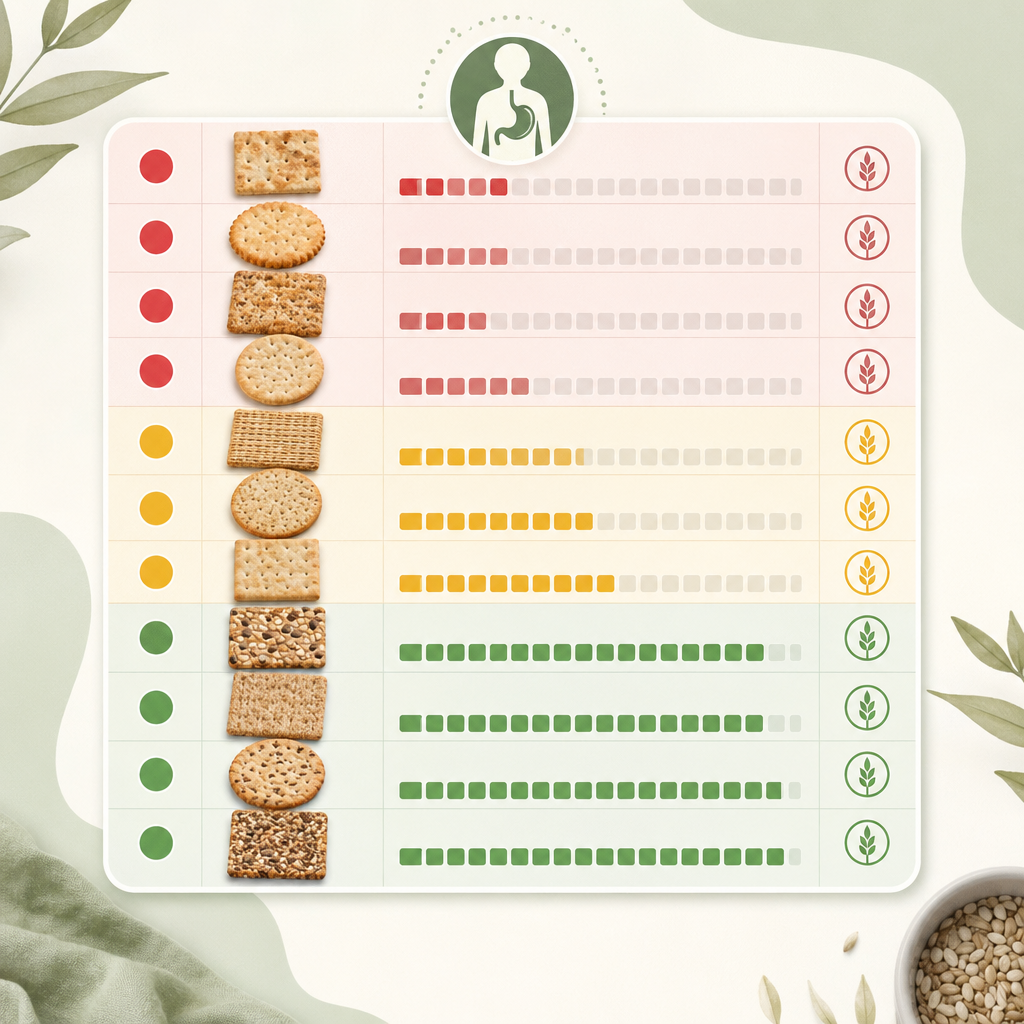
The pattern is consistent: the crackers in the "best" and "good" tiers are seed-based or whole-grain rye, with naturally higher fiber and lower sodium. The ones in "skip" are refined wheat with minimal fiber. The "mediocre" and "decent" tiers are mostly whole-grain wheat crackers that hit one of the three markers but not all three.
The Flackers brand is an outlier because it's almost pure flax with very little flour, which is why the protein-and-fiber profile is closer to a nut than a cracker. Wasa and Ryvita are European-style crispbreads with whole rye as the only grain, which gives them very high fiber per calorie.
Why portion creep is the bigger problem than the food itself
USDA standard serving size for crackers: 1 oz (about 30 g, which translates to 5 saltines, 5 Ritz, 7 Wheat Thins, or 6 Triscuits).
Real-world portion: most people eat 2 to 3 oz from a sleeve in front of a movie, often without noticing. That's 280 to 480 calories, depending on the brand, with little protein and high sodium.
A full sleeve of Ritz (about 3.5 oz, 32 crackers) is 560 calories and 875 mg of sodium. A box of saltines, finished over the course of a day with cheese, is well over 1,000 calories.
For a 5'5" woman on a 1,400-calorie weight-loss target, a single sleeve of Ritz erases her entire deficit for that day and adds calories on top. For a 5'10" man on a 2,000-calorie target, it's about a quarter of his day, gone, with no protein and no fiber.
The fix that works: pre-portion the crackers as soon as they come home. Buy the box, then split into 1 oz snack bags. The pre-portioned snack packs that some brands sell solve the same problem at roughly 2x the cost per ounce.
The food itself is rarely the driver of weight-loss derailment. The packaging is. Sleeves and family-size boxes are designed to be finished over a few sittings.
The cracker-and-protein pairing trick
A 1 oz serving of crackers on its own has high glycemic impact and moderate satiety. Pair it with 10 to 15 g of protein and the same crackers become a balanced 200-calorie snack with 4-hour staying power.
Protein pairings that turn a refined-flour cracker into an acceptable snack:
- 2 oz of low-fat cheese (string cheese, Babybel, sliced cheddar). Adds 14 g protein, 12 g fat, 130 calories.
- 1/2 cup low-fat cottage cheese. Adds 14 g protein, 1 g fat, 80 calories.
- 2 oz canned tuna. Adds 14 g protein, 1 g fat, 70 calories.
- 2 tbsp peanut butter or almond butter. Adds 7 g protein, 16 g fat, 190 calories.
- 2 oz turkey or ham deli slices. Adds 12 g protein, 3 g fat, 80 calories.
- 2 hard-boiled egg whites + 1 whole egg. Adds 14 g protein, 5 g fat, 100 calories.
- 1/4 cup hummus. Adds 5 g protein, 8 g fat, 110 calories.
The cottage cheese, tuna, and turkey pairings give you the best protein-per-calorie ratio. Cheese pairings are the most satisfying texture-wise but add the most fat. Hummus and nut butters are the highest in calories for the protein they deliver, but they pair well with seed-based crackers.
The general rule: if your crackers don't have at least 3 g protein per serving on their own, they need a protein partner before they count as a snack.
How crackers fit on a GLP-1 plan
If you're on compounded semaglutide or compounded tirzepatide, a few cracker-specific things change.
1. Salt sensitivity goes up. GLP-1 medications can cause mild fluid shifts, particularly during dose increases. High-sodium snacks (300+ mg per serving) often feel more uncomfortable than they used to, with bloating or puffiness in the first 24 hours after eating. Lower-sodium crackers (under 150 mg per serving) work better.
2. Plain crackers become a useful tool for nausea. Saltines and other plain crackers settle the stomach the same way they do for morning sickness. If you're in the first few weeks of titration and dealing with nausea waves, 4 or 5 plain crackers in the morning before getting out of bed can take the edge off. (See more in foods that help with GLP-1 nausea.)
3. Crackers as a meal replacement is a trap. Some patients on GLP-1 medications find that hunger drops so much that "a few crackers" becomes a stand-in for a meal. This works in the short term and creates muscle-loss risk in the longer term. Crackers are a snack, not a meal. If your appetite is suppressed enough that you're skipping meals, the fix is protein-first food planning, not refined-carb grazing.
4. Pair them with protein every time. This rule matters more on a GLP-1 because total daily calories are typically lower (often 1,200 to 1,500), and every snack needs to pull its weight on the protein and satiety side.
Better alternatives if your goal is satiety
If you're picking up crackers because you want a salty crunch, but the satiety isn't there, these are the swaps with the best protein-to-calorie ratios:
- Roasted chickpeas. 1/4 cup is 110 calories, 6 g protein, 5 g fiber. Crunchy, salty, satisfying.
- Lupini beans (salted). 1/2 cup is 100 calories, 12 g protein, 3 g fiber. Best protein-to-calorie ratio of any crunchy snack.
- Edamame (in shell, salted). 1 cup is 120 calories, 11 g protein, 5 g fiber. Active eating helps slow consumption.
- Pork rinds. 1 oz is 150 calories, 17 g protein, 0 carbs. Best for low-carb plans.
- Quest protein chips. 1 bag is 140 calories, 19 g protein. Texture is closer to a baked chip than a fried chip.
- Seaweed snacks. 1 pack (5 g) is 30 calories, 1 g protein, 1 g fiber. Lowest-calorie crunchy snack on the market.
None of these are technically crackers, but most of the appeal of crackers (salt, crunch, hand-to-mouth) is satisfied by these alternatives at a much higher protein content. The protein turns off the hunger signal in a way that crackers can't, even with cheese on top.
A simple weekly snack-swap framework
Most weight-loss plateaus come from snacking patterns, not meal patterns. A framework that works (see Drewnowski 2018 work on energy density and the more recent McGill et al. 2023 satiety data): allocate one snack slot per day to a low-cost calorie-dense snack like crackers, and the second snack slot to a protein-dense snack like Greek yogurt or cottage cheese.
Sample one-week allocation:
| Day | Snack 1 (3 PM) | Snack 2 (8 PM) |
|---|---|---|
| Mon | Triscuits + tuna | Greek yogurt + berries |
| Tue | 1 oz almonds | Apple + peanut butter |
| Wed | Wasa + cottage cheese | Hard-boiled egg + cucumber |
| Thu | Cottage cheese + pineapple | 1 oz dark chocolate |
| Fri | Flackers + hummus | Edamame, 1 cup |
| Sat | Tuna pouch on Triscuits | 1 oz roasted almonds |
| Sun | Greek yogurt + walnut | Wasa + cheese |
That gives you crackers four times a week without making them the cornerstone of your snacking. It also stops the pattern of "I had crackers yesterday and the day before, and now I'm 200 calories over my goal every night."
FAQ
Are crackers actually bad for weight loss?
Most refined-flour crackers (saltines, Ritz, Cheez-Its) are bad weight-loss snacks because they're calorie-dense, low in protein and fiber, and easy to overeat. Whole-grain or seed-based crackers (Triscuits, Wasa, Flackers) can fit a weight-loss plan when paired with protein and kept to listed serving sizes.
What's the healthiest cracker for weight loss?
On the metrics that matter (fiber, protein, low sodium, whole-grain or seed first ingredient), Flackers (flaxseed crackers) and Wasa or Ryvita crispbreads are the strongest options. They have 5-6 g of fiber per serving and use seeds or whole rye as the primary ingredient.
How many crackers can I eat per day on a diet?
Stick to a 1 oz serving per snack, which is 5-7 crackers depending on size. Two servings per day (one paired with protein at lunch or as a snack, one with vegetables at dinner) is fine for most weight-loss plans. The risk is unportioned grazing from the box.
Are saltines good for weight loss?
No. Saltines are refined flour with high sodium and almost no fiber or protein. They have a high glycemic index (around 74) and don't drive satiety. They're useful for nausea management but not for weight-loss snacking.
Are Triscuits good for weight loss?
Triscuits are one of the better mass-market options because they use whole-grain wheat as the only grain ingredient and have 3 g of fiber per serving. They're not a "weight-loss food," but they're a defensible choice when paired with protein.
Are crackers low calorie?
Most crackers run 120 to 160 calories per ounce, which is similar to chips and pretzels. Crispbreads (Wasa, Ryvita) are an exception at 70-80 calories per ounce because they're mostly air and rye.
Are gluten-free crackers better for weight loss?
Not necessarily. Most gluten-free crackers use rice flour or corn flour, both of which are highly refined and similar in glycemic profile to regular white flour. Look for fiber and protein on the label, not the gluten-free label.
Can I eat crackers on a GLP-1 medication?
Yes, in 1 oz portions paired with protein. Plain crackers are also useful for managing GLP-1-induced nausea. Avoid high-sodium varieties (over 250 mg per serving), which can worsen the bloating that some patients report during titration.
What's the best cracker-and-cheese combo for weight loss?
Triscuits or Wasa crispbreads paired with 1 oz of part-skim mozzarella or 1/2 cup of low-fat cottage cheese. The combo runs 200 to 240 calories with 12 to 14 g of protein.
Are seed crackers better than wheat crackers?
Generally yes. Seed crackers (Flackers, Mary's Gone Crackers, multi-seed varieties) tend to have higher fiber, higher protein, and lower glycemic impact than wheat-based crackers. They're more expensive per ounce but better satiety per calorie.
Will crackers stall my weight loss?
Eating one 1 oz serving per day, paired with protein, won't stall most plans. Eating a full sleeve of crackers as a snack regularly (around 500-600 calories of refined carbs and salt) will likely stall weight loss for most patients.
Why am I always hungry an hour after eating crackers?
Most crackers have very little protein and a high glycemic index, which produces a blood sugar spike followed by a trough that registers as hunger 60 to 90 minutes later. Pairing crackers with 10 to 15 g of protein (cheese, tuna, hummus) flattens the curve.
Author / review note
Reviewed by the FormBlends Medical Team. References cited include the USDA FoodData Central database, Drewnowski A., Annual Review of Nutrition, 2018 (energy density and weight management), McGill et al., Appetite, 2023, and the U.S. Dietary Guidelines for Americans, 2020-2025.
Footer disclaimers
Platform Disclaimer. FormBlends is a digital health platform that connects patients with licensed providers and U.S.-based pharmacies. We do not manufacture, prescribe, or dispense medication directly. All clinical decisions are made by independent licensed providers.
Compounded Medication Notice. Compounded semaglutide and tirzepatide are not FDA-approved. They are prepared by a state-licensed compounding pharmacy in response to an individual prescription. Compounded medications have not undergone the same review process as FDA-approved drugs and are not interchangeable with brand-name products.
Results Disclaimer. Individual results vary. Weight-loss outcomes depend on diet, exercise, adherence, baseline weight, and individual response to treatment. Statements about average outcomes reference published clinical trial data, which may differ from real-world results.
Trademark Notice. Brand names referenced in this article (Triscuit, Wheat Thins, Ritz, Cheez-It, Goldfish, Wasa, Ryvita, Flackers, Mary's Gone Crackers, Crunchmaster, Trader Joe's, Quest) are the property of their respective owners. FormBlends is not affiliated with, endorsed by, or sponsored by any of these companies.
Related guides
- Are Saltine Crackers Healthy for Weight Loss? An Honest Look at the Nutrition
- Are Ritz Crackers Healthy for Weight Loss? An Honest Answer Backed by the Nutrition Label
- Are Peanut Butter and Jelly Sandwiches Good for Weight Loss? An Honest Look
- Is Yogalates Good for Weight Loss? An Honest Look at What the Research Actually Shows
- Is Burning 200 Calories a Day Good for Weight Loss? The Math, the Catch, and What 200 Calories Actually Looks Like
- Is Jasmine Rice Good for Weight Loss? The Honest Answer Backed by the Numbers
See your options in about 2 minutes
Take the free quiz and see what fits you. Quick, private, and no commitment to continue.
See my options →