The short answer
A typical takeout chicken chow mein runs 480 to 600 calories per cup, with 1,000 to 1,800 mg of sodium and 14 to 22 g of fat. It's not inherently fattening, but standard restaurant portions of 2 to 3 cups push the meal to 1,200+ calories. With portion control and the right protein add-ons, chow mein can fit a weight-loss plan.
Table of contents
- The 30-second answer
- What chow mein actually is
- Reading the calorie label
- Restaurant portions vs serving sizes
- The sodium problem
- Chow mein vs other Chinese takeout (table)
- How to order chow mein for weight loss
- Chow mein on a GLP-1 plan
- Homemade chow mein that fits
- FAQ
- Footer disclaimers
What chow mein actually is
"Chow mein" translates roughly to "stir-fried noodles." The dish has Chinese origins and several regional variations, but the version most Americans recognize is Cantonese-American chow mein: parboiled wheat-flour noodles tossed in a wok with vegetables, oil, soy sauce, oyster sauce, and a protein.
Check your GLP-1 eligibility
Use our free BMI Calculator to see if you may qualify for provider-reviewed GLP-1 therapy.
Try the BMI Calculator →The two main styles served in the United States:
- Crispy chow mein. Noodles are deep-fried until crunchy, then topped with a saucy stir-fry of vegetables and protein. Common in older American Chinese restaurants. Higher in fat because of the frying.
- Soft chow mein (lo mein-style). Noodles are parboiled, then stir-fried in oil with vegetables and protein. This is the version most takeout restaurants serve when you order chow mein. The line between this and lo mein is fuzzy in the United States and depends on the restaurant.
Real Cantonese chow mein, served in Hong Kong, uses thinner noodles and less sauce, with the noodles crisped on one side. American chow mein is heavier, oilier, and saucier, which drives up the calorie count.
The base ingredients are wheat-flour noodles, vegetables (typically cabbage, bean sprouts, carrots, celery, onion, sometimes bell pepper), protein (chicken, beef, pork, shrimp, or tofu), oil for the wok, soy sauce, and often a thickener like cornstarch slurry. Some restaurants add oyster sauce, which adds umami and sodium.
The calorie content varies by all of these inputs, so a "calorie of chow mein" is really a range that depends on which restaurant and which order.
Reading the calorie label
A typical 1-cup serving of chicken chow mein from a sit-down American Chinese restaurant looks like this:
| Macro | Amount | % daily value |
|---|---|---|
| Calories | 510 | 25% |
| Total fat | 18 g | 23% |
| Saturated fat | 3 g | 15% |
| Sodium | 1,150 mg | 50% |
| Total carbohydrate | 60 g | 22% |
| Dietary fiber | 4 g | 14% |
| Total sugars | 6 g | 12% |
| Protein | 24 g | 48% |
Notes on this profile:
- The sodium is the most striking number. A single cup hits half the daily limit. A typical takeout portion of 2 to 3 cups hits the full daily limit.
- Protein is reasonable at 24 g for a meal-sized portion, especially if the protein is chicken or shrimp.
- Carbohydrates are high but not extreme for an entrée. The 60 g per cup is roughly equivalent to a slice of pizza or a sandwich on regular bread.
- Fiber is low (4 g per cup). Most of the fiber comes from the vegetables, which restaurants include in modest amounts.
- The fat content is mostly from the cooking oil. Different restaurants use different oils and different amounts.
Chow mein from a buffet line, a frozen meal, or a fast-food chain will have different numbers. Panda Express's Chow Mein side, for example, runs 510 calories per 9.4 oz serving with 860 mg of sodium and 19 g of fat. P.F. Chang's Vegetarian Chow Fun (a related dish) is 660 calories per serving.
The single largest variable: how much oil the wok cook uses. A heavy-handed pour can add 200 to 300 calories to the same dish.
Restaurant portions vs serving sizes
This is the part that quietly destroys most chow mein weight-loss math.
A "serving" of chow mein on a nutrition label is typically 1 cup (around 200 to 240 g). A typical takeout container holds 2.5 to 3.5 cups. A typical sit-down restaurant entrée plate is 2 to 3 cups. A typical buffet plate of chow mein is 1.5 to 2 cups, often eaten alongside other dishes.
So when someone reads "510 calories per cup" and orders chicken chow mein for dinner, the math becomes:
- 1 takeout container = 2.5 to 3.5 cups = 1,275 to 1,785 calories
- 1 sit-down entrée = 2 to 3 cups = 1,020 to 1,530 calories
- 1 buffet plate of chow mein alone = 1.5 to 2 cups = 765 to 1,020 calories
This is why chow mein has a reputation for being fattening even though the per-cup macros aren't catastrophic. The meal is portioned for a high-energy-output day, not a sedentary office worker.
The fix is decanting at the table. Pour 1 to 1.5 cups onto your plate, save the rest for later, and eat the served portion with vegetables on the side. That gets the meal into the 510 to 770 calorie range, which is reasonable for a single dinner.
If you can't or don't want to take leftovers home, ordering chow mein as a side and a vegetable-heavy entrée as the main is the alternative.
The sodium problem
Chow mein is one of the highest-sodium menu items in American Chinese cuisine. A typical takeout portion can run 2,500 to 4,000 mg of sodium, which is 100 to 175 percent of the daily limit (2,300 mg per current dietary guidelines).
The sodium comes from three sources: soy sauce (around 900 mg per tablespoon), oyster sauce (around 500 mg per tablespoon), and the salt added during cooking. Restaurants don't tend to be conservative with any of these.
For weight loss specifically, sodium isn't a calorie issue. It's a fluid retention issue. A high-sodium meal can cause 2 to 4 pounds of overnight water weight, which scares people on the scale the next morning. The water weight resolves over 24 to 48 hours as the kidneys excrete the sodium. It's not fat gain. It's a feature of the dish.
For weight-related comorbidities (high blood pressure, kidney disease, heart failure), the sodium content matters more. Patients with these conditions should treat chow mein as an occasional meal rather than a weekly habit.
Lower-sodium ordering tactics:
- Ask for chow mein "lightly sauced" or "sauce on the side." This typically reduces sodium by 30 to 50 percent.
- Skip the additional soy sauce packets at the table.
- Order with vegetables added (bok choy, snap peas, broccoli) rather than the standard mix. The additional vegetable volume dilutes the sauce-to-food ratio.
- Drink water with the meal. Soup-based sides like wonton soup or hot and sour soup add another 600 to 1,200 mg of sodium.
Chow mein vs other Chinese takeout (head-to-head)
| Dish | Serving | Cal | Protein | Fiber | Sodium | Best for |
|---|---|---|---|---|---|---|
| Chicken chow mein | 1 cup | 510 | 24 g | 4 g | 1,150 mg | Moderate option |
| Lo mein | 1 cup | 480 | 18 g | 3 g | 1,250 mg | Slightly lower cal |
| Beef and broccoli | 1 cup | 280 | 22 g | 3 g | 1,400 mg | High protein, low cal |
| Chicken and broccoli | 1 cup | 230 | 25 g | 3 g | 1,300 mg | Best protein-to-cal |
| Kung pao chicken | 1 cup | 430 | 27 g | 3 g | 1,000 mg | Spicy, peanuts add fat |
| Sweet and sour chicken | 1 cup | 600 | 18 g | 1 g | 950 mg | Highest sugar |
| General Tso's chicken | 1 cup | 660 | 22 g | 2 g | 1,500 mg | Highest cal entrée |
| Steamed white rice | 1 cup | 200 | 4 g | 0.6 g | 0 mg | Plain carb |
| Steamed brown rice | 1 cup | 220 | 5 g | 3.5 g | 10 mg | More fiber |
| Fried rice | 1 cup | 350 | 9 g | 1 g | 850 mg | High cal/sodium |
| Egg drop soup | 1 cup | 65 | 4 g | 0 g | 690 mg | Lowest cal starter |
| Hot and sour soup | 1 cup | 90 | 5 g | 1 g | 1,000 mg | Modest cal, high sodium |
| Spring roll (fried) | 1 roll | 220 | 4 g | 1 g | 420 mg | High fat appetizer |
| Steamed dumpling | 1 dumpling | 60 | 4 g | 0.5 g | 100 mg | Lowest cal app |
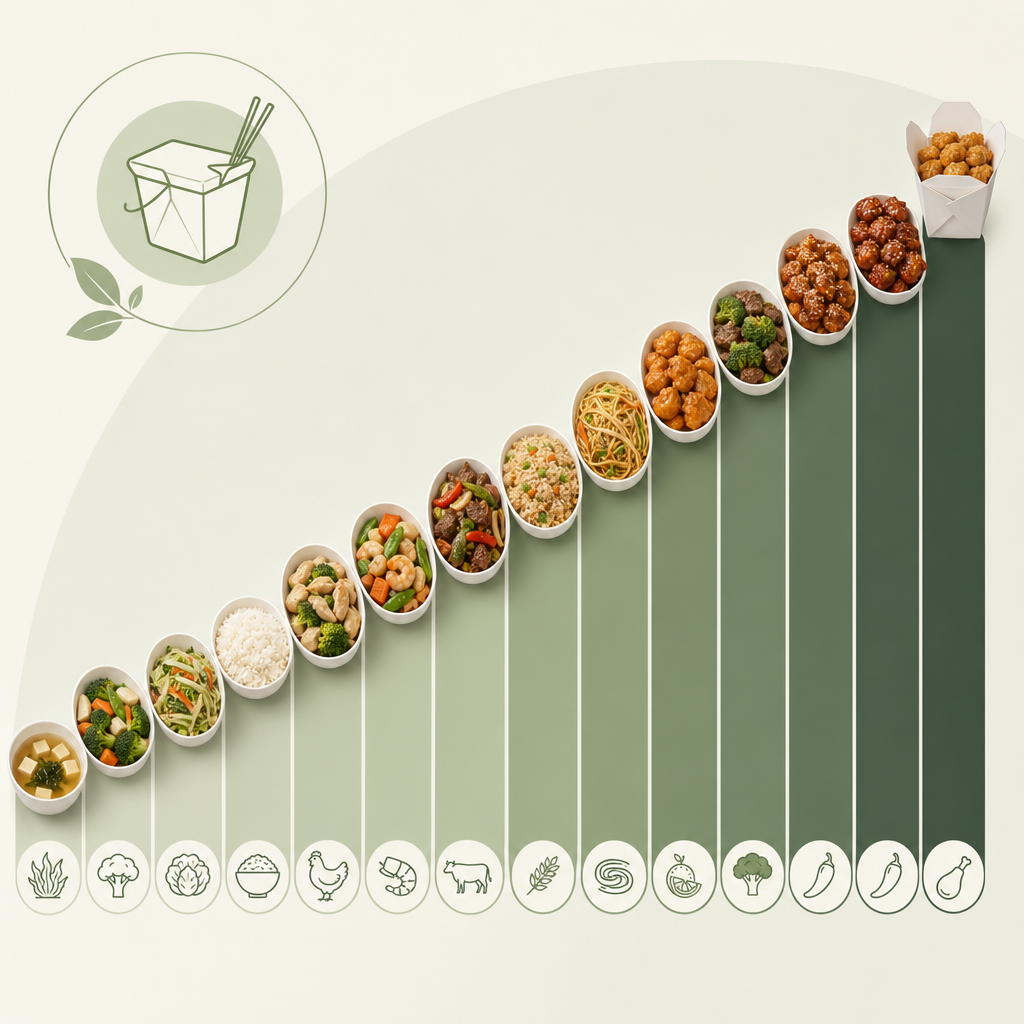
The takeaway: among entrées, beef and broccoli, chicken and broccoli, and kung pao chicken (without rice) are the higher-protein, lower-calorie picks. General Tso's, sweet and sour, and orange chicken are the highest-calorie options. Chow mein lands in the middle. Lo mein is essentially identical to soft chow mein in calorie math.
How to order chow mein for weight loss
If you want chow mein to fit a weight-loss plan, ordering matters as much as portion size. The strategy that works best for most people:
- Order chow mein as a half-portion or shared dish. If the menu lists half-portions, take one. If it doesn't, share with a dining partner. A 1-cup serving with a vegetable side beats a 3-cup solo chow mein every time.
- Pick a lean protein. Chicken and shrimp chow mein are around 480 to 520 calories per cup. Beef chow mein is closer to 540. Pork chow mein is around 560. House special (mixed protein) is the highest at around 600 because it usually includes pork and shrimp.
- Ask for extra vegetables. Most restaurants will add bok choy, broccoli, or snap peas at no charge or for a $1 to $2 upcharge. The added volume reduces the noodle-to-vegetable ratio and improves satiety per calorie.
- Skip the appetizers or pick steamed dumplings. Crab rangoon (200 cal each), spring rolls (220 cal each), and fried wonton (35 cal each, easy to eat 8) add up fast. Steamed dumplings are 60 cal each. Edamame is around 100 cal per half cup.
- Order broth-based soup as the starter. Egg drop soup (65 cal per cup) or hot and sour (90 cal) are filling without adding meaningful calories. The volume helps slow eating and reduces total intake.
- Skip fried rice as a side. Fried rice doubles the carbohydrate calories of the meal. Steamed white or brown rice is a smaller calorie hit if you want a starch beyond the noodles.
- Take half home. This is the single most-effective tactic. The leftover container is tomorrow's lunch.
A "good" chow mein order for weight loss: half-portion of chicken chow mein with extra broccoli, side of egg drop soup, water. Total calories: around 580 to 650.
A "bad" chow mein order for weight loss: full house special chow mein, fried rice, two crab rangoons, sugary soda. Total calories: around 1,800 to 2,200.
Chow mein on a GLP-1 plan
If you're on compounded semaglutide or tirzepatide, your relationship with restaurant Chinese food shifts in two ways. First, you eat less than you used to, often noticeably so. Second, high-fat or high-sugar meals can produce more nausea or reflux than they used to.
Chow mein on a GLP-1 plan, in practice:
- Most patients can eat 1 to 1.5 cups comfortably. Beyond that, fullness pushes back.
- The high sodium can cause overnight water retention, which sometimes shows up as a 2 to 4 pound scale jump the next morning. This is normal. It resolves in 1 to 2 days.
- The fat content (15 to 22 g per serving) is at the upper edge of what some tirzepatide patients tolerate without nausea. Lower-fat options like chicken and broccoli or beef and broccoli are usually easier on the stomach.
- The carbohydrate content can produce a noticeable post-meal energy dip in some patients, partly because GLP-1s slow gastric emptying and the carbs hit later than expected.
The practical play for chow mein on a GLP-1: order half a portion, eat it slowly, drink water, and don't push through fullness. If you've had reflux issues during titration, pick a lower-fat entrée instead. For more on managing reflux during GLP-1 titration, see our piece on why GLP-1 medications can cause acid reflux.
Homemade chow mein that fits
Restaurant chow mein is the high-calorie version. Homemade chow mein, made with intentional portion control, can be a 350 to 450 calorie meal with 30+ g of protein.
A simple weight-loss-friendly recipe:
- 4 oz dry whole-wheat or shirataki noodles (cook per package)
- 6 oz raw chicken breast, sliced thin
- 3 cups mixed vegetables (cabbage, bell pepper, snap peas, carrot, bean sprouts)
- 1 tbsp avocado oil
- 1 tbsp low-sodium soy sauce
- 1 tsp oyster sauce
- 1 tsp toasted sesame oil
- 1 clove garlic, minced
- 1 inch ginger, grated
- 1 tbsp rice vinegar
- 1 tsp cornstarch + 2 tbsp water (slurry)
Total calories: around 470. Protein: 38 g. Sodium: around 800 mg. Fiber: 7 g.
The trade-offs versus restaurant chow mein: less oil (1 tbsp vs 2 to 3 tbsp), more vegetables (3 cups vs 1 cup), lean protein, low-sodium soy sauce. The flavor is close enough that it scratches the same craving for most people.
Shirataki noodles (made from konjac yam) are a low-calorie noodle alternative. They have around 10 calories per serving but a different texture (chewier, with a slight rubbery quality). Mixing half shirataki with half regular noodles is a calorie-saving compromise that most people find acceptable.
FAQ
Is chow mein fattening?
Not inherently. A 1-cup serving has 480 to 520 calories, which is reasonable for an entrée. The reason chow mein has a fattening reputation is that restaurant portions are 2 to 3 cups, and the dish is high in sodium and oil.
How many calories are in a typical takeout chow mein?
A typical takeout container of chicken chow mein holds 2.5 to 3.5 cups, totaling 1,275 to 1,785 calories. A single restaurant entrée portion is usually 1,000 to 1,500 calories.
Is chow mein healthier than lo mein?
They're nearly identical. Both are stir-fried wheat noodles with vegetables and protein. Soft chow mein and lo mein use slightly different noodle types but the calorie and macro profiles are within 30 calories per cup. Crispy chow mein is higher in fat because of the deep-frying step.
Can I eat chow mein on a diet?
Yes, in moderate portions. A 1 to 1.5 cup serving with extra vegetables and a broth-based soup is a 600 to 700 calorie meal, which fits most weight-loss plans.
Is chow mein high in carbs?
Yes. A 1-cup serving has around 60 g of carbohydrates. The low-fiber wheat noodles are the main source. For low-carb plans, chow mein is not a fit. Shirataki noodle versions have around 5 to 8 g of carbs per cup.
Is chow mein high in sodium?
Very. A 1-cup serving has 1,000 to 1,500 mg of sodium, around 50 percent of the daily limit. A full takeout portion can hit 3,000 to 4,000 mg. People with high blood pressure or kidney conditions should be cautious.
Is chow mein keto?
No. The wheat noodles are too high in carbs for a ketogenic plan. A keto-friendly version would substitute shirataki or kelp noodles and skip the cornstarch slurry.
Can I eat chow mein on a GLP-1 medication?
Generally yes, in smaller portions. Most patients tolerate 1 to 1.5 cups. The high fat and sodium content can cause more reflux or nausea during titration, so lower-fat options like beef and broccoli might be better in the first month.
Is chicken chow mein the lowest calorie chow mein?
Chicken and shrimp chow mein are tied for the lowest, around 480 to 520 calories per cup. Beef is closer to 540. Pork is around 560. House special (mixed proteins) is highest at around 600.
Should I order chow mein with rice?
Adding 1 cup of steamed white rice (200 calories) or fried rice (350 calories) to a chow mein meal pushes the total above 1,000 calories. For weight loss, skip the rice or share with a dining partner.
How does chow mein compare to a sandwich for calories?
A 1-cup chow mein portion (510 calories) is roughly equivalent to a turkey sandwich on whole wheat with cheese, mayo, and lettuce. A full takeout chow mein portion (1,500 calories) is closer to three sandwiches.
What's the lowest-calorie Chinese takeout option?
Steamed chicken or shrimp with mixed vegetables and brown rice, around 350 to 450 calories per portion. Steamed dumplings (around 60 calories each) and egg drop soup (65 calories per cup) are the lowest-calorie sides.
Author / review note
Reviewed by the FormBlends Medical Team. This article was last reviewed and updated on April 28, 2026. References cited above include the USDA FoodData Central database for chow mein and related dish entries; the U.S. Dietary Guidelines for Americans, 2020-2025; and Panda Express and P.F. Chang's published nutrition information.
Footer disclaimers
Platform Disclaimer. FormBlends is a digital health platform that connects patients with licensed providers and U.S.-based pharmacies. We do not manufacture, prescribe, or dispense medication directly. All clinical decisions are made by independent licensed providers.
Compounded Medication Notice. Compounded semaglutide and tirzepatide are not FDA-approved. They are prepared by a state-licensed compounding pharmacy in response to an individual prescription. Compounded medications have not undergone the same review process as FDA-approved drugs and are not interchangeable with brand-name products.
Results Disclaimer. Individual results vary. Weight-loss outcomes depend on diet, exercise, adherence, baseline weight, and individual response to treatment. Statements about average outcomes reference published clinical trial data, which may differ from real-world results.
Trademark Notice. Brand names referenced in this article are the property of their respective owners. FormBlends is not affiliated with, endorsed by, or sponsored by any brand-name pharmaceutical manufacturer.
Related guides
- Is Tonic Water Fattening? A Look at the Calories, the Sugar, and the Quinine Question
- Is Tajin Good for Weight Loss? An Honest Look at the Calories, Sodium, and Capsaicin Math
- Is Burning 600 Calories a Day Enough to Lose Weight? An Honest Look at the Math, the Body's Response, and What Actually Works
- Will You Lose Weight on 1700 Calories a Day? An Honest Look at the Math
- Is Burning 100 Calories a Day Enough to Lose Weight? The Real Math
See your options in about 2 minutes
Take the free quiz and see what fits you. Quick, private, and no commitment to continue.
See my options →