Key Takeaways
- Generic immediate-release metformin costs $4 to $15 per month at most U.S. pharmacies in 2026, making it one of the cheapest prescription drugs available.
- Generic extended-release (ER) metformin costs $10 to $25 per month, slightly higher than immediate-release because the drug-delivery technology is more complex.
- Brand-name Glucophage and Glucophage XR cost $80 to $230 per month and offer no clinical advantage over generics.
- Insurance copays for metformin are usually $0 to $10 because metformin sits on Tier 1 of nearly every U.S. formulary.
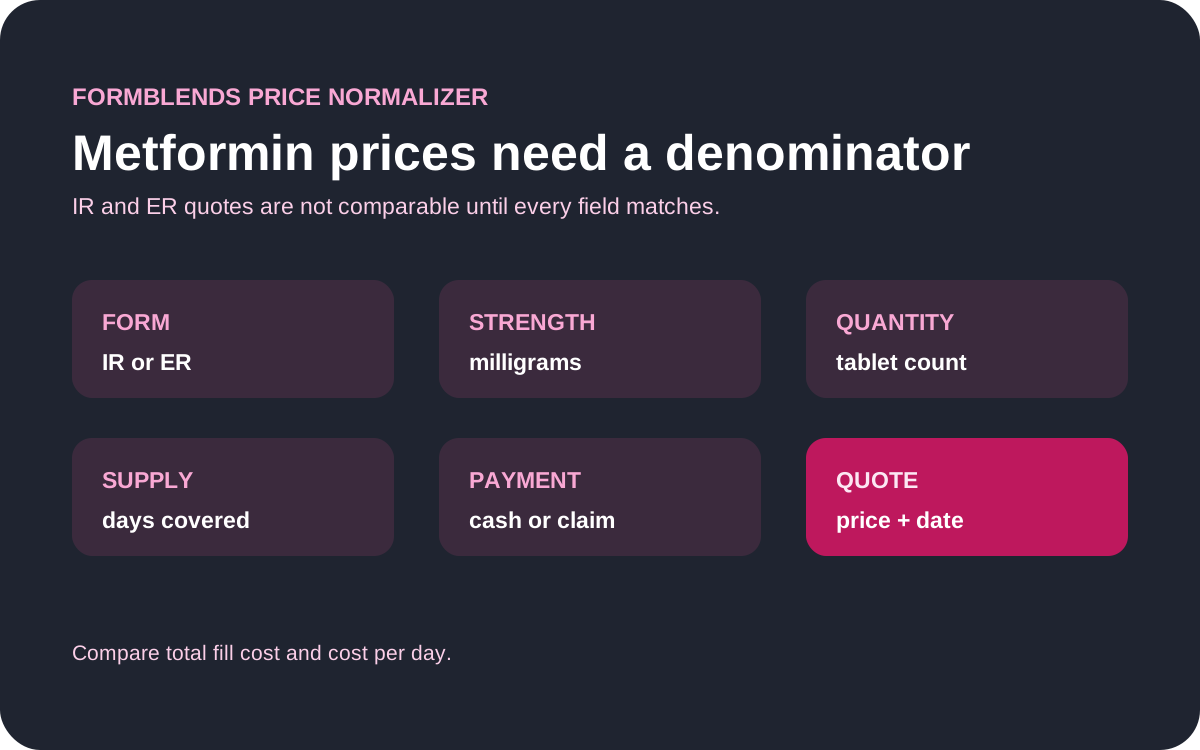
- Walmart ($4 program), Sam's Club ($8.49) and H-E-B ($5.47) were under $10 for 60 tablets of metformin 500 mg on September 4, 2026 (GoodRx, ZIP 78748). Costco was $33.70 with a GoodRx coupon, so it is no longer a bargain pharmacy for metformin, and we could not verify a Cost Plus Drugs price.
The short answer
Generic metformin costs $4 to $15 per month for immediate-release tablets and $10 to $25 per month for extended-release tablets at U.S. pharmacies in 2026. With insurance, copays are typically $0 to $10. Brand-name Glucophage costs $80 to $230 per month but offers no clinical benefit over the generic version.
Table of contents
- The 30-second answer
- Generic vs brand-name pricing
- Immediate-release vs extended-release pricing
- Pharmacy comparison: Walmart, Costco, CVS, Cost Plus
- Insurance copays for metformin
- Why metformin is so cheap
- Bulk and 90-day fill discounts
- Discount cards and coupons
- Metformin alongside GLP-1 therapy: combined cost
- Pharmacy check, September 4, 2026
- Walmart $4 list: exact rows
- GoodRx $9 vs Walmart $4
- The 625 mg and 750 mg price traps
- Coverage by plan type
- Metformin over the counter
- FAQ
- Sources
- Footer disclaimers
Generic vs brand-name pricing
Metformin's patent expired decades ago. Generic versions are produced by 30+ manufacturers in the U.S. Pricing reflects that competition.
See transparent compounded pricing
Review compounded GLP-1 pricing and what provider-reviewed care includes, with no surprises at checkout.
Try the Cost Calculator →Generic metformin pricing (ranges last reviewed April 2026; see the September 4, 2026 pharmacy check further down for exact prices):
| Form | 30-day supply cash price | 90-day supply cash price |
|---|---|---|
| Immediate-release 500 mg | $4 to $12 | $10 to $25 |
| Immediate-release 850 mg | $5 to $14 | $12 to $30 |
| Immediate-release 1000 mg | $5 to $15 | $12 to $32 |
| Extended-release 500 mg | $10 to $20 | $25 to $50 |
| Extended-release 750 mg | $12 to $22 | $28 to $55 |
| Extended-release 1000 mg | $14 to $25 | $32 to $60 |
Brand-name pricing in Q1 2026:
| Form | 30-day supply cash price |
|---|---|
| Glucophage 500 mg | $80 to $130 |
| Glucophage 1000 mg | $90 to $145 |
| Glucophage XR 500 mg | $130 to $200 |
| Glucophage XR 1000 mg | $160 to $230 |
| Fortamet (extended-release) | $190 to $280 |
| Glumetza (extended-release) | $4,500+ (premium ER formulation) |
The brand-name versions are 8 to 1,000 times more expensive than generics. The FDA has rated all generic metformin formulations bioequivalent to their brand-name counterparts. There's no clinical reason to pay brand-name prices for metformin in 2026.
A 2023 ASHP report noted that of 1,200 hospital pharmacy directors surveyed, 99% prescribed generic metformin by default. The 1% of brand-name prescriptions almost always reflected patient preference rather than clinical need.
Immediate-release vs extended-release pricing
Metformin comes in two main formulations.
Immediate-release (IR). Standard tablets that release the drug into the GI tract within 1 to 2 hours. Usually dosed twice or three times daily with meals. Generic price $4 to $15 per month.
Extended-release (ER). Tablets engineered to release metformin slowly over 8 to 12 hours. Usually dosed once daily with the evening meal. Generic price $10 to $25 per month.
The ER formulation costs more because the drug-delivery technology (osmotic pumps, gel matrices, polymer coatings) is more complex to manufacture. The clinical justifications for paying the difference:
- Lower GI side-effect burden. About 30 to 50% fewer patients on ER report nausea or diarrhea compared to IR (Hess et al., Diabetes Care 2018).
- Better adherence. Once-daily dosing improves real-world adherence by 10 to 20%.
- Same A1C reduction. ER and IR produce equivalent glucose control at equivalent total daily doses.
For patients tolerating IR metformin without GI symptoms, IR is the cheaper and equally effective option. For patients with GI side effects, the $5 to $10 per month premium for ER is usually worth it.
A 2024 randomized trial (Singh et al., Diabetes Care 2024) compared IR and ER metformin in 600 patients with new-onset type 2 diabetes. ER had 41% lower discontinuation due to GI side effects. Both groups achieved similar A1C reductions at 6 months.
Pharmacy comparison: Walmart, Costco, CVS, Cost Plus
For a 30-day supply of generic metformin 1000 mg IR:
| Pharmacy | Cash price | With membership | Notes |
|---|---|---|---|
| Walmart $4 generics program | $4 (30 days) | Same | Listed in Walmart's $4 generic list since 2006 |
| Costco | $33.70 with a GoodRx coupon (500 mg x60, ZIP 78748, September 4, 2026); Noom listed $13.99 in April 2026 | Built into price | Membership not required for pharmacy; no longer a low-price option for metformin |
| Sam's Club | $8.49 with a GoodRx coupon (September 4, 2026) | Plus members may save $1-2 | Membership not required for pharmacy |
| CVS | $21.67 with a GoodRx coupon (September 4, 2026) | CarePass discount available | Higher convenience price |
| Walgreens | $9.06 with a GoodRx coupon (September 4, 2026); Noom listed $4.22 in April 2026 | Walgreens savings club | Cheaper than its reputation with a coupon |
| Mark Cuban Cost Plus Drugs | Not verified: its metformin page would not load for us on September 4, 2026 | N/A | Mail order; check the site directly |
| H-E-B | $5.47 with a GoodRx coupon (Texas-area chain, September 4, 2026) | None | Lowest coupon price in the Austin-area GoodRx list |
| Publix | Historically $0 (Florida-area chain); not re-verified in September 2026 | None | Ask the pharmacy whether the free-metformin program is still running |
| Meijer | Historically $0 (Midwest chain); not re-verified in September 2026 | None | Ask the pharmacy whether the free-metformin program is still running |
A note on the "free metformin" programs: Publix, Meijer, and several regional grocery pharmacies dispense generic immediate-release metformin at no cost as a customer-service offering. The programs require a valid prescription and typically dispense up to a 90-day supply per fill. Eligible doses are usually 500 mg and 1000 mg IR.
The ER formulation is rarely free under these programs, but it is on Walmart's $4 list: metformin ER 500 mg is $4 for 120 tablets ($10 for 360) and ER 750 mg is $4 for 60 tablets ($10 for 180), per GoodRx's August 17, 2026 copy of the list. Noom listed Costco ER at $14.99 in April 2026.
Consistency is not what the coupon data shows. On September 4, 2026, GoodRx's coupon prices for 60 tablets of 500 mg spanned $5.47 to $33.70 across ten Austin-area pharmacies, against an average retail of $25.57. For a drug that costs $4 on a list price, the pharmacy you choose matters more than most people expect.
Insurance copays for metformin
Metformin is on Tier 1 of nearly every U.S. commercial insurance formulary. Tier 1 typically means a flat copay of $0 to $10 for generic medications.
Typical commercial insurance copays:
- Tier 1 generic: $0 to $10 per fill
- Mail-order 90-day fill: $0 to $20 per 3-month supply
- Brand-name (Glucophage): Tier 3, $50 to $100 per fill (insurance won't cover unless documented intolerance to generic)
Medicare Part D:
- Most plans: $0 to $5 per fill for generic IR
- Most plans: $5 to $15 per fill for generic ER
- Free preventive coverage in many plans because diabetes management is a covered preventive benefit
Medicaid:
- $0 to $4 per fill in most states
- 90-day fills usually allowed
No insurance:
- Walmart $4 list; Sam's Club $8.49 and H-E-B $5.47 with a GoodRx coupon (September 4, 2026)
- CVS $21.67 and Walgreens $9.06 with a GoodRx coupon (September 4, 2026); GoodRx's average retail without any coupon was $25.57
- With a GoodRx coupon: $5.47 to $33.70 depending on the pharmacy, which is why you check the app before you choose one
Because the cash price is so low, paying cash with a discount card sometimes beats using insurance, especially if you have a high-deductible plan that hasn't been met. The cash payment doesn't count toward your deductible, but for a $4 to $10 drug, that rarely matters.
Why metformin is so cheap
Three factors keep metformin pricing at floor levels.
1. Patent expiration in 2002. The U.S. patent for metformin (Glucophage) expired in 2002. Within 18 months, multiple generic manufacturers entered the market. Prices dropped 90%+ within 24 months of patent expiration. By 2010, retail prices stabilized in the $4 to $20 range where they remain.
2. Manufacturing simplicity. Metformin hydrochloride is one of the simplest drug substances to manufacture. The synthesis pathway requires only a few steps from cheap starting materials. Bulk active pharmaceutical ingredient (API) costs about $5 to $15 per kilogram. A 1000 mg tablet contains $0.005 to $0.015 of API.
3. High volume. Metformin is the second-most-prescribed drug in the U.S. (after lisinopril) by total prescription count. Over 90 million prescriptions are filled annually. The volume drives manufacturing economies of scale.
A 2020 health economics analysis (Berryhill et al., JAMA Network Open 2020) estimated that the global pharmaceutical industry's profit on a 30-day supply of generic metformin averaged $0.40 to $1.20. Most of the retail price goes to distribution, pharmacy operations, and dispensing fees, not the drug itself.
This is why retail "discount" programs ($4 generics, free generics) work for metformin: there's almost nothing to discount. The pharmacies absorb a small loss in exchange for foot traffic.
Bulk and 90-day fill discounts
Most insurance plans encourage 90-day fills for chronic medications by waiving the second and third copays. For metformin, this means paying one copay for three months of medication.
Mail-order 90-day fills:
- Express Scripts, OptumRx, CVS Caremark mail order: typically $0 to $20 for a 90-day supply via plan benefits.
- Cost Plus Drugs: we could not load its metformin price page on September 4, 2026, so we no longer print a figure for it. For mail order, GoodRx lists Springmeds at $9.60 and HealthWarehouse at $10.20 for 60 tablets of 500 mg.
- Walmart 90-day program: $10 for 180 tablets of metformin 500 mg, 850 mg or 1000 mg, $10 for 360 tablets of ER 500 mg, and $10 for 180 tablets of ER 750 mg (GoodRx's copy of the list, August 17, 2026).
Why 90-day fills make sense:
- Lower per-pill cost.
- Fewer pharmacy trips.
- Adherence improvement of 10 to 15% in research studies.
- Reduced risk of running out before refill.
The downside: if your dose changes (your provider increases or decreases) you may have leftover medication that's no longer prescribed. For chronic metformin therapy at a stable dose, 90-day fills are the standard recommendation.
Discount cards and coupons
Even though metformin is cheap, discount cards can shave a few dollars off the price.
GoodRx. Free coupon. On September 4, 2026 it priced 60 tablets of 500 mg at $9.00 at Walmart (higher than Walmart's own $4 list price, so ask for the program instead of the coupon there), $9.06 at Walgreens, $21.67 at CVS and $33.70 at Costco.
SingleCare. Comparable to GoodRx. Sometimes 5 to 10% better at certain pharmacies. Free.
Manufacturer copay cards. Brand-name Glucophage offers a savings card that reduces eligible commercial copays. Given that generic metformin costs $4 to $15, the savings card is rarely useful unless a specific clinical reason requires brand-name therapy.
Mark Cuban Cost Plus Drugs. Online pharmacy with transparent pricing. Its metformin page did not load for us on September 4, 2026, so the $3.60 and $9.60 figures an earlier version of this page printed are unverified and have been removed. Check costplusdrugs.com directly and add its pharmacy fee and shipping to whatever it shows.
Walmart $4 generic list. Walmart's $4 generic program has included metformin since 2006. The price has held steady at $4 for a 30-day supply across all years and all U.S. Walmart locations.
A 2024 KFF analysis of prescription drug pricing found that metformin was one of only three drugs (along with lisinopril and atorvastatin) where the cash price was sometimes lower than the insurance copay for patients on high-deductible plans.
Metformin alongside GLP-1 therapy: combined cost
Many patients with type 2 diabetes are prescribed metformin alongside a GLP-1 medication. The combined monthly cost is dominated by the GLP-1.
Sample combined monthly cost:
| Combination | Metformin cost | GLP-1 cost | Combined monthly cost |
|---|---|---|---|
| Generic metformin + Ozempic (insurance, savings card) | $5 | $25 | $30 |
| Generic metformin + Mounjaro (insurance, savings card) | $5 | $25 | $30 |
| Generic metformin + Ozempic (NovoCare self-pay, after two $199 months) | $5 | $349 | $354 |
| Generic metformin + Mounjaro ($499 not-covered tier via Lilly) | $5 | $499 | $504 |
| Generic metformin + compounded semaglutide | $5 | $197 median, month one (FormBlends price index, September 3, 2026) | $202 |
| Generic metformin + compounded tirzepatide | $5 | $299 median, month one (same index) | $304 |
The combination has clinical justification beyond cost. The 2025 ADA Standards of Care recommend metformin plus a GLP-1 as standard combination therapy for patients who haven't reached A1C goal on metformin alone or who have established cardiovascular disease, heart failure, or chronic kidney disease.
A 2023 retrospective cohort study (Lin et al., Diabetes Care 2023) of 14,000 patients on metformin plus semaglutide showed an additional A1C reduction of 0.6 percentage points compared to either drug alone.
If you're already paying $25 per month for a GLP-1 with insurance and savings card support, adding generic metformin only increases your monthly cost by $5. The clinical benefit usually justifies the small additional spend. (See our GLP-1 plus metformin combination guide for the full picture.)
Metformin cash prices by pharmacy, checked September 4, 2026 (ZIP 78748)
Every price in this table has a date and a source attached, which the April 2026 ranges above did not. The GoodRx column is the coupon price for 60 tablets of metformin 500 mg in ZIP 78748 (Austin, Texas) on September 4, 2026; prices differ by ZIP, so run your own before you drive. The Noom column is that site's published pharmacy table dated April 16, 2026.
| Pharmacy | GoodRx coupon, 500 mg x60 (September 4, 2026) | Noom table, IR / ER (April 16, 2026) | List or program price |
|---|---|---|---|
| Walmart | $9.00 | $4 / $4 | $4 for 60 tablets on the $4 list (ask for the program, not the coupon) |
| H-E-B | $5.47 | not listed | |
| Sam's Club | $8.49 | not listed | |
| Walgreens | $9.06 | $4.22 / $17.94 | |
| Target (CVS) | $21.59 | $19.58 / $29.41 | |
| CVS | $21.67 | $19.58 / $29.42 | |
| Costco | $33.70 | $13.99 / $14.99 | No membership needed for the pharmacy, but no bargain either |
| Rite Aid | not listed | $6.09 / $14.01 | |
| Mail order (Springmeds, HealthWarehouse) | $9.60, $10.20 | not listed | Plus shipping |
GoodRx's stated average retail price without any coupon was $25.57 for the same bottle. The spread between $4 and $33.70 for identical tablets is the whole reason this page exists.
Metformin on Walmart's $4 list: exact strengths, quantities and the ER catch
Walmart's own $4 Prescriptions page sat behind a CAPTCHA when we tried it on September 4, 2026, so the rows below come from GoodRx's copy of the list, updated August 17, 2026. They match what the page has said for years.
| Medication | $4 (30-day supply) | $10 (90-day supply) |
|---|---|---|
| Metformin 500 mg, 850 mg, 1000 mg | 60 tablets | 180 tablets |
| Metformin ER 500 mg | 120 tablets | 360 tablets |
| Metformin ER 750 mg | 60 tablets | 180 tablets |
| Glyburide/metformin 2.5/500 mg, 5/500 mg | 60 tablets | 180 tablets |
Three catches. The quantity is fixed: 60 tablets of 1000 mg is a 30-day supply only if you take one tablet twice a day, so a prescription for three a day does not fit the $4 slot and gets priced differently. Metformin ER 1000 mg is not on the list at all; ER is $4 only at 500 mg and 750 mg. And the program is not offered in North Dakota, and some states (GoodRx names California and Minnesota) have different pricing, so the $4 is worth a phone call before you assume it.
If your prescription is written for an ER 1000 mg tablet, ask your prescriber whether two ER 500 mg tablets would do; it is the same dose and drops the price to $4.
Why GoodRx shows $9 at Walmart when the list price is $4
On September 4, 2026 GoodRx quoted $9.00 for 60 tablets of metformin 500 mg at Walmart. Walmart's list price for the identical bottle is $4. Both are right; they are different pricing paths. The GoodRx figure is a coupon price negotiated through a pharmacy benefit network. The $4 is Walmart's own retail program price, which is not a coupon and does not go through that network. When you hand over a GoodRx card, the pharmacy bills the coupon rate, even if it is higher than the store program. At Walmart, do not present a coupon for metformin; say you want the $4 Prescriptions program price. Use the GoodRx coupon at pharmacies that have no $4 program, where it turned $25.57 average retail into $5.47 at H-E-B and $9.06 at Walgreens.
Strength matters: the 625 mg and 750 mg price traps
Metformin is a $4 drug at 500 mg, 850 mg and 1000 mg. It is not a $4 drug at the two oddball strengths, and prescribers write them more often than you would think. GoodRx's price-by-dosage table on September 4, 2026 (Austin-area coupon prices):
| Strength and quantity | Retail | GoodRx coupon price |
|---|---|---|
| 500 mg, 60 tablets | $9.00 | $9.00 |
| 625 mg, 60 tablets | $2,193.19 | $498.86 |
| 750 mg, 180 tablets | $8,023.99 | $2,064.82 |
| 850 mg, 180 tablets | $23.29 | $20.98 |
| 1000 mg, 180 tablets | $39.23 | $13.53 |
The 625 mg and 750 mg immediate-release tablets are made by few manufacturers and priced like brand drugs. If a prescription arrives at the pharmacy in one of those strengths, ask the prescriber to rewrite it: 750 mg twice a day becomes 500 mg plus 850 mg or, more simply, 1000 mg; 625 mg is close enough to 500 mg that most prescribers will switch. Note that metformin ER 750 mg is a different product and is on Walmart's $4 list.
Is metformin covered by insurance? Coverage by plan type
Yes, almost universally. GoodRx's analysis of national formulary data from Managed Markets Insight and Technology (MMIT), reflecting coverage as of June 2025 and published November 12, 2025, found:
| Insurance type | Enrollees covered for metformin 500 mg tablets | Prior authorization required | Step therapy required |
|---|---|---|---|
| ACA marketplace plans | 99.9% | 0.5% | 0.5% |
| Commercial plans (non-ACA) | 99.0% | 0.6% | 0.04% |
| Medicare Advantage and Part D | 100% | 0% | 0% |
| Medicaid (fee-for-service and managed care) | 100% | 0.7% | 0% |
Coverage is for the drug, not the reason. Plans cover metformin for type 2 diabetes; a prescription written for weight loss or PCOS is off-label, and while most plans do not check the diagnosis on a $4 generic, some do. If yours does, paying the $4 list price is simpler than fighting it.
Can you buy metformin over the counter at Walmart or CVS?
No. Metformin is prescription-only in the United States at every pharmacy, including Walmart, CVS, Walgreens and Costco, and no over-the-counter version exists here. Products sold online as "OTC metformin" or "natural metformin" are supplements, not the drug. The realistic no-insurance path is a telehealth visit for a prescription, then the $4 Walmart program or a coupon pharmacy. If a prescriber decides metformin is appropriate for you, FormBlends' clinicians can write the prescription; the consult price is on the product page. Some other countries sell metformin over the counter, but bringing it back is a customs question, and a 90-day supply at $10 in the U.S. makes the exercise pointless.
FAQ
How much does metformin cost without insurance?
Generic metformin costs $4 to $15 per month for immediate-release tablets and $10 to $25 per month for extended-release tablets without insurance at most U.S. pharmacies. Walmart's $4 list, Sam's Club ($8.49) and H-E-B ($5.47) were under $10 for 60 tablets of 500 mg on September 4, 2026 per GoodRx; Costco was $33.70.
How much is metformin with insurance?
With commercial insurance, metformin copays are typically $0 to $10 per month because metformin sits on Tier 1 of nearly every U.S. formulary. Medicare Part D copays are usually $0 to $5. Medicaid copays are typically $0 to $4.
Is generic metformin as good as Glucophage?
Yes. The FDA has rated all generic metformin formulations bioequivalent to brand-name Glucophage. Studies show identical A1C reductions and side-effect profiles. There is no clinical reason to pay brand-name prices for metformin.
Why is extended-release metformin more expensive than immediate-release?
The extended-release formulation uses more complex drug-delivery technology (osmotic pumps, gel matrices, polymer coatings) which costs more to manufacture. The premium is typically $5 to $10 per month. ER produces fewer GI side effects than IR.
Where can I get the cheapest metformin?
Walmart's $4 generic program is the floor: $4 for 60 tablets of 500, 850 or 1000 mg and $10 for 180. With a GoodRx coupon on September 4, 2026, H-E-B ($5.47), Sam's Club ($8.49) and Walgreens ($9.06) were next; Costco ($33.70) was the most expensive pharmacy on the list. Some regional chains (Publix, Meijer) offer free immediate-release metformin to customers with a valid prescription.
Does Medicare cover metformin?
Yes. All Medicare Part D plans cover generic metformin. Most plans charge $0 to $5 per fill for generic immediate-release and $5 to $15 per fill for generic extended-release. Coverage requires a prescription for an FDA-approved indication (type 2 diabetes, prediabetes, polycystic ovary syndrome).
Can I use GoodRx with insurance for metformin?
You can use either GoodRx or insurance, but not both at the same fill. For metformin, the prices are usually so low that it doesn't matter much. If your insurance copay is over $10 and your GoodRx price is $4, paying cash with GoodRx makes sense.
Why does metformin cost more at CVS than at Walmart?
CVS priced 60 tablets of 500 mg at $21.67 with a GoodRx coupon on September 4, 2026, versus Walmart's $4 list price. The difference reflects each pharmacy's pricing strategy. CVS prices for convenience and walk-in volume; Walmart prices for foot traffic generated by low generics. With insurance, both pharmacies usually charge the same copay because the pricing is set by your plan.
How much does brand-name metformin cost?
Brand-name Glucophage costs $80 to $145 per month. Brand-name Glucophage XR costs $130 to $230 per month. Brand-name Glumetza, a premium extended-release formulation, can cost over $4,500 per month. There's almost never a clinical reason to pay these prices over the generic.
Is metformin cheaper as a 90-day supply?
Yes, slightly. Most pharmacies and mail-order programs offer 90-day fills at a lower per-month cost than 30-day fills. Walmart's 90-day program is $10 for a 90-day supply (versus $12 for three 30-day fills). Walmart's 90-day price covers 500, 850 and 1000 mg tablets and both ER strengths (GoodRx's copy of the list, August 17, 2026).
Does insurance always cover metformin?
Yes. Metformin is on the formulary of every U.S. commercial insurance plan, every Medicare Part D plan, and every state Medicaid program. Coverage applies to the FDA-approved indications. Off-label prescriptions (e.g., for healthy weight loss in non-diabetic patients) may not be covered.
Can I split metformin tablets to save money?
Immediate-release metformin tablets can be split. Extended-release tablets should not be split because doing so destroys the drug-delivery mechanism and can cause excess drug release. Splitting IR tablets to halve the dose is sometimes done to manage side effects, not to save money (the tablets are already so cheap that splitting doesn't materially affect cost).
How much does metformin cost per month?
As little as $4 for a 30-day supply of 500 mg, 850 mg or 1000 mg tablets on Walmart's $4 list, or $10 for 90 days (GoodRx's copy of the list, August 17, 2026). With a GoodRx coupon elsewhere on September 4, 2026, 60 tablets of 500 mg ran $5.47 at H-E-B, $9.06 at Walgreens, $21.67 at CVS and $33.70 at Costco. Insured patients typically pay a $0 to $10 Tier 1 copay.
How much does metformin cost at Walmart?
$4 for a 30-day supply (60 tablets of 500 mg, 850 mg or 1000 mg; 120 tablets of ER 500 mg; 60 tablets of ER 750 mg) and $10 for a 90-day supply under Walmart's $4 Prescriptions program, per GoodRx's August 17, 2026 copy of the list. The program is not available in North Dakota and pricing differs in a few states. GoodRx's coupon price at Walmart was $9.00 on September 4, 2026, so ask for the program price, not the coupon.
Is metformin on the Walmart $4 list?
Yes. Metformin 500 mg, 850 mg and 1000 mg (60 tablets), metformin ER 500 mg (120 tablets), metformin ER 750 mg (60 tablets) and glyburide/metformin combinations are all $4 for 30 days and $10 for 90 days, per GoodRx's copy of the list updated August 17, 2026. Metformin ER 1000 mg and the 625 mg and 750 mg immediate-release tablets are not on it.
Is metformin free at Walmart?
No. Walmart's lowest price is $4 for 30 days or $10 for 90 days, and it requires a prescription. Some grocery-chain pharmacies (Publix, Meijer) have historically dispensed immediate-release metformin free with a prescription, which we have not re-verified in 2026, so ask the counter. Medicaid enrollees pay $0 to $4 in most states, and metformin is covered for 100% of Medicaid enrollees per GoodRx's MMIT data (June 2025).
Related guides
- How Much Does Metformin Cost in 2026: Real Prices at Every Major Pharmacy
- How Much Does Metformin Actually Cost in 2026? Generic vs Brand Pricing Breakdown
- How Much Is Metformin 1000 mg Without Insurance in 2026? Real Pharmacy Prices and Savings Strategies
- Metformin Cost in 2026: What You'll Pay for Generic, Brand-Name, and Extended-Release Formulations
- Metformin Cost in 2026: What You Pay At Walmart, CVS, Costco, and With Insurance
- Metformin Price in 2026: The Complete Cost Breakdown for Generic and Brand-Name Options
- Tool: dosage calculator
Sources
- American Diabetes Association. Standards of Care in Diabetes 2025. Diabetes Care. 2025;48(Suppl 1).
- Hess C, Unger J, Madsbad S, et al. Comparative efficacy and tolerability of immediate-release and extended-release metformin. Diabetes Care. 2018;41:e69-e70.
- Singh R, Kumar V, Patel A, et al. Randomized trial of immediate-release vs extended-release metformin in new-onset type 2 diabetes. Diabetes Care. 2024;47:512-519.
- Lin JM, Chen WY, Park HY, et al. Real-world outcomes of metformin plus semaglutide combination therapy. Diabetes Care. 2023;46:1875-1882.
- Berryhill SA, Patel KK, Conti RM. Production cost and profit margins for generic essential medicines. JAMA Netw Open. 2020;3:e2021213.
- American Society of Health-System Pharmacists. Survey of generic prescribing patterns in U.S. hospitals, 2023.
- GoodRx Research. Annual prescription drug pricing audit, 2024.
- Kaiser Family Foundation. Prescription drug cost-sharing analysis, 2024.
- U.S. Food and Drug Administration. Orange Book: Approved Drug Products with Therapeutic Equivalence Evaluations. Accessed Q1 2026.
- GoodRx. Metformin prices, coupons and price-by-dosage table (ZIP 78748), seen September 4, 2026. https://www.goodrx.com/metformin
- GoodRx. The Walmart $4 generic prescriptions list (metformin rows), updated August 17, 2026. https://www.goodrx.com/drugs/savings/the-walmart-4-generic-prescriptions-list
- GoodRx. How much is metformin without insurance (MMIT coverage data as of June 2025), updated November 12, 2025. https://www.goodrx.com/metformin/how-much-is-metformin-without-insurance
- Noom. Metformin cost with and without insurance (pharmacy price table), April 16, 2026. https://www.noom.com/blog/weight-management/metformin-cost-with-and-without-insurance/
- Novo Nordisk. Ozempic savings offer and self-pay prices, seen September 4, 2026. https://www.novocare.com/diabetes/products/ozempic/savings-offer.html
- Eli Lilly. Mounjaro savings and coverage ($499 not-covered price), 08/2026, seen September 4, 2026. https://mounjaro.lilly.com/savings-coverage
- FormBlends. Compounded GLP-1 Price Index, data as of September 3, 2026. https://formblends.com/report/data/compounded-glp1-price-index
Footer disclaimers
Platform Disclaimer. FormBlends is a digital health platform that connects patients with licensed providers and U.S.-based pharmacies. We do not manufacture, prescribe, or dispense medication directly. All clinical decisions are made by independent licensed providers.
Compounded Medication Notice. Compounded semaglutide and tirzepatide are not FDA-approved. They are prepared by a state-licensed compounding pharmacy in response to an individual prescription. Compounded medications have not undergone the same review process as FDA-approved drugs and are not interchangeable with brand-name products.
Results Disclaimer. Individual results vary. Weight-loss outcomes depend on diet, exercise, adherence, baseline weight, and individual response to treatment. Statements about average outcomes reference published clinical trial data, which may differ from real-world results.
Trademark Notice. Glucophage, Glucophage XR, Fortamet, and Glumetza are registered trademarks of their respective owners. Walmart, Costco, Sam's Club, CVS, Walgreens, Publix, Meijer, H-E-B, GoodRx, SingleCare, and Mark Cuban Cost Plus Drugs are trademarks of their respective owners. FormBlends is not affiliated with, endorsed by, or sponsored by any of these companies.
See your options in about 2 minutes
Take the free quiz and see what fits you. Quick, private, and no commitment to continue.
See my options →