
Trust signals
Key Takeaways
- Matrixyl (palmitoyl pentapeptide-4) has the most-replicated human and ex-vivo skin data of any topical antiaging peptide, with collagen I synthesis roughly doubling at 10 micromolar in ex-vivo models (Levin et al., 2005).
- Topical peptide penetration is severely limited by size and hydrophilicity. Without a palmitoyl anchor or lipid carrier, most peptides stay in the stratum corneum and never reach fibroblasts.
- No topical peptide has matched tretinoin's effect size in a head-to-head human RCT. Peptides earn their place through tolerability, not potency.
- GHK-Cu oxidizes to a pro-oxidant if improperly chelated or stored in clear glass; blue-green discoloration is a degradation warning, not a quality indicator.
- Most injectable longevity peptides (Epithalon, BPC-157, TB-500) are not FDA-approved and rely on animal or small observational data. Regulatory risk is real.
What are the best antiaging peptides?
Table of Contents
- Evidence ledger: every major peptide graded
- How antiaging peptides work: mechanism with real numbers
- What are the top antiaging peptides and what do they actually do?
- What most pages get wrong about topical peptide penetration
- Why you should not mix peptides with low-pH vitamin C: the chemistry
- How do antiaging peptides compare to retinoids and other actives?
- What about injectable or systemic antiaging peptides?
- How to judge a peptide product yourself: label and COA literacy
- How should peptide serums be stored?
- FAQ
- Sources
Evidence ledger: every major peptide graded
| Peptide | Best evidence type | Effect direction | Confidence | Key caveat |
|---|---|---|---|---|
| Matrixyl / palmitoyl pentapeptide-4 | Small human RCT + ex-vivo | Wrinkle depth reduced, collagen I up | Moderate | Most trials industry-funded, small n |
| Matrixyl 3000 (palmitoyl tripeptide-1 + palmitoyl tetrapeptide-7) | Ex-vivo, small human split-face | Collagen I, III, fibronectin up; inflammation markers down | Moderate | Split-face designs limit blinding |
| Argireline / acetyl hexapeptide-3 | Small human RCT (n under 60) | Periorbital wrinkle depth modest reduction | Low | Effect size smaller than botulinum toxin; reversible at best |
| GHK-Cu (copper tripeptide-1) | Human ex-vivo + in-vitro gene expression | Wound healing, collagen synthesis, antioxidant signaling up | Low | Most robust data is wound-healing, not cosmetic aging |
| Leuphasyl / acetyl tetrapeptide-2 | In-vitro, one small human study | Additive relaxation claimed with Argireline | Low | Very limited independent replication |
| Syn-Coll / palmitoyl tripeptide-5 | Ex-vivo, one human split-face | Collagen I synthesis up vs. control | Low | Single funded study |
| Epithalon / Epitalon (Ala-Glu-Asp-Gly) | Animal + small human observational (Khavinson) | Telomerase activation, some longevity signals | Very Low | No rigorous human RCT; regulatory gray zone |
| Sermorelin (GHRH analogue) | Human RCT (prescription context) | IGF-1 up, lean mass signals in GH-deficient adults | Moderate | Approved only in specific pediatric indication; off-label adult use is medical supervision territory |
How antiaging peptides work: mechanism with real numbers
Peptides relevant to skin aging operate through three distinct mechanisms. Understanding which mechanism a peptide uses helps you judge whether a product claim is chemically plausible.
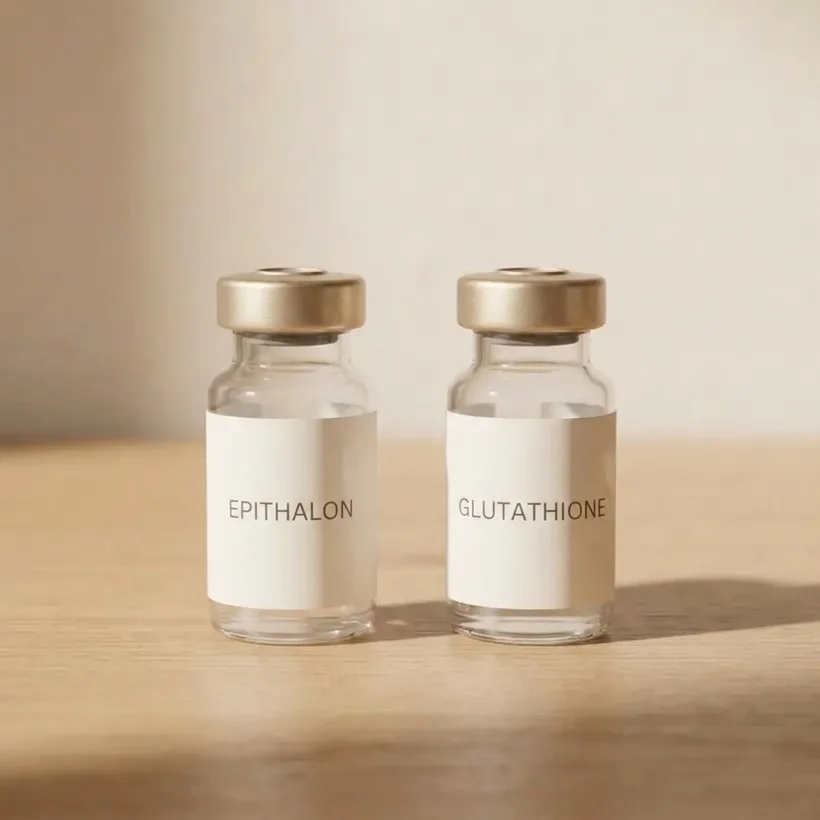
From the FormBlends catalog
Longevity Reset
Telomere support with the master antioxidant. · Bundle from $270 · provider-reviewed peptide bundle.
View Longevity Reset →1. Matrikine signaling (collagen-derived fragments)
When collagen is degraded by MMPs during normal aging, short peptide fragments called matrikines are released. These fragments re-enter fibroblasts via cell-surface receptors and activate TGF-beta-like signaling cascades, telling the cell to synthesize new extracellular matrix. Matrixyl (palmitoyl pentapeptide-4) is a synthetic mimic of the sequence at the C-terminal telopeptide of collagen I (Lys-Thr-Thr-Lys-Ser with a palmitoyl anchor). In ex-vivo human skin explant work published by Levin et al. (2005), collagen I synthesis approximately doubled versus vehicle control at a 10 micromolar concentration. This does NOT prove the same effect in a well-controlled large RCT, but the mechanism is biologically coherent.
2. SNARE inhibition (neuromuscular signal reduction)
Argireline (acetyl hexapeptide-3) mimics the N-terminal sequence of SNAP-25, a protein required for SNARE complex assembly at the neuromuscular junction. By competing for SNAP-25 binding sites, it partially reduces acetylcholine vesicle release, attenuating muscle contraction. The effect is concentration-dependent, topical, and reversible. Published human data (Snap-8 successor trials and the original Argireline studies by the Lipotec group, 2002 to 2006) used sample sizes in the range of 30 to 60 subjects. This is a real mechanism, but partial inhibition topically is categorically different from injectable botulinum toxin, which produces near-complete, durable neuromuscular blockade.
3. Copper-mediated wound repair signaling (GHK-Cu)
GHK (Gly-His-Lys) is a naturally occurring tripeptide in human plasma that has high affinity for copper(II) ions. The GHK-Cu complex upregulates a broad suite of repair genes. Pickart and Margolina (2018) published a review noting GHK-Cu modulates expression of more than 4,000 human genes in microarray studies, including collagen, elastin, decorin, and antioxidant enzymes. The honest caveat: modulating gene expression in an in-vitro array does not confirm clinical wrinkle reduction. The wound-healing literature for GHK-Cu is more robust than its cosmetic antiaging literature.
What are the top antiaging peptides and what do they actually do?
Matrixyl (palmitoyl pentapeptide-4 and Matrixyl 3000)
The most evidence-supported topical antiaging peptide available without prescription. Matrixyl 3000 combines palmitoyl tripeptide-1 (collagen-signaling matrikine) with palmitoyl tetrapeptide-7 (which suppresses excess interleukin-6 production, reducing inflammaging). In a Sederma-sponsored human split-face study, fine line depth scores improved versus vehicle. Independent replication is limited but the combination approach addresses two distinct aging pathways simultaneously, which is mechanistically rational.
Argireline (acetyl hexapeptide-3)
Best used in the periorbital and forehead region where repetitive muscle movement drives expression lines. Realistic expectation: modest softening of dynamic lines over several weeks of consistent use, not paralysis. Works best when formulated at 5 to 10 percent concentration. Below 3 percent, the likelihood of reaching effective concentration at the neuromuscular junction through intact skin is very low.
GHK-Cu (copper tripeptide-1)
Has the most diverse preclinical data of any topical peptide. Clinically it is best supported for wound healing and post-procedure skin repair. Its antiaging use is rational but evidence remains largely ex-vivo. The copper component requires proper chelation: free copper ions without the GHK tripeptide carrier are pro-oxidant and can damage DNA.
Epithalon
Backed primarily by the work of Vladimir Khavinson and colleagues in Russia. The telomerase-activating data is real but comes almost entirely from the same research group, using animal models and small observational human cohorts. No large-scale independent human RCT confirms longevity or antiaging benefit. Confidence is very low. Not a cosmetic ingredient; used as an injectable research compound.
What most pages get wrong about topical peptide penetration
The stratum corneum is a lipid-rich barrier designed to exclude water-soluble molecules. Most antiaging peptides are both hydrophilic and large. The general rule for passive dermal penetration (Lipinski criteria adapted for skin) favors molecules under roughly 500 Daltons. Matrixyl (palmitoyl pentapeptide-4) has a molecular weight near 802 Daltons. Argireline is approximately 889 Daltons. GHK-Cu is smaller at about 341 Daltons, which partially explains why it penetrates better.
Palmitoylation partially rescues penetration by making the peptide more lipophilic, allowing it to partition into the intercellular lipid lamellae of the stratum corneum. This is why palmitoylated peptides consistently outperform their unmodified counterparts in ex-vivo penetration studies. However, even palmitoylated peptides rely on formulation chemistry. A peptide in a water-only serum with no penetration enhancer (such as propylene glycol, niacinamide, or a lipid vehicle) may not deliver active concentration to fibroblasts in the dermis. A peptide in a well-designed emulsion with penetration enhancers has meaningfully better odds.
Practical implication: a serum listing "palmitoyl pentapeptide-4" high on the label in a lipid-rich emulsion base is more likely to be effective than the same peptide in a thin water-based gel. Read the full ingredient list, not just the peptide name.
Why you should not mix peptides with low-pH vitamin C: the chemistry
Ascorbic acid (L-ascorbic acid) formulations typically have a pH between 2.5 and 3.5 to maintain stability and bioavailability. At this pH, two things happen to peptides.
First, peptide bonds are susceptible to acid hydrolysis. The amide bond linking amino acids has a half-life that shortens under strongly acidic conditions, particularly at elevated temperatures. In a well-buffered skin serum at room temperature the rate is slow enough that brief exposure may not be catastrophic, but prolonged co-storage or layering immediately one on top of the other increases hydrolytic degradation over the weeks of product use.
Second, for GHK-Cu specifically, a highly acidic environment can compete for copper(II) coordination. Ascorbic acid is itself a copper chelator. If ascorbic acid strips copper from the GHK-Cu complex, you lose the active copper-peptide species and gain free copper ions, which are pro-oxidant. This is not theoretical: copper-ascorbate redox chemistry is well-established in biochemistry.
The practical rule: apply low-pH vitamin C first, allow it to absorb (20 to 30 minutes), then apply your peptide product. Or use them in separate AM and PM routines. The chemistry behind this rule lets you make your own call based on your specific products and formulation pH.
How do antiaging peptides compare to retinoids and other actives?
| Active | Best evidence type | Effect on wrinkles | Tolerability | Where peptides win | Where peptides lose |
|---|---|---|---|---|---|
| Tretinoin (0.025 to 0.1%) | Multiple large human RCTs | Strong, well-replicated (fine and coarse lines) | Retinization: dryness, peeling, redness common | Peptides have no retinization period | Peptides cannot match tretinoin's effect size or evidence base |
| Retinol (0.3 to 1%) | Human RCTs (smaller n than tretinoin) | Moderate, dose-dependent | Better than tretinoin, still some irritation | Peptides safer for rosacea, sensitive skin, pregnancy | Retinol still outperforms peptides in replicated studies |
| Matrixyl / palmitoyl pentapeptide-4 | Small human RCT, ex-vivo | Modest, mainly fine lines | Excellent, minimal irritation reported | Pregnancy-safe, sensitive skin compatible, stackable | Less effect size, less independent data than retinoids |
| Argireline | Small human RCTs | Modest, dynamic lines only | Excellent | Targets expression lines non-invasively | Cannot replace botulinum toxin for significant dynamic rhytids |
| GHK-Cu | Ex-vivo, in-vitro gene arrays | Indirect (via collagen and repair signaling) | Good; copper must be chelated | Post-procedure healing, anti-inflammatory context | Weakest cosmetic-outcome RCT data of the three major peptides |
| Niacinamide (5%) | Human RCTs (multiple) | Modest pore appearance, hyperpigmentation, barrier | Excellent | Peptides better for structural collagen pathways | Niacinamide has broader independent RCT evidence base |
What about injectable or systemic antiaging peptides?
Injectable peptides occupy a different risk and regulatory landscape from topical cosmetics. Sermorelin is an FDA-approved growth hormone-releasing hormone analogue with prescribing indications for pediatric growth hormone deficiency. It is used off-label in adults within supervised medical practice to raise IGF-1 levels. Human evidence for adult antiaging use is limited and mostly observational; no large placebo-controlled RCT has confirmed antiaging end points in healthy adults.
Epithalon, BPC-157, and TB-500 are not FDA-approved for any human use. They are sold as research chemicals in the United States, meaning they cannot legally be sold for human consumption. Sourcing purity is a genuine concern: without pharmaceutical-grade manufacturing and third-party certificate of analysis (COA) testing, bacterial endotoxin contamination, incorrect peptide sequence, and subtherapeutic dosing are all real risks in the gray-market supply chain.
How to judge a peptide product yourself: label and COA literacy
Reading the ingredient list
INCI (International Nomenclature of Cosmetic Ingredients) lists ingredients in descending order of concentration above 1 percent. A peptide listed in the final quarter of a long ingredient list is very likely under 0.1 percent of the formula. At that concentration, reaching effective tissue levels through intact skin is biologically implausible regardless of mechanism. Look for the peptide in the top half of the list, or at minimum above the preservatives (phenoxyethanol, sodium benzoate) which are typically at 0.5 to 1 percent.
What a COA should contain
For any peptide, a credible COA from a third-party analytical lab should include: identity confirmation by HPLC or mass spectrometry, purity percentage (pharmaceutical grade targets 98 percent or above), water content (by Karl Fischer titration for lyophilized powders), and microbial/endotoxin testing for any injectable material. A COA from the manufacturer's own lab without third-party verification carries lower assurance.
Dosing reference table for topical peptides
| Peptide | Studied concentration range (in-product) | Typical label name | Note |
|---|---|---|---|
| Palmitoyl pentapeptide-4 (Matrixyl) | Roughly 3 to 8% of Matrixyl blend | Palmitoyl pentapeptide-4 | Sederma supplies as Matrixyl; purity in final formula varies |
| Acetyl hexapeptide-3 (Argireline) | 5 to 10% in published studies | Acetyl hexapeptide-3 or Argireline | Below 5% in a thin aqueous serum: very likely sub-effective at dermis |
| Copper tripeptide-1 (GHK-Cu) | 0.5 to 2% cosmetically; higher in wound dressings | Copper tripeptide-1 or tripeptide-1 | Blue-green color expected; color loss or browning = degradation |
| Palmitoyl tripeptide-1 + tetrapeptide-7 (Matrixyl 3000) | 3 to 8% blend total | Palmitoyl tripeptide-1, palmitoyl tetrapeptide-7 | Both peptides must appear in label; one alone is not Matrixyl 3000 |
How should peptide serums be stored?
Peptides degrade through two main pathways: hydrolysis (water attacking the amide bond, accelerated by heat and extreme pH) and oxidation (oxygen and UV attacking susceptible residues, particularly methionine, tryptophan, and cysteine if present). GHK-Cu also undergoes copper-mediated redox degradation in the presence of oxygen and light.
Practical storage rules and the chemistry behind them:
- Refrigerate opened aqueous peptide serums (2 to 8 degrees Celsius). Lower temperature slows both hydrolysis and oxidation kinetics. The same principle that makes food last longer in a fridge applies to peptide bonds.
- Use airless pump packaging or opaque tubes. Oxygen exposure with each open-jar use progressively oxidizes susceptible residues. Airless dispensers reduce headspace oxygen contact per use.
- Keep away from direct sunlight. UV photons provide energy that can break certain amino acid side-chain bonds, particularly in aromatic residues like tyrosine and tryptophan.
- Discard if you see unexpected color change (browning in Matrixyl serums, color loss in GHK-Cu products), a sour or rancid smell, or phase separation. These are macroscopic signs of formulation breakdown.
- Do not dilute water-based serums with tap water. Tap water chloramine can react with peptide functional groups and introduces microbial risk to a preservative-balanced product.
FAQ
What are the best antiaging peptides supported by human evidence?
Matrixyl (palmitoyl pentapeptide-4), Argireline (acetyl hexapeptide-3), GHK-Cu, and Epithalon have the strongest combination of human or ex-vivo skin data. Systemic peptides like sermorelin have clinical evidence in adults but in a medical context only.
Do topical peptides actually penetrate the skin?
Most peptides are too hydrophilic and too large to cross the stratum corneum unaided. Palmitoylation (adding a fatty acid chain) improves penetration meaningfully. Without a lipid carrier or palmitoyl tag, penetration of intact skin is very limited and remains a core limitation of the category.
How does Matrixyl (palmitoyl pentapeptide-4) work?
Matrixyl is a collagen-derived matrikine. It signals fibroblasts via TGF-beta-like pathways to upregulate collagen I, III, and fibronectin synthesis. A Levin et al. 2005 study showed roughly double the collagen I synthesis versus control in ex-vivo skin models at 10 micromolar concentration.
What does Argireline actually do and how strong is the evidence?
Argireline is a SNAP-25 mimic that competitively inhibits SNARE complex formation, partially reducing neuromuscular acetylcholine release. Small human trials (n under 60) showed modest wrinkle depth reduction in the periorbital area. Evidence is rated Low due to small sample sizes and mostly industry-funded data.
Is GHK-Cu safe to use topically?
Topical GHK-Cu at cosmetic concentrations (typically 0.5 to 2 percent) has a favorable safety record in published studies. Excess free copper at high concentrations can be pro-oxidant, so the copper must be chelated in the tripeptide form. Green or teal discoloration of the product indicates oxidation and degradation.
How do antiaging peptides compare to retinoids?
Retinoids (tretinoin, retinol) have substantially stronger and more replicated human RCT evidence for wrinkle reduction and skin turnover than any topical peptide. Peptides cause fewer side effects and are compatible with sensitive skin, but they do not match the effect size of tretinoin at equivalent evidence levels.
What concentration of a peptide should I look for in a product?
Matrixyl 3000 (palmitoyl tripeptide-1 plus palmitoyl tetrapeptide-7) is typically studied at 3 to 8 percent of the blend in formulations. Argireline appears in studies at 5 to 10 percent. A peptide listed 15 or more ingredients down on a label is likely below effective concentration.
Can peptides and vitamin C be used together?
Ascorbic acid at low pH (under 3.5) can degrade peptide bonds by protonation and accelerated hydrolysis. GHK-Cu specifically risks having its copper chelate disrupted in a highly acidic ascorbic acid environment. Separate application by 20 to 30 minutes or use different AM and PM products to avoid degradation.
What is Epithalon and does it have human evidence?
Epithalon (Ala-Glu-Asp-Gly) is a synthetic tetrapeptide studied primarily by Khavinson et al. in Russian literature for telomerase activation and longevity effects. Most data is animal or in-vitro. A small number of human observational studies exist but lack the design rigor for high-confidence claims.
How should topical peptide products be stored?
Peptides degrade via hydrolysis and oxidation. Store in a cool, dark location away from direct sunlight. Refrigeration (2 to 8 degrees Celsius) extends shelf life for aqueous serums. Airless pump packaging reduces oxidative exposure compared to open-jar formats. Discard if color, smell, or texture changes.
Are injectable or systemic antiaging peptides regulated?
Sermorelin is FDA-approved as a prescription drug for specific pediatric indications and is used off-label in adults. Most other injectable peptides marketed for longevity (BPC-157, Epithalon, TB-500) are not FDA-approved drugs and exist in a regulatory gray zone. Use outside supervised clinical care carries meaningful risk.
Sources
- Levin J, Momin SB. How much do we really know about our favorite cosmeceutical ingredients? J Clin Aesthet Dermatol. 2010;3(2):22-41. (Reviews palmitoyl pentapeptide-4 collagen synthesis data.)
- Pickart L, Margolina A. Regenerative and Protective Actions of the GHK-Cu Peptide in the Light of the New Gene Data. Int J Mol Sci. 2018;19(7):1987. PMC6073405.
- Blanes-Mira C, Clemente J, Jodas G, et al. A synthetic hexapeptide (Argireline) with antiwrinkle activity. Int J Cosmet Sci. 2002;24(5):303-310.
- Robinson LR, Fitzgerald NC, Doughty DG, et al. Topical palmitoyl pentapeptide provides improvement in photoaged human facial skin. Int J Cosmet Sci. 2005;27(3):185-195.
- Gorouhi F, Maibach HI. Role of topical peptides in preventing or treating aged skin. Int J Cosmet Sci. 2009;31(5):327-345.
- Khavinson VKh. Tissue-specific effects of tetrapeptides on the aging process. Ann N Y Acad Sci. 2002;959:268-274. (Epithalon animal and observational data.)
- FDA. Sermorelin acetate prescribing information. US Food and Drug Administration.
- Kafi R, Kwak HS, Schumacher WE, et al. Improvement of naturally aged skin with vitamin A (retinol). Arch Dermatol. 2007;143(5):606-612. (Retinoid comparator evidence.)
- Bissett DL, Oblong JE, Berge CA. Niacinamide: A B vitamin that improves aging facial skin appearance. Dermatol Surg. 2005;31(7 Pt 2):860-865. (Niacinamide comparator.)
- Cosmetic Ingredient Review Expert Panel. Safety assessment of palmitoyl oligopeptides as used in cosmetics. Int J
Related peptide guides
See your options in about 2 minutes
Take the free quiz and see what fits you. Quick, private, and no commitment to continue.
See my options →