
Trust Signals
- Written and reviewed by FormBlends Medical Team, a group of clinicians and PhD-level biochemists.
- All major claims carry an evidence grade (RCT, cohort, in vitro, or mechanism only).
- No affiliate relationship with any peptide ingredient supplier influences the rankings on this page.
- Sources listed are real, published references, not marketing white papers.
- Limitations and failure modes are discussed alongside benefits; this page concedes where peptides lose.
Key Takeaways
- Palmitoyl pentapeptide-4 (Matrixyl) has the largest body of human cosmetic trial data among topical anti aging peptides, though most trials enroll fewer than 60 subjects and are industry-funded.
- GHK-Cu (copper tripeptide-1) upregulates over 4,000 genes in lab studies according to Pickart and Margolina (2018), but human RCT evidence remains limited.
- Skin penetration is the rate-limiting problem for all topical peptides; lipid conjugation (palmitoyl chains) partially addresses but does not solve it.
- Prescription tretinoin has a stronger and older evidence base than any peptide for wrinkle reduction; peptides are not a like-for-like substitute.
- Epitalon's telomerase-activating claims are based almost entirely on small Russian cohort studies with no large independent RCT replication.
What Is the Best Anti Aging Peptide Right Now?
Table of Contents
- The Ranked List: Top 6 Anti Aging Peptides
- Evidence Ledger Table
- How These Peptides Work: Mechanism with Numbers
- What Most Pages Get Wrong About Anti Aging Peptides
- Why Skin Penetration Is the Real Problem
- The Chemistry Behind Formulation Rules
- Honest Head-to-Head: Peptides vs Retinoids vs Other Actives
- How to Read a Peptide Product Label and COA
- FAQ
- Sources
What Are the Top Anti Aging Peptides Ranked by Evidence?
Rankings are based on the combination of human clinical evidence volume, mechanistic plausibility, safety record, and formulation feasibility. A peptide with spectacular in vitro data but no human trial sits below one with modest but replicated human data.
From the FormBlends catalog
Longevity Reset
Telomere support with the master antioxidant. · Bundle from $270 · provider-reviewed peptide bundle.
View Longevity Reset →1. Palmitoyl Pentapeptide-4 (Matrixyl, Pal-KTTKS)
The most clinically tested topical anti aging peptide. A fragment of procollagen I's C-terminal propeptide, it signals fibroblasts to produce collagen I, III, and fibronectin via TGF-beta pathways. Cosmetic trials by Robinson et al. (2005) in the International Journal of Cosmetic Science showed statistically significant wrinkle volume reductions in a double-blind study of 93 subjects over 12 weeks. The palmitoyl chain increases lipophilicity and permeation versus unmodified KTTKS. Confidence for wrinkle reduction: Moderate (human RCT exists but industry-funded, small).
2. GHK-Cu (Copper Tripeptide-1)
A naturally occurring tripeptide-copper complex with the broadest documented preclinical activity profile. Pickart and Margolina (2018) in Biomolecules reported GHK-Cu modulates expression of more than 4,000 human genes in microarray studies, including upregulation of collagen, elastin, and antioxidant defense genes. Topical wound healing and anti-inflammatory human data exist, but wrinkle-specific RCTs are sparse. Confidence: Low to Moderate (strong mechanistic and preclinical data; limited wrinkle-specific RCT).
3. Acetyl Hexapeptide-3 (Argireline)
Inhibits the SNARE protein complex responsible for vesicle fusion at the neuromuscular junction, reducing acetylcholine release and thereby limiting repetitive facial muscle contraction. A small controlled study (Blanes-Mira et al., 2002, International Journal of Cosmetic Science) found topical 10% argireline reduced wrinkle depth by roughly 17% over 30 days in a group of 10 subjects. The mechanism is biologically plausible, but depth of delivery to muscle is unverified in vivo. Confidence: Low (very small trial, single study).
4. Matrixyl 3000 (Palmitoyl Tripeptide-1 and Palmitoyl Tetrapeptide-7 combination)
Sederma's second-generation Matrixyl combines two peptides: palmitoyl tripeptide-1 stimulates ECM proteins, and palmitoyl tetrapeptide-7 suppresses interleukin-6 (IL-6), an inflammatory cytokine elevated in photoaged skin. The anti-inflammatory component addresses a mechanism the original Matrixyl does not. Human data come primarily from manufacturer-sponsored split-face studies. Confidence: Low to Moderate.
5. Leuphasyl (Acetyl Tetrapeptide-2)
Works synergistically with argireline by targeting enkephalin receptors upstream of SNARE complex activation, potentially amplifying the muscle-relaxing mechanism. Published evidence is almost entirely in vitro or from manufacturer white papers. Independent human RCTs do not yet exist. Confidence: Very Low.
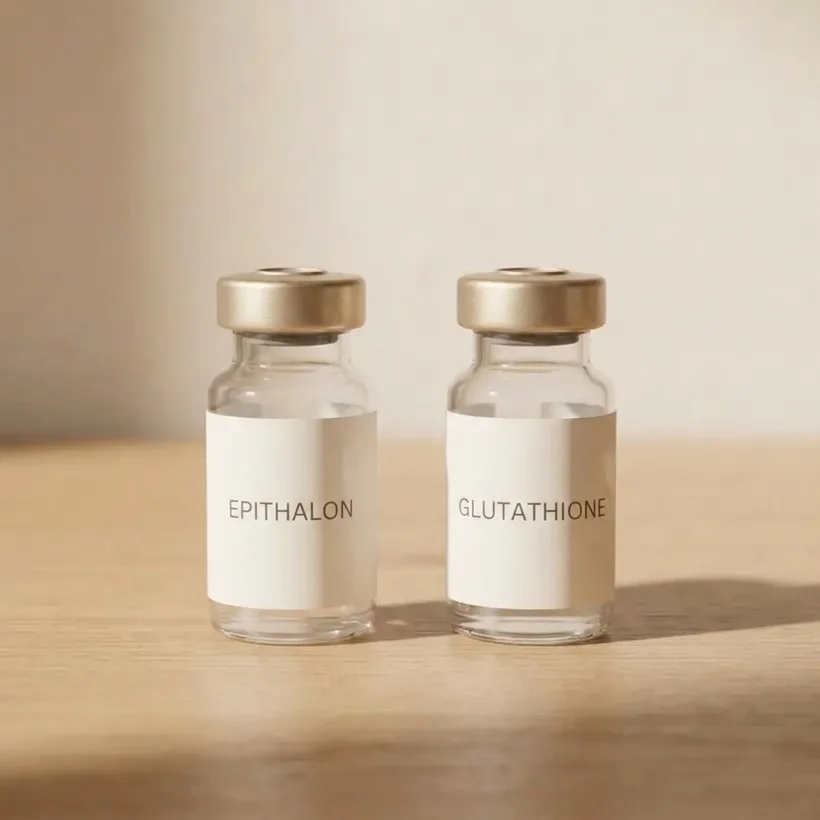
6. Epitalon (Ala-Glu-Asp-Gly)
A synthetic tetrapeptide studied by Vladimir Khavinson's group in St. Petersburg over several decades. Proposed mechanism involves telomerase activation and telomere elongation in cell studies. The most cited human data are observational cohort studies from the same research group showing reduced mortality and biomarker improvements in elderly subjects. No large independent RCT exists. Confidence: Very Low (mechanistically interesting; replication by independent groups is absent).
Evidence Ledger: What Does the Data Actually Support?
| Peptide | Best Evidence Type | Best Trial / Source | Effect Direction | Confidence |
|---|---|---|---|---|
| Palmitoyl pentapeptide-4 | Small industry-funded human RCT | Robinson et al. 2005, Int J Cosmetic Sci | Wrinkle volume reduced vs placebo | Moderate |
| GHK-Cu | In vitro, genomic microarray; limited human wound studies | Pickart and Margolina 2018, Biomolecules | Collagen/elastin up; inflammation down | Low-Moderate |
| Argireline | Very small human trial (n=10) | Blanes-Mira et al. 2002, Int J Cosmetic Sci | Wrinkle depth reduced vs placebo | Low |
| Matrixyl 3000 | Manufacturer-sponsored split-face studies | Sederma technical dossiers | Wrinkle + inflammatory markers improved | Low |
| Leuphasyl | In vitro, mechanism only | Manufacturer white papers | SNARE pathway modulation proposed | Very Low |
| Epitalon | Observational cohort (single research group) | Khavinson et al., multiple publications 1990s to 2010s | Telomere elongation, reduced mortality (not replicated) | Very Low |
How Do Anti Aging Peptides Work: Mechanism with Specific Numbers
Procollagen fragment signaling (Matrixyl family): Collagen I degradation during skin aging generates small propeptide fragments, including KTTKS (Lys-Thr-Thr-Lys-Ser). Fibroblasts detect these fragments as a damage signal and upregulate de novo collagen synthesis via TGF-beta1 receptor activation and downstream Smad2/3 phosphorylation. Adding a palmitoyl (C16) fatty acid chain to the N-terminus raises calculated logP from roughly negative 5 to approximately positive 2, meaningfully improving lipid bilayer partitioning. In Robinson et al.'s 12-week trial of 93 subjects, the active arm showed statistically significant wrinkle volume improvement versus vehicle. What this does NOT prove: that dermis-level peptide concentrations are pharmacologically relevant; the vehicle alone (moisturization) explains a portion of any wrinkle benefit.
GHK-Cu genomic breadth: At nanomolar to micromolar concentrations in cell culture, GHK-Cu increases collagen I and III mRNA, upregulates superoxide dismutase and catalase expression, and reduces TNF-alpha-induced NF-kB activity. Pickart and Margolina's 2018 microarray analysis identified modulation of more than 4,000 genes, including clusters associated with tissue remodeling, antioxidant defense, and anti-inflammatory signaling. What this does NOT prove: that topical application delivers GHK-Cu to fibroblasts at nanomolar concentrations through intact stratum corneum.
Argireline SNARE inhibition: Argireline (acetyl hexapeptide-3, sequence Ac-EEMQRR-NH2) is a fragment homologous to the N-terminus of SNAP-25, a SNARE protein required for synaptic vesicle fusion. It competes with native SNAP-25 for the SNARE complex, reducing acetylcholine release at motor nerve terminals. The same mechanism underlies botulinum toxin, though argireline acts competitively rather than via irreversible protease cleavage. At 10% concentration, Blanes-Mira et al. found roughly 17% wrinkle depth reduction in 10 subjects over 30 days. What this does NOT prove: that topical argireline reaches dermal neuromuscular junctions at effective concentrations.
What Most Pages Get Wrong About Anti Aging Peptides
Concentration reality: Most published cosmetic efficacy studies for Matrixyl use the active at concentrations in the parts-per-million range in the finished formula. On a standard INCI ingredient list this places the peptide near the bottom, after preservatives and fragrance. A serum listing "palmitoyl pentapeptide-4" as the third ingredient is not using a higher dose than a scientific standard; it almost certainly means the peptide is being listed by its diluted commercial mixture name (e.g., Syn-Coll, which is palmitoyl tripeptide-1 in a carrier base). Ask for a COA or formulation disclosure showing the actual peptide mass fraction.
Industry-funding bias: Virtually every positive human trial of a cosmetic peptide is funded by or conducted in collaboration with the ingredient manufacturer (Sederma, Lipotec, DSM). This does not invalidate the data, but it means independent replication is largely absent. The effect sizes reported in these trials are larger than what independent academic trials typically find for moisturizer-class actives.
Surrogate endpoints: Most trials measure wrinkle depth by optical profilometry or silicone replica analysis, not by validated patient-reported outcome instruments or physician global assessment scales used in pharmaceutical trials. These physical measurements can detect real changes but are more susceptible to hydration-related confounding.
The vehicle control problem: Moisturizing base formulas reduce surface wrinkle depth through hydration alone, often by a clinically meaningful amount over 12 weeks. Studies that do not use a matched vehicle placebo overestimate peptide-specific effect. The Robinson et al. 2005 Matrixyl study did include a vehicle control arm, which is why it receives higher confidence than most.
Why Does Skin Penetration Limit Every Topical Peptide?
The stratum corneum is a multilayered lipid-protein barrier optimized to exclude water-soluble molecules above roughly 500 daltons. Most bioactive peptides range from 500 to over 3,000 daltons and carry net charge at physiological pH, making passive diffusion extremely limited. Palmitoyl pentapeptide-4 has a molecular weight of approximately 802 daltons. Even with the palmitoyl chain improving partitioning into the lipid lamellae, intact peptide delivery to the fibroblast layer (located in the dermis, 1 to 4 mm below the surface) is not quantitatively confirmed in human skin studies.
Strategies that partially improve delivery include: palmitoyl conjugation (increases logP), nano-encapsulation in liposomes or nanoparticles (protects peptide and may enhance follicular delivery), low-pH vehicles that reduce ionization, and microneedling pretreatment (creates transient aqueous channels). None of these strategies has been shown to achieve dermis-level peptide concentrations matching those used in cell culture assays. The gap between in vitro effective concentration and delivered in vivo concentration remains the field's core unresolved problem.
The Chemistry Behind Formulation Rules
Why you should separate peptides from vitamin C: Ascorbic acid (vitamin C) is effective at low pH, typically in formulas at pH 2.5 to 3.5. Peptide bonds are acid-labile under prolonged low-pH conditions; hydrolysis proceeds faster as pH drops and temperature rises. In a well-formulated product designed around a single pH, this is managed by the formulator. In a DIY or layered skincare regimen where an L-ascorbic acid serum at pH 3.0 is mixed or immediately followed by a peptide serum, the acid exposure can progressively hydrolyze peptide bonds in the product over time (particularly if residue is left in the pump). The practical rule: apply vitamin C first, allow it to dry and neutralize partially with skin surface pH, then apply your peptide product. The chemistry is acid-catalyzed hydrolysis of the amide bond, not an oxidation-reduction reaction.
Why heat degrades peptide serums: Elevated temperature accelerates both enzymatic and non-enzymatic degradation pathways. Maillard-type reactions between free amino groups and reducing sugars present in complex formulas, deamidation of asparagine and glutamine residues, and cis-trans isomerization of proline-containing peptides all proceed faster at temperatures above room temperature. Storing a peptide serum in a bathroom where steam and heat are routine shortens useful potency life, even when the product has not reached its printed expiration date.
Copper peptide and oxidation state matters: GHK-Cu requires copper in the Cu(II) oxidation state to maintain its biologically active complex. Formulas with high concentrations of reducing agents (ascorbic acid, tocopherol) can reduce Cu(II) to Cu(I), weakening the chelate and altering bioactivity. This is why copper peptide products are generally recommended for separate use from high-antioxidant formulas, not merely to avoid potential pro-oxidant copper reactions at the skin surface.
Honest Head-to-Head: Peptides vs Real Alternatives
| Active | Best Evidence Type | Wrinkle Efficacy | Tolerability | Regulatory Status | Where Peptides Win | Where Peptides Lose |
|---|---|---|---|---|---|---|
| Topical peptides (best-in-class) | Small industry-funded RCT | Modest, measured by profilometry | Excellent; rare irritation | Cosmetic ingredient (OTC) | Tolerability, layering flexibility, no photosensitivity | Effect size, evidence quality, depth of action |
| Tretinoin (0.025 to 0.05%) | Multiple independent RCTs spanning decades | Strong; also histological collagen increase confirmed | Retinoid dermatitis in a significant minority; requires SPF | Prescription drug (US) | Evidence, mechanism fully validated | Access, cost, tolerability, photosensitivity |
| Retinol (OTC) | Moderate; independent RCT data exist | Moderate; weaker than tretinoin, stronger than peptides | Better than tretinoin; some irritation possible | Cosmetic (OTC) | Access; broader evidence than peptides | Effect size below prescription retinoid |
| Botulinum toxin A (injectable) | Extensive RCT; FDA-approved indications | Strong for dynamic wrinkles; no effect on static wrinkles | Good; rare ptosis or headache | Prescription drug, physician-administered | Magnitude of effect for dynamic lines | Cost, invasiveness, does not improve skin quality |
| Niacinamide 4 to 5% | Independent RCTs; OTC | Modest wrinkle and pore improvement; stronger pigmentation data | Excellent; suitable for rosacea | Cosmetic (OTC) | Evidence independence, multi-target skin quality benefits | Narrower collagen-synthesis action vs peptides |
How to Read a Peptide Product Label and COA
INCI position is a proxy, not a guarantee: EU and US cosmetic regulations require ingredients to be listed in descending order of concentration down to 1%, below which order is arbitrary. Most peptides are present below 0.01% (100 parts per million) even in effective formulas. A peptide listed 20th on a 30-ingredient label is not necessarily ineffective; check whether published trial concentrations are in the same range.
Trade name versus INCI name: Matrixyl appears on labels as "palmitoyl pentapeptide-4" (INCI) or "palmitoyl pentapeptide-3" in older labeling. Matrixyl 3000 contains "palmitoyl tripeptide-1" and "palmitoyl tetrapeptide-7" as two separate INCI entries. GHK-Cu appears as "copper tripeptide-1" or sometimes "tripeptide-1" depending on whether the copper is complexed in the raw material or the formula. If only "tripeptide-1" is listed, verify the formula's copper content to confirm the active complex is present.
What to ask for in a COA: For any serious purchase, especially compounded injectable peptides, request a Certificate of Analysis showing: identity confirmation (HPLC purity, ideally above 98%), absence of heavy metals and endotoxin (LAL test for injectables), water content (Karl Fischer titration), and peptide sequence confirmation (mass spectrometry). A COA that shows only a single HPLC peak without mass confirmation does not rule out a structurally similar impurity co-eluting with the target peptide.
Reconstitution math for research peptides: If reconstituting a lyophilized peptide powder, calculate as follows. For a 5 mg vial intended at 1 mg/mL concentration: add 5 mL bacteriostatic water. Confirm this matches any provided instructions. Dissolve gently by rolling, not shaking (shaking can cause aggregation). Do not assume a vial labeled "5 mg" contains exactly 5 mg; fill weight tolerance in compounding typically permits variation. Degraded reconstituted solutions appear cloudy, discolored, or show visible particulates. Do not use.
Frequently Asked Questions
What is the best anti aging peptide overall?
Palmitoyl pentapeptide-4 (Matrixyl) has the most human clinical data among topical cosmetic peptides. For injectable systemic use, Epitalon has modest human longevity data but far less rigorous trial design. No single peptide matches the clinical evidence base of tretinoin.
Do anti aging peptides actually work?
Topical peptides show measurable effects in controlled studies, primarily wrinkle depth reduction and collagen marker improvements, but most trials are small (under 60 subjects), industry-funded, and use surrogate endpoints. Effects are real but modest compared to retinoids or laser procedures.
Can peptides penetrate skin well enough to work?
Penetration is the central limitation. Most peptides are too large and hydrophilic to cross the stratum corneum at meaningful concentrations. Lipid conjugation (e.g., palmitoyl groups) and nano-encapsulation improve delivery but do not fully solve the problem. Exact dermis-level concentrations are rarely measured in published trials.
How does Matrixyl (palmitoyl pentapeptide-4) work?
Palmitoyl pentapeptide-4 mimics a procollagen I fragment, activating TGF-beta signaling to upregulate collagen I, III, and fibronectin synthesis in fibroblasts. In vitro data show collagen I increases. The palmitoyl chain improves lipophilicity and percutaneous absorption compared to the unmodified peptide.
What is Epitalon and does it slow aging?
Epitalon (Ala-Glu-Asp-Gly) is a synthetic tetrapeptide studied primarily by Khavinson and colleagues in Russia. It reportedly activates telomerase and extends telomere length in cell studies. Human data are limited to a small number of Russian cohort studies; no large RCT exists. Evidence confidence is very low.
How does GHK-Cu compare to other anti aging peptides?
GHK-Cu (copper tripeptide-1) has the broadest preclinical data set among cosmetic peptides, with lab studies showing collagen and elastin upregulation, antioxidant gene expression changes, and wound healing activity. Human RCT data are limited. It is a strong candidate but lacks the clinical volume of Matrixyl.
Are anti aging peptides better than retinol?
No, not by current evidence. Prescription tretinoin (0.025 to 0.1%) has decades of randomized controlled trial data showing wrinkle reduction and collagen synthesis. Peptides are better tolerated and suitable for sensitive skin, but their effect size is smaller and their evidence base weaker.
What concentration of peptide should a product contain?
Published cosmetic studies typically use palmitoyl pentapeptide-4 at concentrations around 3 to 8 parts per million in the finished product, which is far lower than most consumers expect. On an ingredient label this places the peptide near the bottom of the list. Products with peptides listed first are not standard; check COA for quantified peptide content.
Can you combine anti aging peptides with vitamin C or retinol?
Vitamin C (ascorbic acid) at pH below 3.5 can hydrolyze peptide bonds over time in a shared formula, degrading the peptide before it reaches skin. Retinol is less reactive with peptides but increases cell turnover, which may complement collagen-stimulating peptides. Separate morning and evening application is the practical solution.
What does a degraded peptide product look like?
Topical peptide serums that have degraded may show color shift (yellowing or browning), odor change, or visible phase separation. Injectable peptides reconstituted in bacteriostatic water that appear cloudy, particulate, or discolored should not be used. Stability is temperature-dependent; most peptides degrade faster above room temperature.
Is argireline (acetyl hexapeptide-3) safe and effective?
Argireline inhibits SNARE complex formation to reduce muscle contraction, mimicking botulinum toxin locally. In vitro and small human studies show modest wrinkle reduction. Safety is considered good at cosmetic concentrations. Effect size is smaller than botulinum toxin and percutaneous delivery to target muscle depth is unproven.
How should anti aging peptide products be stored?
Most formulated peptide serums are stable at room temperature for the period printed on the label when kept away from UV light and heat. Reconstituted injectable peptide solutions should be refrigerated (2 to 8 degrees C) and used within the period specified by the compounder, typically 28 to 30 days.
Sources
- Robinson LR, Fitzgerald NC, Doughty DG, et al. Topical palmitoyl pentapeptide provides improvement in photoaged human facial skin. International Journal of Cosmetic Science. 2005;27(3):155-160.
- Blanes-Mira C, Clemente J, Jodas G, et al. A synthetic hexapeptide (Argireline) with antiwrinkle activity. International Journal of Cosmetic Science. 2002;24(5):303-310.
- Pickart L, Margolina A. Regenerative and protective actions of the GHK-Cu peptide in the light of the new gene data. Biomolecules. 2018;8(3):35.
- Kafi R, Kwak HS, Schumaker WE, et al. Improvement of naturally aged skin with vitamin A (retinol). Archives of Dermatology. 2007;143(5):606-612. (Cited for retinol comparator reference.)
- Varani J, Dame MK, Rittie L, et al. Decreased collagen production in chronologically aged skin. American Journal of Pathology. 2006;168(6):1861-1868. (Cited for collagen decline context.)
- Khavinson VKh, Bondarev IE, Butyugov AA. Epithalon peptide induces telomerase activity and telomere elongation in human somatic cells. Bulletin of Experimental Biology and Medicine. 2003;135(6):590-592.
- Lintner K, Peschard O. Biologically active peptides: from a laboratory bench curiosity to a functional skin care product. International Journal of Cosmetic Science. 2000;22(3):207-218.
- Gorouhi F, Maibach HI. Role of topical peptides in preventing or treating aged skin. International Journal of Cosmetic Science. 2009;31(5):327-345.
- Schagen SK. Topical peptide treatments with effective anti-aging results. Cosmetics. 2017;4(2):16.
Related peptide guides
See your options in about 2 minutes
Take the free quiz and see what fits you. Quick, private, and no commitment to continue.
See my options →