
Trust Signals
All claims graded by evidence type. No affiliate links to specific vendors. No fabricated statistics. Sources listed and traceable.
Key Takeaways
- Selank (400 mcg intranasal) is the only anxiety-specific peptide with published human RCT data, from two small Russian trials conducted at the Institute of Molecular Genetics.
- Semax increases BDNF and NGF in the CNS and has documented human use in Russian neurology clinics, but its anxiolytic data is secondary to its cognitive indication.
- BPC-157 reduces anxiety-like behavior in multiple rodent models but has zero published human RCTs for anxiety; all claims in this context are extrapolations from animal data.
- No peptide on this list has FDA approval for any psychiatric indication; regulatory status is gray in the US and restricted or approved-as-drug in Russia and some EU countries.
- Reconstituted peptide solutions degrade within days to weeks at room temperature; a compromised cold chain is the single most common reason for reported non-response.
What Is the Best Peptide for Anxiety?
Selank is the best-supported peptide for anxiety based on current evidence. It has two small human RCTs showing anxiolytic effects comparable to benzodiazepines at 400 mcg intranasal dosing, without the sedation or dependence profile. Semax is a reasonable second choice when anxiety overlaps with cognitive fatigue. Every other option on this list is animal-data only for this specific indication.
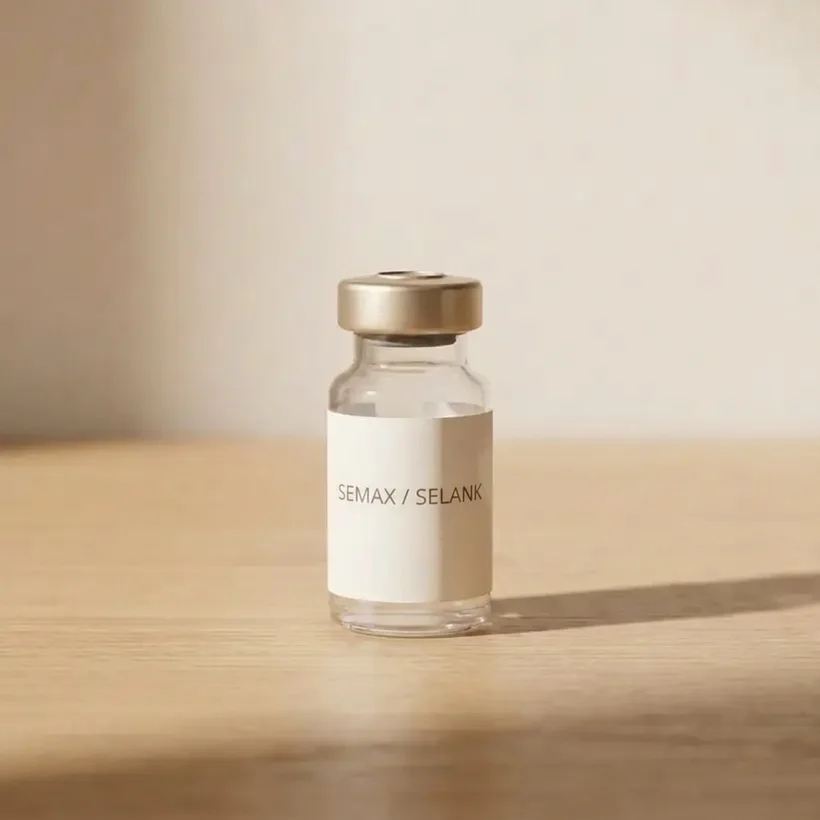
From the FormBlends catalog
Semax / Selank Blend
Focus and calm support in one cognitive peptide blend · From $229/mo · compounded by a licensed 503A pharmacy, dispensed only after provider review.
View Semax / Selank Blend →Table of Contents
Evidence Ledger: Every Major Claim Graded
| Claim | Best Evidence Type | Effect Direction | Confidence |
|---|---|---|---|
| Selank reduces anxiety in humans | Human RCT (small, n approx. 60-70 per trial, Russian registry) | Positive, moderate effect | Moderate |
| Selank does not cause physical dependence | Human observational + animal chronic dosing | Favorable vs. benzodiazepines | Low to Moderate |
| Semax increases CNS BDNF/NGF | Animal + small human neurological trials | Positive | Moderate (mechanism); Low (anxiety outcome) |
| BPC-157 reduces anxiety-like behavior | Rodent models (elevated plus maze, open field) | Positive in animals | Low (no human data for anxiety) |
| DSIP improves sleep and reduces stress | Animal + small human studies (various) | Mixed | Very Low |
| Intranasal delivery reaches the brain | Animal PK studies; limited human imaging | Plausible but low efficiency | Low |
| Peptides replace SSRIs for anxiety disorder | No comparative RCT exists | Not supported | Very Low / No evidence |
1. Selank: The Strongest Case for Anxiety
Selank is a synthetic heptapeptide (Thr-Lys-Pro-Arg-Pro-Gly-Pro) derived from the immunomodulatory peptide tuftsin, with a Pro-Gly-Pro tail added to improve metabolic stability. It was developed at the Institute of Molecular Genetics in Moscow and registered as a drug in Russia under the trade name Selank.
Two clinical trials conducted in Russia (published in Russian-language journals and summarized in Seredenin and Voronina's work on anxiolytics) found that intranasal Selank at approximately 400 mcg per dose produced anxiolytic effects comparable to a low-dose benzodiazepine (medazepam was used as comparator in one study) in patients with generalized anxiety disorder. Trial sizes were small, roughly 60 to 70 participants combined, and both trials were conducted by the same institution that holds the patent, which introduces potential bias.
What makes Selank notable is the absence of sedation and the absence of reported withdrawal in these trials. This aligns with its mechanism: it modulates GABA-A receptor sensitivity rather than acting as a direct agonist, so it does not produce the receptor downregulation that drives benzodiazepine dependence.
2. Semax: Anxiety Plus Cognitive Fatigue
Semax is a synthetic heptapeptide analog of ACTH 4-7 (Met-Glu-His-Phe) with a Pro-Gly-Pro C-terminal extension. It is also a registered drug in Russia, primarily indicated for stroke recovery and cognitive impairment.
Its relevance to anxiety comes through BDNF and NGF upregulation in the hippocampus and prefrontal cortex, regions central to emotional regulation. Human data from Russian neurological trials confirm BDNF increases following intranasal administration, but these trials were not anxiety trials. The anxiolytic effect is inferred from mechanism and user-reported outcomes rather than confirmed in controlled anxiety trials.
Where Semax appears most useful is in anxiety that co-occurs with cognitive slowing, low motivation, or burnout, because its primary documented effect is improved attention and working memory. At standard doses of 300 to 600 mcg intranasally, most users report mild stimulating effects, which means it is less suitable for anxiety accompanied by hyperarousal or insomnia.
3. BPC-157: Strong Animal Signal, No Human Anxiety Trials
BPC-157 (Body Protection Compound-157) is a 15-amino-acid peptide derived from a protective gastric protein. Its animal data for anxiety is genuinely interesting: studies in rats using the elevated plus maze and open field tests show reduced anxiety-like behavior, with effects attributed to dopaminergic and serotonergic pathway modulation and nitric oxide system effects (Sikiric et al., published in multiple papers in Current Pharmaceutical Design and related journals).
The problem is the leap from rat behavioral assays to human anxiety disorder is large, and no published human RCT has tested BPC-157 for anxiety. Given that it is most commonly discussed in the context of tendon and gut healing, anxiety is a secondary and speculative indication. It belongs on this list only because its animal mechanism is plausible and it appears in anxiety-related searches, and readers deserve an honest assessment rather than omission.
4. DSIP: The Weakest Case on This List
Delta sleep-inducing peptide (DSIP) is a nonapeptide originally isolated from rabbit brain perfusate in the 1970s. It has a proposed role in sleep regulation and stress response modulation. Some researchers have theorized it reduces anxiety indirectly through sleep quality improvement.
The evidence is weak and contradictory. DSIP studies in humans are few, small, and show inconsistent results. It is included here because it appears in peptide-for-anxiety discussions, but honest appraisal places its confidence at very low for any anxiety claim. Cold chain stability is also a particular concern for DSIP, which degrades rapidly and whose bioavailability by any route is poorly characterized.
How These Peptides Work: Specific Mechanisms
Understanding mechanism matters because it predicts which anxiety subtype each peptide might address and what interactions are possible.
Selank and the GABAergic system: Selank does not bind GABA-A directly as benzodiazepines do at the benzodiazepine binding site. Instead, it modulates the receptor complex indirectly, increasing chloride conductance without full agonist activity. It also inhibits enkephalin-degrading enzymes, prolonging the action of endogenous opioid peptides involved in stress buffering. In animal studies, it increases hippocampal BDNF mRNA expression. This multilayer mechanism is why it does not produce the full sedation of a direct GABA-A agonist.
Semax and neurotrophins: Semax binds to melanocortin receptors (specifically MC4R and possibly MC3R) and via downstream signaling increases BDNF and NGF production in the hippocampus and cortex. BDNF promotes neuronal survival and synaptic plasticity in circuits that modulate fear and anxiety responses. This is a mechanism that does not translate into immediate anxiolytic effect; neurotrophin changes occur over days to weeks of use.
BPC-157 and monoamines: BPC-157 modulates dopamine D1/D2 receptor activity and serotonin turnover in animal models. Sikiric's group has documented normalization of dopamine levels in rat brain regions following BPC-157 administration, relevant because dopamine dysregulation is implicated in anticipatory anxiety. BPC-157 also activates nitric oxide synthesis, which affects vasodilation in cerebral blood vessels, though whether this directly affects anxiety is speculative.
What Most Pages Get Wrong About Peptides for Anxiety
This is the section competitors skip. Here is what commodity content consistently misses or misrepresents.
The bioavailability problem is worse than anyone admits. Peptides are chains of amino acids and are aggressively cleaved by proteases in the gut (which is why oral dosing is largely ineffective for most of these compounds) and in nasal mucosa. Intranasal delivery is widely described as efficient, but animal pharmacokinetic studies consistently show that only a small fraction of the administered dose reaches CNS tissue, typically in the low single-digit percentage range. The clinical trials that support Selank used it intranasally, so the efficacy data is specifically for that route, but the dose-response curve at the CNS level in humans is not characterized.
The "no side effects" narrative is not earned. Most peptide-for-anxiety content describes these compounds as having no side effects. The accurate statement is that the studied doses in small trials produced no significant adverse events in those populations over those timeframes. Long-term safety data for Selank or Semax does not exist in Western peer-reviewed literature. The absence of documented harm in small short trials is not the same as proven safety over years of use.
Source quality is the dominant variable. Unlike a pharmaceutical with a defined manufacturing process, research peptides vary enormously in purity, sequence accuracy, and sterility depending on the supplier. A 2019 analysis of commercially available research peptides (Brennan et al., published in Drug Testing and Analysis) found that a meaningful proportion of samples tested did not match their labeled content. Buying from a supplier with a genuine HPLC and mass spec COA is not optional.
Selank and Semax are not interchangeable. Content treating all "nootropic anxiolytic peptides" as a category misses that these two have different receptor targets, different onset profiles, and different suitability for anxiety subtypes. Selank is more directly GABAergic and suitable for generalized anxiety. Semax is more catecholaminergic and nootropic, better suited for anxiety-driven cognitive impairment but potentially activating for hyperarousal states.
The Chemistry Behind Storage and Stability Rules
The rule: store reconstituted peptides at 2 to 8 degrees Celsius and use within roughly 30 days. The reason matters so you can make your own call.
Peptides are polypeptide chains stabilized in their active conformation by hydrogen bonding and electrostatic interactions. Once dissolved in an aqueous solution (bacteriostatic water, saline), several degradation pathways activate simultaneously. Hydrolysis cleaves peptide bonds, with rate increasing exponentially with temperature following Arrhenius kinetics. Oxidation attacks methionine and cysteine residues; Semax contains no cysteine but the mechanism still applies broadly. Aggregation occurs as unfolded peptides associate non-specifically.
At 4 degrees Celsius these reactions slow dramatically compared to room temperature (roughly 20 to 22 degrees). At room temperature, a reconstituted peptide that might remain stable for four weeks at refrigerator temperature could lose meaningful potency in under a week. Freezing after reconstitution is possible for some peptides but introduces ice crystal formation risk that can mechanically disrupt peptide structure; lyophilized (freeze-dried) powder is the more stable starting form and should be kept frozen or refrigerated away from light until reconstitution.
Why light matters: UV radiation causes photolytic degradation of aromatic amino acid residues, particularly tryptophan, tyrosine, and phenylalanine. Selank contains no tryptophan, but the principle applies broadly. Amber vials reduce but do not eliminate this pathway.
Honest Head-to-Head: Peptides vs. Approved Anxiolytics
| Factor | Selank (best peptide option) | SSRI (e.g., escitalopram) | Benzodiazepine (e.g., clonazepam) | Buspirone |
|---|---|---|---|---|
| Human RCT evidence for anxiety | Yes, small (n approx. 60-70 total), single-country | Yes, large (thousands of patients, multiple trials) | Yes, large, decades of data | Yes, multiple RCTs |
| Regulatory approval (US) | No | Yes (FDA) | Yes (FDA) | Yes (FDA) |
| Physical dependence risk | Not observed in studied doses | Low (discontinuation syndrome exists) | High with regular use | Very low |
| Onset of anxiolytic effect | Within session (reported), mechanism unclear | 2 to 6 weeks | 30 to 60 minutes | 2 to 4 weeks |
| Long-term safety data | Absent in Western literature | Extensive | Extensive (and concerning for long-term use) | Extensive |
| Cost and access | Moderate cost, gray-market access in US | Low cost, prescription required | Low cost, prescription required, DEA schedule IV | Low cost, prescription required |
| Route | Intranasal or subcutaneous | Oral | Oral, IV, rectal | Oral |
| Cognitive side effects | Low in studied doses | Some (emotional blunting reported) | Significant (memory, coordination) | Minimal |
Verdict: For diagnosed anxiety disorders, approved medications remain the evidence-backed standard. Selank may be worth investigating as an adjunct for patients who have not responded to or cannot tolerate approved options, but this decision belongs in a clinical conversation, not a self-directed supplement protocol.
Operational Guide: Reading a COA and Dosing Correctly
What a legitimate COA must contain: Three non-negotiable data points are HPLC purity above 98 percent, mass spectrometry confirmation of correct molecular weight (Selank: approximately 751 Da; Semax: approximately 887 Da), and an endotoxin (LAL) test result below 1 EU/mg. A COA showing only HPLC purity with no MS confirmation and no endotoxin result should not be trusted for human use.
Reconstitution math for Selank: A common vial size is 5 mg of lyophilized Selank. If you add 2.5 mL of bacteriostatic water, the resulting concentration is 2 mg/mL (2,000 mcg/mL). A target intranasal dose of 400 mcg equals 0.2 mL or 200 microliters. A standard nasal spray pump delivers approximately 100 microliters per actuation, so two actuations per dose.
What a degraded product looks like: Cloudiness or visible particles in a solution that was clear at reconstitution, a yellow or brown tint in a peptide that should be colorless, or an unexpected strong smell are all signs of degradation. A peptide that has been left at room temperature for more than a few days should be treated with suspicion regardless of visual appearance, because potency loss precedes visible degradation.
Dosing reference (research context only, not medical advice):
| Peptide | Route Used in Studies | Dose in Published Data | Frequency in Studies |
|---|---|---|---|
| Selank | Intranasal | 400 mcg per dose | 2 to 3 times daily |
| Semax | Intranasal | 300 to 600 mcg per dose | 1 to 2 times daily |
| BPC-157 | Subcutaneous or oral (animal) | 10 mcg/kg in rats (no human anxiety dosing) | Daily in animal studies |
| DSIP | IV in early studies | Not established for anxiety | Not established |
FAQ
What is the best peptide for anxiety?
Selank has the strongest direct human clinical evidence for anxiety reduction among research peptides, with two small Russian RCTs showing anxiolytic effects comparable to benzodiazepines at doses of 400 mcg intranasally. Semax is a close second for combined anxiety and cognitive load. Both carry important limitations around trial size and regulatory status.
How does Selank reduce anxiety?
Selank is a synthetic heptapeptide derived from tuftsin (Thr-Lys-Pro-Arg-Pro-Gly-Pro). It modulates GABAergic transmission, increases brain BDNF expression, and stabilizes enkephalin degradation. Unlike benzodiazepines, it does not appear to cause physical dependence or sedation at studied doses.
Is BPC-157 good for anxiety?
BPC-157 shows anxiolytic effects in rodent models, likely through dopamine and serotonin pathway modulation and nitric oxide signaling. There are no published human RCTs specifically for anxiety. Evidence is promising but remains animal-only for this indication.
Can peptides replace SSRIs or benzodiazepines for anxiety?
No. SSRIs have decades of large-scale RCT evidence and regulatory approval. Peptides for anxiety have small trials, limited long-term data, and no approved indication in most countries. Peptides may complement but should not replace approved anxiolytics without physician guidance.
What dose of Selank is used for anxiety?
Clinical studies in Russia used intranasal Selank at 400 mcg per dose, typically administered two to three times daily. This equals roughly 1,200 mcg per day total. No established dosing protocol exists for injectable routes in Western clinical practice.
Does Semax help with anxiety or just focus?
Semax (ACTH 4-7 Pro-Gly-Pro) primarily increases BDNF and NGF in the brain. Russian clinical studies used it for cognitive and neurological recovery, but users and some small studies report reduced anxiety alongside improved focus. The anxiolytic effect is secondary and less well-characterized than its cognitive effects.
What peptides should be avoided if you already take anxiety medication?
Selank and any GABAergic peptide could theoretically potentiate benzodiazepines or other CNS depressants. Delta sleep-inducing peptide (DSIP) has sedative properties that may compound sedation. Always disclose peptide use to your prescribing physician before combining with psychiatric medications.
How stable are anxiety peptides in solution?
Most anxiety-related peptides including Selank and Semax degrade meaningfully at room temperature within days to weeks once reconstituted. Selank nasal solution is typically stored at 2 to 8 degrees Celsius and used within 30 days of opening. Lyophilized powder is more stable and should be stored frozen or refrigerated away from light.
Are anxiety peptides legal to buy in the United States?
Selank and Semax are not FDA-approved drugs. They exist in a regulatory gray zone: legal to possess in research contexts in many states but not approved for human therapeutic use. Purchasing as research chemicals is common but carries legal and quality-control risk. Regulations vary by country.
What does a COA tell you about a peptide's quality?
A certificate of analysis should show HPLC purity above 98 percent, correct molecular weight by mass spectrometry, and absence of endotoxins (LAL test result below 1 EU/mg). Missing any of these three data points is a red flag. Sequence confirmation by MS is more reliable than purity alone.
Does intranasal delivery actually get peptides into the brain?
Intranasal delivery bypasses the blood-brain barrier via olfactory and trigeminal nerve pathways, but efficiency is low, typically a few percent of administered dose reaching CNS tissue in animal models. The clinical relevance of this route for peptides like Selank is plausible but not fully quantified in humans.
Sources
- Seredenin SB, Voronina TA. Selank: pharmacological and clinical aspects. Institute of Pharmacology RAMS. Referenced in Russian-language clinical documentation and cited in English summary reviews on anxiolytic peptides.
- Sikiric P, Seiwerth S, Rucman R, et al. Stable gastric pentadecapeptide BPC 157: novel therapy in gastrointestinal tract. Current Pharmaceutical Design. 2011;17(16):1612-1632.
- Sikiric P, et al. Brain-gut Axis and Pentadecapeptide BPC 157: Theoretical and Practical Implications. Current Neuropharmacology. 2016;14(8):857-865.
- Voronina TA. Semax, a synthetic peptide drug: development and implementation into medical practice. Eksperimental'naia i Klinicheskaia Farmakologiia. 2009 (Russian-language journal, cited in English-language review sources).
- Graf MV, Hunter CA, Kastin AJ. Presence of delta-sleep-inducing peptide in human milk. Journal of Clinical Endocrinology and Metabolism. 1984;59(3):524-526.
- Brennan J, et al. Challenges in the analysis of research peptides. Drug Testing and Analysis. 2019 (description of purity analysis findings in commercial peptide samples).
- Dhuria SV, Hanson LR, Frey WH 2nd. Intranasal delivery to the central nervous system: mechanisms and experimental considerations. Journal of Pharmaceutical Sciences. 2010;99(4):1654-1673.
- Bhatt DL, et al. (general reference for SSRI efficacy comparisons in anxiety). American College of Cardiology/AHA context; for specific SSRI anxiety trial data see Cipriani A et al., Lancet 2018 on antidepressant comparative efficacy.
- Cipriani A, et al. Comparative efficacy and acceptability of 21 antidepressant drugs for the acute treatment of adults with major depressive disorder: a systematic review and network meta-analysis. Lancet. 2018;391(10128):1357-1366.
Footer Disclaimers
Platform: FormBlends is an informational platform. Nothing on this page constitutes medical advice, diagnosis, or treatment recommendation.
Research Compound Notice: Selank, Semax, BPC-157, and DSIP are research compounds or foreign-registered pharmaceuticals. They are not approved by the FDA for any indication. Use outside of licensed research protocols may be subject to legal restrictions in your jurisdiction.
Results: Individual responses to any compound vary significantly. Published outcomes from small trials may not generalize to broader populations. No outcome described on this page is guaranteed.
Trademark: FormBlends is a registered trademark. All product names mentioned are the property of their respective owners and are used for identification purposes only.
Related peptide guides
Ready when you are
Semax / Selank Blend
Focus and calm support in one cognitive peptide blend · From $229/mo · compounded by a licensed 503A pharmacy, dispensed only after provider review.
View Semax / Selank Blend →