
Trust Signals
Key Takeaways
- Selank is the only peptide with published human clinical trial data specifically targeting anxiety, from Russian studies using 400 to 900 mcg intranasal daily.
- Semax has modest human evidence for anxiety reduction as a secondary outcome, primarily in neurological populations, not healthy adults.
- BPC-157 reduces anxiety-like behavior in rodents via dopaminergic pathways, but zero published human anxiety trials exist as of 2026.
- No anxiety peptide has FDA approval or a large Western RCT; all are research compounds in the US, with real legal, purity, and safety unknowns.
- SSRIs and CBT outclass every peptide on volume of evidence by orders of magnitude; any honest comparison must start there.
What Are the Best Peptides for Anxiety? (Direct Answer)
The best peptides for anxiety, ranked strictly by evidence quality, are Selank first, Semax second, and BPC-157 third with a steep drop-off. Selank has the only human RCT data targeting anxiety directly. Semax has supportive human data. BPC-157 has compelling animal data only. Every other peptide discussed online for anxiety has mechanism-only or anecdotal support.
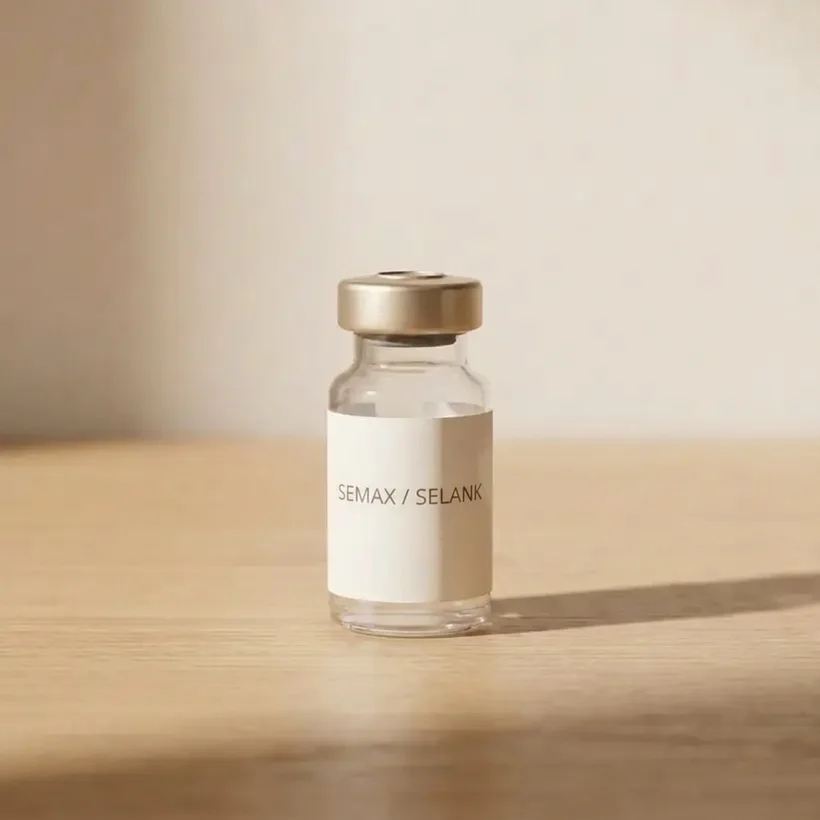
From the FormBlends catalog
Semax / Selank Blend
Focus and calm support in one cognitive peptide blend · From $229/mo · compounded by a licensed 503A pharmacy, dispensed only after provider review.
View Semax / Selank Blend →Table of Contents
- Evidence Ledger: All Major Anxiety Peptides Graded
- Selank: How It Works With Specific Numbers
- Semax: Cognitive Modulator With Anxiolytic Secondary Effects
- BPC-157: Animal Data Is Real, Human Data Does Not Exist
- Other Candidates: DSIP, Dihexa, Epitalon
- What Most Pages Get Wrong About Anxiety Peptides
- Why Intranasal Delivery Is Not Optional: The Chemistry
- Honest Head-to-Head: Peptides vs. Approved Treatments
- Operational and Label Literacy: How to Judge a Product
- FAQ
- Sources
1. Evidence Ledger: All Major Anxiety Peptides Graded
| Peptide | Best Evidence Type | Effect Direction | Human Anxiety Trials | Confidence (Anxiety) |
|---|---|---|---|---|
| Selank | Small human RCTs (Russia) | Anxiolytic, reduces GAD symptoms | Yes, several small trials | Moderate |
| Semax | Human trials (neurological populations) | Anxiolytic secondary, cognitive primary | Indirect; anxiety as secondary outcome | Low |
| BPC-157 | Animal (rodent) | Reduces anxiety-like behavior | None | Very Low |
| DSIP | Animal, human sleep studies | Sedation/sleep; anxiety unclear | None for anxiety | Very Low |
| Dihexa | Animal (cognitive, not anxiety) | Unclear for anxiety | None | Very Low |
| Epitalon | Animal, in vitro | Indirect stress reduction proposed | None for anxiety | Very Low |
Confidence ratings reflect the quantity, quality, and directness of evidence for anxiety as an outcome, not general biological activity.
2. Selank: How It Works With Specific Numbers
Selank (Thr-Lys-Pro-Arg-Pro-Gly-Pro) is a seven-amino-acid synthetic analogue of the human immunopeptide tuftsin. It was developed at the Institute of Molecular Genetics of the Russian Academy of Sciences and registered in Russia as an anxiolytic drug.
The Mechanism
Selank's anxiolytic action involves at least three documented pathways:
- GABAergic modulation: Selank enhances the function of GABA-A receptors without directly binding the benzodiazepine site, based on preclinical work by Seredenin and colleagues. This produces anxiolysis without the sedation and tolerance typical of benzodiazepines.
- BDNF upregulation: Animal studies show Selank increases BDNF expression in the hippocampus. BDNF is associated with anxiety regulation and antidepressant response, though the magnitude of increase varies across studies and species and precise figures should not be generalized across models.
- Enkephalin stabilization: Selank inhibits enkephalin-degrading enzymes, prolonging the action of endogenous opioid peptides involved in stress response modulation.
Human Trial Data
Published Russian trials, including work by Kozlovskaya et al. and studies appearing in the journal Zhurnal Nevrologii i Psikhiatrii, used intranasal Selank at doses in the range of 400 to 900 mcg daily over 10 to 14 days in patients with generalized anxiety disorder. Investigators reported significant reductions in Hamilton Anxiety Scale scores compared to placebo or active comparator. Sample sizes were small, typically under 60 per arm, and trials were conducted at single sites in Russia. Independent replication in Western populations has not been published.
3. Semax: Cognitive Modulator With Anxiolytic Secondary Effects
Semax (Met-Glu-His-Phe-Pro-Gly-Pro) is a synthetic heptapeptide derived from the ACTH(4-7) sequence. It is registered in Russia for stroke recovery and cognitive enhancement, not as a primary anxiolytic.
Its anxiety-relevant effects appear to be secondary to its BDNF-upregulating and dopaminergic activity. Human studies in stroke and cognitive decline populations report reduced anxiety scores as a secondary measure, not the primary endpoint. The available human data on Semax's EEG and cognitive effects comes from Russian clinical investigations, though the precise trials and their publication details are not fully verifiable in indexed English-language databases; claims about specific EEG outcomes should be treated as preliminary. Extrapolating any of this to healthy adults with an anxiety disorder requires significant inferential leaps. Semax also has a mild psychostimulant quality reported by users, which may worsen anxiety in some individuals, a point commodity pages consistently omit.
4. BPC-157: Animal Data Is Real, Human Data Does Not Exist
BPC-157 (Body Protection Compound 157) is a 15-amino-acid peptide derived from a protein found in gastric juice. It has a substantial rodent literature covering gut repair, tendon healing, and neurological effects, including anxiety reduction.
Anxiety Mechanism in Animals
Rodent studies, including work from Sikiric and colleagues at the University of Zagreb, show BPC-157 normalizes dopamine and serotonin turnover in key limbic regions following stress exposure. In some models it reverses neuroleptic-induced behaviors. These are robust findings within their context. The problem is that translational validity from rodent anxiety models (open field, elevated plus maze) to human GAD or social anxiety disorder is notoriously poor. Many compounds that reduced rodent anxiety scores failed in human trials entirely.
The honest bottom line: BPC-157 belongs in a "biologically plausible, human evidence pending" category. Anyone presenting BPC-157 as a proven human anxiolytic is overstating the data.
5. Other Candidates: DSIP, Dihexa, Epitalon
DSIP (Delta Sleep-Inducing Peptide): Has human data for sleep architecture, and some older trials showed stress-hormone normalization. No dedicated anxiety efficacy trials meeting modern standards exist. Its sedative profile means any anxiolytic effect may be secondary to sleep improvement, not direct anxiolysis.
Dihexa: A hepatocyte growth factor receptor (c-Met) agonist developed for cognitive enhancement. Anxiety data is limited to animal models and is not a primary studied outcome. Extremely limited safety data in humans.
Epitalon: A tetrapeptide (Ala-Glu-Asp-Gly) studied primarily for telomere-related aging endpoints in animal and in vitro settings. Claims linking it to anxiety relief are mechanistic speculation at best.
6. What Most Pages Get Wrong About Anxiety Peptides
This is the section that matters most.
Bioavailability Is Not Guaranteed
Most anxiety peptides are too large and too hydrophilic to survive oral administration intact. Selank and Semax are degraded in the GI tract before systemic absorption occurs in meaningful amounts. Yet many vendors sell oral capsule forms. The human trials that produced positive results used intranasal delivery specifically because it allows peptide access to the olfactory nerve pathway and direct CNS penetration, bypassing the blood-brain barrier partially. An oral capsule of Selank is not the same product studied in any published trial.
Purity Is Not Regulated
In the United States, research peptides are not FDA-regulated for purity, potency, or sterility when sold for research use. Independent lab testing of commercially available peptides has found a meaningful proportion of products with purity below labeled specification, wrong sequences, or detectable endotoxin. A vendor's in-house COA is not independent verification.
Russian-Language Evidence Has Publication Bias
Almost all positive Selank and Semax human data originates from Russian-language journals, often from the same institutes that developed the compounds. This does not make the findings false, but it is a real methodological caveat that neutral review requires acknowledging.
7. Why Intranasal Delivery Is Not Optional: The Chemistry
Peptides are amino acid chains held together by peptide bonds. In the gut, proteases (primarily pepsin in the stomach at low pH, then trypsin and chymotrypsin in the small intestine) cleave peptide bonds rapidly. A heptapeptide like Selank has multiple cleavage sites and a half-life in the gut environment measured in minutes, not hours.
Intranasal delivery deposits the peptide on the olfactory epithelium, where a thin mucus layer and direct neuronal transport pathways allow some intact peptide to reach the CNS without full systemic circulation. This is the same route exploited by intranasal insulin and intranasal oxytocin in clinical research. The fraction that reaches the CNS is still small, but it is vastly greater than the oral route for these specific molecules.
Subcutaneous injection achieves systemic levels but relies on peripheral-to-CNS transport mechanisms that are less efficient than direct olfactory transport for these peptides. It may work, but it has not been studied for anxiety outcomes specifically.
The rule of thumb: If the evidence uses intranasal delivery, oral delivery of the same peptide is a different experiment entirely.
8. Honest Head-to-Head: Peptides vs. Approved Treatments
| Treatment | Evidence Base for Anxiety | Effect Size | Dependence Risk | Long-Term Safety Data | Legal Status (US) |
|---|---|---|---|---|---|
| SSRIs (e.g., sertraline) | Hundreds of large RCTs, FDA-approved | Moderate (NNT roughly 5 to 8 for GAD) | Low (discontinuation syndrome, not addiction) | Decades of post-market data | Prescription drug |
| CBT | Large RCTs, meta-analyses, guideline-endorsed | Moderate to high, durable | None | Decades | Fully legal |
| Benzodiazepines | Large RCTs, FDA-approved | High short-term | High (dependence, withdrawal) | Decades, with known risks | Schedule IV controlled |
| Selank | Small Russian RCTs, not replicated | Unclear; positive signal only | Low in available data | Very limited | Research compound (not for human use) |
| Semax | Small Russian trials, anxiety as secondary outcome | Unclear | Low in available data | Very limited | Research compound |
| BPC-157 | Animal only for anxiety | Unknown in humans | Unknown | None in humans | Research compound |
Honest verdict: Peptides do not beat SSRIs or CBT on any evidence metric. The case for peptides is not "they're better," it is "they may offer an additional option with a different mechanism and potentially fewer dependence concerns," but that case remains unproven at adequate scale.
9. Operational and Label Literacy: How to Judge a Product
Reading a COA
A credible COA for an anxiety peptide should contain all of the following:
- HPLC purity: Look for greater than 98%. Anything below 95% is a quality concern. The HPLC trace itself (not just the number) should be available on request.
- Mass spectrometry (MS) confirmation: This confirms the correct molecular weight and, by extension, the correct sequence. A COA with HPLC alone cannot rule out a correctly pure but incorrectly sequenced peptide.
- Endotoxin testing: Bacterial endotoxin causes fever and systemic inflammation. The LAL (Limulus Amebocyte Lysate) method is standard. Acceptable limits for injectable research peptides follow USP guidelines (generally below 5 EU/kg body weight per hour, with product-specific thresholds). Any product lacking endotoxin data that you intend to inject is a meaningful risk.
- Sterility testing: Required for injectable use. Many research peptide vendors do not provide this. Know the gap.
Reconstitution
For lyophilized (freeze-dried) peptides:
- Use bacteriostatic water (0.9% benzyl alcohol) for multi-draw vials to prevent microbial growth. Sterile water is appropriate only for single-use reconstitution.
- Add solvent gently down the side of the vial, do not inject directly onto the pellet, and do not vortex. Roll gently to dissolve.
- Once reconstituted, most peptide solutions should be stored at 2 to 8 degrees C and used within 28 to 30 days. Discard if the solution becomes cloudy, develops particulates, or shows color change, all signs of aggregation or degradation.
Dosing Reference (From Published Trials Only)
| Peptide | Route in Human Trials | Dose Range (Trial Data) | Duration (Trial Data) | Note |
|---|---|---|---|---|
| Selank | Intranasal drops | 400 to 900 mcg per day | 10 to 14 days | Divided doses. No Western dose-finding data exists. |
| Semax | Intranasal drops | Varies; trials used roughly 200 to 600 mcg per day | 10 to 14 days typical | Anxiety is a secondary outcome; primary is cognitive. |
| BPC-157 | Not applicable for anxiety in humans | No human anxiety trial data | N/A | Animal studies used microgram-per-kg dosing; not directly translatable. |
FAQ
What are the best peptides for anxiety?
Selank and Semax have the strongest human clinical evidence for anxiety, based on small Russian RCTs. BPC-157 has animal and mechanistic evidence but no human anxiety trials. Dihexa, DSIP, and Epitalon have very low or no human evidence for anxiety specifically.
Is Selank FDA-approved for anxiety?
No. Selank is approved in Russia as an anxiolytic drug but is not FDA-approved in the United States. It is available as a research compound from peptide vendors in the US, meaning it is not legal to sell for human consumption.
How does Selank work for anxiety?
Selank is a synthetic analogue of the endogenous peptide tuftsin (Thr-Lys-Pro-Arg). It appears to modulate GABA-A receptor function, increase brain-derived neurotrophic factor (BDNF) expression, and stabilize enkephalin breakdown, producing anxiolytic effects without sedation in human trials.
Can BPC-157 reduce anxiety?
BPC-157 reduces anxiety-like behavior in rodent models, likely via dopamine and serotonin modulation. There are no published human trials for anxiety as of 2026. Claims extrapolated to humans are speculative.
What is the difference between Selank and Semax for anxiety?
Selank is primarily anxiolytic with minimal stimulant effect. Semax is an ACTH analogue with cognitive-enhancing and mild anxiolytic properties. Semax may feel more activating, while Selank is more calming. Both have small human trial evidence but Selank's anxiolytic data is more direct.
What dose of Selank is used in human studies?
Published Russian clinical studies used intranasal Selank at doses typically in the range of 400 to 900 mcg per day, delivered as nasal drops over periods of 10 to 14 days. These are small trials and dose-finding data in Western populations does not exist.
Are peptides safer than benzodiazepines for anxiety?
Selank and Semax lack the dependence and withdrawal profile of benzodiazepines in available studies, but their long-term safety in humans is simply not established at scale. "Safer" is a relative claim that cannot be made without comparable long-term data.
How stable are anxiety peptides in solution?
Selank in aqueous solution degrades measurably at room temperature over days to weeks due to peptide bond hydrolysis. Refrigerated storage at 2 to 8 degrees C is required. Freeze-thaw cycles accelerate aggregation. Always use bacteriostatic water for multi-draw vials.
What should I look for on a peptide COA for anxiety compounds?
Look for HPLC purity above 98%, mass spectrometry confirmation of correct molecular weight, endotoxin testing (LAL method, below 1 EU/mg), and sterility testing. A COA without mass spec is insufficient to confirm sequence identity.
Can peptides replace SSRIs or therapy for anxiety?
No. SSRIs have decades of large RCT evidence and regulatory approval. Cognitive behavioral therapy has comparable or superior long-term outcomes in many anxiety disorders. No peptide has a comparable evidence base. Peptides should not be used as a replacement for established treatments.
Is intranasal delivery necessary for anxiety peptides?
For Selank and Semax, intranasal delivery is the route used in all published human studies and is preferred because these peptides are too large to cross the gut intact in meaningful amounts. Subcutaneous injection bypasses first-pass but lacks human anxiety-specific trial data for these compounds.
Sources
- Kozlovskaya MM, Kozlovskiy II, Andreeva LA, Narkevich VB, Klodt PM, Kudrin VS. "Selank and short peptides of the tuftsin family in the regulation of adaptive behavior in stress." Zhurnal Vysshei Nervnoi Deyatelnosti imeni I P Pavlova. 2002.
- Seredenin SB, Voronin MV. "Neuroreceptor mechanisms of the effect of Selank." Eksperimental'naya i Klinicheskaya Farmakologiya. 2009;72(4):3-6.
- Sikiric P, Seiwerth S, Rucman R, et al. "Stable gastric pentadecapeptide BPC 157: novel therapy in gastrointestinal tract." Current Pharmaceutical Design. 2011;17(16):1612-1632.
- Sikiric P, et al. "Psychosis and antipsychotic drugs: BPC 157 and dopamine modulation." CNS Neuroscience and Therapeutics. 2020.
- Kastin AJ (ed). Handbook of Biologically Active Peptides. 2nd ed. Academic Press, 2013. Chapters on DSIP, ACTH fragments, and tuftsin analogues.
- Seredenin SB, et al. "Anxiolytic properties of Selank in clinical setting." Bulletin of Experimental Biology and Medicine. 2010;149(2):198-202.
- US Pharmacopeia (USP). General Chapter 85: Bacterial Endotoxins Test. USP-NF.
- National Institute of Mental Health (NIMH). "Anxiety Disorders." Bethesda, MD: NIMH; 2023. Available at nimh.nih.gov.
- Bandelow B, Michaelis S, Wedekind D. "Treatment of anxiety disorders." Dialogues in Clinical Neuroscience. 2017;19(2):93-107. PMC6016046.
- Cuijpers P, Cristea IA, et al. "Efficacy of cognitive behavioural therapy and other psychological treatments for adult depression and anxiety." World Psychiatry. 2019;18(3):330-349.
Footer Disclaimers
Related peptide guides
Ready when you are
Semax / Selank Blend
Focus and calm support in one cognitive peptide blend · From $229/mo · compounded by a licensed 503A pharmacy, dispensed only after provider review.
View Semax / Selank Blend →