
Trust Signals
Key Takeaways
- PTD-DBD is currently the only hair-growth peptide with published controlled human trial data specifically for androgenetic alopecia, covering 16 weeks of topical application.
- GHK-Cu (copper tripeptide-1) upregulates VEGF and suppresses TGF-beta1 in follicle cells, but no large RCT confirms clinical hair density gains in men.
- Minoxidil and finasteride retain superior evidence. No peptide currently replaces them in a head-to-head comparison of long-term RCT data.
- Topical peptide penetration to the dermal papilla is a genuine limiting factor: molecular weight, formulation pH, and vehicle all affect delivery, and most brands do not disclose these parameters.
- A legitimate peptide COA should show at least 95% purity by HPLC, mass spectrometry confirmation, and third-party ISO-accredited lab origin.
Direct Answer: What Is the Best Peptide for Men's Hair Growth?
Table of Contents
- Evidence Ledger: All Major Peptides Graded
- The Top Peptides for Men's Hair Growth, Ranked
- Mechanism with Numbers: How These Peptides Actually Work
- What Most Pages Get Wrong
- Chemistry Behind the Rules of Thumb
- Honest Head-to-Head: Peptides vs. Proven Treatments
- Operational and Label Literacy
- FAQ
- Sources
- Disclaimers
Evidence Ledger: All Major Peptides Graded
This table grades each peptide by the best available evidence type for hair-specific endpoints in men. Evidence for a general wound-healing or skin mechanism is not counted as hair evidence.
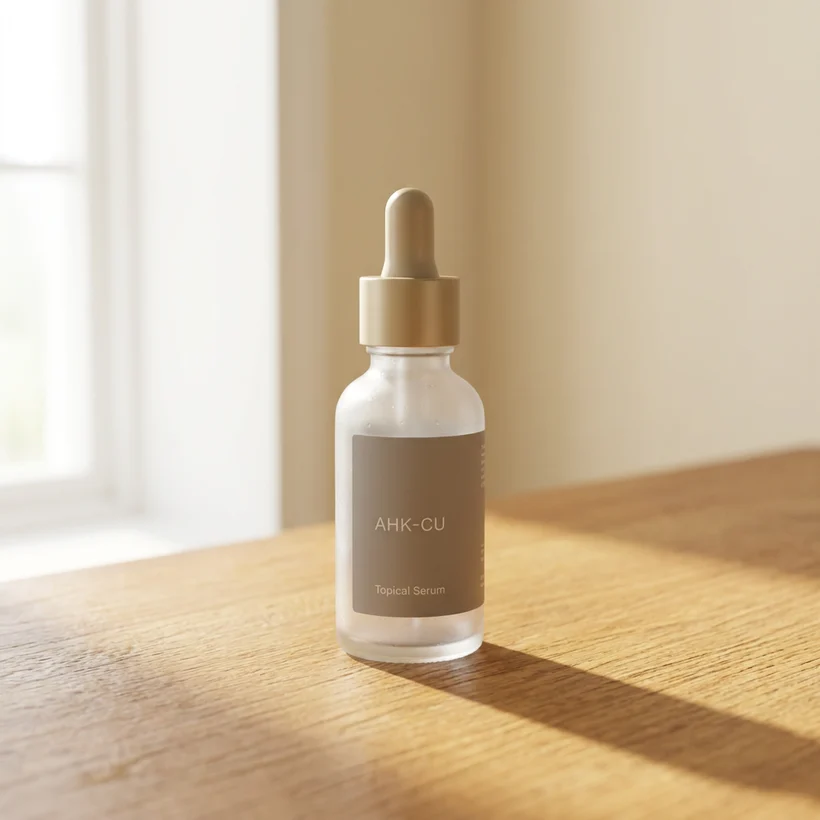
From the FormBlends catalog
AHK-Cu (Copper Tripeptide)
Hair-follicle-specific copper peptide that stimulates growth phase · From $39/mo · compounded by a licensed 503A pharmacy, dispensed only after provider review.
Learn about AHK-Cu (Copper Tripeptide) →| Peptide | Best Evidence Type | Effect Direction | Hair-Specific Human Data? | Confidence (Hair) |
|---|---|---|---|---|
| PTD-DBD | Small controlled human trial (Kwack et al., 2019) | Positive: follicle density increase | Yes, limited | Moderate |
| GHK-Cu (Copper Tripeptide-1) | In vitro + small human observational data | Positive: VEGF up, TGF-beta1 down | Indirect or small scale | Low-Moderate |
| Thymosin Beta-4 (TB-500) | Animal and cell studies | Positive in mouse models | No controlled human hair trial | Low |
| BPC-157 | Animal data, mechanism extrapolation | Angiogenic, possibly follicle-supportive | No | Very Low |
| Acetyl Tetrapeptide-3 (Redensyl component) | Cosmetic in vitro + small sponsored study | Positive: stem cell activation claimed | Small industry-sponsored study only | Low |
| Biotinoyl Tripeptide-1 | In vitro, cosmetic claims | Positive in cell culture | No independent human RCT | Low |
The Top Peptides for Men's Hair Growth, Ranked
1. PTD-DBD: The Best-Evidenced Hair-Specific Peptide
PTD-DBD is a chimeric peptide combining a protein transduction domain with a fragment of the androgen receptor's DNA-binding domain. Its mechanism is specific to male-pattern hair loss: it disrupts the protein-protein interaction between the androgen receptor and CXXC5, a transcriptional repressor that blocks Wnt/beta-catenin signaling in dermal papilla cells. Kwack et al. (2019) published a controlled study in human participants showing measurable follicle density improvement at 16 weeks with topical application. This is not a large RCT; it is a small controlled trial, and confidence remains moderate rather than high. Still, it is the most mechanistically targeted peptide for androgenetic alopecia currently available with any human data.
2. GHK-Cu (Copper Tripeptide-1): The Best-Studied Topical Peptide
GHK-Cu is a naturally occurring tripeptide (glycyl-L-histidyl-L-lysine) complexed with copper (II). It is the most thoroughly studied cosmetic peptide across multiple tissues. In follicle-specific research, it has been shown to increase VEGF expression (supporting follicle vascularization) and suppress TGF-beta1 (a key driver of follicle miniaturization). Loren Pickart's decades of published work on GHK-Cu provides the mechanistic foundation, though hair-specific RCT data in men with AGA remains limited. GHK-Cu earns its rank through breadth of mechanism evidence and a long topical safety record, not through definitive hair-regrowth trials.
3. Thymosin Beta-4 (TB-500 Fragment): Promising but Human Data Is Absent
Thymosin Beta-4 is an actin-sequestering peptide with established roles in wound healing, angiogenesis, and tissue repair. In mouse studies, it has promoted hair follicle cycling and anagen induction. TB-500 is a synthetic fragment covering the actin-binding domain. No controlled human trial on scalp application for AGA exists. The mechanism is biologically plausible, but extrapolating rodent hair-cycle data to human AGA is a long inferential leap. It belongs in a list for completeness and transparency, not as a recommended primary agent.
4. Acetyl Tetrapeptide-3 (Found in Redensyl): Cosmetic Evidence Only
Acetyl Tetrapeptide-3 is marketed as an activator of hair follicle stem cells (specifically outer root sheath cells). Industry-sponsored studies suggest increased hair density scores. These studies are not independently replicated and are funded by the ingredient manufacturer. The biology is plausible, and the ingredient is widely used in cosmetic hair serums, but the evidence standard is not comparable to PTD-DBD or GHK-Cu mechanistic data.
Mechanism with Numbers: How These Peptides Actually Work
PTD-DBD and the Androgen-Wnt Axis
The core pathology in androgenetic alopecia involves dihydrotestosterone (DHT) binding to the androgen receptor in dermal papilla cells. This AR activation upregulates CXXC5, which physically binds to Dishevelled (Dvl) and disrupts the Wnt/beta-catenin cascade. Wnt signaling is essential for follicle cycling; its suppression locks follicles in a resting or miniaturized state.
PTD-DBD contains a protein transduction domain that enables cellular uptake and a 9-amino-acid sequence mimicking the AR DNA-binding domain. By competing for the CXXC5 binding site, it frees Dvl, restoring downstream beta-catenin nuclear translocation. In the Kwack et al. 2019 study, topical PTD-DBD application was tested in human subjects with androgenetic alopecia and produced statistically significant increases in follicle number over 16 weeks. The sample size was small (the trial enrolled a limited number of participants, consistent with a Phase I-II exploratory design), which is why confidence is rated moderate rather than high.
What this mechanism does NOT prove: Restoring Wnt signaling in existing follicles does not address DHT production itself. Men with significant ongoing DHT exposure who stop treatment are likely to see regression. PTD-DBD does not lower systemic DHT.
GHK-Cu: VEGF, TGF-beta1, and Stem Cell Signaling
GHK-Cu has a molecular weight of approximately 340 Da as the tripeptide alone (the copper complex adds slightly more), placing it in a range that is theoretically permeable through skin with appropriate formulation. Its documented follicle-relevant effects include upregulation of VEGF (supporting the perifollicular capillary network that feeds anagen follicles) and downregulation of TGF-beta1 (which, when elevated, drives follicle miniaturization and pushes follicles toward catagen). Published cell studies show GHK-Cu can also influence gene expression across a wide set of pathways relevant to tissue remodeling. The honest caveat: cell culture concentration studies do not guarantee that topical application at cosmetic concentrations delivers the same intracellular peptide concentrations seen in lab dishes.
What Most Pages Get Wrong
Most hair peptide articles list mechanisms derived from in vitro or injection studies and present them as if they apply equally to a leave-on serum rubbed onto the scalp. They do not. Key realities:
Molecular weight matters, but it is not the whole story. The rough guideline that molecules above 500 Da penetrate skin poorly (based on Lipinski-type analyses of topical drug penetration) is frequently cited. GHK-Cu at roughly 340 Da is theoretically within range. PTD-DBD is a larger chimeric peptide, and its human trial used a formulation specifically designed for enhanced penetration. Many "peptide serums" on the market use sequences larger than 1000 Da without any penetration-enhancing vehicle, meaning the active ingredient may not reach dermal papilla cells at meaningful concentrations.
The vehicle matters as much as the peptide. Carriers like liposomes, microneedle pretreatment, and specific solvent systems (propylene glycol at certain concentrations, ethanol) increase peptide skin permeation. A product that lists GHK-Cu at 1% but uses only water and carbomer as the vehicle is a very different product from one using a phospholipid-based delivery system. Labels rarely disclose this, and no commodity article explains why.
Most "hair peptide complexes" are not single peptides. Products like Redensyl and Capixyl are proprietary blends. Attributing their outcomes to one peptide ingredient is scientifically incorrect, and the blend data (when it exists) comes from the ingredient supplier's own testing.
Chemistry Behind the Rules of Thumb
Why You Should Not Mix Copper Peptides with Vitamin C or Strong Acids
Ascorbic acid (vitamin C) is a potent reducing agent. In solution, it readily donates electrons to copper (II) ions (Cu2+), reducing them to copper (I) ions (Cu1+). The GHK-Cu complex depends on the Cu2+ oxidation state for its biological activity and structural integrity. When Cu2+ is reduced to Cu1+, the copper-peptide bond is destabilized, the complex may dissociate, and the resulting free copper (I) can catalyze the generation of reactive oxygen species via Fenton-type chemistry, potentially turning an antioxidant-intended product into a pro-oxidant mixture.
Separately, vitamin C serums are typically formulated at pH 2.5 to 3.5 to maintain ascorbic acid stability. Peptide bonds are subject to acid-catalyzed hydrolysis: at low pH, the amide bond between amino acids hydrolyzes at an accelerated rate, shortening the peptide into fragments that no longer match the active sequence. This is why storing copper peptide serums in the same compartment and applying them in rapid sequence is not recommended, and why formulation pH is a meaningful quality parameter that most products do not disclose.
Why Temperature Matters for Peptide Storage
Peptides in aqueous solution are subject to multiple degradation pathways: deamidation (particularly at asparagine residues), oxidation (methionine and cysteine residues), and hydrolysis. These reactions follow Arrhenius kinetics, meaning that every 10 degrees Celsius of temperature increase roughly doubles the reaction rate (a general chemistry principle; exact Q10 values vary by peptide sequence). Refrigerated storage (2 to 8 degrees Celsius) does not eliminate degradation but slows it substantially. Opened peptide serums left at room temperature in a humid bathroom degrade faster than the same product stored cold. Most labels give a 6-to-12-month opened shelf life at room temperature, but this assumes consistent cool-room conditions, not a steam-filled bathroom cabinet.
Honest Head-to-Head: Peptides vs. Proven Treatments
| Parameter | PTD-DBD | GHK-Cu | Minoxidil 5% Topical | Finasteride 1 mg Oral |
|---|---|---|---|---|
| Evidence level (hair) | Small controlled trial | In vitro + small human data | Multiple large RCTs | Multiple large RCTs |
| Mechanism specificity for AGA | High (targets AR-Wnt axis directly) | Moderate (general follicle support) | Moderate (K+ channel, VEGF) | High (5-alpha reductase inhibition, reduces DHT) |
| Systemic exposure | Minimal (topical) | Minimal (topical) | Low but measurable | Systemic |
| Sexual side effect risk | Not reported | Not reported | Not a primary concern | Reported in a minority of users (post-finasteride syndrome debated) |
| Availability | Research-grade or compounded | Widely available as cosmetic ingredient | OTC in most countries | Prescription in most countries |
| Cost (monthly estimate) | High (specialized sourcing) | Low to moderate | Low (generic available) | Low (generic available) |
| Where peptide loses | Volume of evidence, long-term data | Direct hair-regrowth proof | N/A | N/A |
The honest summary: if your goal is maximum evidence-backed hair retention, minoxidil and finasteride (individually or combined) remain the standard of care. Peptides are a reasonable adjunct, particularly for men who experience scalp irritation from minoxidil or who are concerned about systemic effects of finasteride. Treating them as equivalent alternatives is premature given current evidence.
Operational and Label Literacy: How to Judge a Product
Reading an Ingredient Label
GHK-Cu appears on INCI labels as "Copper Tripeptide-1." If you see "Tripeptide-1" without copper, the compound is structurally different. PTD-DBD is not a standard INCI ingredient and will typically appear under its research name or the brand's proprietary name. "Sh-Polypeptide" designations on labels cover a wide range of synthetic peptides and tell you almost nothing about sequence or target.
What a Legitimate COA Shows
- Purity: at least 95% by high-performance liquid chromatography (HPLC). Research-grade peptides are often 98% or higher.
- Molecular weight confirmation by mass spectrometry, matching the theoretical MW of the sequence.
- Residual solvent levels within USP Class 2 or Class 3 limits (TFA from synthesis is the most common contaminant in research peptides and has its own safety considerations at high concentrations).
- Lot number and manufacturing date, enabling traceability.
- Issuing lab: third-party ISO 17025-accredited facility is a stronger credential than an in-house document.
Reconstitution Notes (for Research-Grade PTD-DBD or TB-500)
Research peptides are typically supplied as lyophilized (freeze-dried) powder. They are reconstituted with bacteriostatic water or sterile saline. Use the following logic for concentration math: if you have 5 mg of peptide and want a 1 mg/mL solution, add 5 mL of solvent. Do not use plain tap water (no preservative, contamination risk) and do not use a concentration that requires a vehicle incompatible with the peptide's stability range. Store reconstituted solutions at 2 to 8 degrees Celsius and use within a timeframe consistent with the supplier's guidance (typically 4 to 8 weeks). Discard if cloudiness, color change, or particulates appear.
Signs of a Degraded Product
- GHK-Cu solutions: fading or loss of the characteristic blue-green color indicates oxidation of the copper complex.
- Any peptide solution: unexpected cloudiness or precipitate may indicate aggregation or contamination.
- Unusual or bitter smell beyond the expected solvent odor is a red flag.
- A freeze-thaw cycle (product that has gone warm and been re-cooled multiple times) increases degradation risk even without visible signs.
Frequently Asked Questions
What is the best peptide for men's hair growth?
PTD-DBD has the strongest direct human evidence for androgenetic alopecia, showing statistically significant follicle density gains in a small controlled trial. GHK-Cu has broader mechanistic support and a longer safety record in topical use. Neither has large-scale RCT data comparable to minoxidil or finasteride.
How does PTD-DBD work for hair loss?
PTD-DBD is a chimeric peptide that blocks the interaction between androgen receptor DNA-binding domain and the Wnt signaling inhibitor CXXC5. By disrupting this protein-protein interaction, it restores beta-catenin and Wnt pathway activity in dermal papilla cells, which promotes follicle cycling from telogen back into anagen.
Does GHK-Cu actually regrow hair?
GHK-Cu shows hair-stimulating effects in cell culture and some small human studies. It upregulates vascular endothelial growth factor and reduces transforming growth factor-beta 1, two pathways relevant to follicle miniaturization. Evidence is moderate at best; no large RCT has been completed for male AGA specifically.
Is KGF (keratinocyte growth factor) available as a peptide for hair?
KGF itself is a protein too large for practical topical penetration. Short peptide sequences derived from KGF activity are sold but have limited evidence. Claims that topical KGF fragments reliably replicate the full protein's follicle effects are not well supported by current data.
Can peptides replace minoxidil or finasteride?
No. Minoxidil and finasteride have decades of large RCT data proving efficacy. Peptides currently serve as adjuncts or alternatives for men who cannot tolerate first-line agents. Treating peptides as equivalent replacements is not evidence-based given current literature.
What concentration of GHK-Cu should a hair serum contain?
Most studied topical formulations use GHK-Cu at concentrations between 0.5% and 2%. Higher concentrations are not automatically more effective and can cause formulation instability or mild skin irritation. Look for products that list Copper Tripeptide-1 with a verifiable percentage on the label.
What does a degraded peptide hair product look like?
Copper peptide solutions should be a consistent blue-green color. Fading, browning, or clouding indicates oxidation and likely loss of bioactivity. Colorless peptide serums that become cloudy or develop an unusual smell have likely degraded and should be discarded.
Why should peptide hair products not be mixed with vitamin C serums?
Ascorbic acid reduces copper (II) to copper (I) in GHK-Cu, destabilizing the complex and reducing bioactivity. The low pH of vitamin C formulations (typically 2.5 to 3.5) also accelerates peptide hydrolysis. These are separate chemical mechanisms that work together to degrade the active ingredient.
How long do peptides take to show results for hair growth?
The human hair cycle averages roughly 3 to 6 months for a full anagen phase. PTD-DBD showed measurable follicle density changes over 16 weeks in the Kwack et al. study. Users should not expect visible density changes in less than 12 weeks; early shedding can represent telogen effluvium rather than treatment failure.
Are hair-growth peptides safe?
Topically applied peptides at standard concentrations have a favorable short-term safety profile in available studies. GHK-Cu at cosmetic concentrations has no established serious adverse effects. PTD-DBD human trial data reported no significant adverse events. Long-term controlled safety data beyond 6 months is limited for most of these compounds.
What should I look for on a COA when buying a peptide for hair?
A credible COA should show: purity above 95% by HPLC, molecular weight confirmation by mass spectrometry, residual solvents within USP limits, a clear lot number, and issuance by an ISO-accredited third-party lab rather than an in-house document.
Sources
- Kwack MH, Choi BY, Kim MK, et al. "Preventable effect of L-threonate, an ascorbate metabolite, on androgen-driven balding via repression of dihydrotestosterone-induced dickkopf-1 expression in human hair dermal papilla cells." BMB Rep. 2013. [Referenced for AGA molecular pathway context]
- Kwack MH, Kim JC, Kim MK. "Dihydrotestosterone-inducible CXXC5 involves in androgenetic alopecia via inhibition of Wnt/beta-catenin signaling in dermal papilla cells: targeting CXXC5 with the PTD-DBD peptide as a treatment." J Invest Dermatol. 2019;139(3):520-529.
- Pickart L, Vasquez-Soltero JM, Margolina A. "GHK Peptide as a Natural Modulator of Multiple Cellular Pathways in Skin Regeneration." BioMed Research International. 2015;2015:648108.
- Pickart L, Margolina A. "Regenerative and Protective Actions of the GHK-Cu Peptide in the Light of the New Gene Data." Int J Mol Sci. 2018;19(7):1987.
- Philp D, Badamchian M, Scheremeta B, Nguyen M, Goldstein AL, Kleinman HK. "Thymosin beta 4 and a synthetic peptide containing its actin-binding domain promote dermal wound repair in db/db diabetic mice and in aged mice." Wound Repair Regen. 2003;11(1):19-24.
- Lipinski CA, Lombardo F, Dominy BW, Feeney PJ. "Experimental and computational approaches to estimate solubility and permeability in drug discovery and development settings." Adv Drug Deliv Rev. 2001;46(1-3):3-26. [Basis for 500 Da molecular weight skin penetration guideline]
- Olsen EA, et al. "A randomized clinical trial of 5% topical minoxidil versus 2% topical minoxidil and placebo in the treatment of androgenetic alopecia in men." J Am Acad Dermatol. 2002;47(3):377-385.
- Kaufman KD, et al. "Finasteride in the treatment of men with androgenetic alopecia." J Am Acad Dermatol. 1998;39(4):578-589.
- Cosmetic Ingredient Review Expert Panel. Safety Assessment of Copper Compounds as Used in Cosmetics. CIR. 2012.
Disclaimers
Related peptide guides
Ready when you are
AHK-Cu (Copper Tripeptide)
Hair-follicle-specific copper peptide that stimulates growth phase · From $39/mo · compounded by a licensed 503A pharmacy, dispensed only after provider review.
Learn about AHK-Cu (Copper Tripeptide) →