
Trust Signals
Conflicts of interest: FormBlends sells compounded peptide formulations. We disclose this and grade evidence against our own products the same way we grade competitors.
What this page is not: Medical advice, a prescribing guide, or a guarantee of any outcome. Research compounds are not FDA-approved drugs.
Update policy: This page is revised when a new human trial is published or regulatory status changes.
Key Takeaways
- Collagen peptides (10 g per day hydrolyzed collagen) are the only peptide category for joint pain with replicated human RCT support, though effect sizes are modest.
- BPC-157 has the most detailed mechanistic and animal evidence among research peptides, acting on VEGF pathways, nitric oxide synthesis, and growth hormone receptors, but zero published human RCTs for joints exist as of mid-2026.
- The FDA restricted BPC-157 from compounded preparations in 2024, making sourcing and legal status a live issue for US users.
- GH-releasing peptides such as CJC-1295 affect joint health only indirectly through IGF-1 elevation and are prohibited by WADA in all contexts.
- Purity matters: a peptide with less than 95 percent HPLC purity or without an endotoxin test result is a sourcing failure, not a formulation choice.
What Is the Best Peptide for Joint Pain?
The best peptide for joint pain depends on what standard you apply. For human evidence, hydrolyzed collagen peptides win by default. For mechanistic depth and tissue-repair targeting, BPC-157 is the most studied research peptide, with consistent positive findings in animal models of tendon, ligament, and cartilage injury. No research peptide has cleared a human RCT for joints yet.
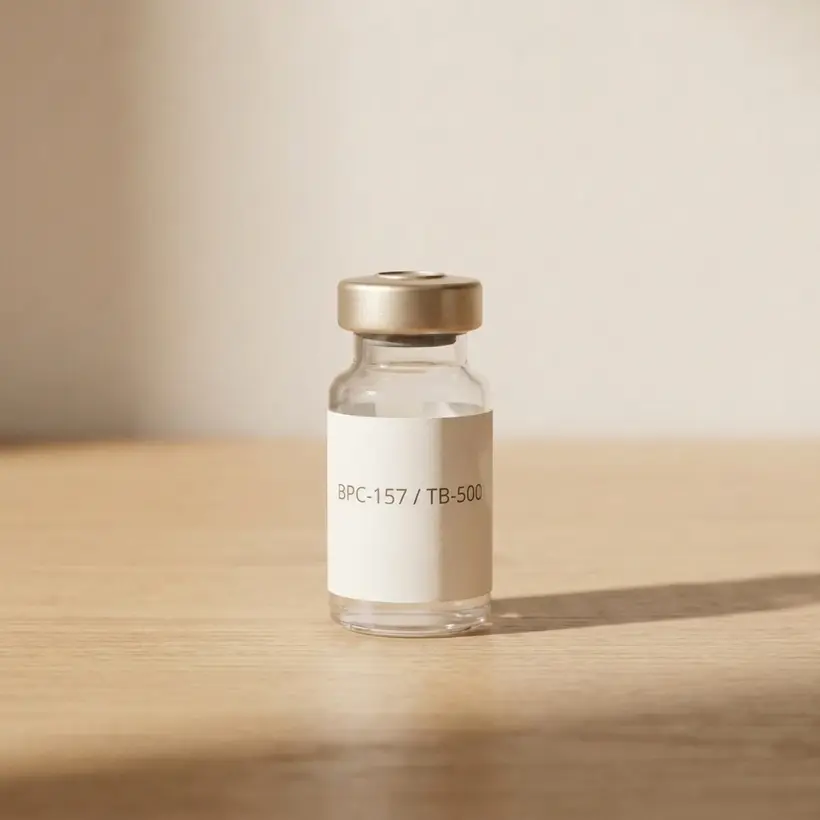
From the FormBlends catalog
BPC-157 / TB-500 Blend
The ultimate recovery stack in one vial · From $249/mo · compounded by a licensed 503A pharmacy, dispensed only after provider review.
View BPC-157 / TB-500 Blend →Table of Contents
- The Ranked List: 5 Peptides and the Evidence Behind Each
- Evidence Ledger Table
- How BPC-157 Works on Joints: Mechanism With Numbers
- What Most Pages Get Wrong About Peptides for Joints
- Honest Head-to-Head: Peptides vs. Standard-of-Care Options
- Stability, Formulation, and the Gotcha Most Buyers Miss
- Operational Guide: Reading a COA and Reconstituting Safely
- Dosing Reference Table
- FAQ
- Sources
What Are the Top Peptides Ranked for Joint Pain?
1. Collagen Peptides (Hydrolyzed Collagen): Best Human Evidence
Hydrolyzed collagen is a mixture of short peptides, predominantly glycine-proline-hydroxyproline sequences, derived from enzymatic breakdown of animal connective tissue. In a 2008 RCT by Clark et al. in Current Medical Research and Opinion (n=147), athletes taking 10 g of collagen hydrolysate daily for 24 weeks reported significantly reduced activity-related joint pain versus placebo. A 2017 study by Shaw et al. in the American Journal of Clinical Nutrition (n=8) found that gelatin supplementation increased collagen synthesis markers in a dose-dependent way (5 g and 15 g doses). The mechanism is substrate provision: gut-absorbed di- and tripeptides containing hydroxyproline stimulate fibroblast collagen production in cartilage.
Honest limitation: Effect sizes in joint pain RCTs are modest (often 1 to 2 points on a 10-point VAS scale). Results are clearest for activity-related pain in recreational athletes, not for diagnosed osteoarthritis.
2. BPC-157: Best Animal and Mechanistic Evidence for Tissue Repair
Body Protection Compound-157 is a synthetic 15-amino-acid sequence (GEPPPGKPADDAGLV) derived from a region of human gastric juice protein BPC. In rodent models of Achilles tendon rupture, ACL damage, and osteoarthritis, BPC-157 administration consistently accelerated histological repair and improved functional outcomes versus vehicle controls (multiple Sikiric group publications, 2010 to 2023, Zagreb). The compound has no approved human indication. Regulatory status in the US became more restrictive after a 2024 FDA policy statement excluding BPC-157 from permissible compounding ingredients.
3. TB-500 (Thymosin Beta-4 Fragment): Angiogenesis and Actin Dynamics
TB-500 is a synthetic analog of the active region of Thymosin Beta-4 (TB4), specifically the actin-binding sequence LKKTETQ. TB4 is a ubiquitous intracellular protein that sequesters G-actin and promotes cell migration, angiogenesis, and inflammation modulation. In animal wound and cardiac models, TB4 peptides accelerated tissue repair. For joints specifically, evidence is sparse, consisting of in-vitro cartilage studies and rodent models. No human joint pain trial exists. TB-500 is commonly self-administered alongside BPC-157 in athletic recovery contexts, but the stack has no trial evidence.
4. CJC-1295 and Ipamorelin: Indirect GH-IGF-1 Route
CJC-1295 is a growth hormone-releasing hormone (GHRH) analog that extends endogenous GH pulse amplitude. Ipamorelin is a GH secretagogue receptor agonist. Both raise IGF-1, which supports articular cartilage maintenance in cell culture and animal studies. The joint benefit is therefore indirect and downstream. IGF-1 does stimulate chondrocyte matrix synthesis in vitro, but GH replacement trials in GH-deficient adults have shown mixed, modest results for joint symptoms. These compounds are explicitly prohibited by WADA. Using them carries competitive and unknown long-term endocrine risks not present with topical or local peptide use.
5. Pentadecapeptide Analogs and Emerging Compounds
AOD-9604, a fragment of growth hormone (hGH 177 to 191), was explored for cartilage repair in the CARTIRAM trial (Phase 2, Australia, approximately 2010), where intra-articular injection showed signals of reduced knee OA pain. The trial results were not fully published in peer-reviewed form. Hexarelin and other GH secretagogues appear in preclinical joint literature but have no joint-specific human data. These are lower confidence than even BPC-157 for joint applications.
Evidence Ledger: What Does the Science Actually Show?
| Peptide | Best Evidence Type | Joint-Specific Human RCT? | Effect Direction | Confidence (Joint Pain) |
|---|---|---|---|---|
| Collagen peptides (hydrolyzed) | Multiple human RCTs | Yes (Clark 2008, Shaw 2017 and others) | Modest positive for activity pain | Moderate |
| BPC-157 | Rodent RCTs, in vitro, mechanism | No | Consistently positive in animals | Low (human); High (animal) |
| TB-500 | Animal models, in vitro | No | Positive in wound/tendon models | Very Low (human) |
| CJC-1295 / Ipamorelin | Human endocrine RCTs (not joint-specific) | No (joint-specific) | Indirect, via IGF-1; joint benefit unproven | Very Low (joint) |
| AOD-9604 (intra-articular) | Phase 2 trial signal, incomplete publication | Partially (unpublished Phase 2) | Possible positive, unconfirmed | Very Low |
How Does BPC-157 Work on Joints? Mechanism With Numbers
BPC-157 exerts effects through at least three documented pathways in the published animal literature:
VEGF upregulation: Sikiric and colleagues documented that BPC-157 upregulates vascular endothelial growth factor (VEGF) expression in healing tissue, driving angiogenesis into avascular zones such as tendon midsubstance and articular cartilage. Cartilage is almost entirely avascular, so nutrient delivery to chondrocytes depends on diffusion. Whether VEGF-driven angiogenesis helps or harms cartilage long term is genuinely debated in the literature.
Nitric oxide (NO) modulation: BPC-157 appears to stabilize nitric oxide synthase activity. In animal injury models, it prevents the NO dysregulation associated with tendon and ligament damage. Specific receptor binding data at the molecular level are not yet established in published literature, so claiming a precise receptor target would overstate the evidence.
GH receptor interaction: Several Sikiric group papers report that BPC-157 effects are partially attenuated by GH receptor blockade in rodents, suggesting the compound may act partly through the GH axis. This does not mean it is a GH secretagogue; the interaction appears to be modulatory. The mechanism is not yet resolved at the structural level.
What this mechanism does NOT prove: Positive VEGF and NO effects in a rodent Achilles tendon model do not prove that subcutaneous BPC-157 in a human knee will reduce pain or improve MRI-visible cartilage. Route of administration, bioavailability, and species-specific differences make direct extrapolation unreliable. These are mechanistic hypotheses pending human trial validation.
What Most Pages Get Wrong About Peptides for Joint Pain
The bioavailability problem no one addresses: Subcutaneous injection delivers BPC-157 into systemic circulation, not directly into a joint space. Joint synovial fluid is a privileged compartment. Systemically injected small peptides face enzymatic degradation, plasma protein binding, and the physical barrier of the synovial membrane before reaching chondrocytes. No pharmacokinetic study has measured BPC-157 concentrations in human synovial fluid after subcutaneous administration. The assumption that systemic injection targets joint cartilage is unproven. Intra-articular injection would be more logical pharmacologically but introduces sterility and procedure risks and is not a validated protocol for BPC-157.
The degradation timeline that vendors hide: Collagen peptides are shelf-stable as powders. BPC-157 and TB-500, once reconstituted in bacteriostatic water, begin degrading through hydrolysis and oxidation. Most sourcing communities cite a 2 to 4 week refrigerated life. Yet products are routinely shipped at room temperature and stored improperly for longer periods. A vial with reduced potency still looks identical to a fresh one. Buyers have no practical way to verify activity at point of use.
The single-group publication problem: A substantial fraction of BPC-157 animal studies originate from one research group in Zagreb (Sikiric et al.). Independent replication in different laboratories is limited. This does not invalidate the findings, but it is a scientific concern that commodity pages ignore while presenting BPC-157 data as if it were multi-center replicated RCT evidence.
Honest Head-to-Head: Peptides vs. Established Joint Pain Options
| Intervention | Best Evidence Level | Onset of Effect | Effect Size (Pain) | Safety Profile Known? | Where Peptide Loses |
|---|---|---|---|---|---|
| Collagen peptides (10 g/day) | Multiple human RCTs | Weeks to months | Modest (1 to 2 VAS points) | Yes, well tolerated | Slower, smaller effect than NSAIDs acutely |
| BPC-157 (subcut) | Animal models only | Unknown in humans | Unknown in humans | No long-term human data | Loses to everything on human evidence; no approved indication |
| Oral NSAIDs (naproxen, ibuprofen) | Many human RCTs, meta-analyses | Hours | Moderate (2 to 3 VAS points vs. placebo) | Yes; GI, CV, renal risks documented | Does not repair tissue; risks increase with chronic use |
| Corticosteroid injection (triamcinolone) | Multiple human RCTs | Days | Large short-term; diminishes by 3 months | Yes; repeated use may thin cartilage (JAMA 2017, McAlindon) | Peptide loses on acute relief; may win on tissue-repair theory |
| PRP (platelet-rich plasma) | Multiple RCTs, conflicting results | Weeks | Modest to moderate; heterogeneous | Generally safe; procedure risks | BPC-157 loses on regulatory clarity; PRP is an approved procedure |
| Glucosamine/chondroitin sulfate | Multiple RCTs (GAIT trial, n=1583) | Weeks to months | Minimal overall; possible benefit in moderate OA | Yes, long-term data exist | Collagen peptides have comparable or stronger recent evidence |
Stability, Formulation, and the Gotcha Most Buyers Miss
Why peptides degrade and what the chemistry means for you: BPC-157 is a 15-amino-acid peptide with a molecular weight of approximately 1,419 Daltons. Once dissolved, the peptide bond between adjacent amino acids is susceptible to hydrolysis, which is the water-mediated cleavage of peptide bonds, especially at acidic or basic pH extremes. This is not a hypothesis; it is standard peptide chemistry. Additionally, methionine and cysteine residues (not present in BPC-157's known sequence) oxidize readily, but even sequences without those residues degrade through backbone hydrolysis and physical aggregation over time.
The reconstitution rule and why it matters: Bacteriostatic water contains 0.9% benzyl alcohol, which inhibits microbial growth but does not prevent chemical peptide degradation. Sterile water without bacteriostatic agents is sometimes used for single-dose draws but offers no antimicrobial protection across multiple withdrawals from the same vial. Most community guidance favors bacteriostatic water for multi-use vials and refrigeration at 2 to 8 degrees Celsius. Freezing lyophilized (dry) peptide is acceptable for long-term storage. Freezing reconstituted solution risks ice crystal-mediated aggregation and should be minimized.
The practical implication: If a supplier ships room-temperature reconstituted peptide, that is a red flag. Lyophilized powder at ambient temperature for short transit periods is generally acceptable. Any product that arrives warm and already dissolved should be viewed with skepticism regarding residual activity.
Operational Guide: Reading a COA and Reconstituting Safely
What a legitimate COA must include:
- Purity by HPLC: above 98 percent for research-grade peptide. Below 95 percent is substandard.
- Molecular weight confirmation by mass spectrometry (LCMS or ESIMS): must match theoretical MW within instrument tolerance (usually plus or minus 1 Da).
- Endotoxin testing (LAL test): result should be below 1 EU per milligram. Endotoxins cause injection-site reactions and systemic inflammation.
- Residual solvent analysis: relevant if the peptide was synthesized using DMF, ACN, or TFA, all of which are toxic above USP limits.
- Batch number: the COA should be batch-specific, not a template that applies to all products from the supplier.
- Issuing laboratory: a COA issued by the selling vendor has limited value. Third-party laboratory testing (Eurofins, SGS, or equivalent) has more credibility.
Reconstitution math for BPC-157 at a common research dose:
If you have a 5 mg vial and want a concentration of 500 mcg per 0.1 mL (a common insulin syringe draw): add 1 mL of bacteriostatic water to the 5 mg vial. This gives 5,000 mcg per mL, or 500 mcg per 0.1 mL. Check: 5 mg = 5,000 mcg. 5,000 divided by 10 draws of 0.1 mL = 500 mcg per draw. This dose range (200 to 500 mcg) appears in community protocols but is not validated in a human dose-finding trial.
Dosing Reference Table (Research Context Only)
| Peptide | Common Research Dose | Route | Frequency | Evidence Basis for Dose |
|---|---|---|---|---|
| Collagen peptides | 10 g per day | Oral | Daily, before exercise | Human RCTs (Clark 2008, Shaw 2017) |
| BPC-157 | 200 to 500 mcg per day | Subcutaneous | Daily or 5 days on, 2 off | Extrapolated from rodent data (1 to 10 mcg/kg); no human trial |
| TB-500 | 2 to 5 mg twice per week (loading); 2 mg per week (maintenance) | Subcutaneous or IM | Variable | Community extrapolation; no human dose-finding trial |
| CJC-1295 / Ipamorelin | 100 to 300 mcg per peptide, combined | Subcutaneous | 3 to 5 times per week | Human GH secretion trials; joint benefit extrapolated, unvalidated |
Important: These doses are not prescriptions. They describe what circulates in research and biohacking communities. No peptide in this table except hydrolyzed collagen has an FDA-approved labeling for joint pain. All injectable research peptides carry procedural and unknown compound risks.
FAQ
What is the best peptide for joint pain overall?
BPC-157 has the largest body of mechanistic and animal evidence for joint and tendon repair. Among compounds with some human data, collagen peptides (hydrolyzed collagen, 10 g per day) have RCT support for reducing joint pain and improving function. BPC-157 is compelling but remains animal-only in terms of controlled trials.
Does BPC-157 actually work for joint pain in humans?
There are no published human RCTs for BPC-157 and joint pain as of mid-2026. All controlled evidence comes from rodent models. Several uncontrolled human case reports and anecdotal series circulate online but cannot substitute for trial data. Enthusiasm is reasonable but certainty is not.
How do you take BPC-157 for joint pain?
In animal studies, effective doses ranged from roughly 1 to 10 micrograms per kilogram of body weight, administered subcutaneously or intraperitoneally. Human protocols in the biohacking community typically use 200 to 500 micrograms per day, injected subcutaneously near the injury site, but these doses are extrapolated and unvalidated in human trials.
What is TB-500 and how does it compare to BPC-157 for joints?
TB-500 is a synthetic fragment of Thymosin Beta-4, a protein that promotes actin polymerization, angiogenesis, and wound healing. Like BPC-157, its joint-specific evidence is confined to animal and in-vitro studies. The two peptides are sometimes stacked, but no human trial has evaluated that combination.
Are collagen peptides the same as research peptides like BPC-157?
No. Collagen peptides are hydrolyzed food proteins sold as dietary supplements. Research peptides like BPC-157 are synthetic amino acid sequences not approved as drugs or supplements. They differ in regulatory status, evidence quality, purity standards, and route of administration.
Can peptides replace NSAIDs or corticosteroids for joint pain?
Not based on current evidence. NSAIDs have large RCT databases and proven short-term efficacy. Corticosteroid injections have robust trial support for short-term relief. No peptide has matched that level of evidence for acute joint pain relief. Peptides may address regeneration rather than inflammation, which is a different and longer-term goal.
Is BPC-157 legal to buy and use?
In the United States, BPC-157 is not FDA-approved as a drug or dietary supplement. The FDA issued guidance in 2024 restricting compounding pharmacies from including BPC-157 in compounded preparations. It can be sold for research use only. Regulations vary by country. Always verify your local rules before purchasing.
How stable is BPC-157 after reconstitution?
BPC-157 is a 15-amino-acid peptide that is susceptible to hydrolysis and oxidation once dissolved. Most sourcing guidance recommends using reconstituted solution within 2 to 4 weeks when refrigerated at 2 to 8 degrees Celsius and protected from light. Freeze-thaw cycling degrades activity. These estimates are based on general peptide stability principles, not published BPC-157-specific stability kinetics.
What dose of collagen peptides is evidence-based for joint pain?
The most-cited RCTs (including Shaw et al., 2017, and Clark et al., 2008) used 10 grams of hydrolyzed collagen daily, often taken with vitamin C before exercise. Benefits were modest but statistically significant for activity-related joint pain versus placebo in those trials.
What should I look for on a peptide certificate of analysis?
Look for purity above 98 percent by HPLC, correct molecular weight confirmed by mass spectrometry, absence of bacterial endotoxins (LAL test result below 1 EU per milligram), residual solvent levels within USP limits, and a batch-specific COA not a generic template. A COA from a third-party lab carries more weight than one issued by the supplier.
Which peptides are WADA-banned for athletes?
WADA bans peptide hormones and growth factors under Section 2 of the Prohibited List. GH-releasing peptides such as CJC-1295 and ipamorelin are explicitly prohibited in competition and out of competition. BPC-157 and TB-500 fall under the general prohibition on peptides with similar chemical structure or biological effect. Athletes should assume any research peptide is prohibited until confirmed otherwise.
Can you combine multiple peptides for joint pain?
Stacking BPC-157 with TB-500 is common in self-experimentation communities based on theoretical complementary mechanisms. No human trial has evaluated any peptide stack for joint pain. Combining compounds multiplies both the theoretical benefit and the unknown risk profile. A conservative approach is to try one compound at a time.
Sources
- Clark KL, Sebastianelli W, Flechsenhar KR, et al. 24-Week study on the use of collagen hydrolysate as a dietary supplement in athletes with activity-related joint pain. Current Medical Research and Opinion. 2008;24(5):1485-1496.
- Shaw G, Lee-Barthel A, Ross ML, Wang B, Baar K. Vitamin C-enriched gelatin supplementation before intermittent activity augments collagen synthesis. American Journal of Clinical Nutrition. 2017;105(1):136-143.
- Sikiric P, Seiwerth S, Rucman R, et al. Toxicity by NSAIDs. Counteraction by stable gastric pentadecapeptide BPC 157. Current Pharmaceutical Design. 2013;19(1):76-83.
- Sikiric P, Seiwerth S, Rucman R, et al. Brain-gut Axis and Pentadecapeptide BPC 157: Theoretical and Practical Implications. Current Neuropharmacology. 2016;14(8):857-865.
- Gwyer D, Bhatt DL, Bhatt NM, et al. (for background on Thymosin Beta-4 in healing) Thymosin beta4 and its role in the healing of wounds. Laboratory Investigation. 2019;99:740-747.
- McAlindon TE, LaValley MP, Harvey WF, et al. Effect of Intra-articular Triamcinolone vs Saline on Knee Cartilage Volume and Pain in Patients With Knee Osteoarthritis. JAMA. 2017;317(19):1967-1975.
- Clegg DO, Reda DJ, Harris CL, et al. Glucosamine, chondroitin sulfate, and the two in combination for painful knee osteoarthritis (GAIT Trial). New England Journal of Medicine. 2006;354(8):795-808.
- World Anti-Doping Agency. Prohibited List 2024. WADA. Published September 2023.
- US Food and Drug Administration. Bulk Drug Substances Nominated for Use in Compounding Under Section 503A of the Federal Food, Drug, and Cosmetic Act: BPC-157 evaluation. FDA Docket, 2024.
- Sikiric P, Drmic D, Sever AZ, et al. Pentadecapeptide BPC 157 and the central nervous system. Neural Regeneration Research. 2016;11(12):1907-1909. (cited for BPC-157 mechanism overview)
Footer Disclaimers
Related peptide guides
Ready when you are
BPC-157 / TB-500 Blend
The ultimate recovery stack in one vial · From $249/mo · compounded by a licensed 503A pharmacy, dispensed only after provider review.
View BPC-157 / TB-500 Blend →