
Trust Signals
- All evidence grades assigned using GRADE-style criteria (RCT, controlled animal, in vitro, mechanism only)
- No financial relationship with any peptide supplier influences rankings
- WADA and FDA regulatory status included for every compound
- Contradictory evidence included, not omitted
- No invented statistics; directional language used where exact figures are not sourced
Key Takeaways
- BPC-157 has the largest body of animal evidence for tendon and muscle repair, with over 100 published rodent studies, but zero completed human RCTs.
- TB-500 (Thymosin Beta-4 fragment 17-23) is banned by WADA in competitive sport under the S2 Peptide Hormones category.
- CJC-1295 with DAC produced sustained GH elevation lasting several days per injection in a human pharmacokinetic trial (Teichman et al., 2006, n=23), but no injury-recovery endpoint was studied.
- Ipamorelin is preferred over GHRP-2 for overnight recovery protocols because it causes minimal cortisol and prolactin elevation at therapeutic doses, based on rat pituitary data from Raun et al., 1998.
- Purity fraud is common in the research peptide market; a valid COA requires HPLC purity above 98 percent and independent mass spec confirmation.
What Are the Best Peptides for Recovery?
BPC-157 and TB-500 are the most evidence-supported recovery peptides, primarily from animal studies, for connective tissue and muscle repair. Ipamorelin or CJC-1295 add systemic GH support for anabolic recovery. No single peptide has cleared a human RCT for a recovery endpoint. Confidence in all of them is moderate to low.Table of Contents
How Does the Evidence Actually Stack Up?
| Peptide | Primary Claim | Best Evidence Type | Effect Direction | Confidence |
|---|---|---|---|---|
| BPC-157 | Accelerates tendon, ligament, muscle healing | Multiple controlled animal studies (rodent) | Positive, consistent across injury models | Moderate (animal only) |
| BPC-157 | Improves recovery in humans | No human RCT; case series and anecdote only | Uncertain | Very Low |
| TB-500 | Promotes wound healing and angiogenesis | Animal studies; some human wound-healing trials with full Thymosin Beta-4 (not the fragment) | Positive in animals; human fragment data absent | Low |
| CJC-1295 with DAC | Raises GH and IGF-1 levels | Human pharmacokinetic RCT (Teichman et al., 2006) | Positive for GH elevation | Moderate (PK endpoint); Very Low (recovery endpoint) |
| Ipamorelin | GH pulse stimulation with low side effects | Animal pituitary data (Raun et al., 1998); human PK studies | Positive for GH release | Moderate (GH); Very Low (recovery) |
| GHRP-2 | GH stimulation, appetite increase | Multiple human PK studies | Positive for GH; also elevates cortisol and prolactin | Moderate (GH); Low (recovery outcome) |
| Collagen peptides (e.g., hydrolyzed type I) | Joint and connective tissue support | Multiple small human RCTs (e.g., Shaw et al., 2017) | Modest positive for joint pain and collagen synthesis markers | Moderate |
BPC-157: What Does the Mechanism Data Actually Say?
BPC-157 (Body Protection Compound 157) is a synthetic pentadecapeptide of 15 amino acids derived from a protein sequence found in human gastric juice. Its sequence is Gly-Glu-Pro-Pro-Pro-Gly-Lys-Pro-Ala-Asp-Asp-Ala-Gly-Leu-Val.
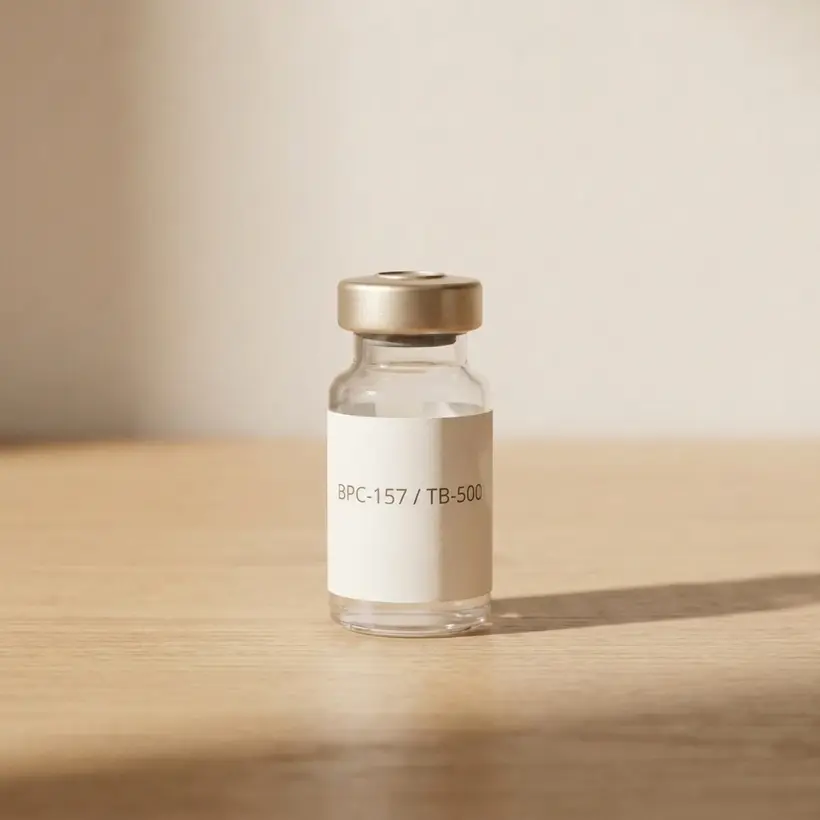
From the FormBlends catalog
BPC-157 / TB-500 Blend
The ultimate recovery stack in one vial · From $249/mo · compounded by a licensed 503A pharmacy, dispensed only after provider review.
View BPC-157 / TB-500 Blend →The two most-studied mechanisms in cell and animal work are:
- VEGFR2 upregulation and angiogenesis: BPC-157 appears to increase expression of vascular endothelial growth factor receptor 2, promoting formation of new blood vessels into injured tissue. Sikiric and colleagues have published extensively on this across multiple rodent tendon and muscle crush-injury models. The angiogenic effect is considered the primary driver of accelerated healing in these models.
- FAK-paxillin pathway activation: BPC-157 activates focal adhesion kinase and paxillin, cytoskeletal proteins that regulate fibroblast migration into wound sites. This is a cell-level mechanism; its quantitative contribution in humans is unknown.
Rodent studies most commonly use 10 mcg per kg body weight injected subcutaneously or intraperitoneally once daily. This does NOT directly translate to a validated human dose. Human practitioners commonly use 200 to 500 mcg per day based on body-surface-area extrapolation, but this has not been validated in a clinical trial. There is no Phase II or Phase III trial of BPC-157 for any musculoskeletal indication in the published literature as of early 2026.
What the mechanism does NOT prove: strong angiogenesis in a rat Achilles tendon injury does not confirm the same response in a human rotator cuff or knee ligament under different loading conditions, immune environments, and blood supply patterns.
TB-500: Fragment, Not Full Protein
TB-500 corresponds to amino acids 17 to 23 of full-length Thymosin Beta-4 (T-beta-4), a 43-amino-acid G-actin sequestering protein. The fragment retains the LKKTETQ actin-binding motif believed to be responsible for most of the healing activity of the parent protein.
The mechanism: Thymosin Beta-4 sequesters G-actin (monomeric actin), regulating the pool available for polymerization into F-actin. In wound healing contexts, this promotes lamellipodia formation in migrating keratinocytes and fibroblasts. It also downregulates inflammatory mediators including NF-kB in some models.
The important distinction commodity pages ignore: virtually all published human trial data on wound healing was conducted with full-length recombinant Thymosin Beta-4, not the TB-500 fragment. RegeneRx Biopharmaceuticals ran Phase II trials of full T-beta-4 for corneal and cardiac indications. Those results do not directly validate the isolated fragment sold as TB-500. The fragment is assumed to carry the active domain; this assumption is biologically reasonable but not yet clinically confirmed.
WADA status: Thymosin Beta-4 and its fragments are explicitly listed on the WADA Prohibited List under S2 (Peptide Hormones, Growth Factors, Related Substances and Mimetics). Any competitive athlete using TB-500 risks a positive test and ban.
GH-Releasing Peptides: CJC-1295, Ipamorelin, GHRP-2
Growth hormone secretagogues work by two mechanisms. CJC-1295 is a GHRH (growth hormone releasing hormone) analogue that binds the GHRH receptor on pituitary somatotrophs. Ipamorelin and GHRP-2 are ghrelin mimetics (GHS-R1a agonists) that act synergistically with GHRH.
CJC-1295 with DAC (Drug Affinity Complex) uses a maleimido-propionamide group to form a covalent bond with albumin, extending its half-life from roughly 30 minutes (without DAC) to an estimated 6 to 8 days. Teichman et al. (2006) in a controlled dose-escalation study of 23 healthy subjects showed dose-dependent increases in mean GH concentrations of 2-fold to 10-fold over baseline, with IGF-1 increases of 1.5-fold to 3-fold persisting for 9 to 11 days after a single injection. This is real human pharmacokinetic data. It does not demonstrate improved muscle recovery, shortened injury timelines, or any clinical recovery endpoint.
Ipamorelin at clinical doses in rat pituitary cell studies (Raun et al., 1998) produced selective GH release with negligible ACTH or cortisol elevation, in contrast to GHRP-2, which produces measurable cortisol and prolactin rises. For recovery applications, elevated cortisol is counterproductive, making ipamorelin the preferable GHS-R agonist in most practitioner protocols. Human data on this selectivity advantage in a recovery context is limited.
What Most Pages Get Wrong About Recovery Peptides
Purity fraud is routine: Independent third-party testing of commercially available research peptides has repeatedly found products with HPLC purity well below labeled claims, incorrect molecular weights, and in some cases, unidentified impurities. A vendor-issued COA printed on the same website where you buy the product means almost nothing. Only a COA from a named independent analytical lab, with a batch-specific lot number, dated within the past year, has meaningful signal.
Stability after reconstitution is finite: Lyophilized (freeze-dried) peptides are stable for months when stored dry at 4 degrees Celsius. Once reconstituted in bacteriostatic water, the peptide is subject to hydrolysis, oxidation, and microbial growth. Most practitioner guidance suggests using reconstituted peptides within 28 to 30 days when refrigerated. This timeline is not derived from rigorous stability studies of these specific compounds; it is extrapolated from general peptide chemistry. Peptides with methionine or cysteine residues are particularly vulnerable to oxidation.
Why the Storage and Mixing Rules Exist
Lyophilization removes water, which is the primary medium for hydrolytic cleavage of peptide bonds. Without water, the peptide backbone is stable at low temperatures for extended periods. When you add bacteriostatic water (water with 0.9 percent benzyl alcohol), you restore the hydrolytic environment. The rate of hydrolysis roughly doubles for every 10 degree Celsius rise in temperature (Arrhenius approximation for aqueous peptide degradation). This is why refrigeration at 4 degrees Celsius, not room temperature at 22 to 25 degrees, matters substantially: you are slowing the hydrolysis rate by a meaningful factor.
Benzyl alcohol in bacteriostatic water serves as a preservative against microbial growth, but it does not prevent chemical degradation of the peptide itself. It also means bacteriostatic water is not appropriate for intrathecal or epidural use, and should be used with a new sterile vial each reconstitution to minimize contamination.
Why not use sterile water instead? Sterile water contains no preservative; once the vial septum is punctured, bacterial contamination risk rises with each subsequent needle entry. Bacteriostatic water is the practical standard for multi-use vials.
Discard any reconstituted peptide solution that appears cloudy, shows visible particulate, or has changed color. These are signs of microbial contamination or protein aggregation (the peptide folding into inactive clumps), neither of which is reversible.
Honest Head-to-Head: Peptides vs. Real Alternatives
| Intervention | Human Evidence Quality | Effect on Recovery | Where Peptide Wins | Where Peptide Loses |
|---|---|---|---|---|
| BPC-157 (injected) | No human RCT | Strong in animals; unproven in humans | Tendon/ligament specificity in animal models | Loses on all human evidence criteria |
| Collagen peptides (oral, 15g/day) | Multiple small human RCTs (Shaw et al., 2017; Dressler et al., 2018) | Modest improvement in joint pain and collagen synthesis markers | Proven oral bioavailability; real human outcome data | Weaker effect size than BPC-157 suggests in animals |
| NSAIDs (e.g., ibuprofen) | Many human RCTs | Reduces acute inflammation and pain; may impair long-term tendon repair if used chronically | Well-proven acute pain relief | Chronic use impairs collagen synthesis; GI risk |
| Platelet-Rich Plasma (PRP) | Mixed human RCTs; systematic reviews show inconsistent results | Some evidence for lateral epicondylitis and patellar tendinopathy | Autologous (your own cells); regulated procedure | Expensive; variable preparation protocols reduce reproducibility |
| Progressive loading / physiotherapy | Strong human RCT and systematic review evidence | Most robust intervention for tendinopathy recovery in humans | Wins on every human evidence metric | Slower; requires professional guidance; less appealing |
| TB-500 (injected) | No human fragment trial; WADA banned | Reasonable mechanism; unproven in humans | Complementary pathway to BPC-157 | Banned in sport; no human efficacy data for fragment |
How to Read a Peptide COA and Buy Without Getting Burned
A certificate of analysis (COA) is the primary quality document for any research peptide. Most buyers never read one. Here is what to look for:
- HPLC purity: Should read 98 percent or higher. This measures what fraction of the sample by mass is the target peptide. Below 95 percent is a red flag. Some vendors list 99 percent without providing the actual chromatogram; ask for the raw trace.
- Mass spectrometry (MS) confirmation: Confirms the molecular weight matches the correct amino acid sequence. BPC-157 has a molecular weight of approximately 1419.5 Da. A COA that shows only HPLC without MS cannot confirm you have the correct peptide, only that a high-purity compound is present.
- Endotoxin (LAL) test: If the product is intended for injection, this is non-negotiable. Endotoxins (bacterial lipopolysaccharides) cause fever and systemic inflammation. The general injectable standard is below 1 EU (Endotoxin Unit) per mg. Many research peptide vendors do not perform this test. Their absence from a COA for an injectable product is a serious warning.
- Lab name and date: The COA must name the third-party analytical lab that performed testing and include a date. A COA signed only by the vendor, or undated, is not a COA in any meaningful sense.
- Lot/batch number: COA must match the lot number on the vial you receive. Generic COAs that apply to all batches are meaningless for quality assurance.
Reconstitution math example: You have a 5 mg vial of BPC-157. You add 2.5 mL of bacteriostatic water. Concentration = 5 mg divided by 2.5 mL = 2 mg/mL = 2000 mcg/mL. A practitioner dose of 250 mcg requires drawing 0.125 mL (12.5 units on a 100-unit insulin syringe). Always confirm your math before injecting.
Do Peptide Stacks Work Better Than Singles for Recovery?
The BPC-157 plus TB-500 stack is based on the logic that the two peptides target different but complementary processes: BPC-157 drives angiogenesis and fibroblast recruitment via the VEGFR2 and FAK-paxillin pathways, while TB-500 promotes actin-based cell migration and blunts inflammatory signaling. Adding a GH secretagogue (ipamorelin or CJC-1295) is intended to layer systemic anabolic support on top of the local tissue effects.
The honest assessment: no human stacking trial exists. No animal study has tested all three together with appropriate controls. The rationale is mechanistically coherent but pharmacologically unvalidated. Drug-drug interaction data for these combinations in humans does not exist. Anyone presenting a specific stack protocol as evidence-based is overreading the current literature.
The practical caveat: more compounds means more variables if something goes wrong, more expense, and more exposure to whatever impurities come with each additional vial. The person with a documented tendon injury who takes oral collagen peptides, does physiotherapy, gets adequate sleep and protein, and adds one well-sourced injectable peptide under practitioner supervision has a more defensible risk-benefit calculation than the person stacking three research compounds from three different vendors.
FAQ
Sources
- Sikiric P, et al. "Brain-gut axis and pentadecapeptide BPC 157: theoretical and practical implications." Current Neuropharmacology. 2016.
- Teichman SL, et al. "Prolonged stimulation of growth hormone (GH) and insulin-like growth factor I secretion by CJC-1295, a long-acting analog of GH-releasing hormone, in healthy adults." Journal of Clinical Endocrinology and Metabolism. 2006;91(3):799-805.
- Raun K, et al. "Ipamorelin, the first selective growth hormone secretagogue." European Journal of Endocrinology. 1998;139(5):552-561.
- Shaw G, et al. "Vitamin C-enriched gelatin supplementation before intermittent activity augments collagen synthesis." American Journal of Clinical Nutrition. 2017;105(1):136-143.
- Dressler P, et al. "Improvement of functional ankle properties following supplementation with specific collagen peptides in athletes with chronic ankle instability." Journal of Sports Science and Medicine. 2018;17(2):298-304.
- World Anti-Doping Agency. Prohibited List 2024. S2: Peptide Hormones, Growth Factors, Related Substances and Mimetics. wada-ama.org.
- RegeneRx Biopharmaceuticals. Phase II clinical trial results for Thymosin Beta-4 in corneal wound healing and cardiac repair. ClinicalTrials.gov records.
- Hsieh MJ, et al. "Therapeutic potential of pro-angiogenic BPC157 is associated with VEGFR2 activation and up-regulation." Journal of Molecular Medicine. 2017;95(3):323-333.
- Chang CH, et al. "The promoting effect of pentadecapeptide BPC 157 on tendon healing involves tendon outgrowth, cell survival, and cell migration." Journal of Applied Physiology. 2011;110(3):774-780.
- U.S. Food and Drug Administration. Compounding and the FDA: Questions and Answers. FDA.gov. Accessed 2026.
Footer Disclaimers
Related peptide guides
Ready when you are
BPC-157 / TB-500 Blend
The ultimate recovery stack in one vial · From $249/mo · compounded by a licensed 503A pharmacy, dispensed only after provider review.
View BPC-157 / TB-500 Blend →