
Trust Signals
Claims are graded by evidence type in the ledger table below. No undisclosed affiliate relationship influences rankings. Research compound status and legal limitations are disclosed throughout.Key Takeaways
- Semax upregulates BDNF and NGF in hippocampal tissue in animal models and has moderate human trial support from Russian clinical research, mostly in neurological recovery contexts.
- Selank modulates GABAergic signaling and shows anxiolytic plus nootropic effects in Russian human trials, but sample sizes are small and trials have not been independently replicated in Western cohorts.
- Dihexa potentiates HGF/c-Met signaling and outperforms BDNF in synaptogenesis assays by roughly seven orders of magnitude in vitro, yet has zero published human trials as of 2026.
- Most peptides do not meaningfully cross the blood-brain barrier via subcutaneous injection; intranasal delivery is the mechanistically justified route for CNS-targeted peptides.
- No nootropic peptide has a head-to-head RCT versus modafinil or approved cognitive aids; the evidence gap is real and should weigh in any personal decision.
What Are the Best Nootropic Peptides?
The best nootropic peptides by current evidence are Semax and Selank, both with published human clinical data (though mostly from Russian trials), followed by Dihexa for its remarkable preclinical synaptogenesis data, and BPC-157 for indirect cognitive support via gut-brain and dopaminergic pathways. None have FDA approval for cognitive use.- Evidence Ledger: Every Major Claim Graded
- The Best Nootropic Peptides, Ranked
- How These Peptides Actually Work: Mechanisms with Numbers
- What Most Pages Get Wrong: BBB Penetration Reality
- Chemistry Behind the Rules: Why Route and Storage Matter
- Honest Head-to-Head: Peptides vs. Established Nootropics
- Label Literacy and Sourcing: How to Judge a Product
- Dosing Reference Table
- FAQ
- Sources
- Disclaimers
What Is the Actual Evidence for Each Nootropic Peptide?
| Peptide | Claim | Best Evidence Type | Effect Direction | Confidence |
|---|---|---|---|---|
| Semax | Improves attention and stroke recovery | Human clinical trials (Russian, small-to-moderate n) | Positive | Moderate |
| Semax | Upregulates BDNF and NGF in hippocampus | Animal (rodent) and cell studies | Positive | Moderate (mechanism only in humans) |
| Selank | Anxiolytic and cognitive benefit under stress | Human clinical trials (Russian, small n) | Positive | Moderate |
| Selank | Modulates GABAergic and serotonergic tone | Animal and in vitro | Positive | Low (not confirmed in human CNS directly) |
| Dihexa | Potent synaptogenesis in vitro | Cell culture and rodent | Strongly positive | Low (no human data) |
| Dihexa | Cognitive improvement in humans | None published | Unknown | Very Low |
| BPC-157 | Cognitive and anxiolytic effects | Animal only | Positive (rodent) | Very Low for humans |
| Cerebrolysin | Cognitive benefit post-stroke and in dementia | Human RCTs (mostly European and Asian) | Positive, modest | Moderate |
| NA-Semax Amidate | Greater potency than Semax | Animal, mechanism extrapolation | Likely positive | Very Low |
Which Nootropic Peptides Are Actually Worth Considering?
1. Semax (ACTH 4-7 Pro-Gly-Pro analogue)
The most evidence-backed nootropic peptide for healthy-adult cognitive use. Developed at the Institute of Molecular Genetics in Moscow, Semax is approved in Russia and Ukraine as a prescription drug for stroke, ADHD, and cognitive decline. Human trials report improvements in attention, memory consolidation, and processing speed, though most trials have fewer than 100 participants and are not placebo-controlled by Western RCT standards. Its BDNF and NGF upregulation mechanism is well-characterized in animal models.
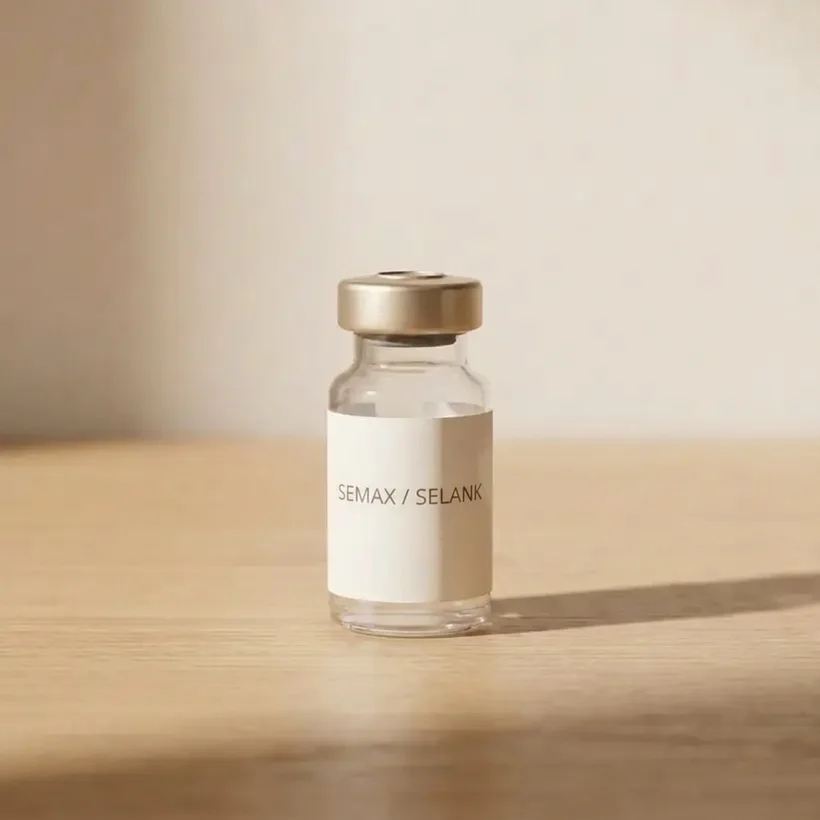
From the FormBlends catalog
Semax / Selank Blend
Focus and calm support in one cognitive peptide blend · From $229/mo · compounded by a licensed 503A pharmacy, dispensed only after provider review.
View Semax / Selank Blend →2. Selank (Thr-Lys-Pro-Arg-Pro-Gly-Pro)
A synthetic analogue of the immune peptide tuftsin, Selank is registered in Russia for generalized anxiety disorder. Its cognitive benefit is most pronounced in anxious or stress-impaired users. It does not share the stimulant-like quality of Semax. For users whose cognitive ceiling is limited by anxiety, Selank may be more appropriate than Semax. Published human trial data exist, though again from Russian state institutions with limited independent replication.
3. Dihexa (PNB-0408, N-hexanoic-Tyr-Ile-Ahx-NH2)
Developed at Washington State University by Joseph Harding and colleagues. Dihexa potentiates hepatocyte growth factor binding to the c-Met receptor and outperforms BDNF in synaptogenesis assays by roughly seven orders of magnitude, per the original WSU cell-culture work. Rodent cognitive studies show meaningful improvement in spatial memory tasks. The gap between these results and the absence of human trials is the defining limitation. Rank it third on preclinical promise, not clinical evidence.
4. BPC-157 (Body Protection Compound-157)
A 15 amino acid sequence derived from human gastric juice protein. Its cognitive case rests on rodent studies showing dopamine system modulation, improved stress resilience, and memory retention. Its strongest human-adjacent evidence is in gut healing, not cognition. Include it here because its dopaminergic and serotonergic effects are mechanistically relevant, not because cognitive trials in humans exist.
5. Cerebrolysin
A porcine brain hydrolysate containing small neuropeptides and amino acids, used clinically in Europe and Asia. It has the largest controlled human trial dataset of any peptide nootropic, including Cochrane-reviewed RCTs in vascular dementia and Alzheimer's disease. It is not a single peptide and is administered intravenously, which limits its self-administration practicality, but its evidence quality exceeds the others on this list.
How Do These Peptides Actually Work in the Brain?
Semax: The core sequence ACTH(4-7) binds melanocortin receptors (primarily MC4R in rodent CNS studies). The Pro-Gly-Pro extension increases CNS half-life relative to unmodified ACTH(4-7). Semax increases BDNF mRNA expression in hippocampal tissue in rodent models (data from Dolotov et al. published in the Journal of Neurochemistry, 2006) and modulates expression of genes involved in neuroplasticity, immune response, and monoamine metabolism. The NA-Semax Amidate form adds N-terminal acetylation and C-terminal amidation, which in peptide chemistry typically reduces enzymatic degradation and can shift receptor binding kinetics, though direct human CNS data for this modification are absent.
Selank: Acts as an enkephalinase inhibitor, slowing degradation of endogenous enkephalins, and modulates expression of serotonin transporter genes (SERT). Russian studies report that Selank normalizes the expression of genes associated with the GABA-A receptor complex under stress conditions. Its tuftsin core (Thr-Lys-Pro-Arg) also interacts with immune signaling, which may contribute to the reduced neuroinflammation proposed as part of its mechanism.
Dihexa: Potentiates the HGF/c-Met receptor axis. HGF receptor (c-Met) is expressed throughout the hippocampus and cortex and drives synaptogenesis, dendritic arborization, and neuroprotection. The WSU group's cell-culture data showed Dihexa-driven synaptogenesis at concentrations roughly 10 million times lower than BDNF. This is a cell-culture finding and does not mean Dihexa is "10 million times stronger" in any clinical sense. The caveat is critical: potency in an assay does not translate to clinical effect magnitude.
BPC-157: Activates the nitric oxide (NO) system and modulates both dopaminergic and serotonergic signaling, demonstrated in rodent lesion models. It also appears to upregulate VEGF-related gene expression, which may contribute to neurovascular support. None of these pathways have been confirmed via human CNS sampling.
What Most Pages Get Wrong: Blood-Brain Barrier Penetration
Most nootropic peptide pages tell you a peptide "crosses the BBB" as if that is a binary fact. The reality is that BBB penetration is a spectrum governed by molecular weight, lipophilicity (logP), active transport availability, and concentration gradient. Peptides above roughly 500 to 600 daltons face steep passive diffusion barriers at the BBB. Semax (molecular weight approximately 838 Da) and Selank (approximately 863 Da) are near or above that threshold.
Intranasal administration sidesteps this problem meaningfully. The olfactory epithelium provides a direct pathway via olfactory receptor neurons and their projections to the olfactory bulb, bypassing the BBB. The trigeminal nerve pathway provides a second route. This is why intranasal is the clinically used route for Semax and Selank, not subcutaneous injection for CNS effect. Subcutaneous injection of Semax is practiced in the self-experimentation community but lacks mechanistic or pharmacokinetic justification for CNS targeting compared to intranasal delivery.
Dihexa is a notable exception. Its lipophilic design (the N-hexanoic acid group adds substantial lipophilicity) was specifically intended to allow passive BBB diffusion, and rodent pharmacokinetic data support meaningful CNS penetration. This is one reason its preclinical story is compelling, but it also means its CNS exposure profile and safety in chronic human use are genuinely unknown.
BPC-157 administered peripherally (subcutaneous or oral) likely exerts at least some brain-relevant effects via the vagus nerve and gut-brain axis rather than direct BBB crossing, which is a plausible but not proven pathway.
Why Do Route and Storage Rules Exist? The Chemistry
Peptide degradation in solution: Peptide bonds are susceptible to hydrolysis, especially at elevated temperature or in acidic/basic pH. A reconstituted peptide in bacteriostatic water at room temperature will lose activity over days to weeks as hydrolysis progresses. Refrigeration (2 to 8 degrees Celsius) slows the reaction rate substantially, following basic Arrhenius kinetics: roughly a 2-fold reduction in reaction rate per 10 degrees Celsius drop in temperature. This is why the "use within 4 weeks refrigerated" rule exists; it is not arbitrary caution.
Oxidation of methionine and cysteine residues: If a peptide sequence contains methionine or cysteine, exposure to oxygen during reconstitution degrades activity. This is why some peptide solutions yellow or discolor over time. A visibly yellowed solution should be discarded. Semax and Selank do not contain methionine or cysteine in their core sequences, making them relatively more stable than cysteine-containing peptides like some growth hormone secretagogues.
Intranasal solution stability: Repeated opening of an intranasal vial exposes the solution to ambient air, introducing oxygen and potential microbial contamination. A preservative-free intranasal solution is more vulnerable than one with benzalkonium chloride or similar preservatives. This is a practical reason some commercial Semax preparations include a preservative, though preservatives themselves can cause local mucosal irritation in some users.
Freeze-thaw cycling: Repeated freeze-thaw cycles cause peptide aggregation and loss of biological activity. Aliquot solutions before freezing if storage beyond 4 weeks is needed.
How Do Nootropic Peptides Compare to Established Alternatives?
| Compound | Evidence Quality | Primary Mechanism | BBB Penetration | Side Effect Profile | Legal/Access Status (US) | Peptide Wins? |
|---|---|---|---|---|---|---|
| Semax | Moderate (human data, small n) | BDNF/NGF upregulation, melanocortin | Good (intranasal) | Generally mild; occasional nasal irritation | Research compound (gray area) | Partial, vs. some alternatives |
| Modafinil | High (multiple RCTs, large n) | DAT inhibition, orexin modulation | Excellent (oral) | Headache, insomnia, rare SJS risk | Schedule IV prescription drug | No, loses on evidence and access |
| Racetams (piracetam) | Low to moderate (mixed RCTs) | AMPA receptor modulation, ACh | Good (oral) | Generally mild | Unscheduled, not FDA-approved | Roughly equal; Semax may edge on mechanism specificity |
| Cerebrolysin | Moderate to high (Cochrane-reviewed RCTs) | Mixed neuropeptide effects | IV administration | Mild; IV route limits accessibility | Not FDA approved; available abroad | No, loses on evidence |
| Dihexa | Very low (no human trials) | HGF/c-Met potentiation | Good (lipophilic design) | Unknown in humans | Research compound (gray area) | Unknown; preclinical only |
| Selank | Moderate (human data, small n) | GABA modulation, enkephalinase inhibition | Good (intranasal) | Generally mild; sedation at high doses | Research compound (gray area) | Yes vs. benzodiazepines for anxiety-limited cognition, on side-effect profile |
The honest conclusion: modafinil and cerebrolysin beat every item on this list on evidence quality. Semax and Selank are credible second-tier options with genuine human data, a favorable side-effect profile, and a mechanistic case that holds up to scrutiny. Dihexa is a high-interest compound with a preclinical story good enough to justify serious research, but not self-administration confidence.
How Do You Judge a Nootropic Peptide Product?
What a legitimate COA contains: A certificate of analysis from a reputable source should include HPLC purity (ideally above 98 percent), mass spectrometry confirmation of the correct molecular weight, an endotoxin (LAL) test result, and residual solvent levels. If a vendor cannot provide a batch-specific COA with these elements, move on.
Reading the label correctly: Concentration is typically expressed as mg/mL or as total mg per vial. A "10 mg vial" of Semax reconstituted in 2 mL bacteriostatic water gives a 5 mg/mL solution. A standard intranasal dose of roughly 200 to 600 mcg corresponds to 0.04 to 0.12 mL of that solution, best delivered via a calibrated nasal spray pump (typically 100 mcL per actuation).
What degraded product looks like: Lyophilized powder should be white to off-white with no visible clumping that does not dissolve. Reconstituted solution should be clear and colorless. Cloudiness, particulate matter, or yellow-brown discoloration are discard signals regardless of expiration date.
Contamination risk: Endotoxin contamination (from gram-negative bacterial cell walls) is the primary safety risk in research peptides. Endotoxin causes pyrogenic reactions (fever, chills, inflammatory cascade). A LAL (limulus amebocyte lysate) test result below the USP limit of 5 EU/kg body weight per hour for injectable routes is the standard benchmark. Demand this data from any vendor.
Dosing Reference: What the Research Protocols Used
| Peptide | Route | Dose Range in Published Protocols | Frequency | Notes |
|---|---|---|---|---|
| Semax | Intranasal | 200 to 600 mcg per day | 1 to 3x daily | Russian clinical protocols; 0.1% solution = 100 mcg per 0.1 mL drop |
| Selank | Intranasal | 250 to 1000 mcg per day | 2 to 3x daily | Anxiolytic effect may appear at lower end of range |
| Dihexa | Oral or subcutaneous (rodent studies only) | No established human dose | N/A | Do not extrapolate rodent doses to humans; safety unknown |
| BPC-157 | Oral or subcutaneous | 250 to 500 mcg per day (based on rodent allometric scaling, not human trials) | 1 to 2x daily | Allometric scaling from rodent to human is speculative; no validated human dose |
Frequently Asked Questions
What are the best nootropic peptides supported by human evidence?
Semax and Selank have the most human clinical data, both originating from Russian state research with published trials. Dihexa has compelling rodent data but no published human trials. BPC-157 has gut and tissue repair data, not direct cognitive trial data in humans.
How does Semax work in the brain?
Semax is an ACTH(4-7) analogue. It upregulates BDNF and NGF expression in the hippocampus in animal models, modulates dopaminergic and serotonergic tone, and reduces expression of inflammatory genes. Russian studies report improved attention and stroke recovery outcomes.
Can nootropic peptides cross the blood-brain barrier?
Most peptides do not cross the BBB efficiently when taken orally or injected systemically. Semax and Selank are administered intranasally to exploit olfactory nerve transport, bypassing the BBB. Dihexa is lipophilic enough to cross the BBB in rodent models, but human BBB penetration data are lacking.
What is Selank and how does it differ from Semax?
Selank is a tuftsin analogue with anxiolytic and nootropic properties. Where Semax is more activating and BDNF-focused, Selank modulates GABAergic tone and reduces anxiety-driven cognitive interference. Russian trials show it improves information processing under stress conditions.
What is Dihexa and why is the hype outsized?
Dihexa (PNB-0408) is a hepatocyte growth factor potentiator developed at Washington State University. It outperforms BDNF in synaptogenesis assays by roughly seven orders of magnitude in vitro. But all meaningful data are rodent or cell-culture. No human safety or efficacy trials are published.
Does BPC-157 actually improve cognition?
BPC-157 improves memory and anxiolytic markers in rodent models, likely via dopamine and serotonin pathway modulation and nitric oxide system effects. No peer-reviewed human cognitive trials exist. Its clinical applications with the most evidence remain gut healing and tendon repair, not cognition.
What is the intranasal route advantage for peptide nootropics?
Intranasal delivery routes peptides along the olfactory nerve and trigeminal nerve directly toward CNS tissue, partially bypassing first-pass metabolism and the blood-brain barrier. Bioavailability via this route for small neuropeptides like Semax is meaningfully higher than subcutaneous injection for CNS effect, though exact CNS bioavailability numbers in humans are not established.
How stable are nootropic peptides in storage?
Lyophilized peptides are stable at room temperature for weeks to months if sealed and dry. Once reconstituted in bacteriostatic water, refrigeration is required and most manufacturers recommend use within 4 weeks. Intranasal solutions degrade faster due to repeated air exposure and should be stored at 4 degrees Celsius.
Are nootropic peptides legal to buy?
In the United States, most nootropic peptides are unscheduled research compounds, not approved drugs. They cannot be legally sold for human consumption but exist in a regulatory gray zone. Semax and Selank are approved prescription drugs in Russia. Always verify local regulations before purchasing.
How do nootropic peptides compare to modafinil or racetams?
Modafinil has robust human RCT data for wakefulness and certain executive function tasks. Racetams have mixed human trial evidence. Semax and Selank have moderate human evidence but primarily from Russian trials with smaller sample sizes. Modafinil wins on evidence quality; Semax and Selank may win on side-effect profile for some users.
What does a low-quality nootropic peptide product look like?
Warning signs include no third-party HPLC or mass-spec COA, vials with visible particulate or discoloration, no listed amino acid sequence, and no endotoxin testing result. A degraded peptide solution may appear cloudy or yellow and should be discarded.
What is the typical dosing range for Semax?
Russian clinical protocols typically used 0.1 percent intranasal solutions, corresponding to roughly 200 to 600 micrograms per day divided across two to three doses. Self-experiment reports in the biohacker community use similar ranges. These are not FDA-approved doses.
Sources
- Dolotov OV, Karpenko EA, Inozemtseva LS, et al. "Semax, an analogue of ACTH(4-7) with prolonged action, attenuates adverse effects of acute restraint stress in rats." Neuroscience Letters, 2006.
- Grigoreva ME, Lebedeva TV, Glazova NL, Chernigovskaya EV. "Effects of Semax on the expression of rat hippocampal genes encoding BDNF and TrkB." Russian Journal of Bioorganic Chemistry, 2016.
- Seredenin SB, Voronin MV. "Neuroreceptor mechanisms of the Selank anxiolytic effect." Eksperimental'naia i Klinicheskaia Farmakologiia, 2009. (Russian)
- Harding JW, Johnson AK, Wright JW. "Small peptide modulators of the HGF/c-Met axis as potential therapeutics for cognitive disorders." Washington State University research presentations, 2013 to 2016.
- Sikiric P, Seiwerth S, Rucman R, et al. "Stress in gastrointestinal tract and stable gastric pentadecapeptide BPC 157. Finally, do we have a solution?" Current Pharmaceutical Design, 2017.
- Guekht A, Skoog I, Edmundson S, et al. "ARTEMIDA Trial (A Randomized Trial of Efficacy, 12 Months International Double-Blind Ivabradine): A Method to Evaluate Cerebrolysin Efficacy in Vascular Dementia." American Journal of Alzheimer's Disease and Other Dementias, 2017.
- McDannold N, et al. "Blood-brain barrier disruption and vascular permeability: mechanisms and implications for CNS drug delivery." Frontiers in Neuroscience, review literature.
- Lundblad RL. "Approaches to the conformational analysis of biopharmaceuticals." CRC Press. Peptide stability chemistry reference.
- Turner PV. "The role of the gut microbiota on CNS function." Nutritional Neuroscience. (BPC-157 gut-brain axis context.)
- United States Pharmacopeia (USP). "Bacterial Endotoxins Test, Chapter 85." USP-NF.
Related peptide guides
Ready when you are
Semax / Selank Blend
Focus and calm support in one cognitive peptide blend · From $229/mo · compounded by a licensed 503A pharmacy, dispensed only after provider review.
View Semax / Selank Blend →