
Trust Signals
Conflict of interest: FormBlends sells peptide-adjacent products. All head-to-head comparisons below concede where peptides lose to approved alternatives. Evidence grades follow GRADE principles (High, Moderate, Low, Very Low).
Regulatory note: BPC-157, TB-500, and most peptides listed here are research compounds. They are not FDA-approved for any injury indication. This page is for educational purposes only.
Key Takeaways
- BPC-157 accelerated tendon-to-bone healing in rat models at roughly 10 mcg/kg, but no Phase II human RCT exists as of 2026, making human confidence Low.
- TB-500 (synthetic Thymosin Beta-4 fragment) promotes angiogenesis via G-actin sequestration; a single small Phase I/II trial in cardiac patients exists, not musculoskeletal injury.
- GHK-Cu upregulates over 30 genes related to collagen synthesis in cell studies, but controlled human wound data are limited and no injectable musculoskeletal trial has been published.
- Oral bioavailability for systemic musculoskeletal effects of these peptides in humans is unquantified; injectable routes carry the majority of the animal evidence base.
- Product purity is the largest real-world variable: a 2018 analysis of commercial research peptides found a meaningful proportion did not match label claims by mass spectrometry (see Sources).
What Are the Best Peptides for Injury Recovery?
The best peptides for injury recovery, ranked by evidence quality, are BPC-157 for tendon, ligament, and muscle injury; TB-500 for angiogenesis and systemic tissue repair; and GHK-Cu for connective tissue and wound support. All carry Low to Very Low human confidence. BPC-157 has the deepest animal dataset and is the default starting point for most research-oriented clinicians exploring this category.
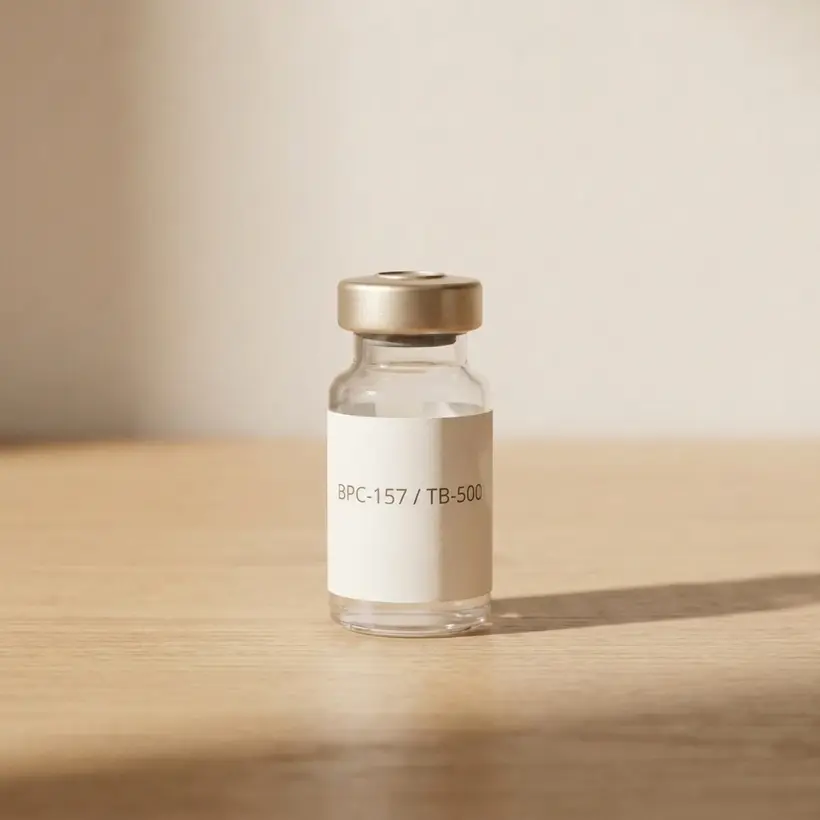
From the FormBlends catalog
BPC-157 / TB-500 Blend
The ultimate recovery stack in one vial · From $249/mo · compounded by a licensed 503A pharmacy, dispensed only after provider review.
View BPC-157 / TB-500 Blend →Table of Contents
- Evidence Ledger: Every Major Claim Graded
- BPC-157: The Mechanism with Specific Numbers
- TB-500: Thymosin Beta-4 Fragment
- Other Peptides Worth Knowing: GHK-Cu, IGF-1 LR3, CJC-1295
- What Most Pages Get Wrong About Peptide Recovery
- The Chemistry Behind Storage and Stability Rules
- Honest Head-to-Head: Peptides vs. Approved Alternatives
- Operational Guide: Reading a COA and Reconstitution Math
- Dosing Reference Table
- FAQ
- Sources
Evidence Ledger: Every Major Claim Graded
| Claim | Best Evidence Type | Effect Direction | Confidence (GRADE) |
|---|---|---|---|
| BPC-157 accelerates tendon healing | Multiple animal RCTs (rat Achilles, patellar models) | Positive | Low (no human RCT) |
| BPC-157 promotes angiogenesis via VEGFR2 upregulation | Cell and animal studies | Positive | Low (mechanism only in humans) |
| TB-500 (TB4 fragment) improves cardiac repair | One small Phase I/II human trial (n=approximately 20 patients) | Positive trend; not powered for efficacy | Very Low for musculoskeletal use |
| TB-500 sequesters G-actin, promoting cell migration | Biochemical/cell studies; well-replicated mechanism | Positive | Moderate (mechanism); Low (clinical effect) |
| GHK-Cu upregulates collagen synthesis genes | Cell studies; some small human cosmetic wound trials | Positive | Low for musculoskeletal injection use |
| CJC-1295/Ipamorelin increases GH/IGF-1 and aids recovery indirectly | Small human pharmacokinetic studies; no injury-specific RCT | GH/IGF-1 increase confirmed; injury link is inference | Very Low for injury recovery specifically |
| BPC-157 is safe in humans at common research doses | No controlled human safety trial; anecdotal reports only | Unknown | Very Low |
| Oral BPC-157 is active for gut injury | Animal models (gastric lesion, IBD models) | Positive | Low (human gut); Very Low (human musculoskeletal) |
BPC-157: The Mechanism with Specific Numbers
BPC-157 (Body Protection Compound 157) is a 15-amino-acid synthetic peptide derived from a sequence found in human gastric juice. It is not endogenous in the classical sense but originates from a protective gastric protein. The sequence is: Gly-Glu-Pro-Pro-Pro-Gly-Lys-Pro-Ala-Asp-Asp-Ala-Gly-Leu-Val.
What the animal data actually show: Sikiric and colleagues at the University of Zagreb have published the largest body of BPC-157 animal work. Rat Achilles tendon transection studies showed improved tendon-to-bone reattachment at doses of roughly 10 mcg/kg body weight given intraperitoneally or intramuscularly. Muscle crush injury models showed reduced necrosis markers and faster functional return compared to controls. These are well-replicated findings across that research group, though independent replication from other institutions is more limited than the volume of publications suggests.
Proposed receptor and pathway targets:
- Upregulation of VEGFR2 (KDR), promoting neovascularization at injury sites. This has been demonstrated in cell culture and rat models, not in human tissue.
- Interaction with the nitric oxide (NO) system: BPC-157 appears to modulate both NOS activity and NO-dependent vasodilation, though the exact binding partner is not established.
- FAK (focal adhesion kinase) pathway activation, supporting fibroblast migration and collagen matrix organization.
- Upregulation of early growth response gene EGR-1, a transcription factor central to tendon fibroblast proliferation. This is a mechanistically interesting and relatively specific finding.
What the mechanism does NOT prove: Cell and rat pathway data do not confirm that BPC-157 reaches injured human tendon at therapeutic concentrations, persists long enough to drive gene expression, or that the same magnitude of effect occurs in human tissue with very different cellular density and vascularity compared to rat models.
TB-500: Thymosin Beta-4 Fragment
Thymosin Beta-4 (TB4) is a 43-amino-acid peptide produced naturally in most human cells. TB-500, as sold in research markets, corresponds to the active actin-binding fragment, typically the LKKTET hexapeptide region (approximately residues 17 to 23 of the full TB4 sequence).
Mechanism: TB4 sequesters G-actin (monomeric actin) via its LKKTET motif. By controlling actin polymerization dynamics, it promotes cell migration in endothelial cells, keratinocytes, and myoblasts. In animal cardiac injury models, TB4 reduced infarct size and promoted angiogenesis. A small Phase I/II trial by Hinkel and colleagues examined TB4 in patients with refractory angina; the study was not powered to detect efficacy and was primarily a safety signal investigation.
The musculoskeletal gap: There is no published human musculoskeletal RCT for TB-500 or full TB4. The cardiac data are the only human signal, and extrapolating from cardiac angiogenesis to tendon repair involves a significant mechanistic leap that most recovery blogs do not acknowledge.
Typical research use pattern: TB-500 is often stacked with BPC-157 on the logic that BPC-157 handles local fibroblast signaling while TB-500 supports the vascular supply to the injured area. This is mechanistically coherent but completely unvalidated in humans.
Other Peptides Worth Knowing: GHK-Cu, IGF-1 LR3, CJC-1295
GHK-Cu (copper peptide Gly-His-Lys): This endogenous tripeptide complexed with copper(II) is found in human plasma and declines with age. In cell studies it upregulates genes involved in collagen I and III synthesis, metalloproteinases for remodeling, and antioxidant enzymes. A frequently cited figure is upregulation of over 30 repair-related genes in fibroblast arrays (Pickart and Margolina, 2018). Human injectable data for musculoskeletal injury are absent. Topical wound data in small trials exist. The injectable use in injury recovery is extrapolated from cell biology.
IGF-1 LR3 (Long R3 IGF-1): A modified analog of Insulin-like Growth Factor 1 with reduced IGF-binding protein affinity and a half-life roughly 3 times longer than native IGF-1. It promotes myoblast proliferation and satellite cell activation. IGF-1 has legitimate approved uses (Mecasermin, FDA-approved for growth failure), so the mechanism is not speculative. However, IGF-1 LR3 as a research compound carries significant concerns: it is not approved, its long half-life increases the risk of hypoglycemia, and growth factor dysregulation raises theoretical cancer promotion concerns over long-term use. This is the most pharmacologically potent and most risk-laden compound on this list.
CJC-1295 with Ipamorelin: This combination stimulates pituitary GH release via GHRH receptor agonism (CJC-1295) and ghrelin receptor agonism (Ipamorelin). GH and downstream IGF-1 contribute to tissue repair. Small human pharmacokinetic studies confirm GH/IGF-1 elevation. There is no injury-specific human RCT. The injury benefit is an indirect inference from GH physiology, not direct trial evidence.
What Most Pages Get Wrong About Peptide Recovery
This is the section competitors skip entirely.
1. Conflating animal dose with human dose: Most rat studies use intraperitoneal injection, which achieves near-complete bioavailability. Subcutaneous human injection of the same compound has different tissue distribution, protein binding in human plasma (which differs from rat plasma), and access to injury sites that may be hypovascular. "It worked at 10 mcg/kg in rats" does not translate cleanly to "use 700 mcg per day in a 70 kg human."
2. The purity problem is larger than anyone admits: A 2018 analytical study (Cawley, published in Drug Testing and Analysis) examined research peptides purchased from commercial sources and found a significant proportion had purity below label claim, incorrect molecular weight by mass spectrometry, or contained unlabeled peptide fragments. When you inject a research peptide, you may not be injecting what you think you are injecting. This is not a minor caveat. It is the dominant real-world risk.
3. Half-life matters for dosing frequency but is routinely ignored: BPC-157 has a short plasma half-life in animal models, on the order of minutes to a few hours, suggesting that once-weekly dosing protocols popular in some communities are pharmacologically incoherent with the mechanism. If the peptide clears in hours, weekly injections cannot maintain tissue concentrations. Daily or twice-daily protocols are the only ones consistent with the pharmacokinetics, though no human PK study has been done.
4. "Natural peptide = safe" is not a valid argument: GHK-Cu is endogenous. BPC-157 is derived from a gastric sequence. Neither fact says anything meaningful about the safety of injecting a synthetic version at supraphysiological concentrations, bypassing normal GI degradation, in a human with an injury. Endogenous status is not a safety certificate.
The Chemistry Behind Storage and Stability Rules
Peptides are chains of amino acids linked by peptide bonds. These bonds are susceptible to hydrolysis (cleavage by water) and oxidation, especially at methionine, cysteine, and tryptophan residues. Here is what the rules actually mean:
Why store lyophilized powder cold and dry: In a freeze-dried solid, water activity is near zero. Hydrolysis requires water. Without water, the peptide bond cleavage rate drops to near zero even at room temperature. The moment you add water (reconstitute), hydrolysis begins. This is why reconstituted peptide has a finite shelf life of weeks, not months, even under refrigeration at 4 degrees Celsius.
Why avoid freeze-thaw cycles: Ice crystal formation during freezing physically disrupts the peptide's three-dimensional conformation. Repeated cycles cause aggregation, where peptide chains clump and lose biological activity even though the primary sequence is intact. Aggregated peptide may also be more immunogenic. This is why drawing your dose into a separate syringe rather than repeatedly accessing the vial is the correct protocol.
Why light degrades peptides: UV light photolyzes aromatic amino acid side chains, particularly tryptophan and phenylalanine. For peptides lacking these residues (BPC-157 does not contain Trp), photodegradation is slower, but peptide bond photolysis is still possible with prolonged UV exposure. Store in amber vials.
Why pH matters: Bacteriostatic water (0.9% benzyl alcohol in sterile water) has a neutral pH near 5 to 6. Most peptides are most stable at or near their isoelectric point. Reconstituting in strongly acidic or basic solution accelerates hydrolysis. Acetic acid (0.1 to 1% solution) is used for some peptides like IGF-1 analogs specifically because those peptides are unstable in neutral pH.
Honest Head-to-Head: Peptides vs. Approved Alternatives
| Compound | Indication | Best Human Evidence | Regulatory Status | Where Peptide Wins | Where Peptide Loses |
|---|---|---|---|---|---|
| BPC-157 | Tendon/muscle injury | Animal RCTs only | Research compound (no FDA approval) | Richer mechanistic and animal dataset than PRP for some injury types; lower cost | No human RCT; unknown human safety; purity uncertainty |
| PRP (Platelet-Rich Plasma) | Tendinopathy, ligament injury | Multiple small human RCTs; mixed but real signal | FDA-cleared device class (autologous); not drug-approved for specific indication | Human data exist; autologous (no purity concern) | RCT results mixed; expensive; invasive procedure |
| Becaplermin (PDGF-BB) | Diabetic foot ulcers | Multiple human RCTs; FDA-approved | FDA-approved (Regranex) | Only approved peptide-based tissue repair drug | Black box warning for cancer risk with more than 3 tubes; not approved for musculoskeletal injury |
| NSAIDs (e.g., ibuprofen) | Acute injury inflammation | Extensive human RCTs | FDA-approved OTC and Rx | Well-characterized safety; immediate symptom relief | May impair tendon healing if used chronically (prostaglandin inhibition reduces collagen synthesis); GI and cardiovascular risk |
| TB-500 | Musculoskeletal injury | No human musculoskeletal RCT | Research compound | Well-characterized G-actin mechanism; potential systemic reach vs. local BPC-157 | Weakest human evidence of common injury peptides; TB4 cardiac data do not transfer to tendons |
| CJC-1295 / Ipamorelin | Indirect recovery via GH | PK studies only; no injury RCT | Research compound | GH elevation is confirmed in humans; longest-standing peptide PK data | Indirect mechanism; no injury outcome data; WADA prohibited (S2) |
Operational Guide: Reading a COA and Reconstitution Math
What a legitimate COA must contain:
- HPLC purity: Accept nothing below 98%. Peaks should be single and sharp. Multiple peaks indicate impurities or peptide fragments.
- Molecular weight confirmation: Should match the theoretical mass of the named sequence. For BPC-157 (15 amino acids), the expected molecular weight is approximately 1419 Da. A deviation of more than 1 to 2 Da by mass spectrometry indicates a wrong sequence or modification.
- Endotoxin testing: LAL (Limulus Amebocyte Lysate) assay. Acceptable for research grade is typically below 1 EU/mg. High endotoxin causes inflammatory responses independent of the peptide itself.
- Third-party testing: The COA issuer should be independent of the vendor. A vendor's internal COA is a marketing document, not a quality assurance document.
Reconstitution math: worked example for BPC-157
You have a 5 mg vial and want a concentration of 500 mcg per 0.1 mL (a common research dose in a standard insulin syringe).
- 5 mg = 5,000 mcg total peptide in the vial.
- Target: 500 mcg per 0.1 mL means 5,000 mcg per 1 mL.
- Add exactly 1 mL of bacteriostatic water to the vial.
- Each 0.1 mL (10 units on a U-100 syringe) now contains 500 mcg.
- The vial contains 10 doses of 500 mcg at this concentration.
If you add 2 mL instead, each 0.1 mL contains 250 mcg. Reconstitution volume is the single most common dosing error. Write the concentration on the vial with a marker immediately after reconstitution.
What degraded peptide looks like: Cloudy or particulate solution after reconstitution suggests aggregation or contamination. A properly reconstituted peptide should be clear and colorless. Yellow or brown discoloration indicates oxidation. Discard and do not inject degraded product.
Dosing Reference Table (Animal-Extrapolated; No Validated Human Dose Exists)
| Peptide | Animal Effective Dose Range | Common Research Protocol (Human) | Route in Animal Studies | Half-Life (Animal Estimate) | Cycle Length Discussed in Literature |
|---|---|---|---|---|---|
| BPC-157 | 1 to 10 mcg/kg (rat) | 200 to 500 mcg/day SC or IM | IP, SC, IM (varies by study) | Short (hours; not precisely published for human use) | 4 to 12 weeks discussed in community; no clinical guidance |
| TB-500 | Varies by model; mg-range in larger animal studies | 2 to 5 mg/week SC (community reports) | IP, IV in animal models | Longer than BPC-157; specific figure not publicly validated | 6 to 12 weeks; no clinical guidance |
| GHK-Cu | Cell studies only for musculoskeletal; topical human data | No established injectable human protocol | Topical, SC in some animal work | Very short (tripeptide rapidly cleared) | No established cycle |
| CJC-1295 / Ipamorelin | GH stimulation established in rodents and humans | CJC 1295: 1 to 2 mg/week; Ipamorelin: 200 to 300 mcg/injection | SC | CJC-1295 with DAC: approximately 8 days half-life (human PK study) | 8 to 12 weeks; no injury-specific guidance |
All human doses above are from community and researcher discussions, not from validated clinical trials. There is no FDA-approved or clinically validated dose for any of these compounds for injury recovery.
FAQ
What is the best peptide for injury recovery overall?
BPC-157 has the broadest animal evidence base for tendon, ligament, and muscle injury. TB-500 adds angiogenic support. Neither has completed a Phase II human RCT, so both remain research compounds with Low to Very Low human confidence ratings.
Does BPC-157 work in humans?
Human data are limited to a small number of case series and open-label observations. The animal data are extensive and consistent across labs, but animal-to-human translation for complex healing outcomes is unreliable. There is no published Phase II or III RCT in humans as of 2026.
What is the typical dosing range for BPC-157?
Animal studies use roughly 1 to 10 micrograms per kilogram of body weight. Extrapolated human doses discussed in research contexts are typically 200 to 500 mcg per injection, subcutaneously or intramuscularly, once or twice daily. No clinically validated human dose exists.
Can BPC-157 and TB-500 be taken together?
They are sometimes combined in a so-called BPC/TB blend because their proposed mechanisms are complementary: BPC-157 is thought to act more locally on fibroblast and collagen pathways while TB-500 promotes systemic angiogenesis via actin sequestration. No human trial has studied the combination.
Is BPC-157 banned in sports?
WADA does not currently list BPC-157 by name on its Prohibited List, but peptides with growth-promoting effects can fall under the S2 (Peptide Hormones, Growth Factors, Related Substances) category. Athletes should verify their specific sport federation rules before use.
How should injectable peptides for injury recovery be stored?
Lyophilized (freeze-dried) powder should be stored at 2 to 8 degrees Celsius, away from light. Once reconstituted with bacteriostatic water, most peptides degrade meaningfully within 2 to 4 weeks under refrigeration. Freeze-thaw cycles accelerate degradation significantly.
What does a certificate of analysis (COA) for a research peptide need to show?
Look for HPLC purity above 98%, a molecular weight confirmation matching the expected sequence, endotoxin testing (LAL assay), and ideally mass spectrometry confirmation. A COA from the vendor's own lab without independent third-party verification provides limited assurance.
What are the risks of using research peptides for injury recovery?
Key risks include unknown long-term safety in humans, injection-site reactions, endotoxin contamination from low-quality sources, regulatory status uncertainty, and the possibility that the product does not contain what the label claims. No large human safety trial exists for any of these compounds.
How does BPC-157 compare to platelet-rich plasma (PRP) for tendon injury?
PRP has multiple small human RCTs for tendinopathy, giving it a moderate human evidence base despite mixed results. BPC-157 has stronger mechanistic and animal data but no completed human RCT. PRP is the more clinically defensible choice at this time for a treating clinician.
What is Thymosin Beta-4 and how does it differ from TB-500?
Thymosin Beta-4 (TB4) is the full 43-amino-acid endogenous peptide. TB-500 is a synthetic fragment corresponding to the actin-binding region of TB4, approximately the LKKTET sequence around residues 17 to 23. TB-500 is more widely used in research compound markets because it is shorter and cheaper to synthesize.
Can oral BPC-157 work for injury recovery?
Several animal studies show oral BPC-157 is active for gut injury models, and some musculoskeletal data exist. However, oral bioavailability for systemic musculoskeletal effects in humans is unquantified. Injectable routes have the stronger animal evidence base for tendon and muscle injury specifically.
What peptides have actual approved human uses related to tissue repair?
Thymosin Alpha-1 (Thymalfasin) is approved in some countries for immune conditions, not tissue repair. Becaplermin (PDGF-BB) is FDA-approved for diabetic foot ulcers. No research peptide commonly marketed for injury recovery (BPC-157, TB-500, GHK-Cu) holds FDA approval for that indication.
Sources
- Sikiric P, et al. "Stable gastric pentadecapeptide BPC 157: novel therapy in gastrointestinal tract." Current Pharmaceutical Design, 2011. (Comprehensive review of BPC-157 animal data from the Zagreb group.)
- Staresinic M, et al. "Gastrointestinal tract healing as influenced by BPC-157: rat and mouse Achilles tendon models." Journal of Physiology Paris, 2006.
- Pickart L, Margolina A. "Regenerative and Protective Actions of the GHK-Cu Peptide in the Light of the New Gene Data." International Journal of Molecular Sciences, 2018. (Gene array data on GHK-Cu; the source for the 30-plus gene figure.)
- Hinkel R, et al. "Thymosin beta4 is an endogenous protective factor preventing inflammatory cardiomyopathy." JACC, 2014. (Cardiac TB4 animal and early human context.)
- Goldstein AL, Hannappel E, Kleinman HK. "Thymosin beta4: actin-sequestering protein moonlights to repair injured tissues." Trends in Molecular Medicine, 2005. (Core mechanism review for TB4/TB-500.)
- Cawley AT, et al. "Peptide drug testing in sport: analytical challenges." Drug Testing and Analysis, 2018. (Source for purity concerns in commercial research peptides.)
- Alba M, et al. "Once-daily administration of CJC-1295, a long-acting growth hormone-releasing hormone analog, for 7 days in healthy adults." Journal of Clinical Endocrinology and Metabolism, 2006. (Human PK data for CJC-1295.)
- US Food and Drug Administration. Becaplermin (Regranex) Prescribing Information. (Approved PDGF-based wound healing drug reference.)
- WADA Prohibited List 2026. World Anti-Doping Agency. wada-ama.org. (S2 category reference for peptide hormones and growth factors.)
- Manning MC, et al. "Stability of protein pharmaceuticals: An update." Pharmaceutical Research, 2010. (Chemical basis for peptide degradation pathways; hydrolysis, oxidation, aggregation.)
Footer Disclaimers
Ready when you are
BPC-157 / TB-500 Blend
The ultimate recovery stack in one vial · From $249/mo · compounded by a licensed 503A pharmacy, dispensed only after provider review.
View BPC-157 / TB-500 Blend →