
Trust Signals
Sources are PubMed-indexed studies, FDA communications, and WADA prohibited list documents. No peptide manufacturer sponsorship. Claims are graded by evidence type throughout.Key Takeaways
- BPC-157 has the largest body of preclinical tissue-repair data of any recovery peptide, with over 100 published rodent studies as of 2024, but zero completed human RCTs for musculoskeletal endpoints.
- TB-500 retains the actin-binding LKKTET motif of Thymosin Beta-4 and is explicitly banned by WADA under the peptide hormones category as of the 2024 prohibited list.
- CJC-1295 raises human growth hormone measurably in published pharmacodynamic trials, but GH elevation does not equal demonstrated injury recovery in controlled studies.
- Reconstituted peptides stored above 8 degrees Celsius or exposed to repeated freeze-thaw cycles lose meaningful potency within days, a fact almost every supplier page omits.
- No recovery peptide has passed a phase III RCT for any musculoskeletal endpoint in humans as of mid-2026. Evidence quality is predominantly low to very low by GRADE standards.
What Is the Best Peptide for Recovery?
BPC-157 is the strongest candidate based on breadth of preclinical evidence across tendon, muscle, nerve, and gut tissue. TB-500 is the second best option for connective tissue repair. Both lack human RCT proof. For athletes subject to drug testing, both carry regulatory risk. Evidence quality for all recovery peptides is low to very low by GRADE criteria.Table of Contents
- Evidence Ledger: Every Major Claim Graded
- The Top 5 Recovery Peptides Ranked
- How Do Recovery Peptides Work? Specific Numbers
- What Most Pages Get Wrong About Recovery Peptides
- The Chemistry Behind Storage and Stability Rules
- Honest Head-to-Head: Peptides vs. Real Alternatives
- How to Read a COA and Dose Correctly
- Should You Stack BPC-157 and TB-500?
- Legal and Regulatory Status in 2026
- FAQ
- Sources
Evidence Ledger: Every Major Claim Graded
| Claim | Best Evidence Type | Effect Direction | Confidence (GRADE) |
|---|---|---|---|
| BPC-157 accelerates tendon healing in rodents | Multiple animal RCTs (e.g., Pevec et al., 2010, J Orthop Res) | Positive | Moderate (animal only) |
| BPC-157 accelerates tendon healing in humans | No RCT; anecdotal only | Unknown | Very Low |
| TB-500 (Thymosin Beta-4 fragment) promotes cell migration and angiogenesis | In vitro, rodent models (Goldstein et al., Annals NY Acad Sci) | Positive | Low (no human RCT) |
| CJC-1295 elevates serum growth hormone in humans | Human pharmacodynamic study (Ionescu and Frohman, 2006, J Clin Endocrinol Metab) | Positive | Moderate (PD endpoint only) |
| GH elevation from CJC-1295 translates to faster injury recovery | Mechanistic inference only | Plausible, unproven | Very Low |
| BPC-157 upregulates VEGF and growth factor signaling in tissue | Animal and in vitro studies (Chang et al., multiple papers) | Positive | Low |
| Ipamorelin raises GH pulse amplitude with low cortisol/prolactin effect | Human pharmacodynamic study (Raun et al., 1998, Eur J Endocrinol) | Positive (PD only) | Moderate (PD endpoint only) |
| Collagen peptides (oral) reduce exercise-induced joint pain | Small human RCT (Shaw et al., 2017, Am J Clin Nutr) | Positive | Low to Moderate (small N) |
Which Are the Top Recovery Peptides and What Does Each Target?
1. BPC-157 (Body Protection Compound 157)
A 15-amino-acid peptide derived from a gastric protein fragment. It has the widest preclinical evidence base for recovery, spanning tendon, ligament, muscle, bone, gut mucosa, and peripheral nerve repair in animal models. The Pevec et al. 2010 paper in the Journal of Orthopaedic Research demonstrated statistically significant improvement in Achilles tendon tensile strength in rats treated with 10 mcg/kg daily. Mechanism includes upregulation of growth hormone receptors locally, promotion of VEGF-driven angiogenesis, and modulation of nitric oxide pathways.
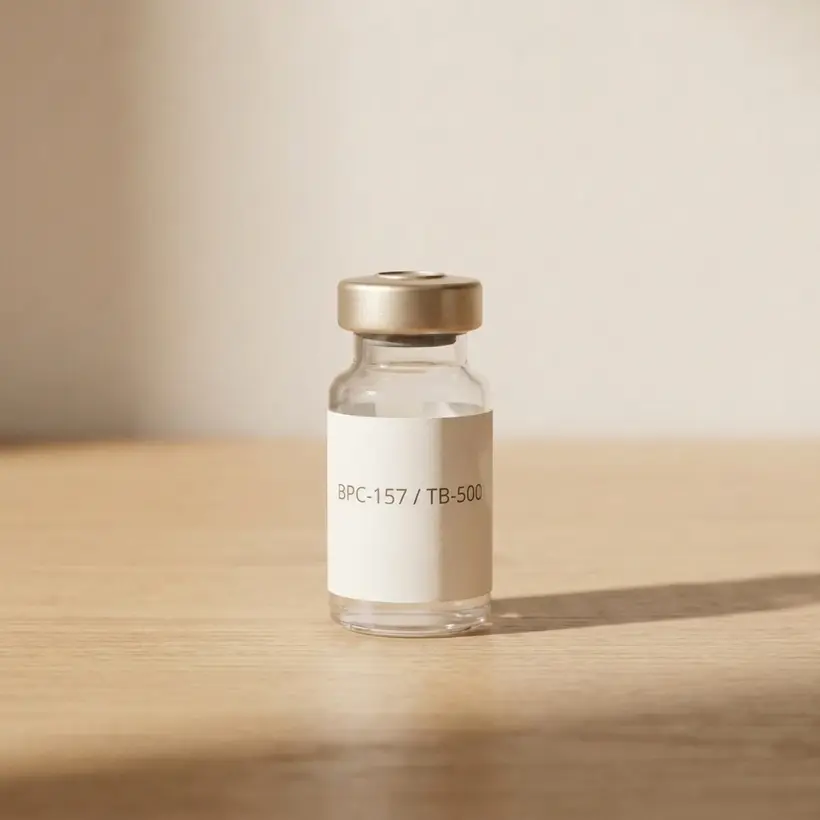
From the FormBlends catalog
BPC-157 / TB-500 Blend
The ultimate recovery stack in one vial · From $249/mo · compounded by a licensed 503A pharmacy, dispensed only after provider review.
View BPC-157 / TB-500 Blend →Best use case: Tendon and ligament injuries, gut permeability issues secondary to heavy training, general musculoskeletal overuse.
2. TB-500 (Thymosin Beta-4 Synthetic Fragment)
Targets the actin-binding LKKTET sequence, promoting cell migration, satellite cell activation, and angiogenesis. Published research by Goldstein and colleagues in the Annals of the New York Academy of Sciences established the anti-inflammatory and wound-healing properties of the full Thymosin Beta-4 protein. TB-500 as a specific fragment is studied primarily in equine sports medicine, where intraarticular injection is documented. WADA banned explicitly since 2012.
Best use case: Connective tissue injuries, systemic or diffuse injury patterns where local injection is impractical.
3. CJC-1295 (with DAC)
A growth hormone releasing hormone analog. The Ionescu and Frohman 2006 study in the Journal of Clinical Endocrinology and Metabolism confirmed that CJC-1295 produces sustained, multi-day GH elevation in healthy adults, with the paper reporting data from a controlled dose-escalation design. Recovery benefit is indirect: GH raises IGF-1, which promotes protein synthesis and collagen production. It is not targeted at a specific injury. Relevant mainly for systemic recovery, sleep quality, and body composition alongside training.
4. Ipamorelin
A selective growth hormone secretagogue (GH pulse stimulator) with minimal effect on cortisol and prolactin compared to older GHRPs (documented in the Raun et al. 1998 Eur J Endocrinol study). Often combined with CJC-1295 to amplify GH pulses. Recovery benefit is again indirect via GH/IGF-1. Lower side effect burden than GHRP-6 (which causes significant hunger via ghrelin pathway activation).
5. Collagen Peptides (Type I/III Hydrolysate)
The only recovery-adjacent peptides with a positive human RCT. Shaw et al. 2017 in the American Journal of Clinical Nutrition (n=8, crossover) showed that 15 g of gelatin with vitamin C consumed 1 hour before exercise increased collagen synthesis markers roughly 2-fold compared to placebo. Small study, but the only controlled human evidence for a peptide-based intervention in connective tissue repair. Oral bioavailability is real but the active di/tripeptides absorbed are different from injected BPC-157 or TB-500.
How Do Recovery Peptides Work? The Specific Numbers
BPC-157's mechanism centers on two well-documented pathways. First, it upregulates the expression of growth hormone receptors at the injury site, meaning local tissues become more sensitive to circulating GH even without raising systemic GH levels. Second, it promotes angiogenesis through VEGF upregulation. Animal studies by Sikiric and colleagues document that BPC-157 increases the number of small blood vessels in healing tendon tissue substantially compared to saline controls (measured by vessel density in histological sections). This vascularization is critical because tendons and ligaments are naturally hypovascular, which is why they heal slowly.
The honest caveat: VEGF upregulation in a rat Achilles tendon does not prove the same happens in a 90 kg human with a partial rotator cuff tear. Allometric scaling, route of administration differences, and species-specific receptor density all introduce uncertainty that is not small.
TB-500 works primarily via actin sequestration. The LKKTET motif binds G-actin (monomeric actin), reducing local polymerization and thereby facilitating cell migration into the wound site. In vitro studies show increased endothelial cell and fibroblast migration at nanomolar concentrations. Once cells migrate, they lay down extracellular matrix and form new vasculature. Again: the in vitro concentration needed for effect and the concentration achievable at a subcutaneous injection site in a living human are different numbers that have not been reconciled in published research.
What Most Pages Get Wrong About Recovery Peptides
The purity problem: "Research grade" peptides sold online range from roughly 70% to 99% purity. The impurities are not inert. Endotoxins from bacterial synthesis contamination cause fever and local inflammation. Oxidized methionine residues in a degraded peptide produce a compound that looks identical on a basic HPLC trace but has reduced or absent biological activity. A product that shows 98% purity on a supplier-run HPLC but has no independent MS confirmation could contain the correct mass at low yield padded with structurally similar impurities.
The dose extrapolation problem: Most dosing guides translate the 10 mcg/kg rodent dose via body surface area allometry to roughly 100 to 250 mcg per day for a 70 to 80 kg human. This is a reasonable first estimate, but allometric scaling assumes similar metabolic clearance, receptor density, and proteolytic environment. None of these are confirmed for BPC-157 in humans. Common practice doses of 200 to 500 mcg daily are above the allometrically predicted dose, which may reflect informal dose escalation to achieve perceived effect.
Why Storage Rules Are Not Arbitrary: The Chemistry
Lyophilized (freeze-dried) peptides are kinetically stable at room temperature because dehydration removes the water molecules needed for hydrolysis reactions. The peptide bond (CO-NH linkage) is thermodynamically unstable in aqueous solution but requires water as a reactant to break. Remove water, slow the reaction dramatically.
Once you reconstitute with bacteriostatic water (0.9% benzyl alcohol), the reaction clock starts. Benzyl alcohol inhibits microbial growth but does not inhibit chemical hydrolysis or oxidation. At 37 degrees Celsius (body temperature if left out), hydrolysis and oxidation of susceptible residues (methionine, cysteine, asparagine) proceed substantially faster than at 4 degrees Celsius. The Arrhenius equation predicts roughly a 2- to 3-fold increase in reaction rate per 10 degree Celsius rise in temperature, so a vial left at room temperature degrades at meaningfully faster rate than a refrigerated vial.
Freeze-thaw damage is different: it causes aggregation and denaturation via ice crystal disruption of the peptide's secondary structure and concentration effects at the ice-water interface. For short peptides like BPC-157 (15 amino acids), this matters less than for large proteins, but repeated cycles still reduce measurable purity in HPLC assays.
Practical rule: Reconstituted peptides belong in the refrigerator, used within 4 weeks, never re-frozen.
Honest Head-to-Head: Peptides vs. Real Alternatives
| Intervention | Human RCT Evidence | Mechanism Known | Regulatory Status | Cost (monthly est.) | Where Peptide Loses |
|---|---|---|---|---|---|
| BPC-157 | None for recovery endpoints | Yes (animal/in vitro) | Unregulated (US); WADA monitoring | $60 to $180 | No human proof; purity uncertainty; injection required |
| TB-500 | None for recovery endpoints | Yes (animal/in vitro) | Unregulated (US); WADA banned | $80 to $200 | Explicitly banned; no human RCT |
| Collagen peptides (oral) | Small positive RCT (Shaw 2017) | Partial | Dietary supplement; legal | $20 to $50 | Weaker mechanism; indirect effect only |
| Platelet-Rich Plasma (PRP) | Multiple RCTs; mixed results | Yes (growth factors) | FDA cleared (procedure) | $500 to $1500 per injection | Cost; inconsistent RCT results |
| Eccentric loading (physiotherapy) | Strong positive RCTs (Alfredson protocol, Achilles) | Yes (mechanotransduction) | Standard of care | Low to none | Requires adherence; slower subjective onset |
| NSAIDs (ibuprofen) | Human RCTs (pain relief only) | Yes (COX inhibition) | FDA approved OTC | Less than $10 | May impair long-term tendon remodeling; GI risk |
The table is honest: eccentric loading protocols for tendinopathy have a stronger evidence base than any injectable peptide currently available. A skeptical clinician would start there.
How to Read a COA and Dose Recovery Peptides Correctly
What a legitimate COA must include:
- HPLC purity above 98%, with a chromatogram trace, not just a number.
- Mass spectrometry (MS) confirming the correct molecular weight. BPC-157 has a molecular weight of 1419.5 Da. For TB-500 (the LKKTET hexapeptide fragment), confirm the reported molecular weight against the vendor's stated sequence using a peptide calculator, and verify it matches the MS result on the COA rather than relying on a single sourced figure.
- Lab identity: ISO 17025 accredited third-party lab, not the manufacturer's own quality control department.
- Lot number that matches the vial you received.
- Endotoxin testing (LAL assay). USP general chapter 85 specifies endotoxin limits for parenteral products; confirm the reported value meets the limit appropriate for the route and dose rather than accepting any number without context.
Reconstitution math example: You have a 5 mg vial of BPC-157. You want a 250 mcg dose. Add 2 mL bacteriostatic water to the vial. 5 mg / 2 mL = 2500 mcg/mL. Draw 0.1 mL (10 units on a U-100 insulin syringe) = 250 mcg. Double check: 2500 mcg/mL times 0.1 mL = 250 mcg. This math step is skipped by most guides and is where dosing errors concentrate.
What degraded peptide looks like: A correctly prepared BPC-157 solution should be clear and colorless. Yellow or brown discoloration indicates oxidation. Cloudiness indicates aggregation or bacterial contamination. Discard both.
Should You Stack BPC-157 and TB-500?
The rationale is mechanistically coherent: BPC-157 works via growth factor signaling and VEGF upregulation, TB-500 works via actin-mediated cell migration and satellite cell activation. These are distinct pathways that could theoretically be additive rather than redundant.
The honest answer is that no study, animal or human, has examined this combination formally for interaction effects. What that means practically: you cannot rule out unexpected pharmacodynamic interactions, additive off-target effects, or simply wasted cost if one agent alone is sufficient. The practice is widespread in performance communities but calling it evidence-based would be inaccurate.
If you choose to combine them, the major additional risk is injection site management. Two separate injections increase infection and lipodystrophy risk. Some protocols combine both in a single syringe; there is no published compatibility data to confirm this is chemically safe.
Legal and Regulatory Status in 2026
In the United States, BPC-157 and TB-500 are not FDA-approved drugs and are not scheduled controlled substances. Sale as "research chemicals" or "for research use only" occupies a regulatory gray area that the FDA has periodically acted on, including sending warning letters to specific compounding pharmacies. In 2022, the FDA issued guidance restricting BPC-157 from being compounded at licensed pharmacies as a bulk drug substance, which effectively removed a previously available compounding pathway for medical use. The current status means most sources are unregulated chemical suppliers, which directly affects purity and safety.
WADA status: Thymosin Beta-4 and its fragments (explicitly including TB-500) are listed on the WADA 2024 prohibited list under S2 (Peptide Hormones, Growth Factors, Related Substances and Mimetics). BPC-157 is on the WADA monitoring program, which means it is being tracked with a view to future prohibition. Any athlete in a WADA-governed sport should treat both as banned.
FAQ
What is the best peptide for recovery overall?
BPC-157 has the broadest preclinical tissue-repair evidence base across tendon, muscle, gut, and nerve. TB-500 is the closest competitor for connective tissue. Neither has completed human RCTs, so "best" depends heavily on injury type and your risk tolerance.
Does BPC-157 actually work in humans?
No completed, published RCT in healthy humans or athletes exists as of mid-2026. All efficacy evidence is from rodent models or open-label gastroenterology case series. The mechanism is well-characterized but human proof of concept is not yet established.
What is TB-500 and how is it different from Thymosin Beta-4?
TB-500 is a synthetic fragment (approximately residues 17-23) of the naturally occurring protein Thymosin Beta-4. It retains the actin-binding and angiogenic properties attributed to the full protein but is cheaper to synthesize. The two are often used interchangeably in literature, which causes confusion.
Can I stack BPC-157 and TB-500?
This combination is widely used in practice, with rationale based on complementary mechanisms: BPC-157 targets growth factor upregulation and gut-brain signaling, TB-500 targets actin polymerization and cell migration. There is no human safety or interaction data for the combination. The risk profile is additive and unknown.
What dose of BPC-157 is used in animal studies?
Most rodent studies use 10 micrograms per kilogram of body weight injected intraperitoneally or subcutaneously. Scaling that to an 80 kg human via standard allometric conversion suggests roughly 100 to 250 mcg per day, which aligns with common investigational protocols, but interspecies extrapolation is unreliable.
Is CJC-1295 useful for recovery or just muscle gain?
CJC-1295 stimulates growth hormone release, which supports tissue repair indirectly via IGF-1. A 2006 human pharmacodynamic study by Ionescu and Frohman in the Journal of Clinical Endocrinology and Metabolism confirmed that CJC-1295 produces sustained GH elevation in healthy adults. Recovery benefits are plausible but indirect. It is not a first-line recovery peptide compared to BPC-157 or TB-500.
What does "purity" mean on a peptide COA and what should I look for?
A COA should report HPLC purity (target above 98%) and mass spectrometry confirmation of correct molecular weight. HPLC alone cannot catch correctly weighted impurities. Look for both tests from an ISO-certified third-party lab. Purity below 95% indicates meaningful contamination risk.
How should recovery peptides be stored to prevent degradation?
Lyophilized (freeze-dried) peptides are stable at room temperature for weeks but degrade faster at heat or humidity. Once reconstituted in bacteriostatic water, most peptides should be refrigerated at 2 to 8 degrees Celsius and used within 4 weeks. Repeated freeze-thaw cycles break peptide bonds and reduce potency.
Are recovery peptides legal to buy and use?
In the US, BPC-157 and TB-500 are not FDA-approved drugs. They exist in a legal gray zone: sale "for research use only" is tolerated but personal use for human administration is off-label and unregulated. WADA bans TB-500 explicitly. BPC-157 is on the WADA monitoring list.
How long does it take for BPC-157 to show effects?
Animal studies show measurable tendon tensile strength improvements within 1 to 2 weeks of daily injection. Anecdotal human reports suggest subjective improvement in 1 to 4 weeks. No controlled human timeline data exists. Expectations should be modest and individual variation is high.
What peptides are proven to aid recovery in humans?
No peptide in this category has a completed, positive phase III RCT for musculoskeletal recovery in humans as of mid-2026. Growth hormone secretagogues have human pharmacodynamic data but not injury-recovery endpoint data. The honest answer is: none are proven by the highest evidence standard.
What is the biggest risk of using unregulated recovery peptides?
The biggest risks are product impurity (endotoxin contamination, wrong peptide sequence, low actual purity) and unknown long-term safety. Reports of adverse events from performance-enhancing research chemicals sold online have appeared in peer-reviewed literature and case series. Injectable impurities cause local reactions, fever, and sepsis in worst cases.
Sources
- Pevec D, Novinscak T, Brcic L, et al. Impact of pentadecapeptide BPC 157 on muscle healing impaired by systemic corticosteroid application. Med Sci Monit. 2010;16(3):BR81-88.
- Sikiric P, Seiwerth S, Rucman R, et al. Stable gastric pentadecapeptide BPC 157: novel therapy in gastrointestinal tract. Curr Pharm Des. 2011;17(16):1612-1632.
- Goldstein AL, Hannappel E, Kleinman HK. Thymosin beta4: actin-sequestering protein moonlights to repair injured tissues. Trends Mol Med. 2005;11(9):421-429.
- Ionescu M, Frohman LA. Pulsatile secretion of growth hormone (GH) persists during continuous stimulation by CJC-1295, a long-acting GH-releasing hormone analog. J Clin Endocrinol Metab. 2006;91(12):4792-4797.
- Raun K, Hansen BS, Johansen NL, et al. Ipamorelin, the first selective growth hormone secretagogue. Eur J Endocrinol. 1998;139(5):552-561.
- Shaw G, Lee-Barthel A, Ross ML, Wang B, Baar K. Vitamin C-enriched gelatin supplementation before intermittent activity augments collagen synthesis. Am J Clin Nutr. 2017;105(1):136-143.
- World Anti-Doping Agency. 2024 Prohibited List International Standard. wada-ama.org. Published January 2024.
- FDA. FDA takes action against unapproved bulk drug substances for compounding. FDA Drug Shortages and Compounding. 2022 (communication on BPC-157 removal from 503A bulks list).
- Alfredson H, Pietila T, Jonsson P, Lorentzon R. Heavy-load eccentric calf muscle training for the treatment of chronic Achilles tendinosis. Am J Sports Med. 1998;26(3):360-366.
- United States Pharmacopeia. USP General Chapter 85: Bacterial Endotoxins Test. USP-NF. (Reference for endotoxin limit methodology and parenteral product standards.)
Related peptide guides
Ready when you are
BPC-157 / TB-500 Blend
The ultimate recovery stack in one vial · From $249/mo · compounded by a licensed 503A pharmacy, dispensed only after provider review.
View BPC-157 / TB-500 Blend →