Semax, Selank, and Dihexa are the three peptides most often discussed together for cognition. Semax and Selank have a real, if mostly Russian, clinical research history. Dihexa is a research compound with striking lab data and almost no human evidence. This guide explains what each does, what the research actually shows, and how people combine them, written as information rather than a product pitch.
Quick answer: Semax targets BDNF and dopamine signaling for focus, Selank works on GABA and the immune-peptide system for calm without sedation, and Dihexa is a preclinical compound studied for synapse formation. These are not FDA-approved drugs and FormBlends does not sell them. This article is informational. If you want a supervised path, talk to a licensed clinician. FormBlends itself focuses on GLP-1 therapy with compounded semaglutide and tirzepatide.
Semax vs Dihexa: How They Differ
The most common comparison readers ask about. They are not interchangeable.
| Peptide | Primary Mechanism Studied | Human Evidence | Typical Route |
|---|---|---|---|
| Semax | Raises BDNF, modulates dopamine and norepinephrine | Russian clinical use for stroke and cognition; limited Western trials | Intranasal |
| Selank | GABAergic and immune-peptide (tuftsin analog) anxiolytic | Russian clinical anxiety research | Intranasal |
| Dihexa | Hepatocyte growth factor / c-Met pathway, synaptogenesis | Preclinical (animal/cell) only | Oral or transdermal |
Semax has the stronger and longer human track record. Dihexa is the most experimental of the three, with no published human efficacy trials.
What Is Semax and What Does the Research Show?
Semax is a synthetic peptide related to a fragment of ACTH, developed in Russia and used there for stroke recovery and cognitive support. The proposed mechanism is increased BDNF expression plus effects on dopamine and norepinephrine. Most published human data comes from Russian clinical settings rather than large Western randomized trials, so the evidence is suggestive rather than definitive. Users often describe improved focus and mental clarity, and the short half-life means people typically dose more than once a day.
What Is Selank?
Selank is a synthetic analog of tuftsin, a naturally occurring immune peptide. It is studied as an anxiolytic that calms without the sedation or dependence associated with benzodiazepines, with secondary effects on attention under stress. As with Semax, the bulk of the clinical literature is Russian. People generally use it once daily, intranasally, and it is the component most associated with stress reduction in a stack.
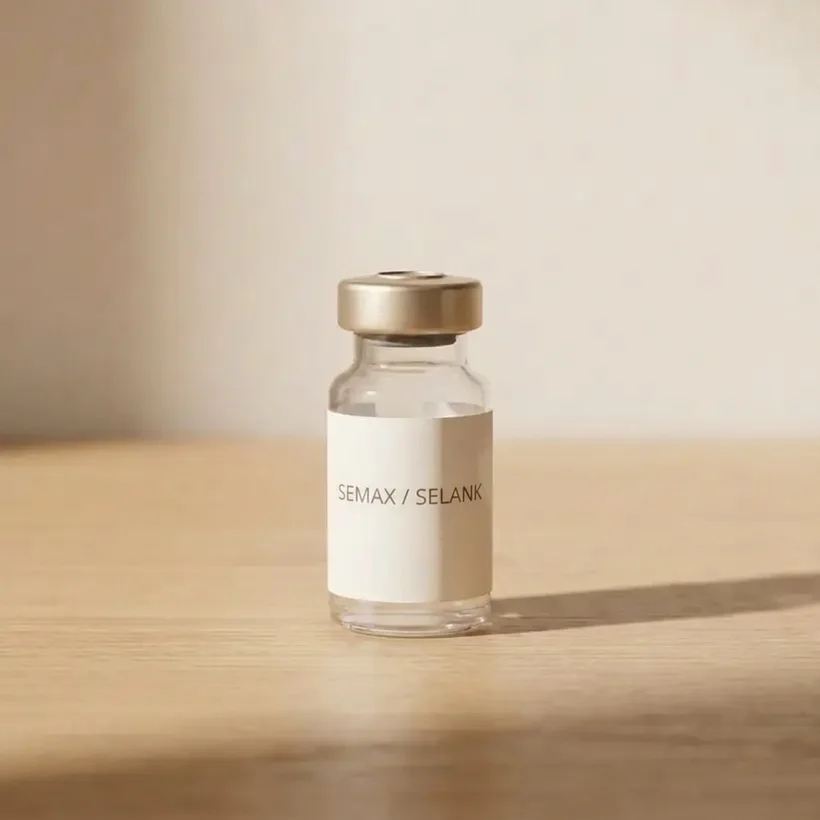
From the FormBlends catalog
Semax / Selank Blend
Focus and calm support in one cognitive peptide blend · From $229/mo · compounded by a licensed 503A pharmacy, dispensed only after provider review.
View Semax / Selank Blend →What Is Dihexa, and Is the Evidence Real?
Dihexa is an angiotensin-derived compound studied in laboratories for its potent effect on synapse formation through the hepatocyte growth factor pathway. The lab findings are genuinely striking, which is why it gets attention. The catch is that human efficacy data is essentially absent, and long-term safety in people is unknown. Treat Dihexa as an experimental research compound, not a proven nootropic. Anyone considering it should do so only with medical guidance and from a verified source.
Semax + Selank Stack: The Most Studied Pairing
The Semax and Selank pairing has the most coherent rationale and the longest combined-use history, both having been developed at the Institute of Molecular Genetics in Moscow. The logic is complementary: Semax for drive and focus, Selank for calm and stress resilience. People who want one entry point into cognitive peptides usually start here because the individual safety records are the most established of the three. Reported effects include steadier focus and reduced stress-related cognitive fog, though rigorous Western trial confirmation is limited.
Semax + Selank + Dihexa: The Full Stack
Stacking all three aims to cover focus (Semax), stress (Selank), and structural plasticity (Dihexa) at once. No published study has tested this exact three-peptide combination in humans, so the rationale is mechanistic rather than trial-proven. The main practical drawbacks are cost, a more complex dosing routine, and the fact that you are adding Dihexa, the least-evidenced and least safety-characterized component. Most practitioners who work with these compounds suggest introducing one peptide at a time to isolate tolerance before combining.
Semax for Post-Operative or Post-Anesthesia Cognition
Some readers ask about Semax for postoperative cognitive issues. The interest comes from Semax's Russian use in neurological recovery contexts and its BDNF-related mechanism. There is no strong Western trial base supporting Semax for postoperative cognitive dysfunction specifically, so this remains an off-label, unproven use that should only be considered with a physician.
Dosing Notes (Informational Only)
Commonly cited ranges in user and practitioner communities are: Semax 200 to 600 mcg intranasally, one to three times daily; Selank 250 to 750 mcg intranasally once daily; Dihexa in low milligram amounts, though Dihexa dosing is poorly standardized given the lack of human trials. These are not FDA-approved dosing schedules. Anyone using these compounds should work with a clinician and start low.
Safety, Legality, and Sourcing
Semax, Selank, and Dihexa are not FDA-approved drugs. Reported side effects for Semax and Selank are generally mild, such as nasal irritation or headache, while Dihexa's safety profile in humans is simply not well characterized. Sourcing is the biggest practical risk: purity and potency vary widely in the gray market. Note also that the compounding market tightened in 2025 to 2026 after the FDA removed semaglutide and tirzepatide from shortage, so pharmacy access to compounded products now generally requires a documented clinical rationale.
How to Approach Cognitive Peptides Safely
Start with the basics before any peptide: sleep, exercise, and managing stress move cognition more reliably than any gray-market compound. If you still want to explore peptides, do it with a licensed clinician, introduce one compound at a time, and verify your source. Be most cautious with Dihexa given the thin human evidence. Our clinical focus is GLP-1 therapy. If weight and metabolic health are also on your radar, FormBlends is one option to compare for physician-reviewed compounded semaglutide and tirzepatide.
Frequently Asked Questions
What is the best cognitive peptide stack?
There is no proven best stack. Semax plus Selank has the most established combined-use history and the cleanest safety records. Adding Dihexa increases experimental risk because its human evidence is minimal.
Semax vs Dihexa, which is better?
Semax has real human use history and a clearer profile. Dihexa is preclinical only. For most people seeking evidence-backed options, Semax is the safer starting point.
What does the research say about Semax for cognition?
Mostly Russian clinical literature suggests focus and recovery benefits via BDNF and dopamine pathways. Large Western randomized trials are limited.
Can Semax help with postoperative cognitive problems?
There is no strong trial evidence for this specific use. It remains unproven and off-label.
Does the Semax Selank stack affect neuroplasticity and BDNF long term?
Semax is associated with BDNF in mechanistic studies, but long-term human neuroplasticity outcomes for the stack are not well established.
Are these peptides legal and safe?
They are not FDA-approved drugs. Semax and Selank have generally mild reported side effects; Dihexa's human safety is poorly characterized. Sourcing quality is a major risk.
Does FormBlends sell Semax, Selank, or Dihexa?
No. FormBlends provides GLP-1 therapy only. This article is informational.
Sources
- FDA, human drug compounding overview: https://www.fda.gov/drugs/human-drug-compounding
- Empower Pharmacy, FDA removes semaglutide and tirzepatide from shortage list: https://www.empowerpharmacy.com/resources/blog/fda-semaglutide-tirzepatide-shortage-update
- PubMed, Semax clinical and mechanistic literature index: https://pubmed.ncbi.nlm.nih.gov/?term=semax
- PubMed, Selank anxiolytic literature index: https://pubmed.ncbi.nlm.nih.gov/?term=selank
- PubMed, Dihexa preclinical synaptogenesis literature index: https://pubmed.ncbi.nlm.nih.gov/?term=dihexa
Ready when you are
Semax / Selank Blend
Focus and calm support in one cognitive peptide blend · From $229/mo · compounded by a licensed 503A pharmacy, dispensed only after provider review.
View Semax / Selank Blend →